Good morning:
This week, senior fellow Abigail Shrier wrote a personal essay for The Free Press about her son’s rare illness that thrust the family into a world of surgeons and pediatric cancer wards, and revealed to her the striking fear that accompanies parenthood.
Occasionally, when parents discuss having a child who is ill or struggling, nonparents misunderstand what is meant. Mothers and fathers are not thinking that it would have been better never to have been a parent at all, that their child would have been better off not having lived, rather than experience pain. That misunderstanding, Shrier writes, is partly “the fault of a culture that celebrates women who Eat, Pray, Love their husbands and family away.” Instead, parents are thinking, “ ‘Thank God I am here for him.’ ... We never wonder why we exist. We couldn’t bear to be anywhere else.”
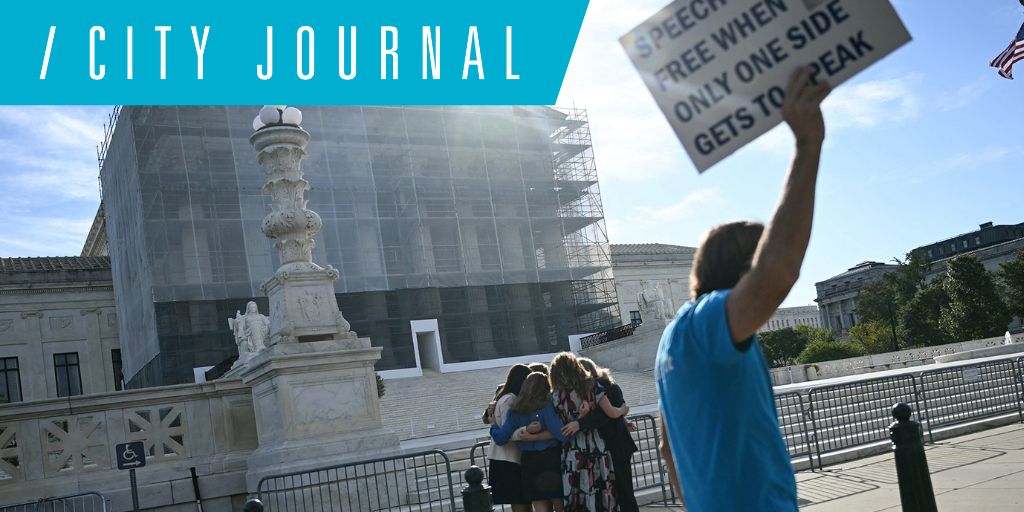
This evening in California, Shrier will speak at an event with senior fellow Rob Henderson on “Therapy or Indoctrination? The Battle Over Childhood Mental Health.” Much of that battle takes place in counseling sessions, where some therapists are unable to speak out against the ideological demands of state governments. In City Journal, fellow Colin Wright wrote about the Supreme Court case on so-called “conversion therapy” bans. It centers on whether a licensed counselor in Colorado has a First Amendment right to offer voluntary talk therapy to young clients who want help accepting their biological sex. The stakes for medical institutions and care providers, not to mention their patients, are immense.
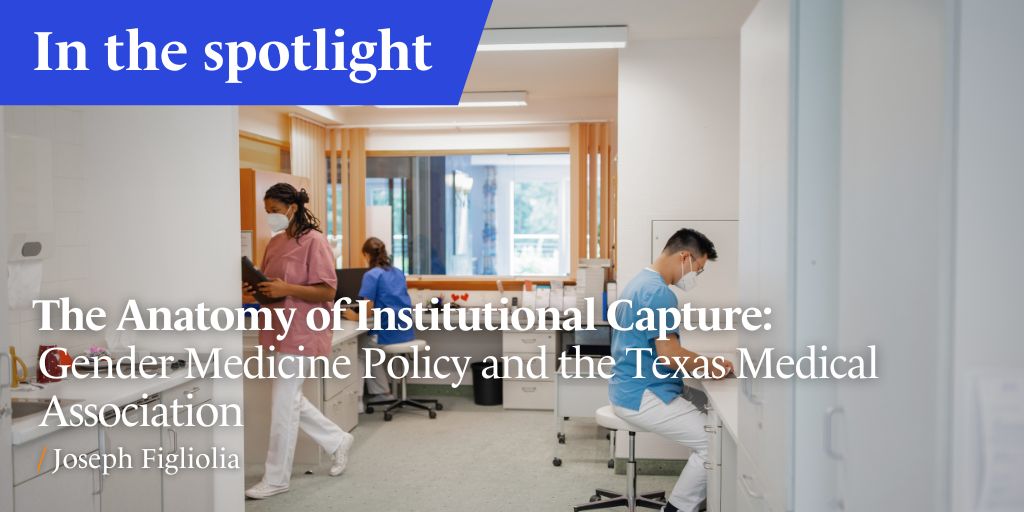
Also important is the risk of ideological capture, writes fellow Joseph Figliolia in a new report on gender medicine policy in medical institutions. Figliolia uses the Texas Medical Association as a case study and relies on original reporting, including the use of never-before-published internal correspondence, to show how ideologues within organizations shape institutional policy.
Sometimes it is easier to call for reform from the outside, and there are many actors in need of reform. That is what senior fellow Danielle Sassoon found after resigning as Manhattan’s U.S. attorney earlier this year. Now, law school administrators are more than happy to invite her to speak on the rule of law and civil dialogue, but they fail to live up to those principles when they buckle under aggressive student protesters who shout down and intimidate speakers their small clique deems unacceptable, she writes in the New York Times.
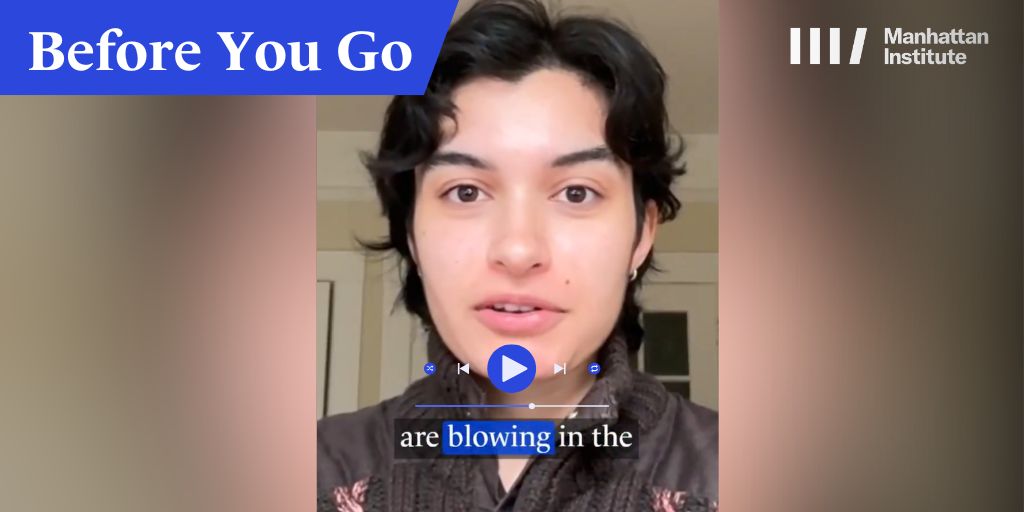
Finally, fellow Robert VerBruggen builds on his new report on gunshot-detection technology with a column about the tradeoffs for policymakers in City Journal. And in a new Tech in the City video, California-based fellow Sanjana Friedman considers the rightward political shift among the Big Tech giants. Continue reading for all these insights and more. Kelsey Bloom
Editorial Director |
|
|
The Anatomy of Institutional Capture: Gender Medicine Policy and the Texas Medical Association By Joseph Figliolia | Manhattan Institute Medical associations are supposed to base policy on science, not ideology. But as Joseph Figliolia shows in a new Manhattan Institute report, the Texas Medical Association (TMA) offers a case study in how activist factions can seize control of professional bodies.
Since 2020, TMA’s LGBTQ Health Section has wielded outsized influence in the association’s policymaking process—writing resolutions, stacking key committees, and using procedural maneuvers to push through policies endorsing “gender-affirming” treatments for minors. Internal correspondence shows members discussing ways to “Trojan-horse” controversial measures through TMA’s House of Delegates. TMA’s own surveys revealed that its embrace of activist positions on gender-affirming care was out of step with the preferences of its own members, many of whom have objected, citing conflicts of interest and suppression of debate. Yet reform efforts have been repeatedly blocked by committees led by the same activists they sought to investigate. Figliolia’s account shows how a small, ideologically unified group captured an influential medical association—illustrating a broader pathology in American institutions: when governance and transparency fail, politics displaces science. |
|
|
I Resigned as Manhattan’s U.S. Attorney. Law Schools Are Missing the Point of My Story.
By Danielle Sassoon | The New York Times
“For years, conservative speakers on campuses — from DePaul University to the University of California, Berkeley, to Dartmouth College — have had their events denied forums, shut down or derailed by security threats or anticipated backlashes that ostensibly posed safety concerns. ...
“To break the cycle of censorship, administrators should warn students: If you disrupt this event in a manner that censors speech, we will identify you and impose severe consequences. If a student organization engineers such a disturbance, the group’s leadership will face the same fate. When robust security is paired with meaningful consequences for those who violate campus policies, threats of disruption and violence will lose their force as a weapon to monopolize campus speech.”
|
|
|
When Your Child Is Sick By Abigail Shrier | The Free Press
“The first time one of your children is seriously ill or hurt, you pass through a portal into a new world. Fear envelops you, but also transforms you. You learn to recognize fear in its purest form. ... But also, you learn, as you did the moment your first child was born, that all the mani-pedis and blowouts don’t change the mammalian truth of your existence. ... For the first time, you understand that you would rip the face from any adult who would intentionally hurt them. You would do it gladly. Go ahead, you think. Try me.
“So many young women today throw around words like fierce to describe female law firm partners and corporate executives, which only proves that they don’t know women in those roles very deeply. ... For a glimpse at the apex predator, enter a pediatric cancer ward.” |
|
|
Chiles v. Salazar: a Defining Test for the First Amendment
By Colin Wright | City Journal
“In what may become the most important free speech case of the decade, the Supreme Court on October 7 heard oral arguments in Chiles v. Salazar, a challenge to Colorado’s ban on ‘conversion therapy’ for minors. ... At stake is not only therapists’ professional freedom but parents and minors’ ability to seek counseling consistent with their beliefs about sex, identity, and morality. ... “(This case shows) exactly why free expression in professional settings is so important. If the state can decide which psychological approaches are acceptable based on ideology, it effectively gains the power to define truth. The First Amendment exists to prevent that, ensuring that moral and scientific questions remain open for discussion, even inside therapy offices and clinics.” |
Is ShotSpotter Effective?
By Robert VerBruggen | City Journal
“Facial recognition. Drones. Police have adopted a range of new technologies in recent years to help prevent and respond to crime. Yet some of the most intense controversies still swirl around a product that’s been around for decades: gunshot-detection technology (GDT), most prominently ShotSpotter, which now operates in roughly 170 cities. ...
“When assessing GDT, Americans should be neither bowled over by fancy tech nor cowed by activist pressure. GDT can be a worthwhile investment for departments capable of using it well, and researchers should continue to study which aspects of implementation are most important. Departments that lack the staff to respond to calls or the infrastructure to process evidence, however, might want to address those problems first.” Related: |
|
|
Tech and the City By Sanjana Friedman | Manhattan Institute
“How real is Silicon Valley's shift to the right? One lagging indicator of where the winds are blowing in the tech industry is how Salesforce CEO Mark Benioff is thinking.” |
|
|
For more information and media requests, please contact
communications@manhattan.institute.
Are you interested in supporting the Manhattan Institute’s public-interest research and journalism? As a 501(c)(3) nonprofit, donations in support of MI and its scholars’ work are fully tax-deductible as provided by law. |
|
|
Photo Credits: adamkaz/E+/Getty Images; Noah Berger/AP Photo; Anadolu/Getty Images; Wong Yu Liang/Getty Images; Catherine McQueen/Getty Images; Probal Rashid/LightRocket/Getty Images |
|
|
The Manhattan Institute works to keep America and its great cities prosperous, safe, and free. Manhattan Institute 52 Vanderbilt Ave. 3 floor New York, New York 10017
Want to change how you receive these emails?
Unsubscribe | Subscription Preferences
Copyright © 2025 Manhattan Institute, All rights reserved. |
|
|
|