Good morning:
In Bloomberg, senior fellow Allison Schrager reports on the findings of two studies that tested whether artificial intelligence is the reason there is a notable decline in the hiring of new college graduates. But when the researchers controlled for work from home status, it turned out that AI did not make much of an impact. Schrager interprets the findings to reveal that WFH, while superficially appealing and desirable for more senior staff at white-collar organizations, limits opportunities for younger staff who need mentorship and training. That type of early-career development and learning from company culture is difficult to replace.
It is also difficult to rebuild an essential industry after policymakers have spent decades dismantling it. That is the situation faced by Western countries that bet their electrical power grids on so-called renewable boondoggles like solar and wind power, writes senior fellow James B. Meigs in the Wall Street Journal. Policymakers pressured power companies into complying with climate and green energy goals by abandoning dependable coal, gas, and nuclear power plants. They achieved this through a mix of credits, mandates, and subsidies. Now, industry watchdogs report that demand for electricity is increasing alongside the risk of power outages. Moving forward, steps to improve the U.S. power grid must be focused on reliability.
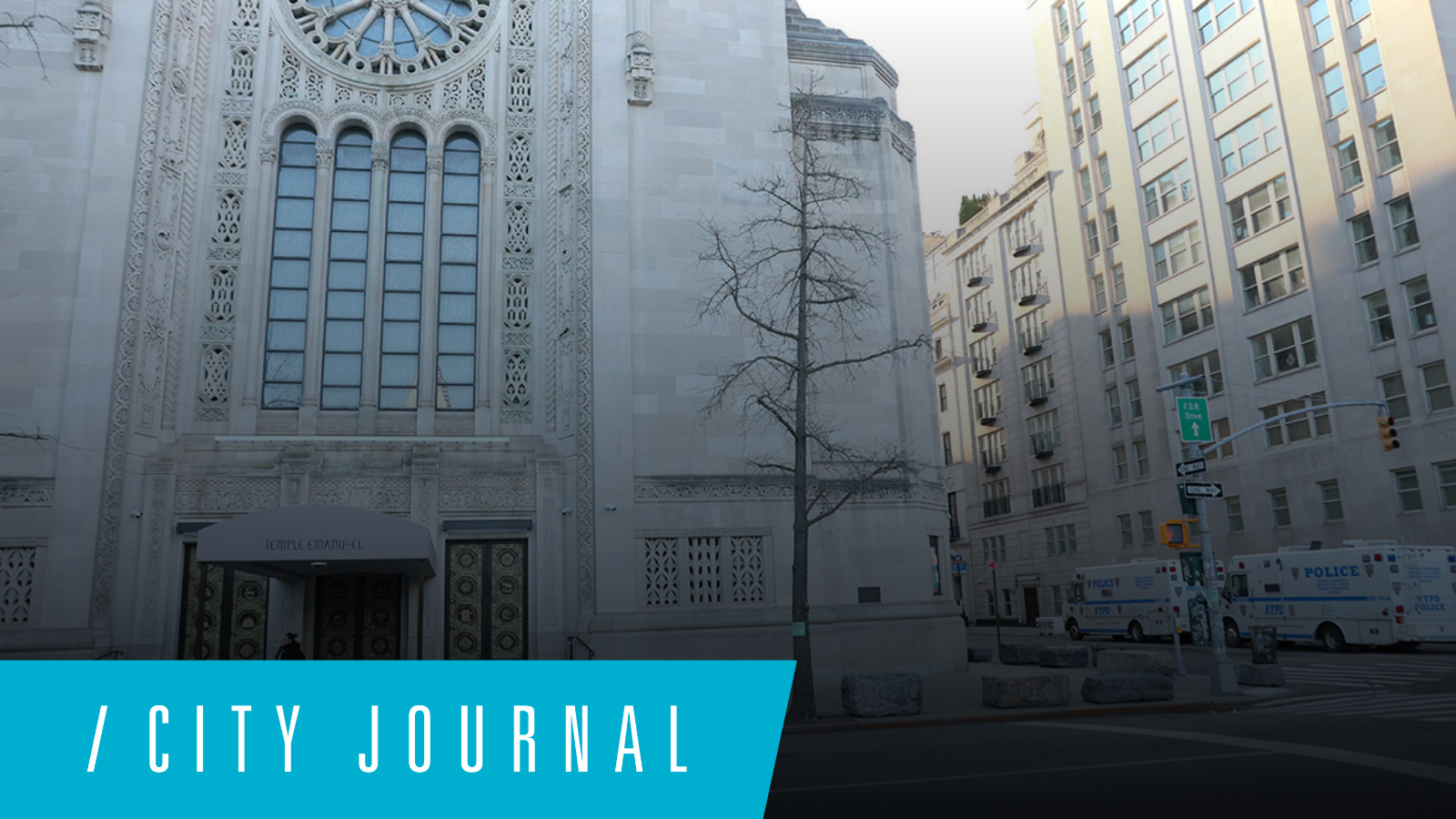
This week, legal policy fellow Tal Fortgang writes about the arrest of a Tehran-backed terrorist who allegedly directed dozens of bombings and attempted attacks throughout Europe and the United States. At the time of his arrest, the 32-year-old Mohammad Baqer Saad Dawood al-Saadi was allegedly plotting an attack on a New York City synagogue, and on Jewish institutions in Los Angeles and Scottsdale. In City Journal, Fortgang writes that this arrest highlights the risk of Iranian sleeper cells, including in the U.S., and the risks we take when we fail to secure our borders.
Also in City Journal, investigative reporter Stu Smith dove into underground networks of a different kind. Two millionaire leftist activists, one based in the U.S. and one based in Shanghai, are feuding over the direction of the left-wing protest movement in the United States. This public airing of intra-movement grievances matters because lawmakers are currently considering removing the tax-exempt status of organizations that may be merely tools of adversarial foreign governments.
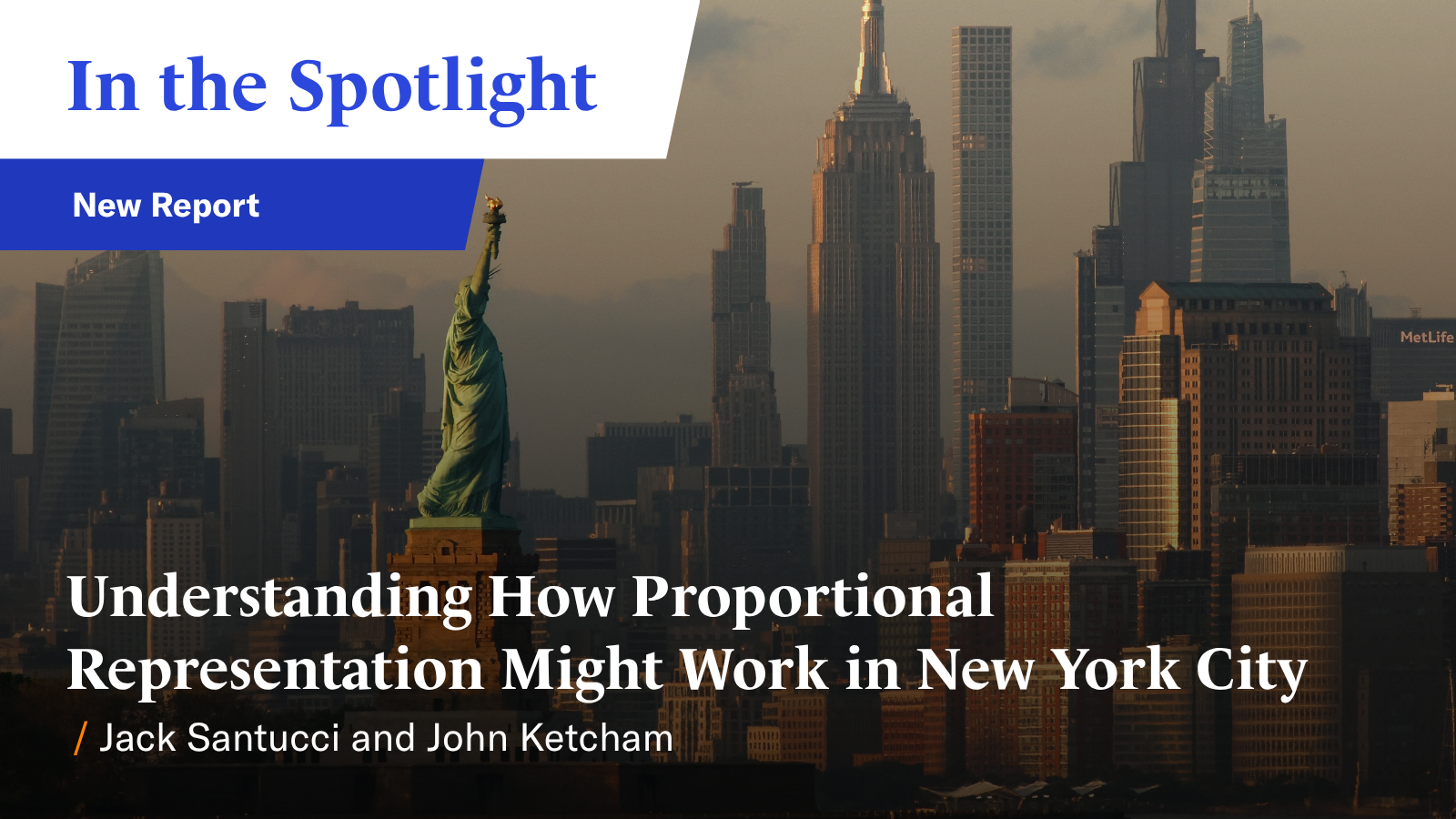
Finally, the Research team published a report today addressing the fact that New York City’s electoral system is producing increasingly unrepresentative outcomes. Scholars Jack Santucci and John Ketcham argue that the city already functions as if it has a multiparty system, with competition divided among establishment Democrats, socialist-aligned Democrats, and a Republican/Conservative bloc. The authors simulate two proportional-representation systems and find that both options would bring seat shares more closely into line with vote shares while preserving most current officeholders.
Continue reading for all these insights and more. Kelsey Bloom Editorial Director |
|
|
|
Understanding How Proportional Representation Might Work in New York City
By Jack Santucci and John Ketcham | Manhattan Institute | Photo by Gary Hershorn/Getty Images
New York City has a de facto multiparty system. Despite recent reforms like ranked-choice voting, its electoral rules channel political competition into lower turnout and intra-party factional fights, rather than contests between multiple distinct parties in the general election. Proportional representation (PR) offers a way to fix this problem.
In a new report for the Manhattan Institute, electoral system expert Jack Santucci and director of Cities John Ketchum examine how PR could reshape New York City's City Council elections. They find that the current single-seat district system produces two problems: right-leaning voters, being geographically dispersed, win far fewer seats than their vote share warrants (roughly 10% of seats on 22% of votes), while low-turnout Democratic primaries give organized factions like the Working Families Party outsized influence over who gets elected.
The report simulates two PR alternatives using 2025 council election data. Open-list PR (OLPR) would use the five boroughs as multi-seat districts, while mixed-member proportional (MMP) would retain current districts and add 20 citywide seats to correct imbalances. Both systems would bring seat shares closer to vote shares without dramatically changing who wins. |
|
|
Can’t Find a Job After Graduation? Blame WFH, Not AI
By Allison Schrager | Bloomberg Opinion | Photo by Nicky Lloyd via Getty Images
“I have a message for the class of 2026: AI is not ruining your job prospects, at least not yet. A better explanation for the tough job market may be the prevalence of (work from home), not the rise of AI. ...
“Where WFH is more common, managing junior staff is more expensive. At the same time, young staffers who receive less training may be less productive than they would be otherwise, even as they mature and demand more pay. So the cost of WFH to young graduates is not just a harder job market — it also makes it harder for young employees to get good training, supervision and mentorship. ...
“AI is becoming a convenient villain for a lot of complaints people have about the economy. Tech executives aren’t helping by regularly declaring that AI can replace a lot of jobs. More likely, they are using AI as an excuse when they are letting people go for financial reasons. In the case of WFH, it may be easier to blame AI than to ask reluctant staff to come into the office.” |
The ‘Renewable’ Boondoggle
By James B. Meigs | The Wall Street Journal | Photo by Daniel Bosma via Getty Images
“Here’s a rough analogy: Imagine a car with three engines, two of which can supply power very cheaply but have the disadvantage of turning on and off at unpredictable times. That would be a ridiculously complex machine! But that’s essentially how the power grid works in California, Germany and other regions with ample wind and solar. Sometimes, solar panels produce more power than the grid needs; at other times, wind dominates. But often, neither renewable option delivers. Then grid operators must fall back on a technology they can control, which today usually means natural-gas power plants.
“So, instead of basing their electrical grid mostly on ‘firm’ power sources including nuclear plants, these regions built three largely redundant power systems that struggle to work together. No wonder Californians pay some of the highest electricity prices in the country. ...
“Whatever direction our power grid takes, let’s hope it’s guided by engineering and economic reality—not politically motivated wishcasting. And let’s drop that obsolete term ‘renewable’.” |
|
|
Hayek Book Prize and Lecture By Manhattan Institute We are pleased to announce that Sean McMeekin has been awarded the 22nd annual Hayek Book Prize for his book To Overthrow the World: The Rise and Fall and Rise of Communism (Basic Books, 2025).
Mr. McMeekin will receive a $100,000 award and deliver the annual Hayek Lecture in New York City on June 4. We also extend our congratulations to the other finalists. |
An Iranian Agent in New York
By Tal Fortgang | City Journal | Photo by Michael M. Santiago/Getty Images
“In the wake of the joint U.S.–Israeli strikes on Iran last summer and this past February, counterterrorism experts and government officials have identified the prospect of Iranian sleeper cells on American soil as a serious threat. The arrest earlier this month of Mohammad Baqer Saad Dawood al-Saadi offers a stark reminder that that threat is real.
“A Kata’ib Hizballah commander working closely with the Iran Revolutionary Guard Corps (IRGC), al-Saadi was allegedly directing bombings of synagogues, Jewish schools, and American financial institutions abroad while simultaneously mapping out a Manhattan synagogue for attack. According to the federal complaint, he explained his motivations for attacking Jews as “either they eradicate us, or we eradicate them.” He now stands accused of six terrorism-related offenses. “The episode highlights with rare comprehensiveness the interlocking problems of global Islamist terrorism, American immigration policy, and a fixation with Jews and Jewish institutions—particularly those that openly support Israel. Preventing such incidents means hardening both our border and the nation’s Jewish institutions—before the next al-Saadi succeeds.” |
Feuding Communist Millionaires Reveal a Secret Network Powering America’s Radicals
By Stu Smith | City Journal | Photo by Chedly Ben Ibrahim/NurPhoto via Getty Images
“Jim ‘Fergie’ Chambers, the Communist millionaire and heir to the Cox media fortune, has long bankrolled one of the nation’s most militant protest networks. But in recent weeks, he has turned his fire on a putative ally: Shanghai-based tech billionaire Neville Roy Singham, who himself funds a transnational web of far-left groups.
“What’s going on? ... Chambers alleged that Singham’s network of nonprofits and activist groups has tried to redirect insurgent organizing into tightly controlled institutions linked to the Party for Socialism and Liberation (PSL), a U.S.-based revolutionary Communist party. Chambers sees Singham’s operation as ... exercising control over the movement [rather than] enabling the sort of serious radicalism Chambers endorses. ...
“In the course of the public feuding, Chambers has ... inadvertently drawn attention to the network’s core organizing hub, the PSL, which he says ultimately anchors the broader system. If that is the case, government scrutiny should not be applied piecemeal across the broad array of peripheral organizations. It must reach the structure at the center of the system, where influence and coordination converge, and where critics, both left and right, argue real control ultimately lies.” |
|
|
A Day in the Life of a Crime Reporter (with New York Post's Joe Marino) By Manhattan Institute
Award-winning crime journalist Joe Marino joins Rafael Mangual for a candid, in-depth conversation on the realities of crime, policing, and public safety in New York City. From criminal justice reform and evolving policing strategies to recidivism, media narratives, and the human behavior behind the headlines, Marino breaks down the complex issues shaping today’s justice system. Drawing on years of frontline reporting, he offers sharp insight into how policy, politics, data, and public perception collide—and what it all means for the future of crime and accountability in America’s largest city.
|
We are pleased to announce our partnership with the Sun Valley Policy Forum (SVPF) and to invite you to join the 5th annual three-day Summer Institute featuring many of your favorite MI scholars.
Friends of Manhattan Institute are eligible for a special perk: a 10% discount on the All-Access Pass or Silver Access Pass. The Manhattan Institute will be well represented at the Sun Valley Policy Forum this year, with presenters including: Reihan Salam: Renewing the Promise of America and its Great Cities: From Institutional Decay to Dynamism Ilya Shapiro: The Supreme Court and the American Experiment Shawn Regan: Burn Out: America’s Wildfire Crisis – Are We Managing Our Forests or Letting Them Burn? Judge Glock: Freedom to Teach: Building a Flexible, Innovative Education Workforce
Other MI scholars and staff will be present as well, including Heather Mac Donald, Sanjana Friedman, Jesse Arm, and more.
Outside speakers at this year's Summer Institute include Scott Jennings, Michael Knowles, Lord Andrew Roberts, General David Petraeus, Josh Wolfe, Elliott Abrams, and our friends from The Free Press, The Daily Wire, Palantir, and Lux Capital. |
|
|
For more information and media requests, please contact
communications@manhattan.institute.
Are you interested in supporting the Manhattan Institute’s public-interest research and journalism? As a 501(c)(3) nonprofit, donations in support of MI and its scholars’ work are fully tax-deductible as provided by law. |
|
|
|
The Manhattan Institute works to keep America and its great cities
prosperous, safe, and free. Manhattan Institute
52 Vanderbilt Ave. 3 floor New York, New York 10017
Want to change how you receive these emails?
Unsubscribe | Subscription Preferences
Copyright © 2026 Manhattan Institute, All rights reserved. |
|
|
|
|