The Vanishing Immigrant Marriage Advantage: How Assimilation Leads to Fewer Marriages

Photo: MykolaSenyuk/iStock/Getty Images Plus via Getty Images
Introduction
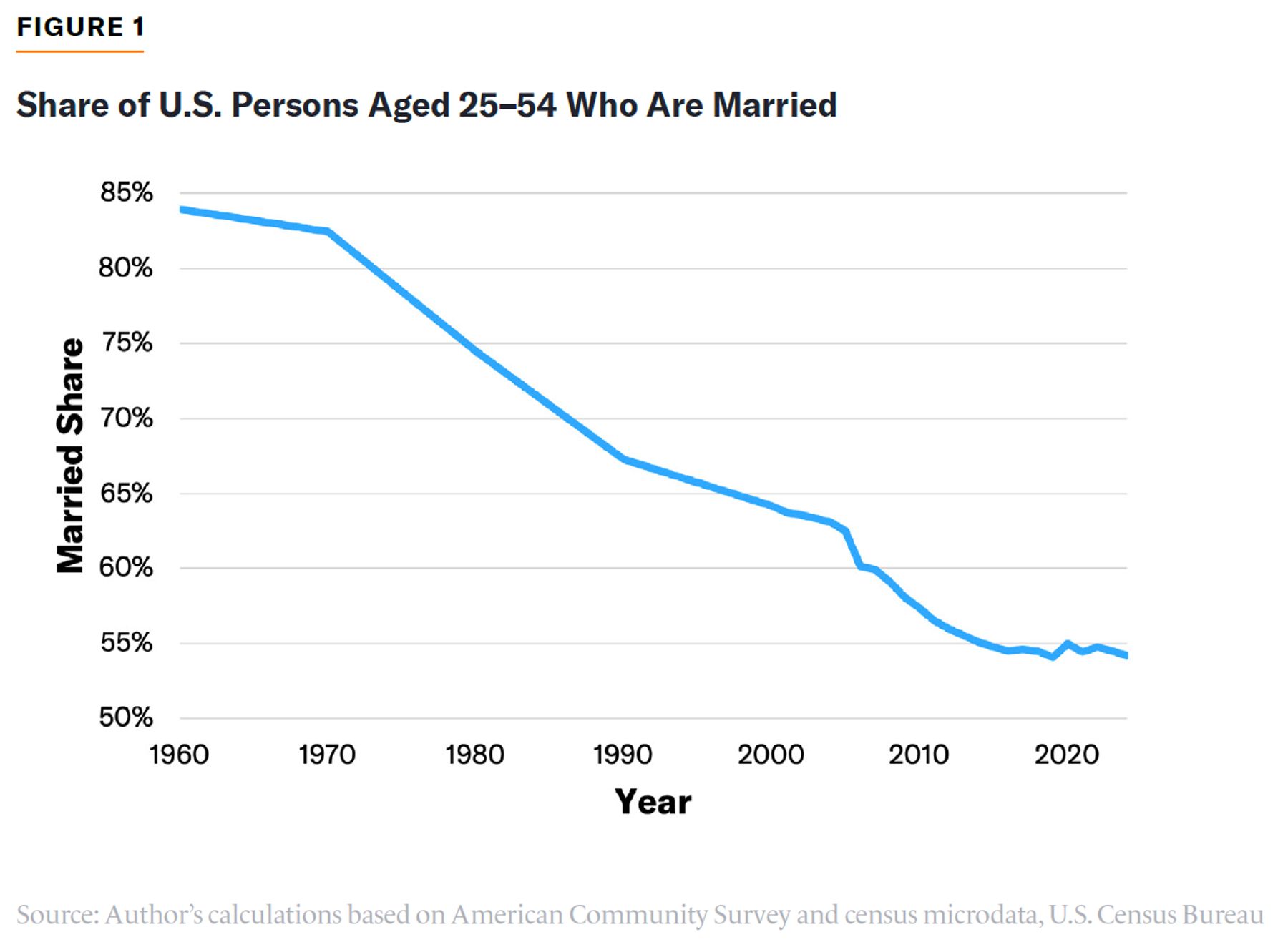
Marriage rates are declining across the world, including in the United States. In 1960, nearly 85% of persons in the U.S. aged 25–54 were married; today, fewer than 55% are married (Figure 1).[1] But even this decline understates the issue because U.S. marriage rates have been propped up by a rising share of immigrants, who tend to have higher marriage rates. These statistics thus conceal a much starker decline in marriage among native-born Americans.
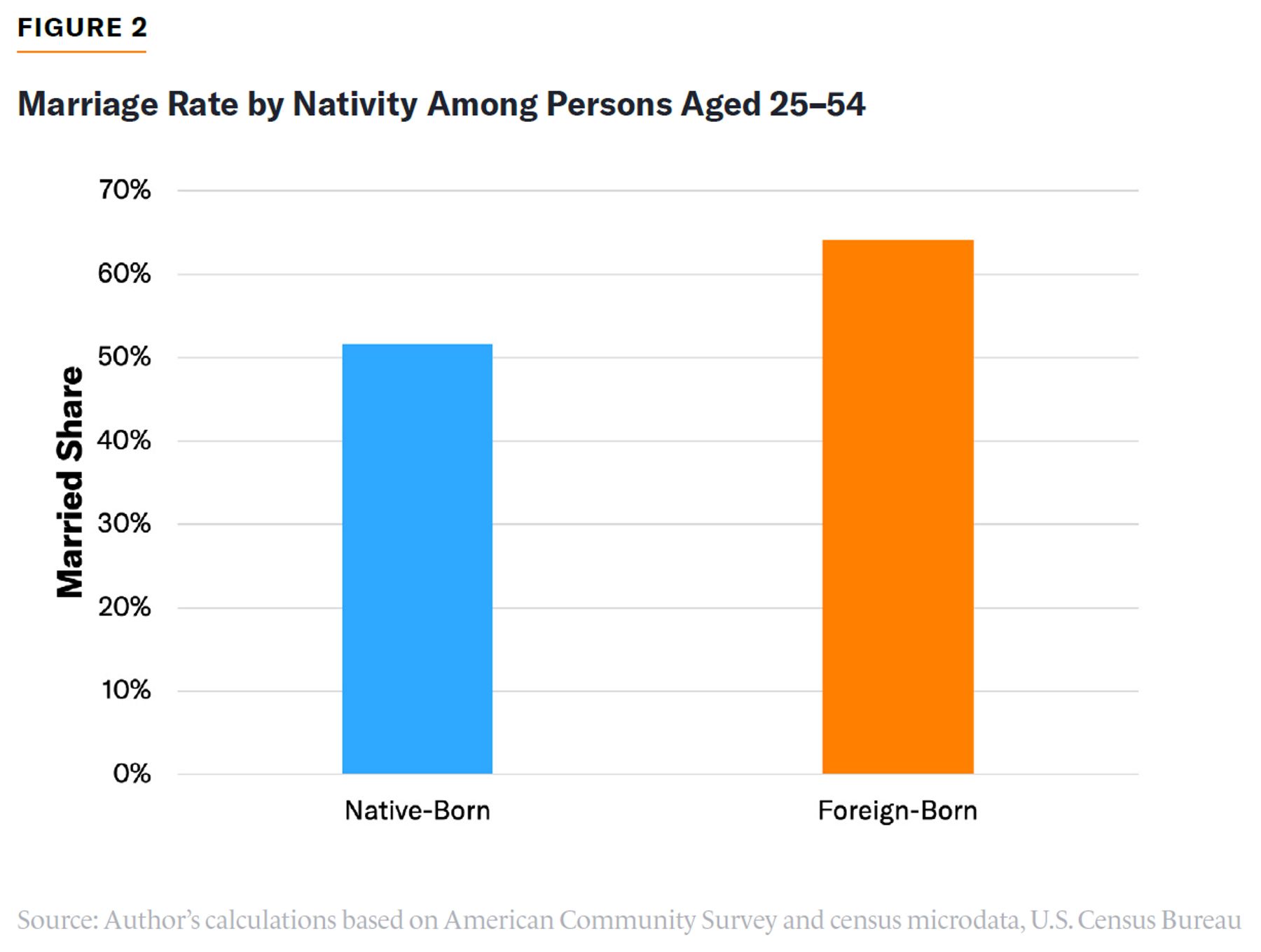
While the overall marriage rate among prime-age adults (aged 25–54) seems to have stabilized at around 54%, there is a nearly 13-point gap between prime-age foreign-born residents (64.1% married) and prime-age native-born U.S. residents (51.6% married).[2] I.e., an immigrant adult in the U.S. is 24% more likely to be married than a native-born American (Figure 2).
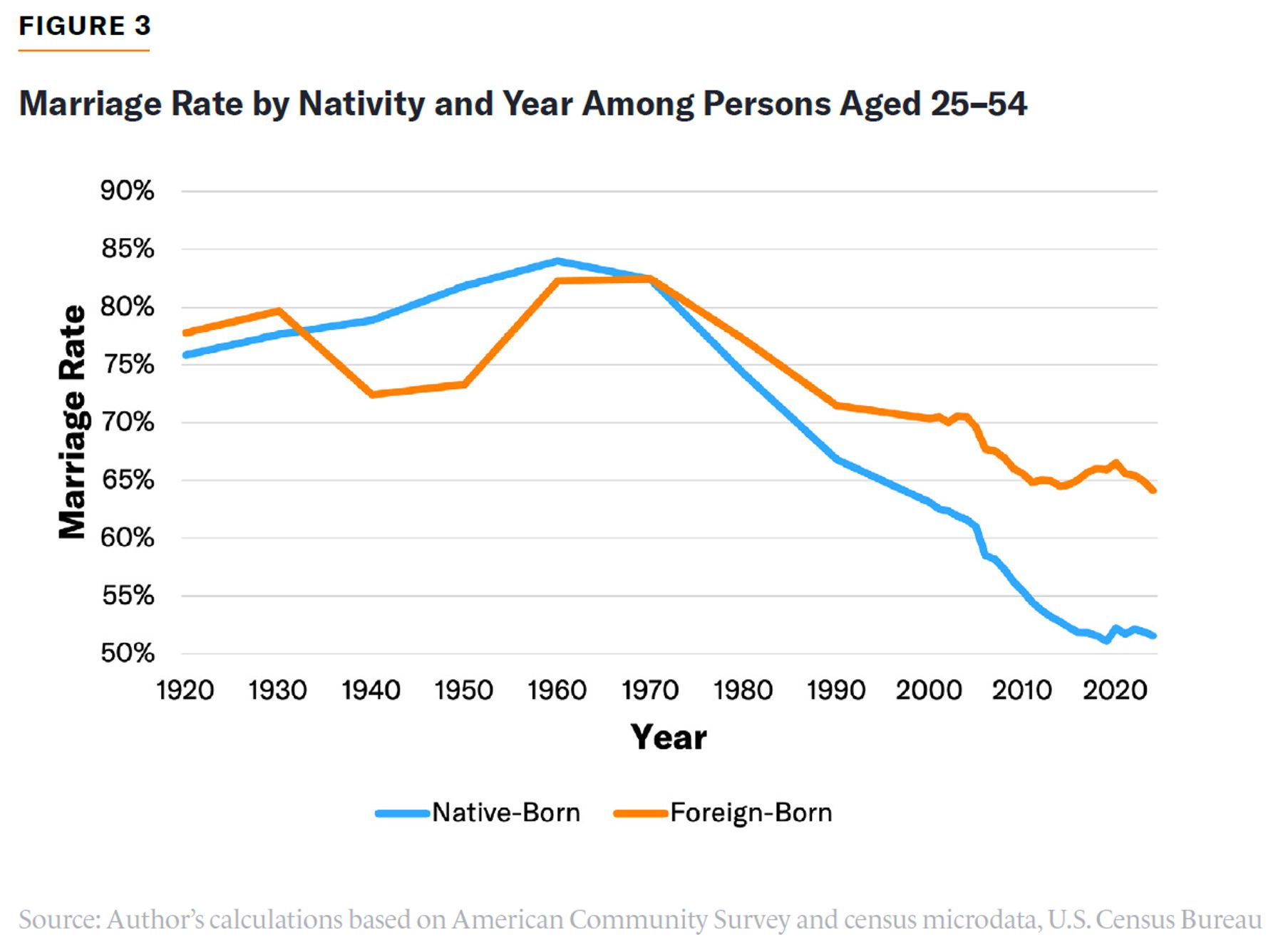
The immigrant-native marriage gap did not always exist (Figure 3). From 1940 to 1960, native-born Americans had a higher marriage rate than immigrants, due to a sudden drop in immigrant marriage rates beginning in the Great Depression and lasting through World War II. After the war, immigrant marriage rates rose until they reached native levels of over 80% in the 1960s. After 1970, marriage rates for both native and immigrants fell but did so much more rapidly among natives. Since the mid-2000s, the immigrant marriage rate has stabilized at around 65%. For native-born American adults, the marriage rate is now just under 52%: nearly half of native-born Americans aged 25–54 are unmarried.[3]
It is often assumed that immigrants have a higher marriage rate because they come from countries and cultures with higher marriage rates. This could be true; but to test this hypothesis, we first need to look more closely at marriage rates by age, since immigrants and natives also differ in age profile, which could explain the marriage gap. More important, a large share of immigrants come to the U.S. through marriage. In 2023, approximately one in three new legal permanent residents was sponsored by virtue of being married to an American or a green-card holder. This has been the case for decades.[4]
Figure 4 shows U.S. marriage rates by age, using data from the American Community Survey and census microdata. The sample is restricted to people aged 35–39 because in this age group, most people who will marry are already married, but the share of remarriages remains relatively limited. This helps approximate first-marriage patterns, since the census data do not distinguish between first and subsequent marriages.
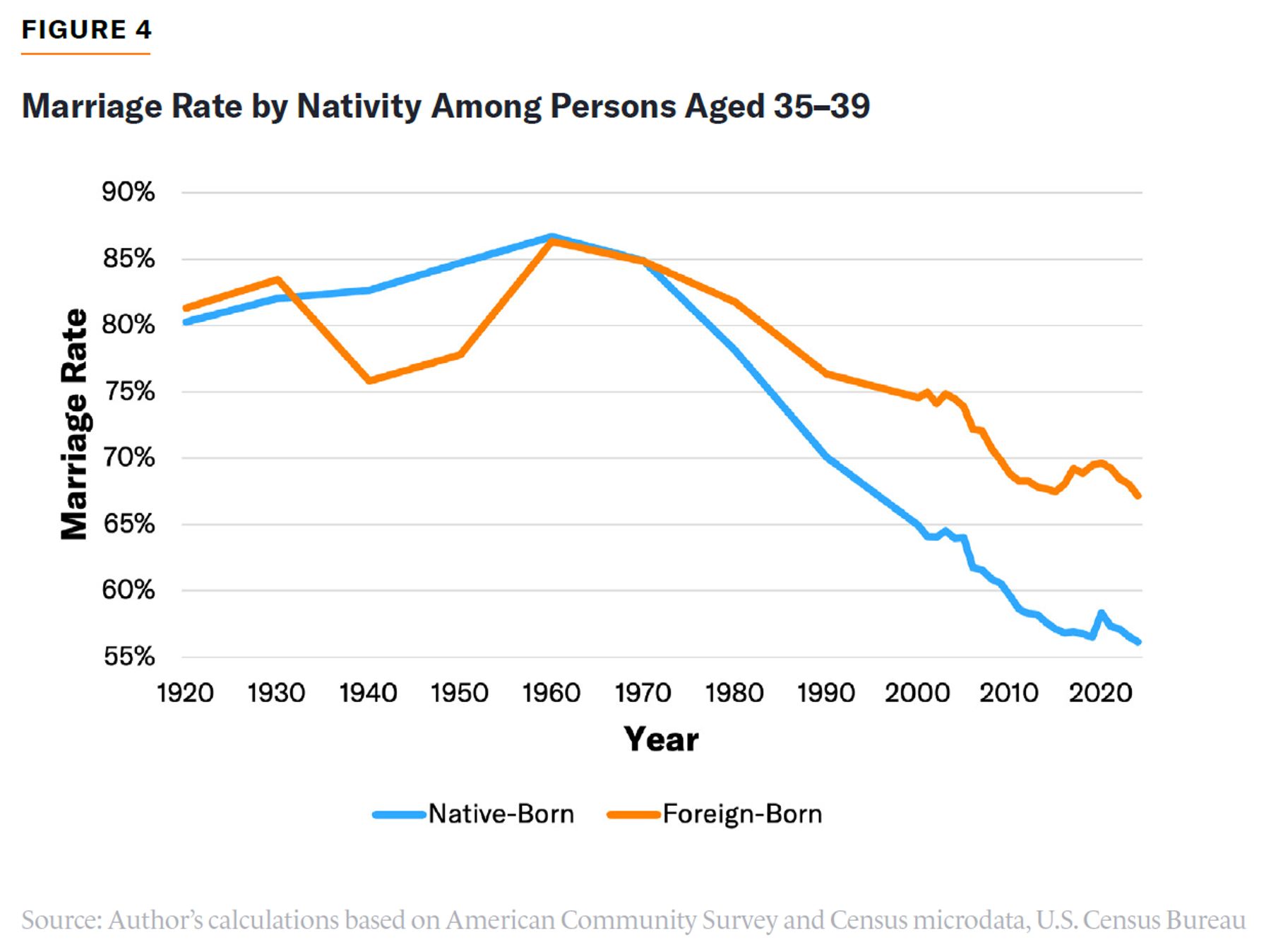
This analysis shows that the dip in immigrant marriage rates during 1930–40 was especially pronounced among those aged 35–39, for whom the decline was 7.7 points, compared with a 7.2-point drop among immigrants aged 25–54.[5] This decline is likely a result of the sharp reduction in immigration rates beginning in 1921 with the first immigration quotas, which targeted Jews and Catholics from Eastern and Southern Europe, as well as declines in immigration during the Great Depression.[6] A decline in newly arriving immigrants likely reduced coupling options, and thus marriages, for preexisting immigrants, rather than increasing the rates of interethnic marriages, which were relatively rare at the time. This hypothesis is further supported by the post-1950 marriage boom among immigrants, which coincided with the 1952 Immigration and Nationality Act and other post–World War II laws that ended the prohibition on sponsoring foreign spouses of any origin.[7]
Today’s immigrant–native marriage gap remains large even after adjusting by age. Among all those aged 25–54, the gap in marriage rates between immigrants and natives is 12.6 points; among those aged 35–39, the gap is 11 points. Among natives aged 35–39, marriage rates have fallen by 31 points from their peak in 1960. For immigrants aged 35–39, by contrast, rates have declined by only 19 points from the peak.[8]
Assimilation or Selection?
As noted above, the gap may also result from the fact that many immigrants arrive through marriage. Alternatively, it may be that marriage is positively correlated with characteristics that make a foreigner more willing and able to immigrate to the U.S., lawfully or unlawfully. Both these hypotheses may play a role, but these phenomena are neither new nor increasing. Especially during 1930–60, when legal immigration was far more restricted, marriage was one of the few ways to come to the U.S. legally, so it represented a larger share of the immigrant flow. Unfortunately, the census does not provide data about which path immigrants took to get to the U.S. (i.e., through marriage or through an employment-based visa). But, at least since the 1970 census, the data do indicate the age at which an immigrant first arrived in the United States. We can reasonably infer that nearly every immigrant who first arrived in the U.S. before the age of 18 did so through an initial path other than marriage; thus, by grouping immigrants according to age at arrival, we can specifically examine the marriage rates of immigrants who arrived unmarried.
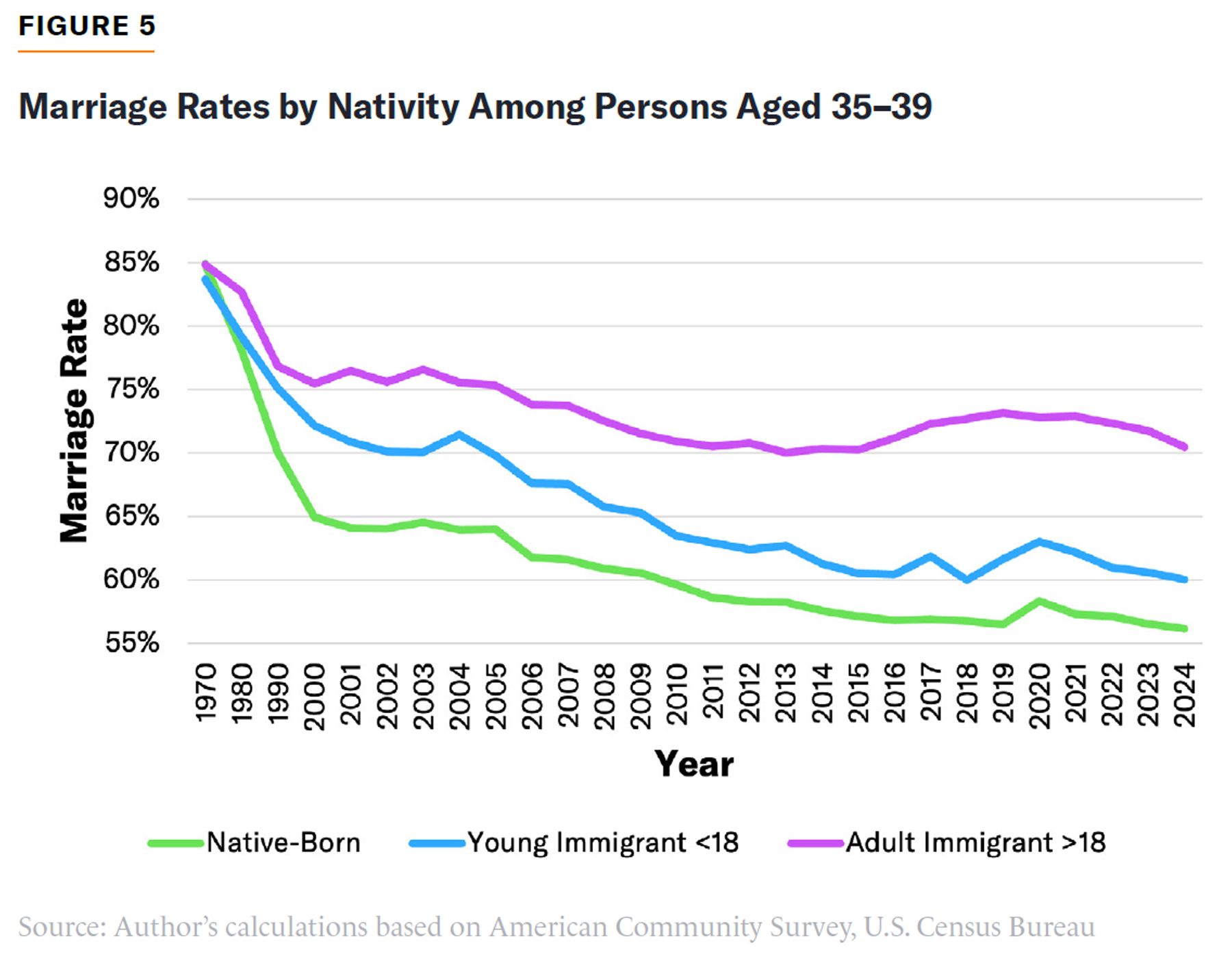
Figure 5 compares the marriage rates of native-born Americans, immigrants who arrived before age 18, and immigrants who arrived after age 18, for the period in which all groups are between 35 and 39 years old. The marriage rate of young arriving immigrants is still higher than that of natives, but the gap is much smaller—less than 5 points. On the other hand, immigrants who arrived as adults have a much higher marriage rate (70%), which has not declined but has hovered at 70%–80% for the last two decades.
The likely reason for this marriage gap is both because many adult immigrants arrive through marriage and because adult immigrants are less assimilated to American customs. Young immigrants, by contrast, have spent more of their formative years in the U.S., assimilating to a culture that now places less importance on marriage.
One way to test the role of assimilation versus marriage selection into immigration is to compare two groups within the young immigrants: those who arrived in the U.S. before they turned 10; and those who immigrated between the ages of 10 and 18. If immigrants assimilate into the U.S.’s lower marriage-rate norms, those who arrived as children will likely have a lower marriage rate than those who arrived as teens.
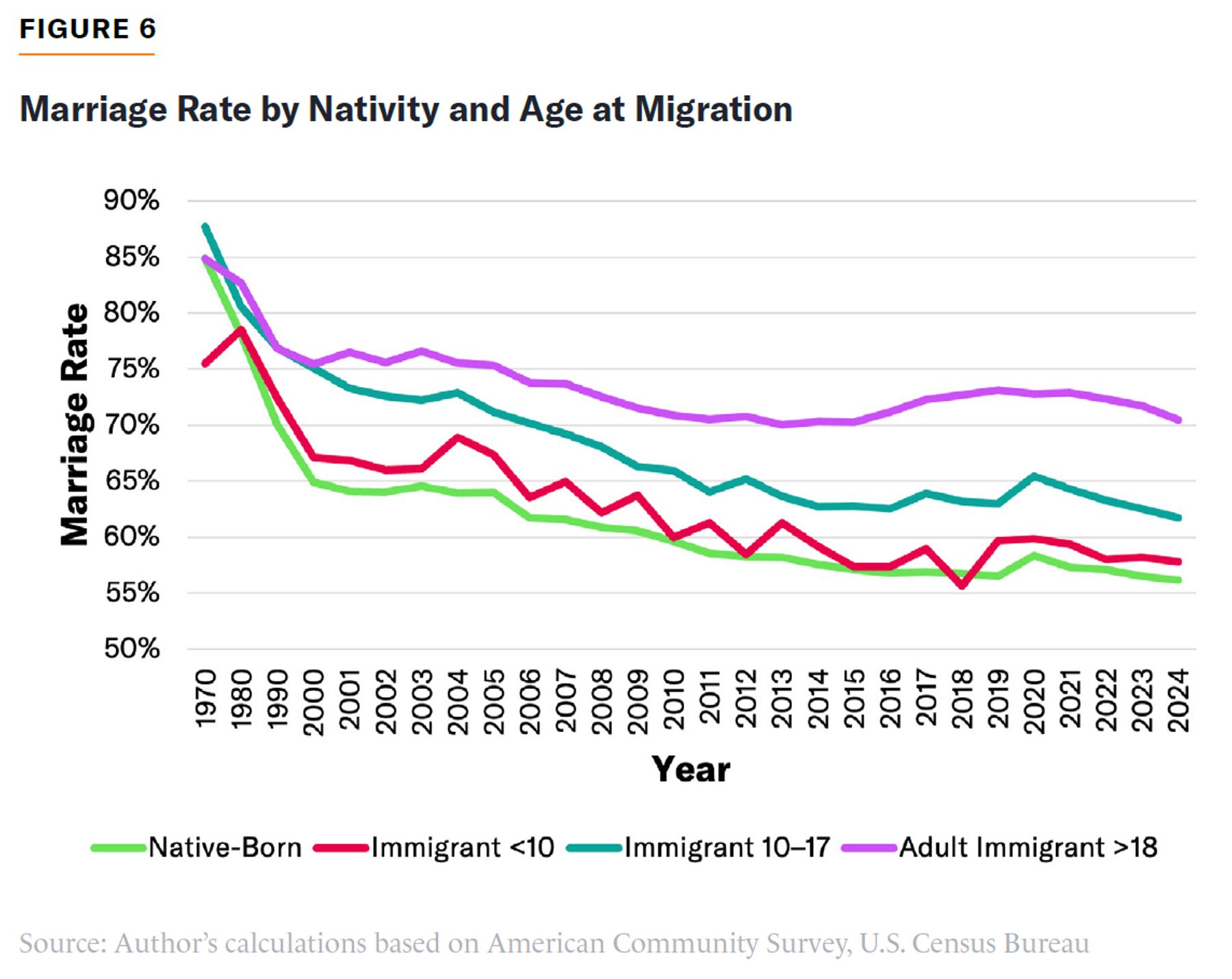
Indeed, that is what we see in Figure 6. Immigrants who arrive in the U.S. before age 10 marry at a similar rate as native-born Americans, while those who arrive as teens have a consistent, but small, marriage advantage. Adult immigrants have a much larger marriage advantage.
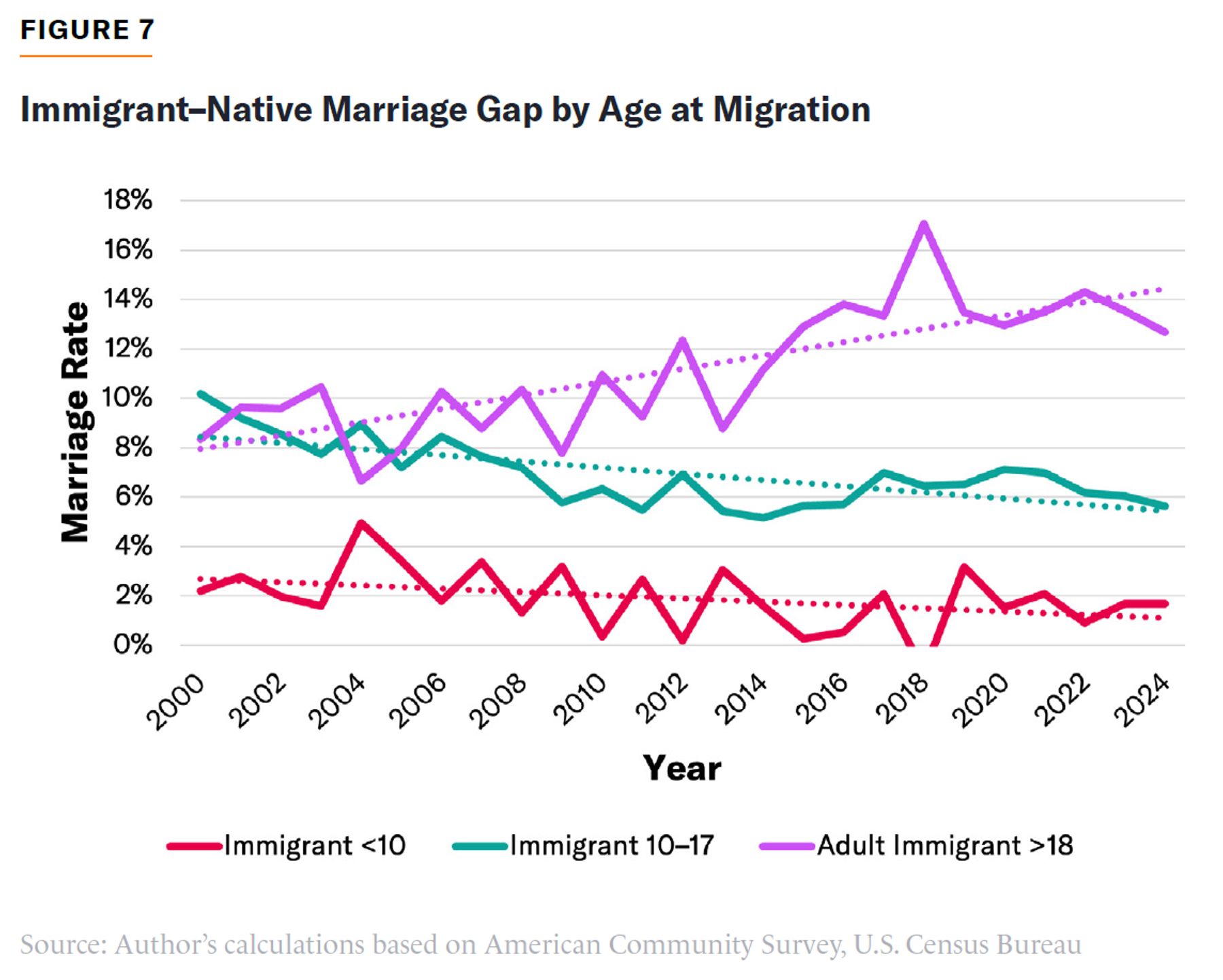
Since the turn of the century, the marriage gap between immigrants and natives has been consistently growing. But as Figure 7 shows, the gap is primarily driven by immigrants who arrived in the U.S. as adults. The marriage gap between natives and immigrants who arrived at age 10 or younger has become negligible—even reversing direction for one year in 2018. The gap between natives and immigrant teens (those who immigrated between the ages of 10 and 17) has also narrowed in this century, falling from 10 to nearly 5 points.
It seems that the longer that young immigrants spend growing up in the U.S., the more they assimilate into American marriage norms and are thus less likely to marry. Adult immigrants are not becoming more different from native-born Americans when it comes to marriage. Instead, native-born Americans are giving up on marriage while immigrants who spent their youth abroad are marrying at the same rate as they were before.
Immigrant Assimilation into American Culture by Ethnic Group
Marriage rates vary not only by age and nativity but also by race and ethnicity, so immigrants might be assimilating into different subcultures of the United States. Moreover, a growing share of native-born Americans—with whom we are comparing immigrants—are themselves children of immigrants who might be experiencing different trends. This trend is especially important, since a rising share of native-born Americans have immigrant parents. During 1994–2024, the share of noninstitutionalized native-born Americans with at least one immigrant parent rose from just under 10% to nearly 15%, and from 5% to 13% in the sample of those aged 35–39 in which we analyzed marriage rates.[9]
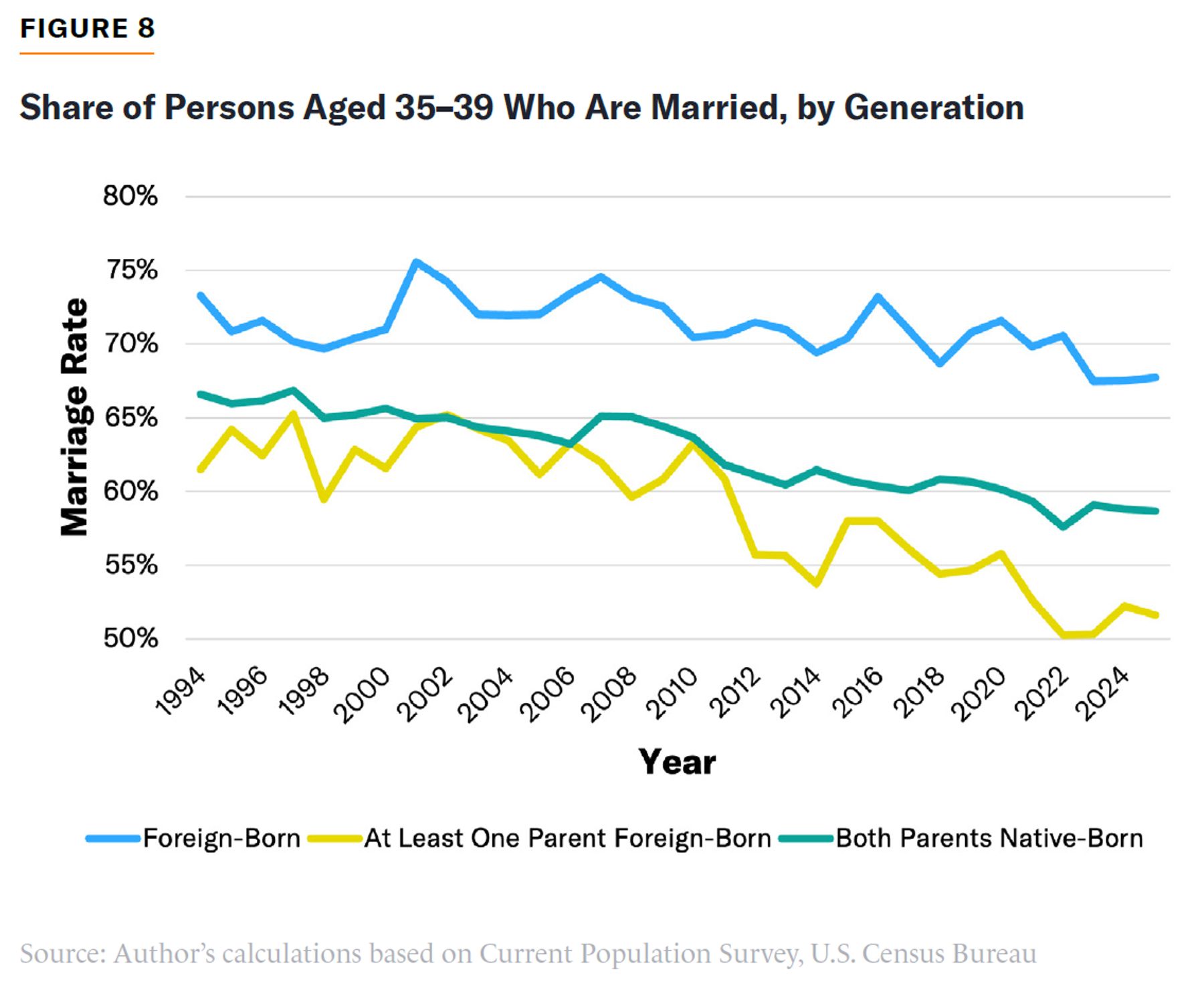
Figure 8 shows marriage rates for immigrants, natives with at least one foreign-born parent, and natives whose parents are both native-born. We see that marriage rates are lower, and have fallen more quickly, among children of immigrants than for children of natives. This is surprising because children of immigrants are more likely to be Asian or Hispanic, and less likely to be black; thus, if the previous data are any indicator, they would be expected to have higher marriage rates than the native population overall.
Figures 9–12 show marriage rates for the four main ethnic groups in the U.S. (non-Hispanic white, non-Hispanic black, Hispanic, and Asian), subdividing each into three groups: foreign-born; native-born with at least one foreign-born parent; and native-born with two native-born parents.
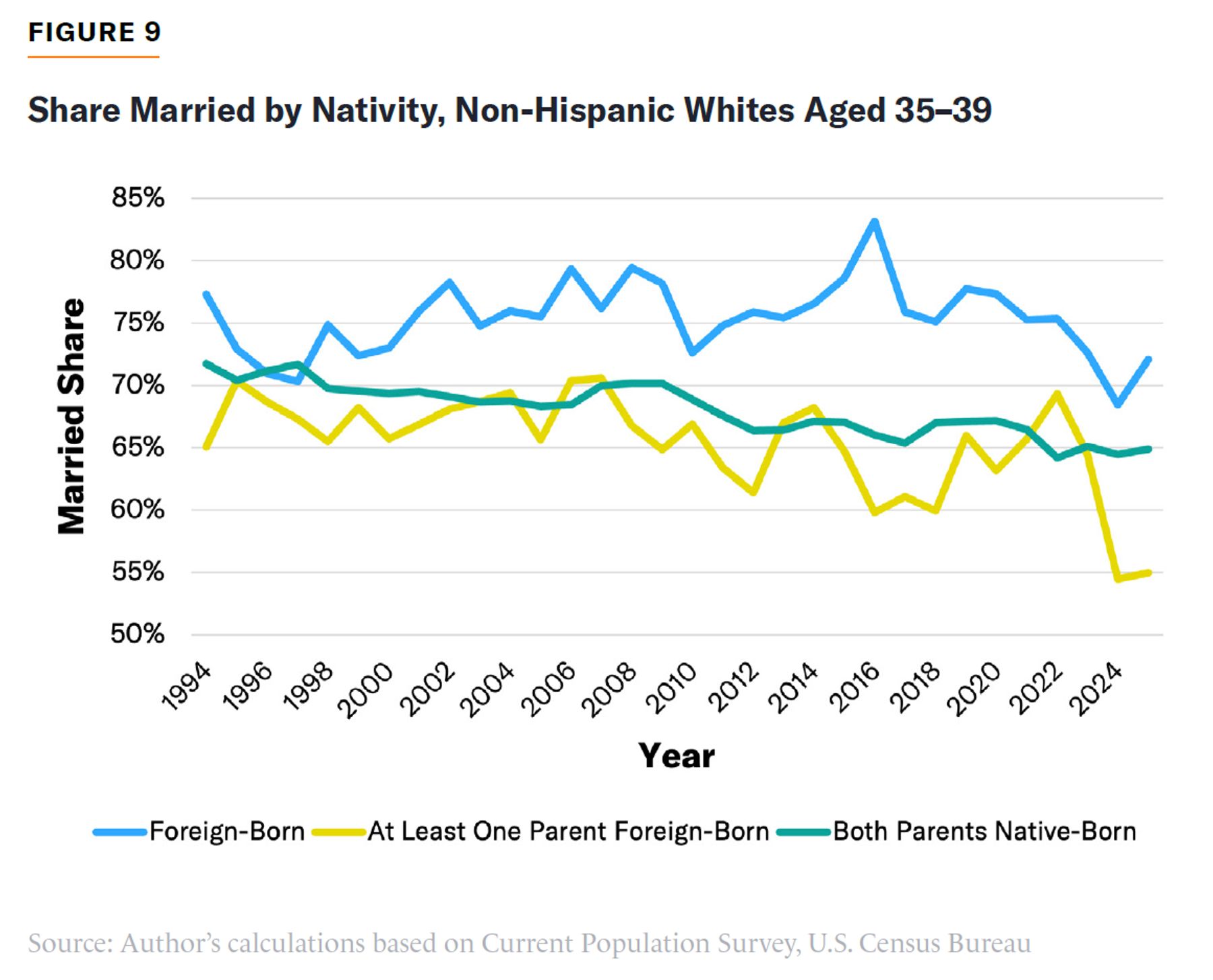
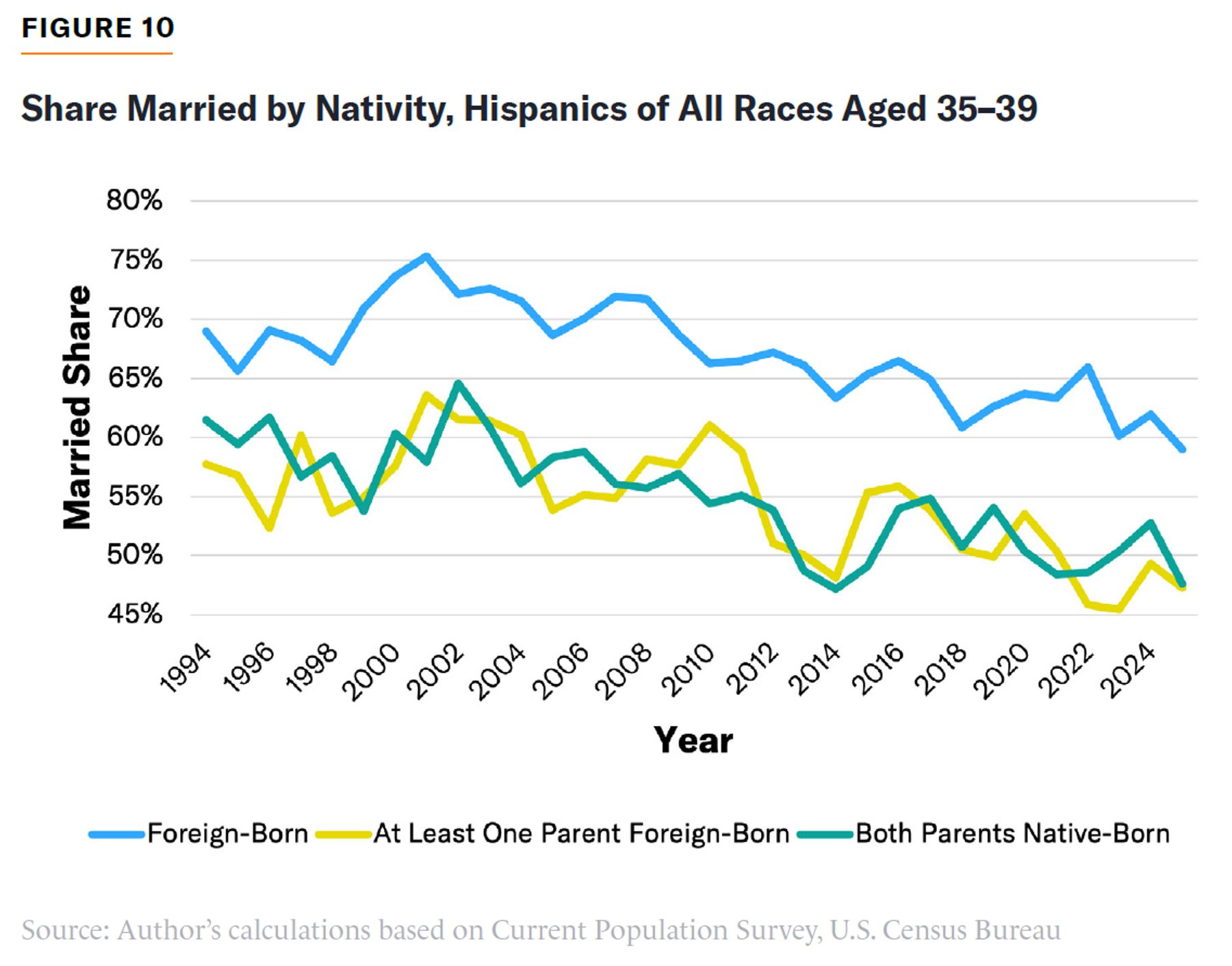
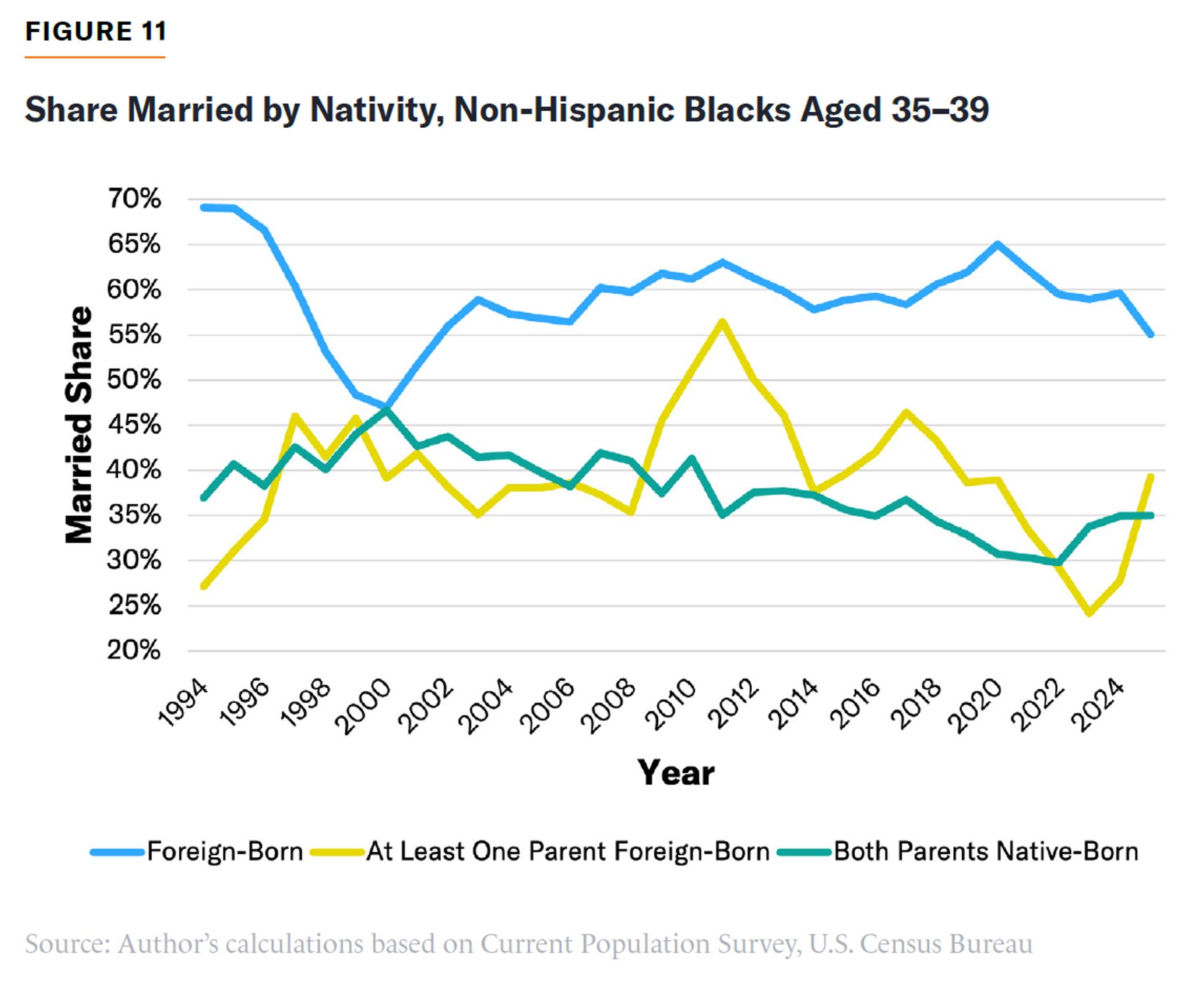
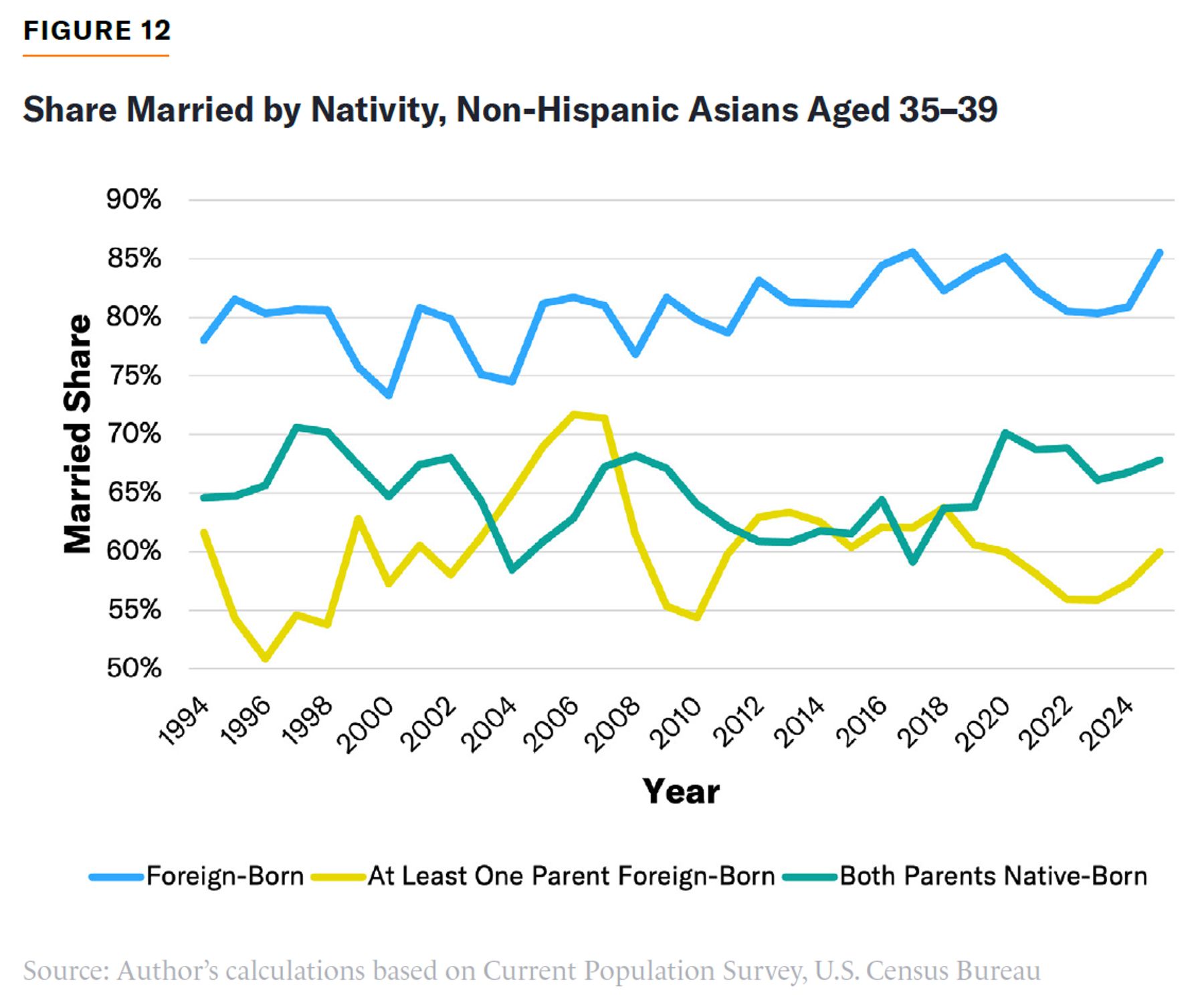
Within all ethnic groups, immigrants have a higher marriage rate than natives, but children of immigrants have the same or lower marriage rates than children of natives in the same ethnic group.
The results within the black population are particularly striking. While black immigrants (most of whom are from Africa and the Caribbean) aged 35–39 have an approximately 60% marriage rate, their American-born children have a marriage rate of about 35%, nearly identical to the rate of native-born black Americans. I.e., children of non-Hispanic black immigrants marry at the same rate as multigenerational native-born black Americans. This suggests that children of African and Caribbean immigrants may be assimilating not to average American marriage norms but to black marriage norms.
Hispanic immigrants also assimilate to native Hispanic marriage norms within one generation. The marriage rate of Hispanic immigrants aged 35–39 has fallen from a peak of 75% to 60%; but for the last 30 years, the marriage rate of their children has consistently matched that of multigenerational Hispanics, falling from 65% to 50%.
Among white immigrants, the gap in marriage rates between natives and immigrants was small at the end of the 20th century, but it has grown as native-born white marriage rates have fallen faster than those of their immigrant counterparts. Now 70% of white immigrants aged 35–39 are married, compared with 65% of native-born multigenerational whites. Yet the marriage rate of whites with at least one immigrant parent is even lower than either group, falling to a record low of 55% last year, after being similar to the multigenerational white population.
Asian immigrants have the highest marriage rate of any group, consistently about 80% among those aged 35–39 during the last 30 years. But children of Asian immigrants do not follow in their parents’ footsteps; their marriage rates have been more similar to those of multigenerational Asian Americans, at about 63%. This was true at least until the 2020 Covid-19 pandemic, when marriage rates for children of Asian immigrants dipped under 60%, compared with over 65% for multigenerational Asian Americans.
The Role of Education
Possibly, the immigrant–native marriage gap is driven primarily by differences in education, and the apparent assimilation by children of immigrants into their ethnic group’s marriage norm is merely a statistical mirage. To test this hypothesis, Figures 13 and 14 show marriage rates among persons aged 35–39 with and without a college degree, by their immigrant background.
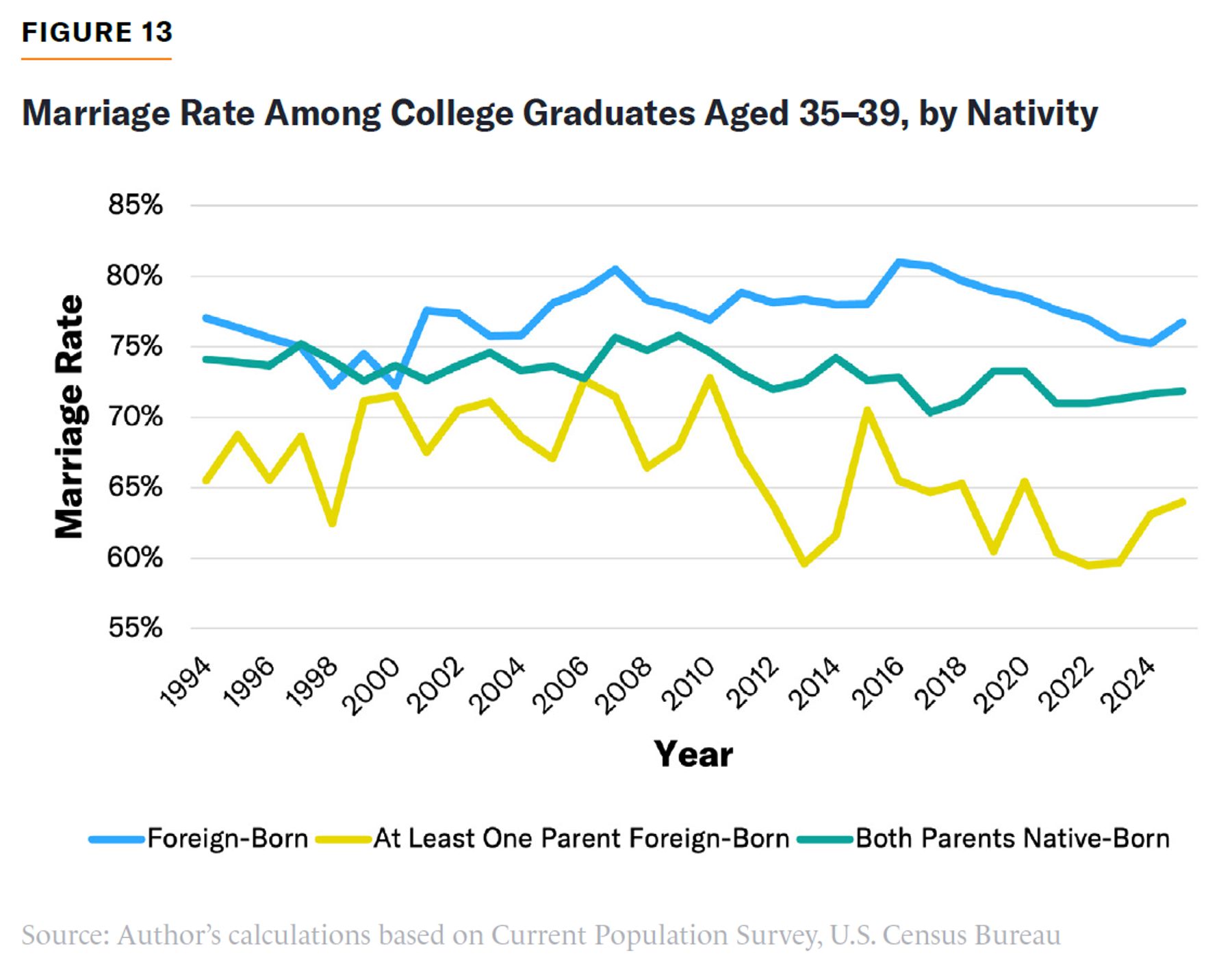
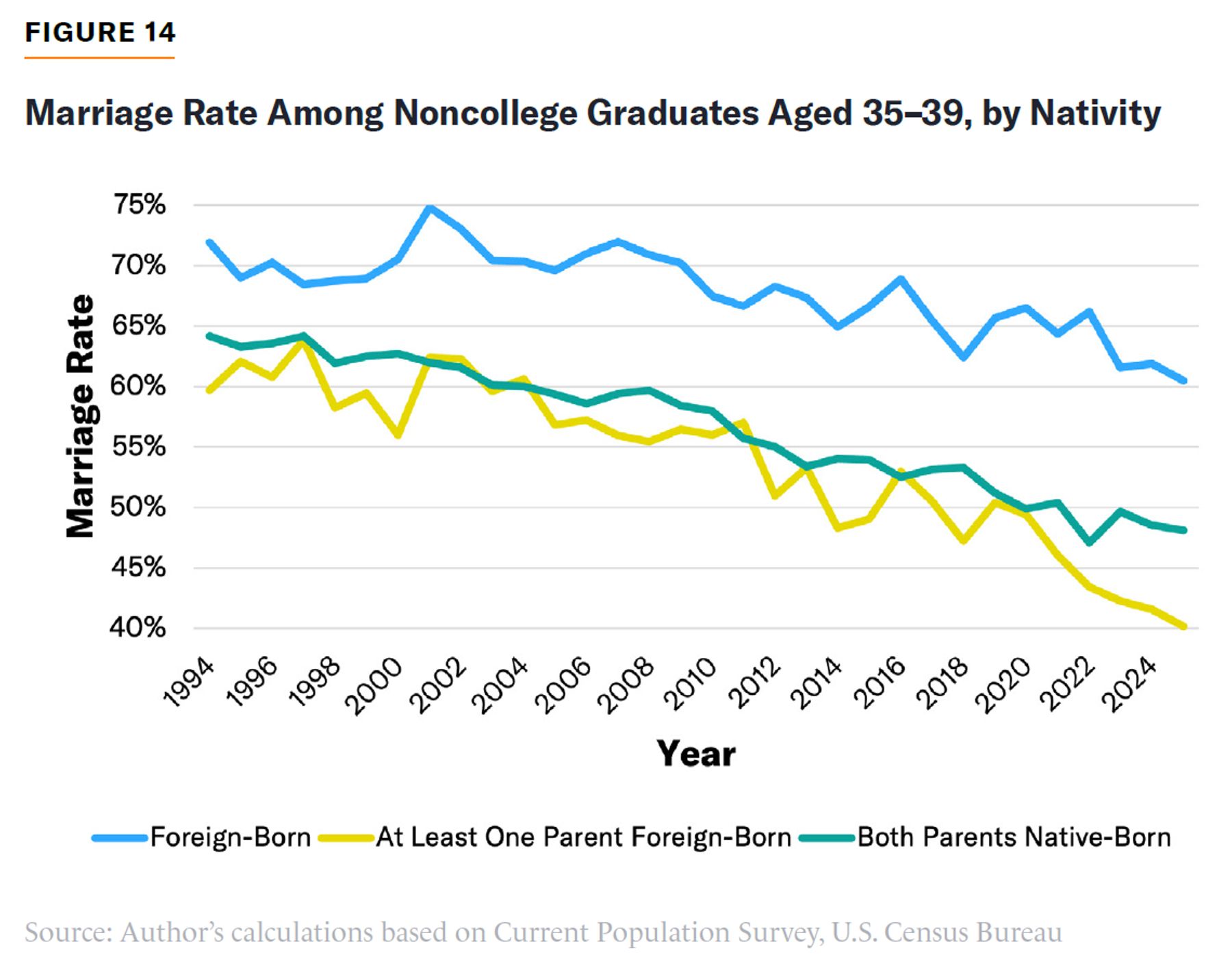
As many studies have found,[10] marriage is declining most steeply among less educated Americans—a trend that holds for both immigrant and native-born Americans as well as for children of immigrants. Not surprisingly, the immigrant–native marriage gap is far larger among those with less education. In 2025, 60% of immigrants aged 35–39 without a college degree were married, compared with less than 50% of noncollege natives born to native parents.
Among college graduates, the gap is half that size (77% among immigrants and 72% for multigenerational natives)—likely because marriage is less educationally polarized in the origin countries of immigrants than it is in the United States.
Yet, unfortunately, second-generation Americans—those with at least one immigrant parent—assimilate to the lower marriage-rate norm of native-born Americans with the same educational level. In fact, among college-graduate children of immigrants, marriage rates are actually lower than those of native multigenerational American college graduates without immigrant parents. This is true among all ethnic groups.
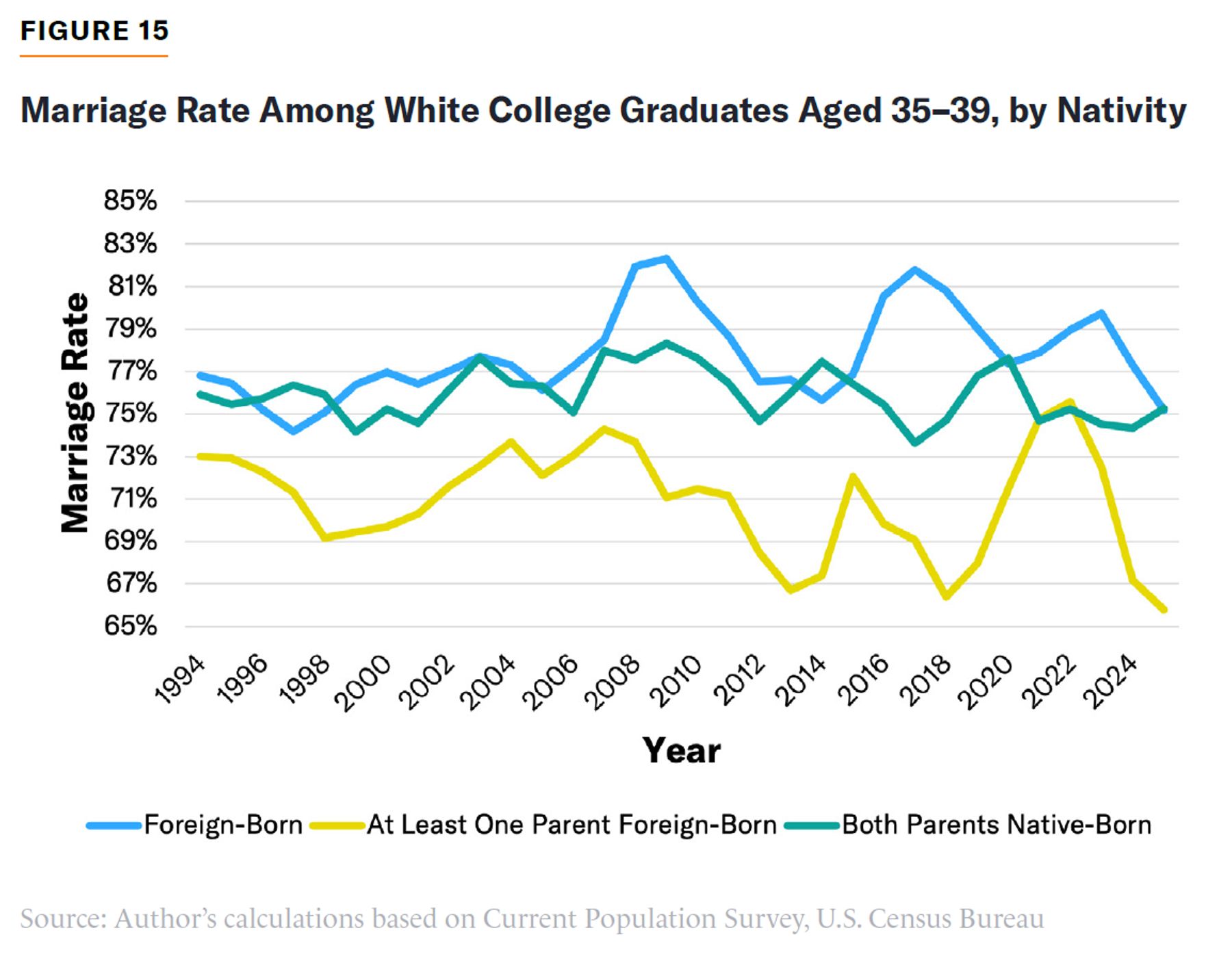
As shown in Figure 15, among white college graduates, immigrants and multigenerational white natives have similar marriage rates—although in some years, the rate of foreign-born whites is a few percentage points higher. The marriage rate of children of white immigrants varies but consistently undershoots that of their parents.
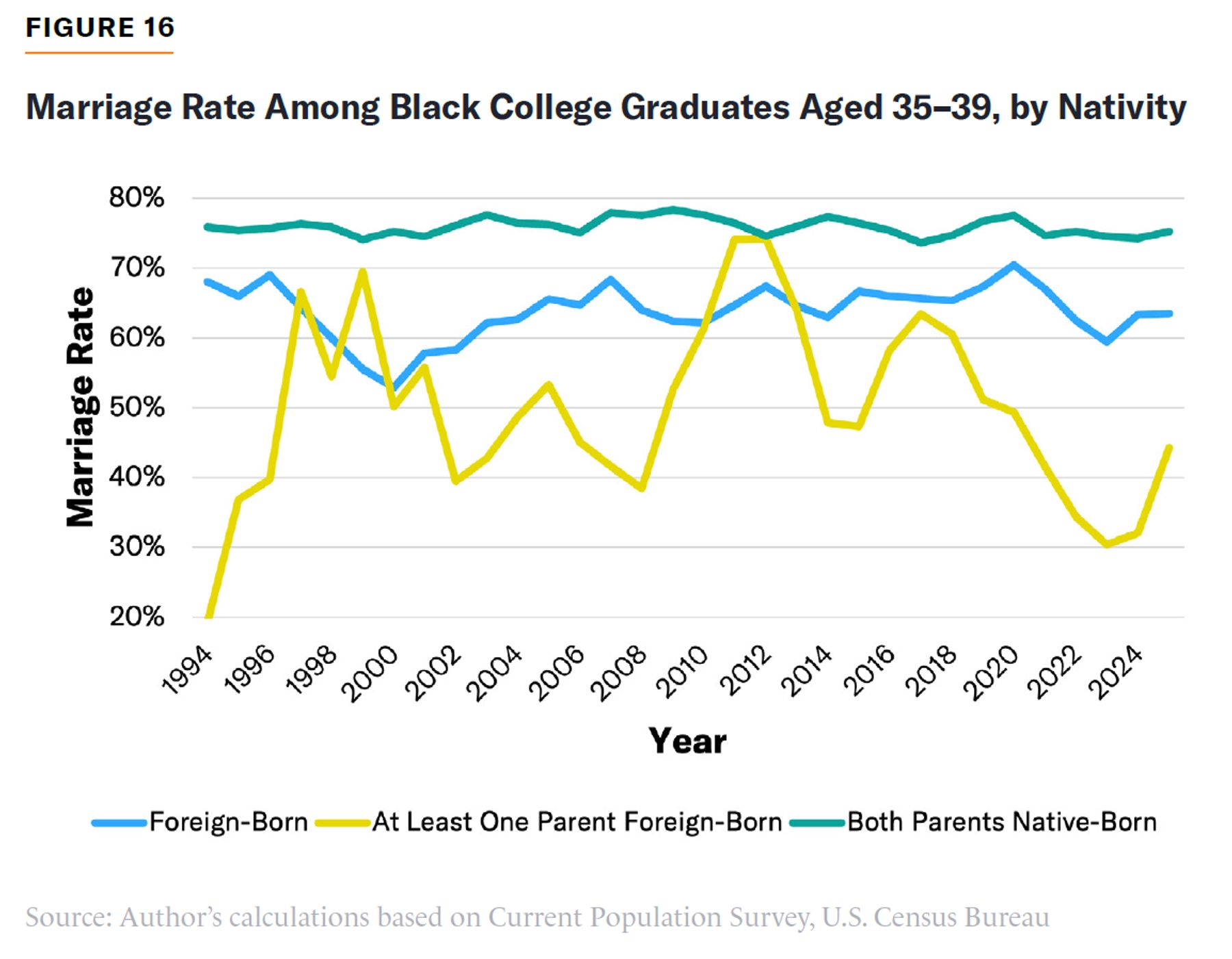
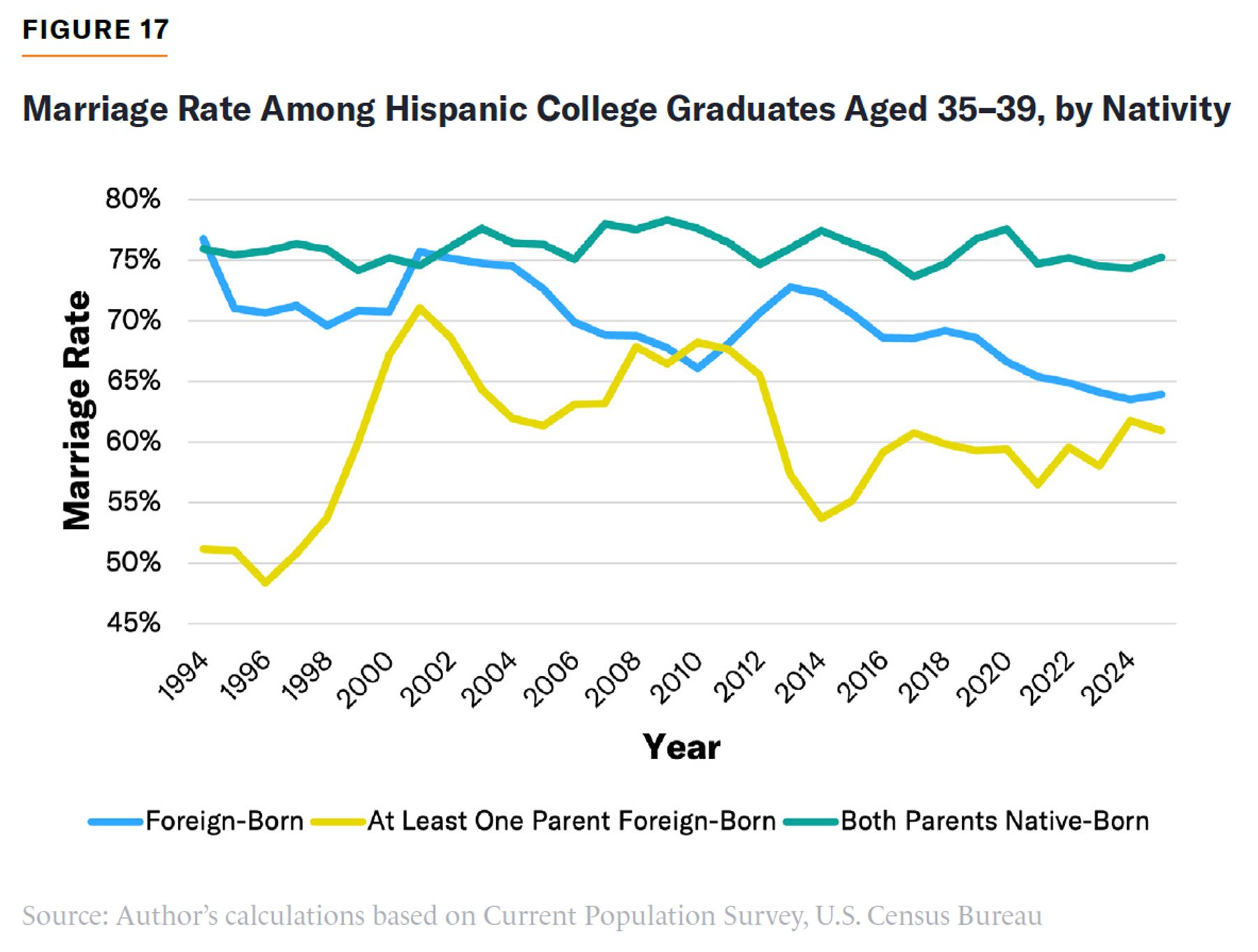
The picture among college-educated blacks and Hispanics is quite different, as shown in Figures 16 and 17. For multigenerational native blacks and Hispanics, the marriage rate is around 75%, similar to that of college-educated whites. The rate for college-educated black and Hispanic immigrants is consistently lower, around 65%. The rate for college-educated children of black immigrants is much more variable (due to sample size) but typically much lower than that of both immigrants and native-born black Americans without foreign background. College-educated children of Hispanic immigrants do marry more often than their black counterparts but still less than Hispanic immigrants and Hispanics without a foreign background.
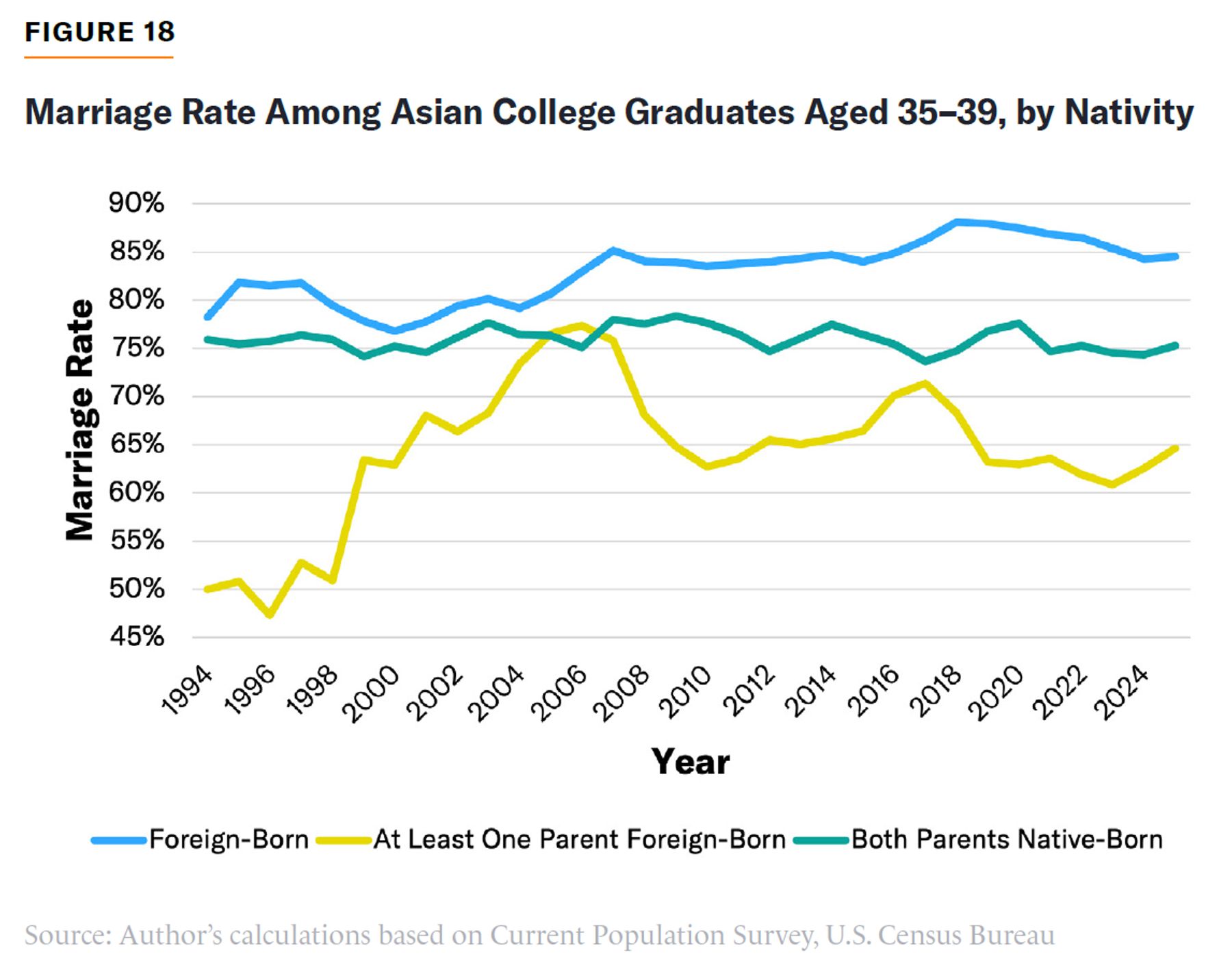
Among college-educated Asians, immigrants hold a 10-point marriage advantage over the native-born (Figure 18). But the Asian college-educated children of immigrants are about 20 points less likely to be married than their immigrant counterparts and 10 points less likely than native-born college-educated Asians without immigrant parents.
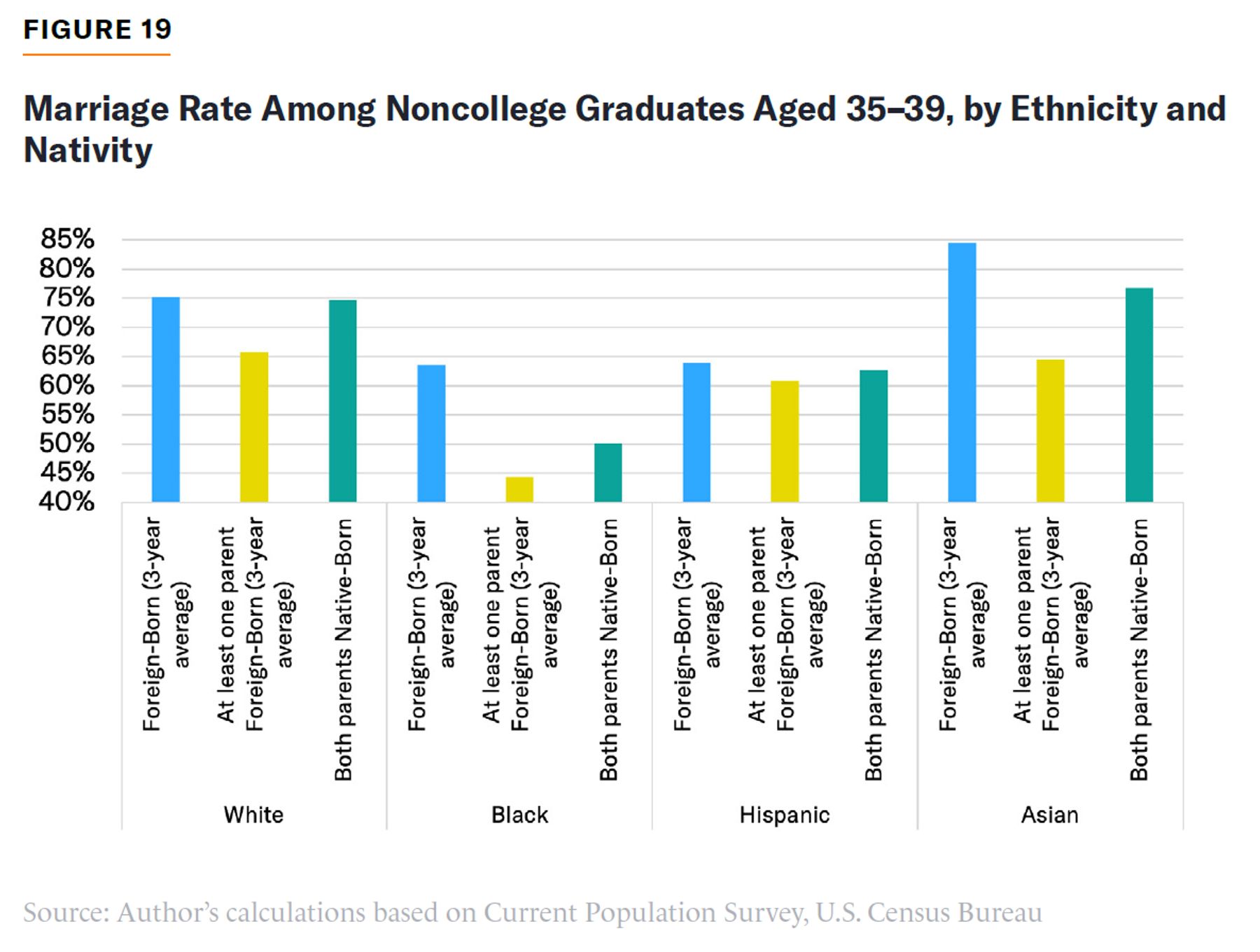
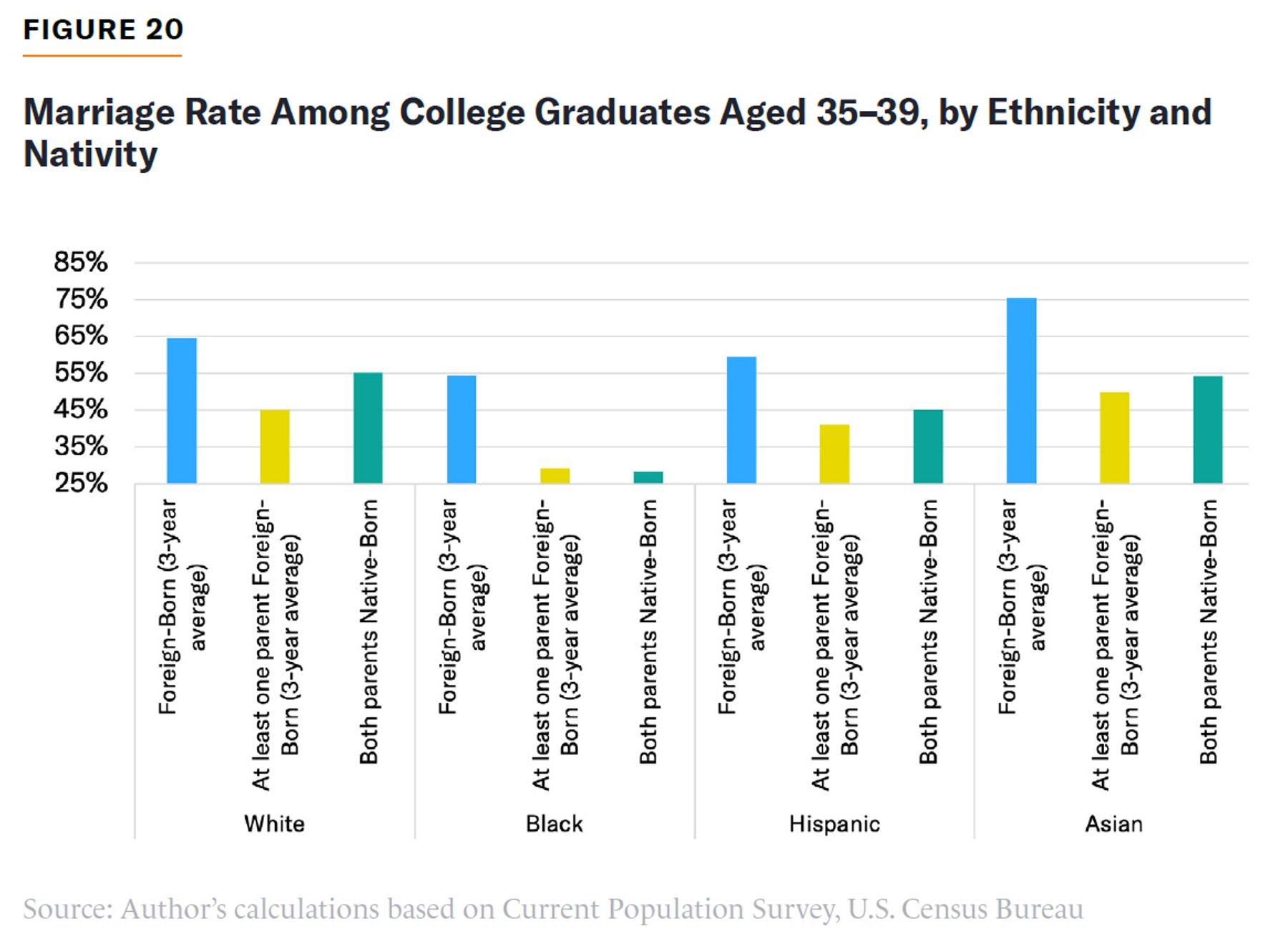
When we repeat the same analysis for those without a college degree, it becomes clear that children of immigrants either fully assimilate into their ethnic and educational group’s marriage norm or they underperform it, while immigrants tend to outperform their native counterparts. These findings are summarized in Figures 19 and 20, which depict only the 2025 marriage rate.
Isolating the Immigrant Effect on Marriage
To estimate the exact size of the immigration effect on being married, I regress nativity against marriage on the 1994–2025 Current Population Survey (CPS) sample of those aged 25 or older, controlling for various demographic characteristics.
The coefficients in Table 1 show the expected marriage gap in percentage points for immigrants and children of immigrants, relative to native-born Americans whose parents were both born in the United States. A positive coefficient means that the group is more likely than multigenerational natives to be married, while negative coefficients mean less likely to be married.
In this analysis, results for children with one foreign-born parent are reported separately from those with two foreign-born parents.
TABLE 1
Expected Marriage Gap Between Immigrants and Children Of Immigrants vs. Native-Born Americans
| Variable | (1) | (2) | (3) | (4) |
| Immigrant | 0.0666*** (0.0007) | 0.0682*** (0.0007) | 0.0852*** (0.0007) | 0.0908*** (0.0009) |
| One foreign-born parent | –0.0291*** (0.0014) | –0.0157*** (0.0014) | –0.0236*** (0.0014) | –0.0327*** (0.0013) |
| Both foreign-born parents | –0.0948*** (0.0013) | –0.0468*** (0.0013) | –0.0459*** (0.0013) | –0.0481*** (0.0013) |
| Fixed effects | ||||
| Year | X | X | X | X |
| Age | X | X | X | |
| Education | X | X | ||
| Ethnicity | X |
Column 1 shows that the expected immigrant–native marriage gap, for all those over the age of 25, is 6.67 points. But as we control for age, education, and ethnicity, we find that the expected immigrant marriage advantage rises to over 9 points in column 4. On the other hand, children of immigrants do seem to marry less often than their parents, and those with two immigrant parents are even less likely to marry than those with only one immigrant parent. The adjusted marriage gap between Americans with one immigrant parent and those with two native-born parents is 3.3 percentage points; for those with two immigrant parents, it is 4.8 percentage points.
To more easily visualize how immigrants and their children differ from multigenerational Americans of the same ethnic group, Table 2 presents a series of comparisons between native-born Americans of various ethnic groups compared with foreign-born immigrants from the countries associated with those ethnic groups. Native-born white Americans are compared with foreign-born European, Australian, New Zealander, and Canadian immigrants; native-born black Americans are compared with foreign-born African and Caribbean immigrants; native-born Hispanics are compared with foreign-born Latin Americans; and native-born Asians are compared with foreign-born Asians.
TABLE 2
Expected Marriage Rate of Native-Born and Foreign-Born Americans, by Ethnic Group
| Variable | White & European & Western | Black & African & Caribbean | Hispanic & Latin American | Asian & East & South Asian |
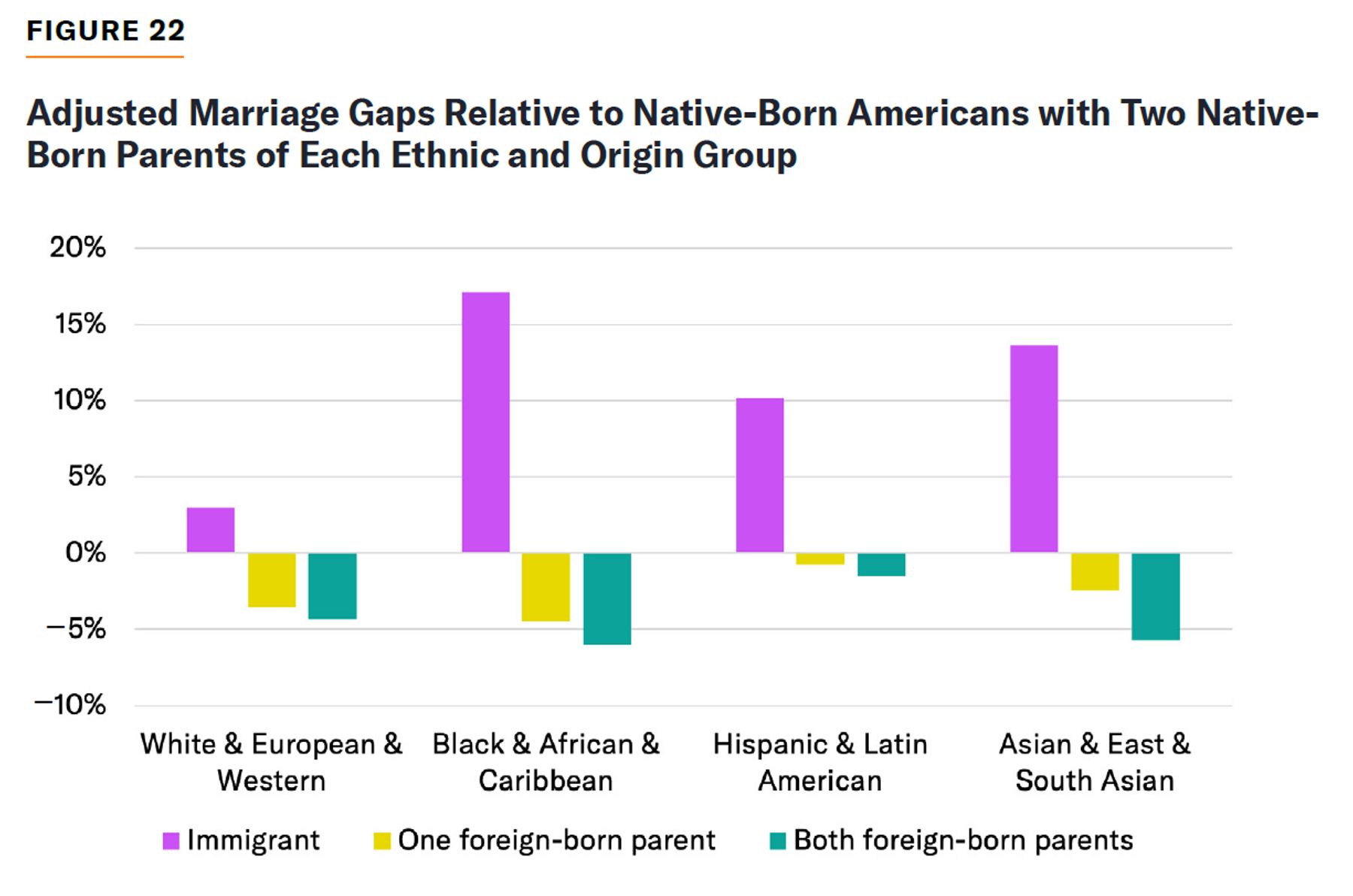
| Immigrant | 0.0299*** (0.0016) | 0.1712*** (0.0023) | 0.1023*** (0.0016) | 0.1365*** (0.0036) |
| One foreign-born parent | –0.0355*** (0.0016) | –0.0446*** (0.0076) | –0.0075** (0.0031) | –0.0243*** (0.0074) |
| Both foreign-born parents | –0.0433*** (0.0020) | –0.0602*** (0.0067) | –0.0153*** (0.0023) | –0.0574*** (0.0046) |
| Fixed effects | ||||
| Year | X | X | X | X |
| Age | X | X | X | X |
| Education | X | X | X | X |
Note: **p < .05; ***p < .01
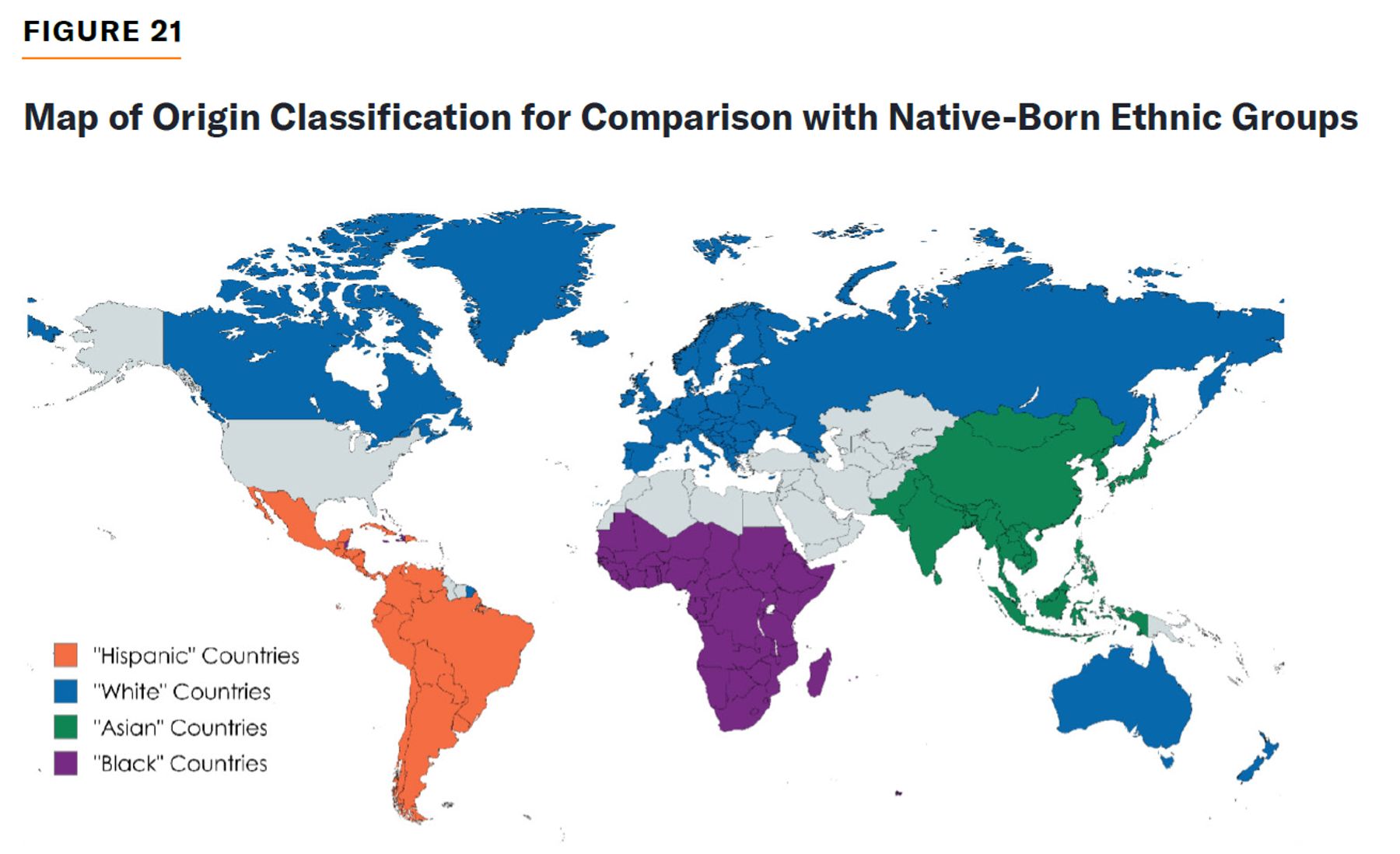
Figure 21 shows a map of the comparison countries for each ethnic group. For the native-born black comparison, the Caribbean countries selected were those from which a majority of immigrants identify as non-Hispanic black.
As shown in Figure 22, the adjusted immigrant–native marriage gap is large only among nonwhite immigrants. The gap is largest among black immigrants because native-born black Americans have a low marriage rate. A typical African or Caribbean immigrant is over 17 percentage points more likely to be married than a native-born multigenerational black American, even after adjusting for education and age. The gap between Latin American immigrants and native Hispanics is over 10 points, while the gap between Asian immigrants and multigenerational native Asian Americans is over 13 points.
The adjusted gaps between children of immigrants and multigenerational Americans of each origin and ethnic group are much smaller but are all negative. Between Hispanic children of immigrants and multigenerational Hispanics, the gap is about 1 percentage point; for other all other groups, gaps range from 2.4 points to 6 points. For all groups, those with two foreign-born parents are less likely to marry than those with only one foreign-born parent, who, in turn, are less likely to be married than those with two native-born parents.
The most striking example of this result is among African and Caribbean immigrants. Although these immigrants have the largest adjusted marriage advantage relative to natives, their children have the greatest negative marriage gap relative to their multigenerational native peers—in this case, black Americans without a foreign background.
Conclusion
The evidence clearly shows that the immigrant–native marriage gap is growing and that it cannot be explained by age, ethnicity, education, or by the mere fact that many immigrants arrive to the U.S. through marriage. Instead, it is driven by cultural differences. Immigrants simply tend to marry more often than native-born Americans.
Of course, immigrants do assimilate—and in this case, immigrants assimilate to the U.S.’s lower marriage-rate norm. Immigrants who spend more time in the U.S. and arrive at a younger age are less likely to marry, behaving more like the average native-born American.
Marriage assimilation occurs not only within each immigrant group over time but also across generations. Children of immigrants marry at much lower rates than their immigrant parents, and at rates similar to, or lower than, multigenerational Americans of the same age, education, or ethnic group. However, there seems to be a marriage penalty for children of immigrants. Unlike their immigrant parents—whose adjusted marriage rate is 9 percentage points higher than natives who have been in the U.S. for at least two generations—children of immigrants are less likely to marry than their native peers, especially if both their parents were immigrants.
Interestingly, it appears that immigrants do not assimilate to one national baseline “American” marriage norm but instead to distinct ethnic and educational subcultures—and they do so within one generation. Children of Hispanic immigrants marry at identical rates as their native-born Hispanic peers, while children of white, Asian, and black immigrants seem to marry at a rate 5 percentage points lower than that of peers. Notably, the large marriage advantage of black immigrants relative to black natives does not persist among their American-born children, suggesting that their children tend to assimilate to the low-marriage culture that characterizes native-born black Americans rather than maintaining their parents’ higher-marriage norms. Taken together, these patterns suggest that the immigrant marriage advantage is real, but it fades over time and within one generation, for reasons independent of educational achievement and ethnic background.
Endnotes
Are you interested in supporting the Manhattan Institute’s public-interest research and journalism? As a 501(c)(3) nonprofit, donations in support of MI and its scholars’ work are fully tax-deductible as provided by law (EIN #13-2912529).