The Power of Governors in Public Higher-Education Reform

Photo: Ryan Herron/iStock/Getty Images Plus
Introduction
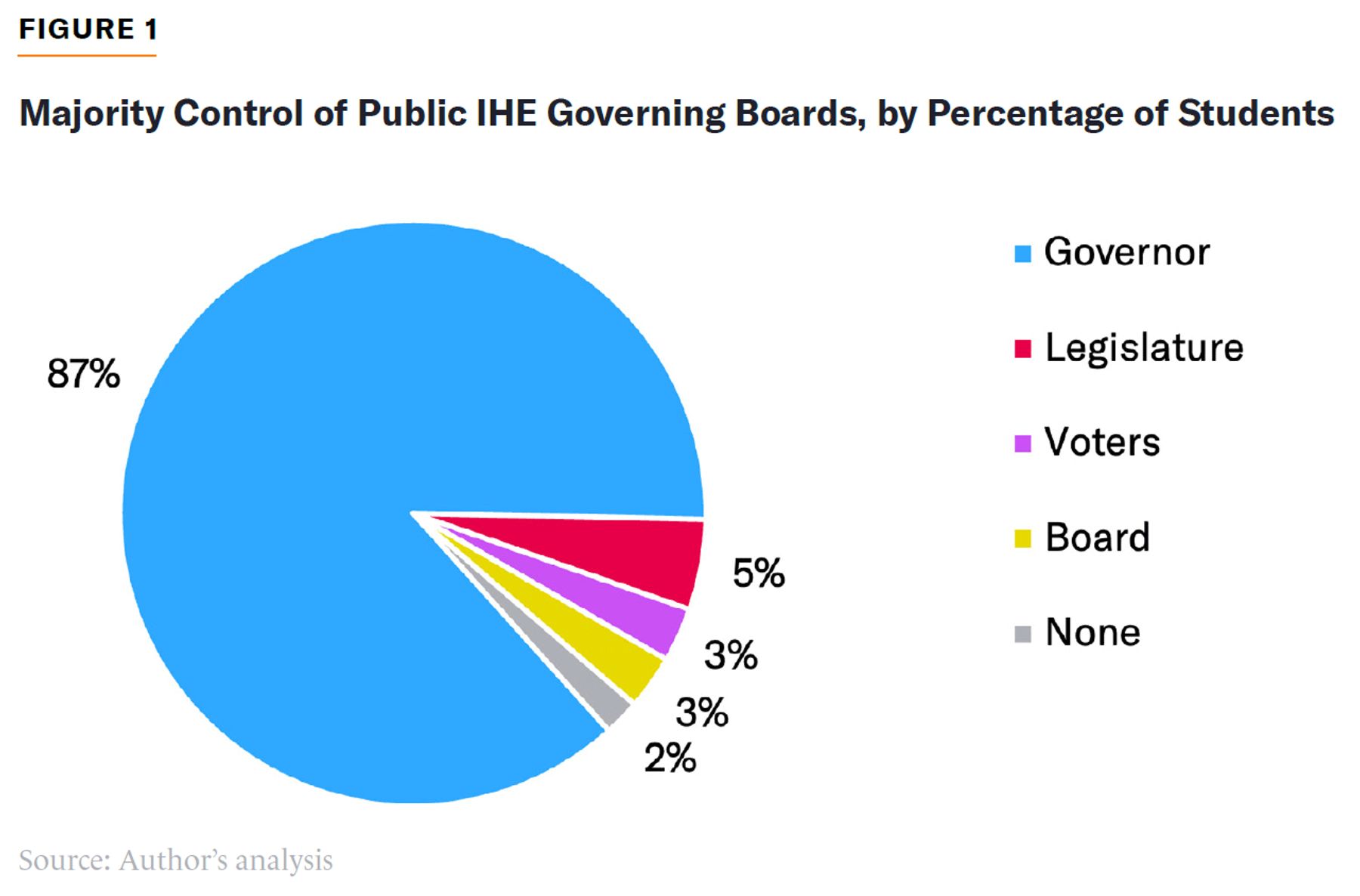
Most students in higher education attend public institutions, and those institutions are governed by public boards. This paper finds that 87% of undergraduates in four-year public colleges and universities attend schools whose boards are controlled by their state governors.
This fact differentiates American public higher education from American public K–12 education, where nearly all students are in schools governed by locally elected boards (instead of the governor or some other state authority). This also differentiates public higher-education institutions from private higher-education institutions, which have private boards insulated from external pressure. For reform-minded public policy professionals, therefore, state governors are the crucial entry point for improving higher education in the United States.
Since governing boards hire and fire college presidents and set the most important campus policies, U.S. governors could dramatically reform public higher education through their appointment power alone. Nearly two-thirds of the nation’s public-college students are in states won by Donald Trump in 2024, so winning governors’ races could transform higher education.
This paper maps out the primary governing entity for college boards in every state in the U.S. and offers suggestions for transforming public boards.
The Entry Point to Reforming Higher Education
Those who want to reform American higher education often feel frustrated, even powerless. Colleges and universities are enormous organizations that can appear impervious to outside forces. Professors lead the hiring process for their colleagues. Tenure protections provide job security.“Shared governance” traditions give the faculty broad decision-making authority. And the list of needed reforms only grows: we need to control higher-education costs, rebuild public confidence, improve the return on investment of many four-year programs, recommit to free speech and inquiry, strengthen the liberal arts and humanities, address student mental-health challenges, revive ideological diversity among faculty and staff, and much more. Given the mismatch between the scope of these problems and the perceived ability to bring about change, some would-be reformers have turned away from improving existing institutions and instead have decided to spend their time and energy creating new schools.
Though that fresh-start approach is promising, it can be resource-intensive, affect relatively few students, and have negligible influence on the broader system. Fortunately, there is a way to change the existing institutions that educate most students: through the governing boards of public colleges and universities.
Public institutions educate almost three-quarters of postsecondary students and about two-thirds of undergraduates pursuing four-year degrees.[1] A vast number of colleges and universities are four-year publics: flagships, land grants, regionals, liberal arts-focused, technology-focused, historically black colleges and universities (HBCUs), Hispanic-serving institutions (HSIs), and more. They contribute meaningfully to local and state economies and workforces, and they produce most public leaders.[2] All these institutions are governed by public boards that influence, and often control, a school’s most important features.
By working through the governing boards of public colleges and universities, reformers can affect most aspects of higher education and most students enrolled in higher education.
Governance in Practice
Just as a board oversees a multinational corporation, a major nonprofit, or a public housing authority, a board oversees each public institution of higher education (IHE). These boards select and hold accountable the college’s president, approve the institution’s budget, and set the school’s most important policies. Boards typically have the final say on how much students pay in tuition, which programs are offered, which degrees are awarded, which buildings are constructed, and which rules govern student conduct and tenure decisions. Though university policies, accreditation standards, and traditions prevent boards from dictating a school’s day-to-day operations, these boards establish the conditions and often the specific policies associated with operations, and they hire and fire the institution’s top executive.[3]
How are these boards populated? How would reform-minded individuals acquire a seat on these boards?
If a board is meant to be an independent body overseeing operations and instituting policies from the outside, its members should not come from the university community and certainly should not be beholden to the university’s operational leadership. Moreover, if the board is meant to advance the public good (i.e., promote the interests of the state and its citizens), the selection process should be attuned to state leaders and public sentiment, not only the interests of the school’s employees.
The good news is that this is exactly what we have.
Methodology
This paper investigates how members are selected for the governing boards of public institutions of higher education. I identified every public four-year institution in the U.S. and its governing board.
States organize their higher-education systems very differently. In some states, each public college or university has its own governing board. In some states, a board oversees a single university, though that university has several major and largely independent campuses. In some states, a single board oversees several IHEs—sometimes all of that state’s public IHEs, and sometimes some of that state’s public IHEs. My approach was to identify every board that oversees at least one public, four-year institution. This excludes boards that oversee only community colleges and other two-year institutions.[4]
In some states, when a governing board oversees more than one institution, each individual school might have its own subsidiary board. In these instances, that local board is typically advisory, while the central governing board possesses ultimate authority. Many states also have a higher-education “coordinating” board that works with all the state’s colleges and universities (including privates). Generally, these boards do not have governing responsibilities.[5] This paper considers only authoritative governing boards.[6]
Though governing boards generally have the same functions, they have different ambits. For example, several “system” boards (overseeing, in some cases, dozens of schools) represent well over 100,000 students, while other boards oversee a single small campus with a few thousand students. My results discuss the total number of students under each type of board.
The term “student”: many universities have thousands of graduate students while some have very few. IHEs can have students who are taking classes but not pursuing a degree. Some two-year schools (such as community colleges) now offer some four-year bachelor’s degrees. This analysis focuses on four-year public institutions, and my results reflect each institution’s 2024 total undergraduate enrollment.
Board memberships vary significantly in size. Some comprise fewer than 10 members, while others have more than 30. Moreover, boards are often populated via two or more methods. For instance, a board could have several members selected by the governor, several selected by the state’s legislative leaders, one member selected by the faculty, one selected by the alumni association, several selected by current board members, and several who serve ex officio.[7] Because this paper seeks to understand who controls the governing boards of public IHEs, I report, for each board, whether any method controls a majority of seats on that board.
I relied on the language of state statutes and regulations, board bylaws, and similar official documents. States change these rules from time to time; this analysis reflects policies as of 2024–25.
In total, I identified 240 public boards that met the above-stated criteria.[8] Combined, they oversee more than 1,000 schools and campuses. The combined undergraduate enrollment of these institutions was 6.06 million students.
Findings: State Governors Matter
The primary finding of this study is that governors control the boards of most public institutions of higher education: 87% of undergraduates in four-year public institutions attend schools governed by boards of which at least a majority of their members are appointed by the state’s governor (Figure 1).[9] In most of these instances, the governor appoints all, or nearly all, the members of these boards, not just a bare majority.
The next most common method is for the state legislature to appoint a majority of an IHE’s board members. But only 5% of U.S. public undergraduates attend such schools.
In some states, board members of public IHEs are elected by state voters; 3% of students attend these schools.
In a few instances, a public IHE has a primarily self-perpetuating board, meaning that current board members select new members when a seat opens; only 3% of students attend these schools.
About 2% of students attend schools where board members are selected in a variety of ways, such that no method controls a majority of seats.
State-Level Results
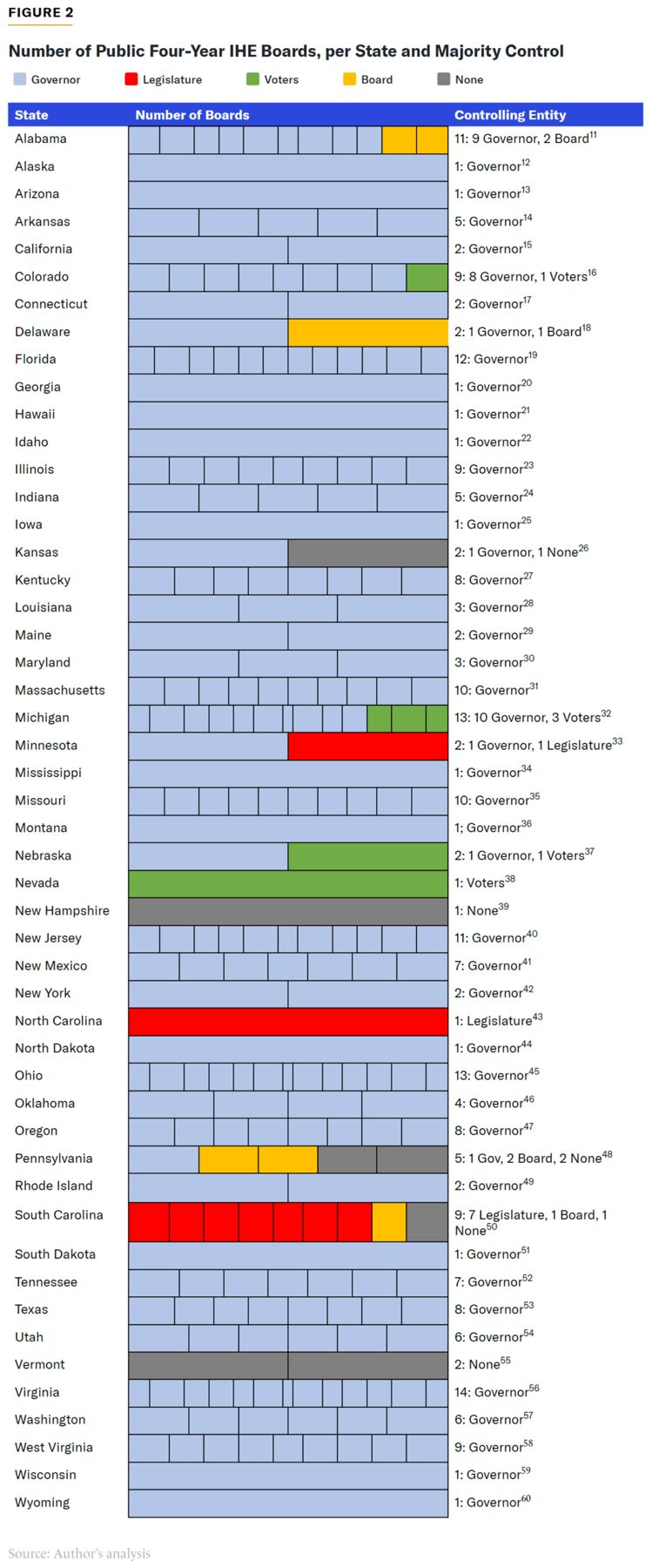
Most states have a single approach for selecting IHE board members; as a general rule, a state will employ the same method across all its public universities. In 39 states, all public IHEs have the same entity controlling their boards; and in 37 of those states, it is the governor (Figure 2). In Nevada, state voters control the boards of all public four-year institutions. In North Carolina, all publics are governed by a board controlled by the state legislature. In New Hampshire and Vermont, all publics have boards with no single entity controlling a majority of seats.
In most other states, the governor still controls some of the state’s public IHE boards. In Colorado, Michigan, and Nebraska, voters elect members of several important boards (i.e., University of Colorado; University of Michigan, Michigan State, and Wayne State; University of Nebraska). But in those same states, other institutions (e.g., Colorado State, Western and Central Michigan, and the three schools in the Nebraska state system) are controlled by the governor.
Similarly, in four states (Alabama, Delaware, Pennsylvania, and South Carolina), at least one public IHE has a majority of board members chosen by members of the board itself. But in three of those states, at least one other public institution is controlled by the governor; i.e., in 45 states, the governor controls at least one public IHE.[10]
Implications and Conclusion
In recent years, as frustration has mounted against institutions of higher education, would-be reformers have invested significant resources of time, energy, and money in high-profile public-relations campaigns against campuses with the most troubling track records. Typically, these are small, elite, private universities.
Although such efforts have strengthened the case for higher-education reform and, in some cases, led to meaningful campus changes, this paper suggests a higher return-on-investment strategy. Rather than focusing on small private campuses with insulated boards and administrations, reformers should focus on public IHEs whose boards (and therefore campuses) can be changed through the gubernatorial appointment power.
This would amount to a two-step process. First, help elect reform-minded governors. Nearly two-thirds of the nation’s public-college students are in states won by Trump in 2024. Governors have majority control of 112 of 134 public IHE boards in those states; by simply winning those offices, Republican governors could have majority control of the boards of schools representing 53% of undergraduates in public IHEs. If we include the boards in these conservative-leaning states that are controlled by voters and legislatures, it grows to 60% of undergraduates in public IHEs.
The second step: help these governors appoint reform-minded individuals to these boards—easier said than done. The governor must set aside the long tradition of selecting business leaders, donors, and heads of cultural institutions. The governor must decide on a reform agenda and clearly articulate its provisions. Then the administration must identify individuals who are aligned with that agenda, willing to serve, and qualified to sit on this type of board. Those individuals must make their way through the confirmation process and then learn how these boards operate.
If this process were to succeed, a majority of public-IHE undergraduates could be attending schools that support free speech and inquiry, that have greater ideological diversity among faculty and staff, and that are committed to holding down costs and ensuring every degree’s return on investment.
Endnotes
Are you interested in supporting the Manhattan Institute’s public-interest research and journalism? As a 501(c)(3) nonprofit, donations in support of MI and its scholars’ work are fully tax-deductible as provided by law (EIN #13-2912529).