The High Cost of Stormwater Regulations

Photo: Nearmap / DigitalVision via Getty Images
Executive Summary
Real estate in the United States is regulated mainly by local governments, which can control everything from the size of new buildings to their design. As the costs of construction—particularly, housing—have increased in recent years, politicians in Washington, DC, have looked for ways to loosen these local regulations. But the federal government has limited tools to control the thousands of local governments across the nation.
Yet one federal program has a direct and significant influence on all types of real estate in the United States: the Clean Water Act’s regulations to control stormwater affect any construction project of over one acre, limit the size of new buildings, require significant water control measures for completed projects, and shape the layout of cities. Yet the federal stormwater control program remains absent in discussions about how to reduce housing costs.
This report shows that the federal stormwater program has widespread effects on the built environment, extensive costs, and limited benefits. When the Department of Housing and Urban Development (HUD) examined how environmental regulations added to building costs, the large majority of such costs were stormwater-related.[1] Although researchers on development usually focus on permits such as those required by the National Environmental Policy Act, stormwater permitting is far more common. As the National Association of Home Builders states: “Stormwater CGPs [Construction General Permits] are the most common environmental permit residential developers and builders must obtain.”[2]
This report includes the following findings:
- Stormwater mandates, depending on the region and types of remediation required, can add anywhere from a few thousand dollars to tens of thousands a year to the cost of new housing, as well as substantial costs to other types of development.
- Stormwater mandates create significant costs for local governments, involving everything from higher installation costs for roads and sidewalks to mandated stormwater “education” campaigns, which can add up to billions of dollars in costs for some cities.
- The Environmental Protection Agency (EPA) and state environmental protection agencies use stormwater regulations to limit new housing and new development, including by mandating larger minimum lot sizes, requiring costly remediation for any new development, and limiting paved surfaces.
- Urban stormwater runoff is a relatively minor part of water pollution—the cause of only about 10% of river and stream pollution, while agriculture is responsible for almost half. Stormwater permits bring very minor gains, relative to their cost. Far more cost-effective means exist to control runoff than current regulations, including controls in agricultural areas, which can cost as little as 1/100th of those in urban areas for equivalent reductions in pollution.
- Stormwater pollution regulation should be removed from the control of the federal government, including through ending CGP for large construction projects, which has no statutory basis. Allowing developers to substitute fees and off-site stormwater control projects for direct stormwater control on-site can also help reduce costs.
Stormwater runoff does create environmental problems. It can pull pollutants off streets and lawns and into rivers and lakes. Sediment can be carried into streams and change waterways. But stormwater is a small source of the water pollution problem in the United States. By current reckoning, the federal stormwater control program is not bringing environmental benefits commensurate with its high and increasing costs. This report argues that costs on developers and cities can be pared back or reformed with few, if any, effects on the environment.
Historical Background
When what became known as the Clean Water Act (CWA) passed in 1972, the law focused on controlling large polluters, especially factories and urban sewage plants. Under the law, industrial and municipal polluters were required to obtain National Pollutant Discharge Elimination System (NPDES) permits from a state government that was overseen by the Environmental Protection Agency or by EPA itself. NPDES permits mandated that industrial facilities and sewage plants institute control technologies to limit pollution discharges into rivers and lakes.
After years of regulations on pollution from these “point sources,” as they are known, the remaining water pollution problems were much more likely to come from diffuse “nonpoint” sources that did not require permits, such as runoff from farms. According to EPA,“nonpoint source pollution is the leading remaining cause of water-quality problems.”[3]
Stormwater runoff would seem to be a model case of nonpoint pollution, in that it happens everywhere and is difficult to control. Depending on the area, stormwater runoff can emerge from hundreds or thousands of discrete storm sewer discharge points, and much flows directly over the land into rivers and lakes.[4] But in 1983, EPA released the Nationwide Urban Runoff Program report, which claimed that urban stormwater runoff showed higher or comparable levels of pollutants to water coming from permitted municipal wastewater plants, and therefore posed a similar threat to the environment that required controls similar to point sources.[5]
In 1987, Congress mandated a new urban stormwater permit system as part of CWA and set a timeline for municipalities to comply. Under this law, cities were required to reduce pollutants in stormwater to the “maximum extent practicable.”[6] In contrast to other point sources of pollution, EPA conditions for these permits would involve little about the technology controlling what came out of discharge pipes and would instead focus on how cities could reshape their landscape to limit discharges. These conditions would include everything from erecting silt fences during construction projects to building permanent water detention ponds for new developments to limiting impervious surfaces in a region.
The main goal of urban stormwater regulations is to limit peak stormwater runoff from urbanized areas, which typically have less water infiltration into the ground and thus more runoff than rural or undeveloped areas. In a purely rural setting, about 50% of rain infiltrates the ground, 40% evaporates, and only 10% runs off the land. In a highly urbanized setting, about 30% evaporates, only 15% infiltrates, and about 55% runs off the land.[7] The first inches of urban runoff are warmer and usually carry more pollutants than natural runoff—most especially, phosphorus and nitrogen, which come from fertilizer or pet waste and can lead to algae blooms. Stormwater also contains general organic matter (leaves and woody debris), sediment (i.e., dirt), and, more rarely, bacterial pathogens, oil, and heavy metals such as copper. Control of this runoff can be temporary, in that the first inch or more of stormwater is “detained” and will slowly return to the stormwater pipes or waterways after sediments and pollutants have settled; or control can be permanent and water is “retained”—in which case, the water, as well as all the pollutants, is supposed to infiltrate the ground or evaporate or otherwise be prevented from entering storm pipes. The main goal of limiting runoff and thus pollutants is to improve water recreation, especially swimming and fishing, but also to improve general aquatic habitats.
In accordance with the 1987 CWA amendments, EPA in 1990 issued Phase I permit regulations for Municipal Separate Storm Sewer Systems (MS4) that served a population greater than 100,000. At the same time, without official congressional authorization but by declaring construction a type of “industrial” activity, EPA began requiring a permit for any construction activity disturbing over five acres of land, known as a Construction General Permit (CGP). In 1994, EPA issued regulations on Combined Sewer Systems, where stormwater pipes mingled with sewage pipes and where the effects of stormwater and typical sewage treatment are difficult to disentangle.[8] In 1999, EPA created its Phase II stormwater rules for MS4s for smaller cities and began requiring CGPs for projects affecting one to five acres. From that point, EPA would use both new formal regulations, issued nationally, and increased conditions in specific permits to tighten mandates on stormwater systems.
During the Obama administration, regulation of stormwater runoff increased significantly. In 2009, EPA created a more extensive national rule to regulate construction sites as their own point source of pollution as part of CGP, with “effluent limitations guidelines” (including requirements for analysis of runoff “turbidity” or cloudiness) and specific control standards for sites of over 10 acres that more closely approximated traditional point source regulations. This regulation established a new and higher national floor under existing permit conditions.[9] In the same year, at the request of EPA, the National Research Council published an extensive report on the agency’s stormwater control system. This report called for regulators to focus on the total flow of stormwater instead of the pollutants because, it argued, almost any stormwater flowing from urbanized land into sewers was polluting. The council claimed that “stormwater discharges would ideally be regulated through direct controls on land use” and limits on overall runoff.[10]
As a result of the council report and a 2010 legal settlement with environmental groups, which required EPA to revise rules “to expand the universe of regulated stormwater discharges and to control, at a minimum, stormwater discharges from newly developed and redeveloped sites,” EPA began to demand more extensive regulations from MS4s in their permits. Although EPA missed the legal deadlines from the settlement to impose new direct rules, in 2014 it stated that it would leverage existing municipal stormwater permits to mandate more control of land use and that it would require more clearly numeric, instead of “narrative,” approaches to goals—i.e., it would prescribe precise levels of reduction in pollutants like nitrogen or phosphorus or total runoff. These changes were implemented in EPA’s MS4 permit for Washington, DC, in 2013 and its 2014 MS4 permit for Massachusetts, which became models for other cities.[11] In 2016, EPA issued an expanded general regulation for MS4s. Responding to the mandates from litigation, these rules required “clear, specific, and measurable” terms for stormwater control permits and stated that “permit requirements must be enforceable,” i.e., there would be legal consequences for cities and new developments that did not sufficiently limit stormwater runoff. EPA emphasized that since the statutory requirement was to reduce stormwater pollutants to the “maximum extent practicable,” new MS4 permits would have to ensure that this standard was met.[12]
Current Urban Stormwater Permits
According to one EPA estimate, areas regulated under MS4 permits contained over 80% of the American population.[13] About another 10% of the population is regulated under Combined Sewer Systems, which tend to be located in older cities, especially in the Northeast and the Midwest (Figure 1).
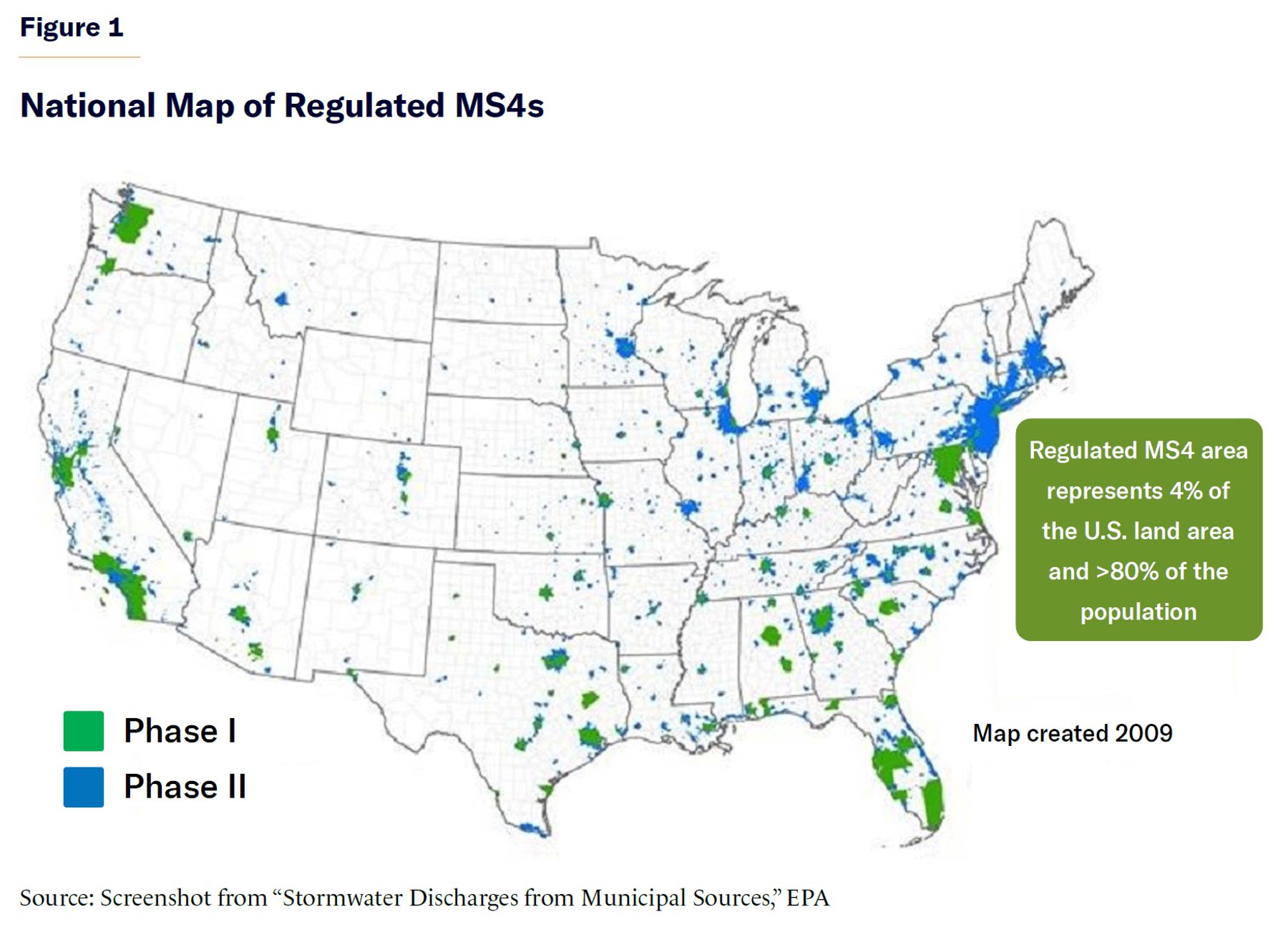
The federal EPA or, more often, delegated state environmental protection agencies overseen by EPA issue two types of municipal stormwater permits: individual and general. Individual permits are typically necessary for large, so-called Phase I MS4s and contain individualized requirements about how to limit stormwater runoff and pollution. There are about 750 individual, Phase I permits. General permits are typically issued statewide for smaller, so-called Phase II MS4s and include rules to which all such MS4s must adhere. About 6,500 systems are operating under general Phase II permits. Both types of permits are supposed to be renewed every five years, after which conditions typically ratchet upward.[14]
As part of individual and general MS4 permits, EPA requires cities to pursue Best Management Practices (BMPs), which involve reducing stormwater runoff and pollutants through municipal regulation. EPA released guidance on the six “minimum control measures” for BMPs that cities must undertake to limit stormwater discharges.[15] The first four measures are focused on what the city can do with its own resources and are process-oriented: public education and outreach on stormwater impacts; public involvement in stormwater design; educating municipal employees about stormwater; and finding and reducing illicit stormwater discharges. But the two most important BMPs in permits are directed at how cities can control developers and involve construction site runoff control and “post-construction runoff control,” i.e., regulations determining the final shape of buildings and landscapes.
EPA’s guidance states that cities should mandate erosion control plans for any construction or disturbance of land of over 5,000 square feet, or about a tenth of an acre, which is a requirement over and above the mandates for erosion control in CGPs for projects of one or more acres. This urban construction control program requires cities to have a stormwater certification program for construction contractors and mandates silt fences and other runoff controls.[16]
The mandates for long-term development, or post-construction runoff control, are more far-reaching and require extensive changes to local ordinances around development. According to EPA, post-construction BMPs require “a combination of structural and/or non-structural” practices and mandate that cities “use an ordinance or other regulatory mechanism to address post-construction runoff from new development and redevelopment” and “[e]nsure adequate long-term operation and maintenance of BMPs” installed in new developments, e.g., long-term funding and maintenance for stormwater controls such as detention ponds.[17]
The extent of EPA stormwater mandates for new development is underappreciated. EPA guidance requires 95% of all building permits to include stormwater control practices and site designs, including targets for reducing total suspended solids (sediment), improving groundwater recharge rates, and limiting runoff volume. For some development, the guidance demands swales (elongated divots in grass, typically seen alongside sidewalks and roadways) or other extended water conveyances that allow rainwater to infiltrate the ground as it is carried into ponds or pipes; or it mandates measures such as retention (temporary) and detention (permanent) ponds to allow settling or infiltration in the ground of stormwater pollutants. The guidance suggests that cities conduct four inspections for each control measure per year and ensure regular maintenance.[18]
Precise requirements of these MS4 permits vary by state, but EPA has the final say about approving the permits or the terms. EPA issues MS4 permits in three states (Massachusetts, New Hampshire, and New Mexico), the District of Columbia, and all U.S. territories except for the Virgin Islands. But the law allows individual states to set their own stormwater standards and provide their own permitting system as long as they are approved by EPA, which evaluates how stringent the state conditions are relative to its own permits.
A National Association of Home Builders (NAHB) survey from 2017 found that 18 states, mainly in the middle of the country, implemented a narrative or flexible approach to post-construction BMPs: they offered general standards without specific quantities of pollutant or stormwater runoff reductions. Eleven states required precise treatment measures for stormwater: mandates to treat a specified volume of runoff through settling or reduction in specific pollutants. Another eight states and D.C. required specific installations for retention of waters, which allows the water to settle or infiltrate without going into stormwater pipes; 13 required both retention and specific types of treatment. The survey noted that more states were switching from a narrative to a specific treatment or retention approach, which was doubtless accelerated after the 2016 EPA regulatory change requiring specific and measurable goals.[19]
According to NAHB’s survey, the majority of states’ general permits for small MS4s required Green Infrastructure (GI) or Low Impact Development (LID) as part of post-construction mandates, including elements such as porous paving (paving with green patches reaching directly to the ground) and increased green space. New Hampshire’s and Massachusetts’s permits, issued directly by EPA, stated: “LID site planning and design strategies must be used to the maximum extent feasible” for new development.[20] Connecticut requires local ordinances to include LID and runoff reduction totals in local land-use permitting. Maryland requires the use of its Stormwater Design Manual, which mandates a particular style of environmental site design and stormwater reduction to the maximum extent feasible for all new and redevelopment projects.[21]
Exact targets for post-construction stormwater management have changed over the years. EPA’s current goal is to “maintain predevelopment runoff conditions.” Thus according to EPA, most development in the U.S. should have little to no impact on stormwater runoff, in terms of the timing (it should be released into storm pipes slowly, more like natural runoff) and in the total amount (more water should infiltrate the ground or evaporate).[22]
Yet EPA and some states have sometimes imposed mandates that development must reduce the peak runoff (at the height of a rainstorm) to below the predevelopment level.[23] Cities or states commonly mandate a certain amount of rainwater or pollutant capture, no matter how—or even if—the development changed stormwater runoff patterns. E.g., a common benchmark is that 80% of total suspended solids should be removed from stormwater, no matter the preexisting runoff conditions. This can be done through long swales to slow runoff or increased settling in detention or retention ponds or other control measures.
The New Mexico stormwater program, created directly by EPA, requires new development to capture on-site water from a 90th percentile storm event and redevelopment to capture the water from an 80th percentile storm event, with no explicit reference to predevelopment conditions.[24] Los Angeles requires both new and redevelopment projects to retain on-site a 0.75-inch 24-hour rainstorm. The San Francisco Bay Area requires not only temporary retention of the water but its treatment on-site, often meaning infiltration of water into the ground, with the goal of releasing no water into the storm system. The Bay Area also requires biotreatment (planted wetlands) to hold up to five inches of new rain every hour and infiltrate it into the ground at the same rate.[25] With increased EPA oversight, these post-construction stormwater targets have continued to ratchet upward.
Current Construction General Permits
Outside MS4s, new construction projects are required to comply only with CGP, a document of over 100 pages, with 11 appendices, accompanied by a 164-page “fact sheet” that explains the permit.[26] Although CGP is technically required only in the states and territories that EPA directly supervises, states with delegated CWA authority base their own permits on CGP.[27]
CGP requirements are extensive. As part of completing the Notice of Intent to perform construction for the CGP permit, developers must prepare another document: the Stormwater Pollution Prevention Plan (SWPPP). The government has prepared a 69-page SWPPP template to be filled out; one company that works on these templates notes that, when completed, they can be over 200 pages.[28] SWPPP requires owners, contractors, or both to identify the receiving waters of any runoff; document any potential endangered species, critical habitat, or historic sites; map the terrain; explain BMPs taken; and write up a spill prevention and response plan. EPA requires a copy of SWPPP to be available at the construction site.[29]
Beyond the documentation, CGP requires substantial changes in how construction is carried out. It requires builders to install silt fences across the site and remove sediment when it reaches one-third the height of the fence, construct water diversion ditches or berms, and phase construction activity to minimize exposed dirt. There are extensive requirements for “dewatering” (removing any excess water from a site). Any water, including “wheel wash water” or water from vehicle washing, must be controlled with a sediment basin or an alternative water control mechanism. Stabilized construction exits, typically made from large, crushed rock, should be instituted to limit sediment from vehicle wheels leaving the site.[30] Other “non-structural” BMPs, or process-oriented ones, require that owners or contractors train their employees on sediment issues.
More important, CGP requires weekly or biweekly inspections and an additional inspection after rainfalls to see whether any sediment is running off the site. These inspections must be done by stormwater control inspectors, typically certified by the state, and should include detailed inspection reports including weather information and locations of on-site BMPs. Inspections should continue until an area is “stabilized,” or, typically, achieves 70% permanent vegetative cover.[31]
Mandates for CGP have increased. The 2022 EPA CGP added mandates for developers to look for evidence of stormwater moving around perimeter fences and to extend those fences, required sampling for turbidity (cloudiness) as part of dewatering discharges, and required measuring those samples against EPA standards, correcting them if the turbid outflow goes to certain sensitive waters. It required inspectors to complete a new EPA construction inspection course and pass the accompanying exam or its equivalent. The new CGP also lengthened the Notice of Intent application form.[32]
Costs of Stormwater Mandates to Development
Despite their ubiquity, surprisingly few studies or estimates about the costs of stormwater regulations exist. When EPA issued Phase I MS4 rules in 1990, it focused on the costs of filling out the permits, stating that they would be minimal. A later GAO report, however, estimated that individual cities could spend over $1 million just on the permit application paperwork.[33] The costs of the actual stormwater control measures on cities and developers were not estimated, but this rule affected large cities such as Los Angeles, which has since spent billions of dollars complying with MS4 mandates.[34]
For the Phase II MS4 rules, EPA estimated the impact at about $1 billion a year ($1.9 billion in 2025 dollars).[35] But according to the Congressional Research Service, many soon “criticized the scope of the stormwater program, saying that EPA had greatly underestimated the cost of the Phase II rules.”[36] EPA did not use any cost-benefit analysis in subsequent years to justify the effects of the gradual tightening of MS4 permit conditions on cities.
When EPA created the 2009 CGP rule, increasing the baseline mandates for future individual CGP permits, it estimated that the annual costs would rise to just under $1 billion a year ($1.4 billion in 2025 dollars).[37] That was over and above the costs imposed in previous CGP rulemakings, where total costs were not estimated. As with MS4s, EPA’s tendency to increase costs in permits but not in general rules (where national cost-benefit calculations are required) obscures their impact. The 2022 CGP estimated an additional $1,300 a year for each permitted project over and above previous requirements but would not estimate nationwide effects.[38]
Most analysts agree that EPA, for obvious reasons, tends to understate the costs of its own rules. Independent estimates of the costs to contractors and developers to control stormwater runoff are substantially higher. For CGP, we know a few costs around paperwork: e.g., states usually charge for the approval of a CGP.[39] The Oregon permit costs about $3,000—likely far less than what an expert would charge to fill out the permit.[40] This is separate from the cost of preparing SWPPP for CGP. A course from one company on how to prepare SWPPP takes 16.5 hours and costs $924.[41] In some places, oversight of these stormwater prevention plans is largely post facto and dependent on developer self-certification; but in cities such as New York, developers must go through extensive bureaucratic procedures for permit approval.
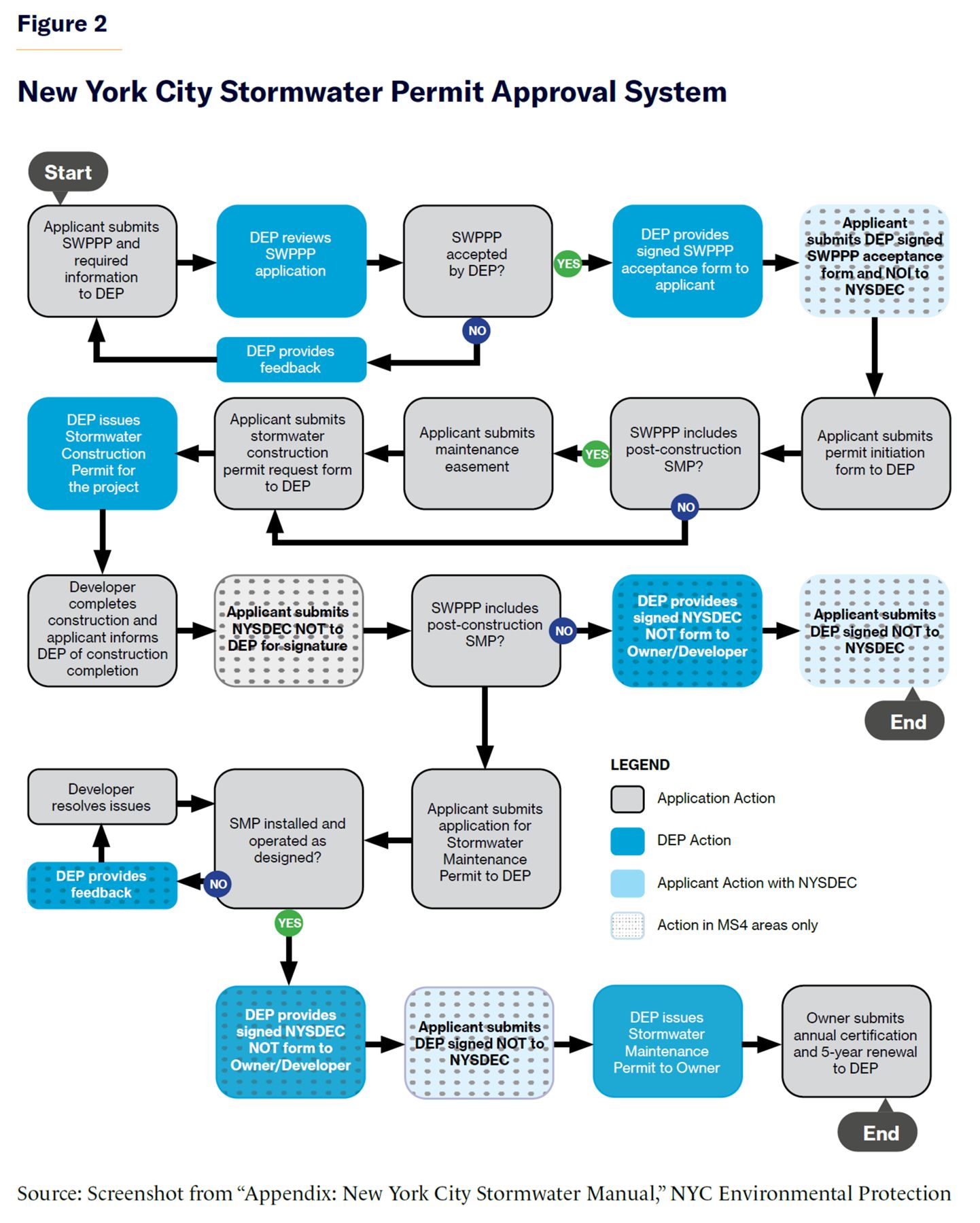
Fines for violations of these construction permits can be substantial. In California, one housing developer agreed to pay $1.6 million for construction permit violations. Notably, about a third of the settlement reflected not the failure to carry out actual BMPs but the developer’s failure to employ a qualified stormwater practitioner and submit a required SWPPP. Another construction contractor was fined hundreds of thousands of dollars, partly for failing to maintain a hard copy of the SWPPP on-site and failing to perform weekly inspections.[42] Around the 2008 financial crisis, EPA made a number of legal settlements with large homebuilders, requiring them to increase efforts to control runoff beyond efforts required in the law or typical permits.[43] Except for application and legal costs, I have been unable to find any general costs for the physical control measures, from dewatering to silt fencing.
Estimates on the cost of post-construction mandates are significant. Maryland asked its state university to look at the costs of various stormwater treatment systems and found totals that could be notable proportions of all construction costs. The university measured how much various types of stormwater control systems, such as swales or detention ponds, were needed to control runoff from the creation of each new paved acre.[44] For example, a typical suburban subdivision with about four houses per acre covers about 30% of its land with paved or impervious surface, i.e., each house covers about 7.5% of an impervious acre, or 13 houses per impervious acre.[45] By Maryland’s estimates, a typical control measure—a simple retention or “wet” pond—cost $63,000 (this and following Maryland estimates in 2025 dollars) per impervious acre treated to construct, amounting to about $5,000 per new typical suburban home.
A more extensive bio-retention pond—which includes planting and other measures to help water infiltrate the ground—cost about $250,000 per impervious acre treated to construct and about $20,000 per house. One of the most expensive control measures (although more common in areas with more expensive land)—creating special permeable pavement—cost $462,000, on average, per impervious acre (about $36,000 per typical suburban house).[46] Some mandates do not require merely a single stormwater control measure but many measures in tandem, in order to accomplish water-quality and treatment goals, which can further drive up costs. These control measures generally need to be redeveloped every two or three decades, further adding to the cost. Regular maintenance and inspection of such stormwater control devices is part of MS4 permits, and some maintenance can run to thousands of dollars a year per stormwater control measure, or 5%–20% of original construction costs annually, depending on the type.[47]
There are sometimes more substantial costs to control measures, including the loss of life in retention ponds, where water is permanently kept. These can be used as a neighborhood amenity by developers that sell new subdivisions, similar to a small lake, which could be seen as an offsetting benefit of some of their costs. But one water safety site reported “a disturbing trend of child drownings in residential retention ponds.”[48] One study reported 265 drowning deaths in retention ponds, mainly children younger than five years old, during 2004–20.[49] There are now attempts to gate or fence these ponds, which can raise the costs and reduce their amenity value for adults.
In more urbanized areas, total costs for stormwater treatment can be especially high. In Arlington, Virginia, the impact of new stormwater mandates consequent on a 2010 Chesapeake Bay agreement caused “costs to surge” and resulted in “projects shrinking in size,” according to one local news site. One developer noted that adding a 400-square-foot home addition required the installation of three dry wells (which are empty but fill during storms and slowly drain into the ground), two stormwater planters, and a detention tank.[50] When an economics consultancy surveyed proposed costs to San Bernardino County, California, of a new MS4 permit in 2024, it estimated that the addition of new plans “could increase the construction cost of single-family homes by up to $25,000 per home.”[51] A recent San Francisco permit application noted several plausible costs of stormwater mitigation for developers. For municipal projects, it estimated $215,000 per impervious acre treated by bio-retention and up to $660,000 for high-cost cases. The consultancy considered the literature and found general costs of over $300,000 per acre of impervious surface treated in similar areas and annual maintenance costs of about 5% of capital costs.[52] A Rand study of Pittsburgh found that the cost per impervious acre treated, including bio-retention and porous pavement, was over $300,000, not including the cost of land.[53]
The federal government has occasionally recognized these costs, even if it has not provided full estimates. One HUD study from 2007 found that environment regulations in general cost $6,000–$26,000 per unit (2025 dollars). The cost of stormwater and erosion control compromised the substantial majority of such costs, about 59%. These estimates, however, were made before more recent—and far stricter—stormwater control measures.[54]
Many surveys of post-construction treatment projects tend to ignore land costs, which can be substantial. One study estimated that 57% of the cost of stormwater ponds and 38% of the cost of wetlands to control runoff were from land taken away that could otherwise be used for development.[55] Obviously, the higher the land value, as in heavily urbanized areas, the higher the land costs of devoting space to water retention, detention, and treatment, especially since permits prioritize on-site, as opposed to off-site, measures.[56]
The cost of these stormwater treatments on a per-housing-unit basis goes down as the density of a project per impervious acre goes up. But especially if those dense units cover all or a substantial portion of the land and if those remaining pieces of land are high value (as in most urbanized areas), the cost for urban development stormwater retention and treatment can be very high, as demonstrated by estimates in San Francisco and other urban areas.[57]
Costs of Stormwater Mandates to Cities
Construction permits and post-construction mandates on developers add costs to new real-estate projects. But municipalities have had to take on new duties as a result of stormwater regulations, which has increased costs on new and old residents of cities alike.
The rise of stormwater utility fees, or fees charged on property owners to deal with stormwater, is largely the result of CWA stormwater mandates. While the earliest stormwater fees arose in the 1960s and 1970s in order to issue revenue bonds and improve general storm sewers, which are mainly used for flood control, notable increases in fees occurred in the early 1990s and especially in the first decade of the 2000s, with dozens of new urban fees imposed each year in the latter period. By the late 2010s, almost 14% of incorporated cities had independent stormwater fees, with the largest cities more likely to require fees. Much of this adoption was driven by the need to raise funds for stormwater treatment. One study found that a Phase I MS4 (large city) permit made a city up to four times more likely to enact a stormwater fee, while a city that had a new Phase II permit was up to nine times more likely to enact a fee.[58] EPA has given grants to cities to encourage and implement such fees.[59] The average home’s stormwater fee is about $72 annually; but in more developed areas, fees can add an annual $200+ per single-family home.[60] At a 5% capitalization rate, that would add $4,000 to the cost of a typical house.
While some cities charge stormwater fees as a proportion of property value, which amounts to a typical property tax, the tendency and preference of environmental administrators is to charge based on impervious surface. One effect of such a change is to distribute the burden of the tax away from single-family residential (where property value is higher and impervious surface is lower) to commercial property, utilities, and nonprofits.[61] Stormwater utility fees fund many public treatments required by MS4 permits, such as general public retention and detention ponds, rainwater infiltration, new pipes or inlets, and other stormwater infrastructure. The fees also pay for programs such as street sweeping, which, in many places, are required by MS4 permits, with the goal of supposedly reducing sediment runoff into waterways.[62]
Cities are required to implement the four main process-oriented BMPs included in national stormwater guidance, as stated above: public education and outreach on stormwater impacts; public involvement in stormwater design; educating municipal employees about stormwater; and finding and reducing illicit stormwater discharges. These mandates can absorb significant administrative effort and cost. For instance, as part of Seattle’s “Public Education” BMP, it created RainWise, which supports rain gardens on private property and holds “multilingual rain garden and rain barrel installation workshops” as well as provides rebates to homeowners who install green infrastructure. Nashville, as part of its “Inspection” BMP, required inspections on average once a year for post-construction BMPs, including sampling and chemical analysis of total suspended solids, nutrients, and oil and grease going into water inlets.[63] In the Biden administration, a stormwater permit could include “Environmental Justice Considerations,” which would require the city to monitor stormwater impacts on various populations.[64]
Public education BMPs feature extensive conditions, even if they seem to have limited effect. Vermont’s stormwater permit requires at least one “stormwater-related brochure” per year and requires local governments to “seek the cooperation of the local news media to run two or more stormwater-related news or features stories per year.” New Jersey’s permit allows local governments to reach their stormwater education goals by acquiring sufficient “points,” e.g., two points for distributing items “with a stormwater-related message”—such as fridge magnets, temporary tattoos, and coloring books—to 10% of the population; and three points to paint a stormwater pollution–themed mural in a downtown area.[65]
MS4 permits can include extensive infrastructure demands on urban governments. The Washington, DC, MS4 requires planting “a minimum net increase of 38,850 trees” within five years, capturing or preventing 108,347 pounds of trash from entering the storm sewer, street-sweeping 10,932 road miles, and completing 1,175 “Acres Managed”—providing new stormwater treatments, of which 175 “must be located in Public Rights-of-Way.”[66]
Although precise overall costs of stormwater control to city governments are hard to find, concrete examples of high costs exist. Los Angeles County estimated that its 2012 MS4 permit would cost about $20 billion over the next 20 years.[67] In response, it developed its nearly 500-page Low Impact Development Standards Manual, which dictated how new development and redevelopment should be carried out—which for the first time required new Los Angeles development to retain on-site.[68] In 2018, this mandate led to voters approving Measure W, a tax of 2.5 cents per impermeable square foot focused on treating stormwater. The measure raises about $300 million a year.[69]
When EPA found that the Boston Water and Sewer Commission, which received its own individual Phase I MS4 permit, was in violation of that permit, EPA forced a consent decree on the commission. The commission—and effectively, the city—had to “emphasize the use of all appropriate currently available Green-Infrastructure (‘GI’) and Low Impact Development (‘LID’) techniques,” and its implementation plan required “private entities” to use these measures “through application of BWSC’s site plan approval process.” Thus, BWSC would act as a municipal zoning institution with control over development. The city needed to create a more expansive construction approval and inspection plan that emphasized GI and LID. In carrying out these mandates, BWSC and the city were required to engage in consultation with the Conservation Law Foundation, which originally brought the suit.
Boston’s 640-page guidance document on BMPs, which emerged out of the lawsuit, states that post-development peak runoff rates “must be controlled to be less than or equal to the predevelopment condition,” which meant minimizing impervious areas, minimizing steep slopes, maximizing infiltration and overland flow paths of runoff, and providing runoff storage.[70] Even redevelopment projects, that just are reworking already developed land, are required to reduce solids to the “maximum extent practicable.” BWSC also provides tens of thousands of dollars a year to environmental groups to support water-quality monitoring and “public education efforts.”[71]
How Stormwater Mandates Limit Development
The regulation of construction projects, new building designs, and mandates on municipal practices are not the only ways that stormwater regulations influence the landscape. EPA also requires states to set water-quality standards for rivers and streams and to have plans to meet the “pollution budgets” or Total Maximum Daily Loads (TMDLs) for pollutants affecting rivers and lakes with pollution issues. In recent years, these TMDL plans have focused more on controlling stormwater runoff; one way they have done so is to push for limitations on development in general.
Since the early 2000s, EPA has encouraged states to meet TMDLs through an “impervious cover” (IC) proxy for stormwater pollution[72]—i.e., in areas with TMDL mandates, the total amount of development or housing or other projects should be limited, as the best way to limit overall stormwater runoff. EPA has taken a stance that even very minor amounts of development in a watershed can be devastating for water quality. EPA has stated that watersheds with impervious areas as low as 4% of landmass show water degradation, while those above 12% “often fail to meet aquatic life criteria and narrative standards.”[73] Academics and activists working on water quality created the term “urban stream syndrome,” soon adopted by EPA, to describe how streams degrade rapidly based on relatively low levels of urbanization.[74]
TMDLs for some local watersheds illustrate how IC standards can restrict development. The TMDL for a Connecticut waterbody states: “It is recognized that IC may not be the direct factor causing the [water-quality] impairment but that there is a strong enough relationship to use IC as a surrogate measure in situations” when other stormwater control measures would not work. The TMDL places a goal of no more than 12% IC in the watershed. This goal can be obtained by stopping new projects, disconnecting projects from the storm sewer system, or reshaping previous development to greenfield or porous pavement states.[75]
TMDL watershed plans sometimes note the dangers of “future residential development” and specifically advocate means “to avoid increased delivery of pollutants” from any new sources.[76] One plan from Washington State states that limiting residential growth to levels below 10% in large parts of a watershed is necessary to control runoff.[77] One way to limit growth is to impose large minimum lot sizes or impervious surface limitations, which prevent most land from being developed. Delaware states that to control wastewater in one watershed, “regulations need to include impervious cover limits for new subdivisions,” with a complete ban over 50% cover and an “environmental impact assessment report and mitigation” for any development that is over 20% impervious.[78] Under these standards, almost no traditional urban development—such as Seattle or Wilmington, Delaware—would be possible.
EPA highlighted some particularly “innovative” plans to provide guidance for state and local governments in crafting TMDLs. A Maine plan notes the goal of reducing IC attached to waterways from about 23% to 12%, achieved by removing existing paving or significant stormwater management that prevents any runoff greater than the natural level. The plan states that “Dense Residential Development” has about five times more IC than “Spare Residential Development,” thus favoring the latter in the stormwater control context.[79]
Some TMDLs have a minor impact on local permitting, since local bodies can try to avoid their mandates; but clear examples of them reshaping the built environment exist. In 1992, North Carolina’s environmental agency, in line with federal rules, required local cities to reform their ordinances to limit development in certain sensitive areas. In several areas of North Carolina, the result was a two-acre minimum lot size requirement for new development.[80] As part of a 2010 Chesapeake Bay agreement to limit runoff, Fairfax, Virginia, agreed to completely offset stormwater pollutant increases from any new development larger than one acre and to turn more of the county from developed land into forest or grassland. The county had to enforce strict rules to reduce total phosphorus and nitrogen runoff, over and above the offset rules; thus, any new development resulted in goal achievement being even more difficult. Until recently, the county provided exemptions from these requirements for projects of five or more acres or of infill; or in urban areas, for development that did not create more than 18% IC, a very low standard for an urban area.[81]
Evidence shows significant cost effects of these limits on development. After Maryland limited residential development around the Chesapeake Bay as a means of controlling runoff and other pollution, a study found that existing housing prices inside the controlled areas increased by 14%–27% and those near the areas increased by almost as much because of the reduction of housing supply in those regions.[82]
Benefits of Stormwater Mandates
EPA and state environmental protection agencies impose costly stormwater regulations because they believe that these regulations will bring offsetting benefits. The benefits include improved water quality in rivers, lakes, and other surface waters. In particular, EPA hopes that improved surface water quality will allow for increased recreation, especially swimming and fishing, as well as improve the diversity of aquatic life.[83]
One problem with the claims of offsetting benefits from stormwater regulations is that surface water regulations in general are the one type of environmental regulation in which overall costs exceed benefits, even by EPA’s own calculations.[84] Yet even this general comparison involves many high-return regulations, such as basic treatments for municipal wastewater and limiting toxic pollution from industries into water streams. Stormwater regulation evolved after the seemingly low-hanging fruit of water regulation had already been reaped and was intended to bring marginal gains after much of the highest-impact regulations were already in place. Thus, contemporary water pollution control measures generally have negative returns, and stormwater control measures most likely have even more negative returns.
EPA often states that it has no significant estimates of benefits when proposing new stormwater regulations—and when it does have estimates of benefits, it uses very wide ranges. The 1999 MS4 rule for smaller cities estimated almost $1 billion in total costs, with benefits ranging from $672 million to $1.6 billion, thus either significantly below or above costs.[85] At other times, its estimates of benefits are significantly below costs. When EPA created the 2009 CGP rule, in which it estimated annual costs of just under $1 billion a year, it came up with benefits of only $369 million per year, although it stated that it was difficult to monetize benefits such as the “reduced cost of ditch maintenance.” From the EPA’s estimates, the regulations imposed costs of $1 to prevent four pounds of pollutants—mainly dirt—from entering streams.[86]
Admittedly, the benefits of clean water for a population are difficult to divine. EPA has occasionally used a “willingness to pay” methodology, whereby surveys ask individuals how much they are willing to pay for, say, making an area “boatable,” with surveys sometimes estimating a few hundred dollars per person.[87] Yet many economists and other researchers note that the willingness-to-pay methodology gives odd results, such as people being similarly willing to pay no matter the size of the impact, and that it is not a trustworthy measure of benefits.[88]
More appropriate measures of clean water benefits have been changes in nearby real-estate valuations, where people are more willing to pay for houses or buildings with more access to clean water. Although studies have usually been focused on point source water treatments—especially at early stages of CWA, when returns would be highest—they show generally negative returns on clean water investment.[89]
Given that stormwater is already a relatively minor source of water pollution, increased efforts to control stormwater runoff pollution will bring lower returns and higher costs relative to other means of water pollution control. An EPA analysis from 2000 found that about 50% of polluted rivers and streams can be attributed to the effects of agricultural runoff and only 11% can be attributed to urban runoff and storm sewers. For lakes and ponds, urban runoff and storm sewers accounted for a bit under 20% of impaired waters.[90] Since that survey was conducted at the beginning of widespread storm sewer mandates, the proportion of pollutants coming from stormwater has likely dropped further and the gains from further regulation will likely be lower.
We know that costs for urban stormwater pollutant reduction measures are much higher than other means to reduce such pollutants. Urban runoff is more likely to contain pollutants than runoff from undeveloped land; but fertilizers, feces, chemicals, and other runoffs from farms and ranches are the major cause of water pollution in most of the country. The University of Maryland study estimated that the median cost of preventing a pound of nitrogen from entering waters was $1,558 through urban stormwater control and only $16 for control measures in agricultural areas. The cost to prevent a pound of phosphorus was $9,639 in urban areas, versus $489 in agricultural areas.[91]
The raw weight of reduction in pollutants from stormwater control plans are minimal, often measured in mere grams per year. In a watershed plan for the Santa Monica Bay, the wastewater treatment plants were allowed to let up to 14,600 grams of the chemical DDT per year slip into the bay, while the MS4 could contribute just 28 grams per year, as well as just 145 grams per year for the chemical PCB, less than half the level coming from the wastewater treatment plant.[92] To put that into perspective, the entire region was supposed to use stormwater control measures to limit runoff to about a third of a pound of two different pollutants, even while it admitted that many tons of those pollutants had historically already gone into the bay. The number of landscape and other changes necessary to try to reduce that third of a pound was significant and costly; yet the impacts, by any measure, were insignificant.
Recommendations for Reform
America’s waters are much healthier than they were in the past, which is to be celebrated. Yet the cost side of water regulations has received relatively little attention. We know that the costs of surface water regulation are high and rising and that the benefits of these programs are low and dropping. The impact of stormwater regulations, in particular, has received little attention, but we know that the cost of these regulations is high and rising and the benefits are minimal.
There are reforms that can reduce the costs of stormwater regulation without imperiling the environment:
- EPA should use a strict cost-benefit test for regulations.
Surface water programs, especially stormwater programs, should undergo a strict cost-benefit test, and previous stormwater mandates should undergo retrospective review to check for cost benefits. If the government and courts find that regulations cannot reasonably meet a cost-benefit test, the regulations should be struck. The Unfunded Mandates Reform Act requires agencies to prepare a cost-benefit assessment for rules that impose significant annual costs per year (focusing on costs imposed on state and local governments) and to select the least costly or most cost-effective option—or to explain why this was not possible. EPA should use this measure to pare back expensive agency water rules that do not meet the test and that are not explicitly required by Congress. Congress should require a stricter cost-benefit rule for any new regulations.[93] - When EPA is evaluating TMDL plans, it should no longer view development as an environmental burden.
States and watersheds have to meet water-quality standards and TDMLs, no matter what their population or level of development, which means that more development makes it look as though an area is becoming more polluting. Yet homes, offices, and other development don’t disappear if they are excluded from one area; most often, they move elsewhere. By limiting development, EPA is not controlling pollution; it is merely shifting it around, at increased cost. State and local watershed plans should measure pollution burdens not in total but on a per-capita basis and should no longer treat new development as a burden on the watershed. - EPA should end its direct oversight of construction through the Construction General Permit.
In its 2009 CGP rulemaking, the EPA admitted that even though it was a “reasonable interpretation of the CWA to exclude C&D [Construction & Development] sites from the definition of ‘new source’ ” that required permits and regulations, it decided to include them. The actual law states that new sources should be a “building, structure, facility, or installation,” and it includes a separate definition of the construction of such sites. EPA admits that “based on a common sense understanding of the term … an owner or operator cannot construct a construction site” but believes that, “[g]iven the evolution of the CWA,” EPA should require permits.[94] Since, in the wake of the Loper Bright decision, courts, rather than agencies, determine the best reading of statutes based on the law, courts or EPA should recognize EPA’s incorrect reading in this CGP case and return the monitoring of construction runoff to local governments. - States can clarify their standards and ensure that they don’t exceed EPA mandates.
Mandates in many states go far beyond what EPA requires—or they are merely confusing. The Home Builders Association of Virginia noted that several regulatory reforms under Governor Glenn Youngkin’s administration reduced building costs and that the “most technical—but arguably the most consequential” reform was to the stormwater mandates. At least seven guidance documents were consolidated and simplified into one stormwater manual, and the government increased the number of potential BMPs that developers could use to meet those standards from 54 to 77.[95] - States should encourage more off-site stormwater compliance options as opposed to on-site, which can often be more expensive.
In 2013, Washington, DC, created new requirements for real-estate development to handle stormwater on-site but allowed 50% of the stormwater retention to be hosted off-site, through paying an in-lieu fee or purchasing stormwater credits.[96] Other states and cities have attempted similar off-site measures. Yet many agencies limit off-site treatment, when government should be agnostic as to where the stormwater benefits come from.[97]
More broadly, stormwater control is a quintessential state and local issue, with little effects beyond the immediate environment of the runoff. Congress should relieve EPA from monitoring this matter and allow those rare instances where stormwater has impacts beyond state lines to be dealt with by deals between states. At minimum, states and cities should have more discretion to decide how to administer these policies, rather than have EPA set a single, and high, stormwater regulatory floor to which state and local governments can only add more costs.
Many researchers, even those involved in urban policy, might be surprised to know that the federal government directly supervises all significant construction projects in the U.S. and determines the shape and layout of most new buildings. The extent of federal control over these issues has significantly added to costs, despite minimal benefits. By removing or reducing such regulations, the federal government can reduce building costs and expand urban opportunity with little effect on the environment.
Glossary
| Acronym | Definition | |
| BMP | Best Management Practices | Practices—structural (involving construction, such as a pond to detain stormwater runoff) or nonstructural (such as street sweeping)—that aim to limit stormwater runoff and pollutant discharges into lakes and streams |
| CGP | Construction General Permit | Permit mandated by EPA for areas that it directly oversees for any construction site larger than one acre; the permit is copied in most of the state-delegated environmental agencies and includes numerous mandates, such as SWPPP |
| CWA | Clean Water Act | Originally adopted in 1972, the act was amended in 1987 to require cities and developers to acquire stormwater permits with many conditions limiting runoff |
| EPA | Environmental Protection Agency | Federal agency that directly permits stormwater MS4s and CGPs in three states and several territories; oversees other state environmental agencies’ stormwater permitting |
| GI | Green Infrastructure | See LID below |
| IC | Impervious Cover | Paved or developed land that allows little or no infiltration of stormwater directly into the ground and that creates more runoff into lakes and streams |
| LID | Low Impact Development, also known as Green Infrastructure (GI) | Development and building methods, including porous pavement and concentrated IC, that aim to limit runoff and reduce the overall impact of buildings on the environment |
| MS4 | Municipal Separate Storm Sewer System | Technically, a system of stormwater collection and pipes that discharge stormwater into lakes, streams, or the ocean; also refers to a permit requiring BMPs that cities and developers must undertake to limit runoff and pollutant discharges. Individual Phase I MS4 permits set requirements for systems of more than 100,000 people; general Phase II MS4 permits comprise rules for smaller urban areas |
| NPDES | National Pollutant Discharge Elimination System | General permitting system for CWA that requires cities and industrial facilities to limit waste discharges into public waters; includes CGPs and MS4s |
| TMDL | Total Maximum Daily Load | Pollution “budget” for a watershed that describes quantity of pollutants that various sources, such as MS4s, can emit if the water-quality goals for a watershed are to be achieved—e.g., limiting an area to a certain number of pounds of nitrogen and phosphorous runoff per year |
| SWPPP | Stormwater Pollution Prevention Plan | Plan required for a CGP that describes how a developer will limit runoff and pollutant discharges from a construction site |
Endnotes
Photo: Nearmap / DigitalVision via Getty Images
Are you interested in supporting the Manhattan Institute’s public-interest research and journalism? As a 501(c)(3) nonprofit, donations in support of MI and its scholars’ work are fully tax-deductible as provided by law (EIN #13-2912529).