Good morning:
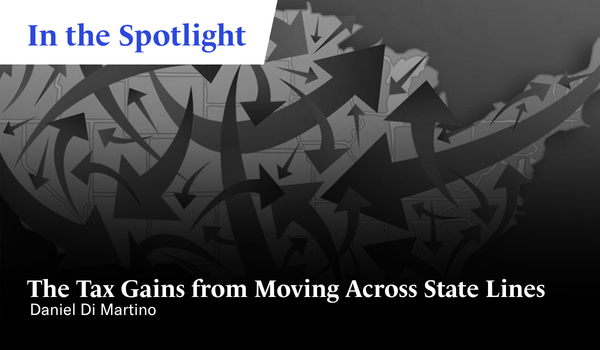
This morning, fellow Daniel Di Martino published a new interactive tool that allows users to model the combined burden of federal, state, and local taxes depending on a taxpayer’s location, income level, and filing status. As Di Martino explains, Americans have been increasingly moving from high- to low-tax states. For the rich, the benefits of such a move are well known. But as Di Martino’s tool shows, fleeing to a low-tax state can also mean a significant increase in take-home pay for low- and middle-class Americans—even if moving also entails a pay cut. As Di Martino points out, if Democratic-controlled states do not keep tax rates in line with those in Republican-controlled states, the middle class in those states might begin to flee as fast as the rich.
Those who have fled Democratic-controlled jurisdictions are often motivated not only by tax rates, but also by crime. In the Atlantic, senior fellow Charles Fain Lehman explains why—notwithstanding the populist backlash against them—Flock police cameras can make the criminal justice system fairer and less punitive, while also reducing crime. That is because cameras increase the certainty that offenders will be caught and thus help to deter crime without increasing the severity of punishment. Regulations on the use of cameras—including limits of data storage and access to the data—can help to mitigate some legitimate privacy concerns raised by camera systems. But if used well, cameras “can be one among many tools in the toolbox of smarter—and therefore less severe—police forces.”
Crime is not the only challenge facing Democratic-led cities. In a Wall Street Journal letter to the editor, legal policy fellow and director of Cities John Ketcham examines the long decline of the Mayor’s Fund to Advance New York City, whose advisory board was recently dismissed by Zohran Mamdani. The fund, which offers a way to fund ambitious public projects with private dollars, has seen donations fall to a fraction of what they were under Mayor Michael Bloomberg, as business leaders have lost confidence in the city’s ability to deliver results.
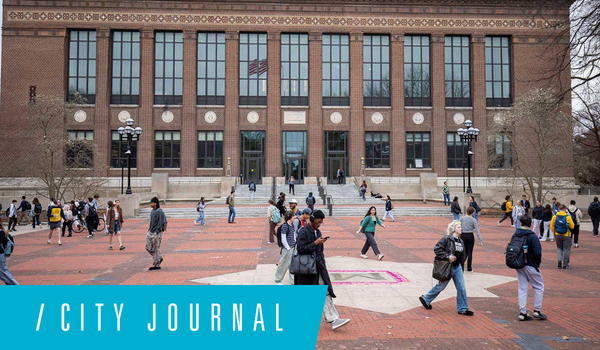
Higher education institutions also continue to face a decline in confidence. In City Journal, policy analyst Neetu Arnold reports on the University of Michigan’s plan to “blow up the transcript” by excluding first-semester grades from freshman GPAs beginning in 2027. The university says that the move is intended to combat a “mental health crisis.” But as Arnold argues, the policy seems more like a response to the university’s decision to weaken admission’s standards, which has led to an increase in the number of students failing early courses.
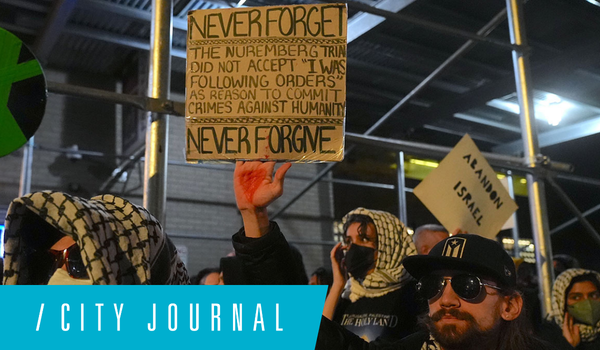
Finally, also in City Journal, legal policy fellow Tal Fortgang makes the case for the bipartisan Right to Worship Act, which would create a 100-foot buffer zone around houses of worship during religious services. Fortgang argues that the measure would deter intimidation and disruption more effectively than existing law, while fitting comfortably within longstanding First Amendment rules governing time, place, and manner restrictions.
Continue reading for all these insights and more. Nick Saffran Senior Editor |
|
|
|
The Tax Gains from Moving Across State Lines
Daniel Di Martino | Photo: Paper Trident / iStock / Getty Images Plus via Getty Images
Americans are increasingly moving from high-tax states such as New York and California to lower-tax states like Texas and Florida. This trend has received ample media coverage, but that coverage has often focused on how the rich benefit by fleeing to low-tax jurisdictions. A new interactive tool created by fellow Daniel Di Martino shows that not only the rich, but also low- and middle-class Americans, have much to gain by moving across state lines. The tool allows users to model the combined burden of federal, state, and local taxes depending on a taxpayer’s location, income level, and filing status. As Di Martino shows, for a middle-class family, a move to a low-tax state—even if it also entails a substantial pay cut—can often mean more take-home pay. If Democratic-controlled states do not keep tax rates in line with those in Republican-controlled states, the middle class in those states might begin to flee as fast as the rich. |
In Defense of Flock By Charles Fain Lehman | The Atlantic | Photo by fhm/Moment via Getty Images
"The case for Flock is simple. Cameras help police catch criminals. That reduces crime through two channels: incapacitating offenders who are caught and convicted, and increasing the certainty of apprehension, which theoretically should deter criminals from offending in the first place. But is it true in practice? Although the research base is still developing, the answer is 'probably.'
…
"If [criminals] know that a camera will help catch them, they become less likely to steal. If they don't offend, they aren't caught, arrested, and incarcerated. Consequently, both crime and punishment fall, leaving everyone better off.
"The benefits of that arrangement accrue, in a sense, to criminals. But they accrue far more to the law-abiding. Crime imposes an enormous cost on society—trillions of dollars in time, money, suffering, and lives lost. Criminal victimization can scar people for years after, a fact that shows up in everything from how much they work to how dependent they are on government benefits. Assuming we take reasonable precautions to protect our liberty and privacy, having ALPRs help reduce these costs is clearly worth it."
|
Why is the University of Michigan Hiding Grades?
By Neetu Arnold | City Journal | Photo by Bill Pugliano/Getty Images
“Starting in fall 2027, the University of Michigan will exclude first-semester grades from overall GPAs for first-year students in its College of Literature, Science, and the Arts, purportedly to curb a ‘mental health crisis.’ The university declined to tell the Wall Street Journal how it decided to launch its “grade covering” pilot program. But university documents suggest that grade covering is part of a larger effort to reshape the university around the students it admits rather than expecting those students to adapt to a demanding academic environment.”
|
|
|
A Buffer Against Civil Terrorism By Tal Fortgang | City Journal | Photo by Selçuk Acar/Anadolu Gomez/Getty Images
“After several high-profile incidents at houses of worship—including disruptions, intimidation, and bloody violence—a bipartisan coalition of lawmakers has introduced federal legislation aiming to put an end to the phenomenon. Introduced in early August, the Right to Worship Act would prohibit disruptions within 100 feet of houses of worship while religious services are underway.
…
“The organizations that the Right to Worship Act seeks to counter are, in many cases, not in the business of free expression at all. Groups like Al-Awda and CodePink, with their connections to ANSWER Coalition, Samidoun, and MECA, operate in a murky ecosystem of foreign funding—just a few degrees separated from terrorism and coordinated harassment campaigns. They are united by hatred of the West and all it stands for, including freedom of worship. “Ultimately, any federal effort to defend houses of worship will have to confront these groups head-on. If the Right to Worship Act can help in that effort, it will have done much more than just protect Americans’ religious rights.” |
|
|
Mamdani's Mayor's Fund Problems Run Deep By John Ketcham | Wall Street Journal | Photo by Tony Anderson/Getty Images
"In a fiscally unconstrained environment, city leaders lost the need and the motivation to fund ambitious public projects with private money. Over the past quarter century, New York City’s budget has tripled in nominal terms, far outpacing roughly 90% inflation over that time. In a city flush with cash, the fund’s purpose withered. Its website today features an appeal for earthquake relief in Venezuela. "Business leaders and voters have also come to doubt the city government’s ability to deliver results. There is little to show for the additional billions spent on homelessness and K-12 education. When donors stop trusting that their dollars yield tangible outcomes, the case for giving collapses.” |
|
|
For more information and media requests, please contact
communications@manhattan.institute.
Are you interested in supporting the Manhattan Institute’s public-interest research and journalism? As a 501(c)(3) nonprofit, donations in support of MI and its scholars’ work are fully tax-deductible as provided by law. |
|
| |
The Manhattan Institute works to keep America and its great cities
prosperous, safe, and free. Manhattan Institute
52 Vanderbilt Ave. 3 floor New York, New York 10017
Copyright © 2026 Manhattan Institute, All rights reserved. |
|
|
|
|