Socialism on the Hudson

Photo by Jakub Porzycki/NurPhoto via Getty Images
Executive Summary
Assemblyman Zohran Mamdani’s upset victory in the June Democratic primary means that New York City is poised, for the first time in a century, to elect its next mayor from among the ranks of the state legislature.
Mamdani’s rise is also notable because he has been an unapologetic proponent of “democratic socialism.” The number of self-described socialists in state government is small. However, a review of current legislative proposals shows widespread interest in policies safely described as socialist: policies that increase government ownership or involvement across the economy.
These concepts would affect nearly every corner of the economy: from health care, education, and housing to energy, transit, and banking. If implemented together, they would render New York economically uncompetitive—and unrecognizable.
Proponents of these legislative measures regularly ignore the extent to which state and local government policy drives up costs for goods and services in the private economy. To make matters worse, they regularly fail to provide cost estimates for their proposals. They also fail to grapple with the extent to which state labor law and other policies already frustrate the delivery of public services, or to recognize the risk of political weaponization of some of the large programs that they imagine.
Introduction
If Assemblyman Zohran Mamdani wins the November mayoral election, it will mark the first time in 100 years that a sitting member of the New York State Legislature has ascended to NYC’s highest local office.
The last state legislator to move directly from Albany to the mayoralty was Jimmy Walker, a Tammany Hall stalwart who won the 1925 election after having served 15 years in the legislature, including the last five as leader of the senate Democratic conference. The dapper, wisecracking Walker was a product of twentieth-century urban machine politics, built on personal connections, shared ethnicity, and patronage.
At 33, now in his fifth year as a state assembly backbencher, Mamdani personifies the rising urban machine of the twenty-first century, dominated by youthful activists employing social media to organize and build a network of supporters around a decidedly left-of-center ideological agenda.
In 2020, Mamdani described socialism as “the extension of democracy into the areas of collective life from which it’s prohibited under capitalism.”[1] Socialism, for the purposes of this report, is defined as policies that seek to have government do one or more of the following:
- Become the single payer for a service, either by eliminating private competitors or user fees
- Create or take ownership of what otherwise would be a private asset
- Reduce the extent to which private entities deliver government services
- Increase the extent to which government socializes costs among users.
All these characteristics are in addition to the many ways that the state has used the tax code as an income redistribution mechanism rather than solely for funding public services.
Mamdani’s criticism of the market economy and his embrace of democratic socialism have been widely noted, and some of his least consequential proposals, bordering on symbolic, have received a disproportionate share of attention.
His call, for instance, for building a government-run grocery store in each borough would not meaningfully alter the market. Other proposals would require permission (and funding) from state government that Mamdani would likely struggle to obtain.
But while he is one of only nine lawmakers who self-identify as a democratic socialist, he is one of a larger number of progressive Democrats in both houses of the New York State Legislature who have embraced policy priorities broadly consistent with socialist aims and principles.[2]
Those priorities deserve closer inspection from New Yorkers as one of their proponents moves closer to higher office. They include:
- Replacing private insurance with a state-run single-payer health-care system
- Implementing more intervention in the housing market, including further rent regulation, more rent subsidies, and a $5 billion government-housing construction program
- Ceasing to collect fares on New York City public buses
- Providing universal no-cost child care
- Reducing, if not eliminating, access to charter schools
- Ceasing to collect tuition at state-owned universities
- Reconfiguring the system for electricity generation, much of which would be publicly owned
- Taking over local gas and electric utilities and expanding redistributive rate schemes
- Creating a state-run bank.
This report explores the most consequential proposals to expand the role of state government in New York. It treats policies as they exist in 2025 (often already following a massive expansion, both in existing and new programs) as a baseline. Some of these proposals—even if implemented in isolation—would make major changes to the state economy.
Taken together, the legislation reviewed in this report would radically transform the state. The agenda proposed here would adversely affect the tax climate, have distortional effects on the price and availability of goods and services, and significantly diminish private investment in New York.
Socialism in Albany
Health Care
Arguably the furthest-reaching proposal in Albany, by almost any measure, is the New York Health Act sponsored by Senator Gustavo Rivera and Assemblywoman Amy Paulin.[3] The legislation, sponsored by most senators and nearly half the assembly, would create a single-payer health-care system operated by state government. The new plan, New York Health, would replace private insurance (which covers about 53% of New Yorkers)[4] as well as Medicaid, Medicare, veterans benefits, and other public programs.
Backers say that the change would be financed “through a progressive tax and cost efficiencies,” as the promotional material puts it (Figure 1).[5]
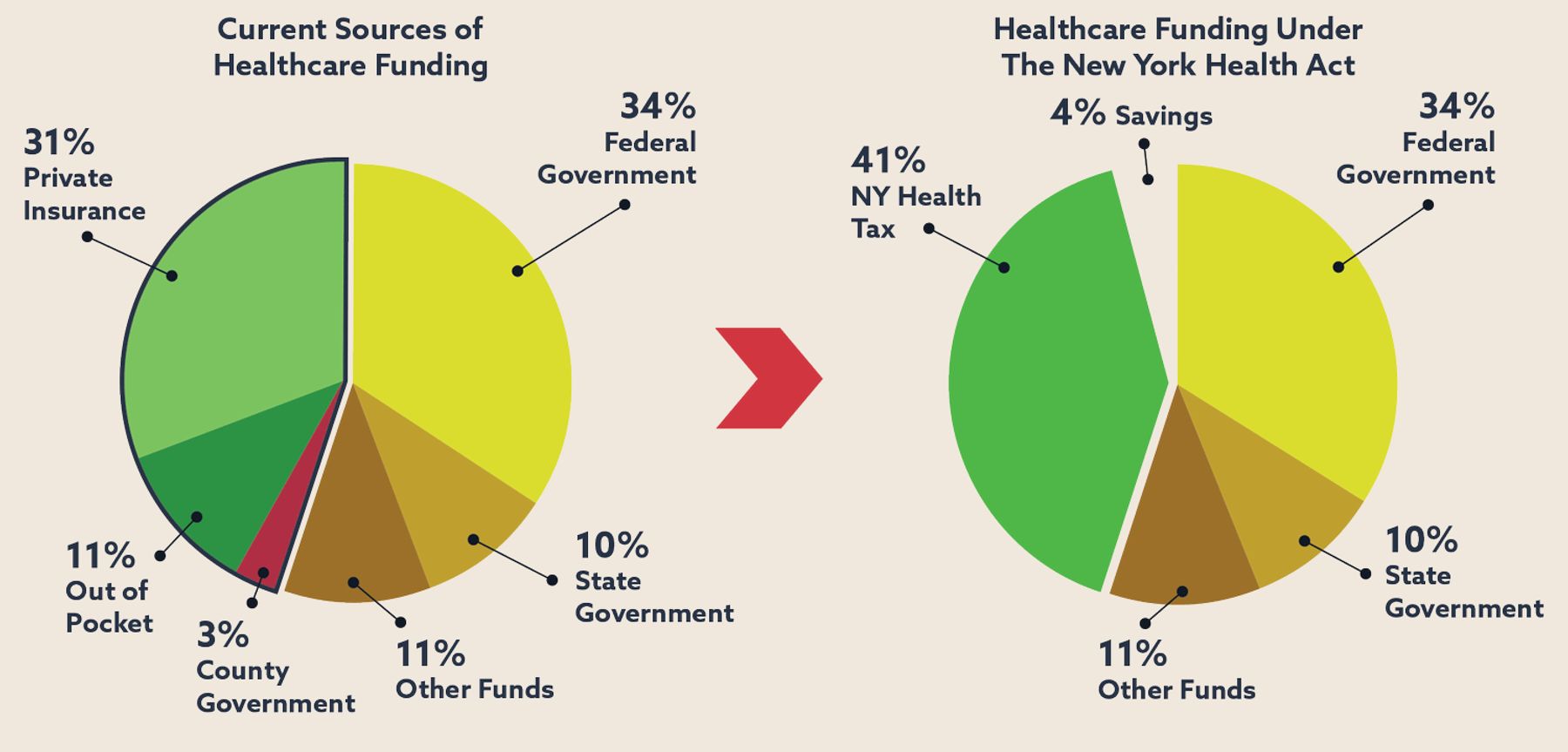
In 2018, the RAND Corporation analyzed an earlier version of the New York Health Act and estimated that, even with necessary federal permission and various cost reductions, New York would need an additional $139 billion in tax revenue in 2022 to finance the program.[6] By comparison, state taxes in fiscal year 2022 totaled $118 billion—following significant corporate and personal income-tax increases in 2021.[7]
The RAND authors hypothesized that the state in 2022 could levy a payroll tax that would begin at 6.1%, rising to 12.2% of income above $27,500 and to 18.3% of income over $141,200.[8] The tax would apply similar rates to non-wage income (such as capital gains and other investment income).
Taken together with NYC and state income taxes—but not including federal taxes—it would create a combined top tax rate over 33%, more than double the current top state-local rate of 14.78%.[9]
It is worth remembering that eight states, including Texas and Florida, do not tax personal income.[10] If New York adopted the proposed plan, “high-income residents may change investment decisions or move out of state,” the RAND team noted.[11]
Bill Hammond of the Albany-based Empire Center summarized arguments for “AlbanyCare” succinctly: “tendentious assumptions, debatable methods, and a dose of wishful thinking.”[12]
The state assembly first approved an earlier version of the New York Health Act in 1992, but interest ebbed amid the intense debate about federal health-care legislation the following year.
The lower house approved an updated version each year between 2015 and 2018, when Republican control of the state senate kept the bill from reaching the governor’s desk. It has not been voted on since senate Democrats took control in 2019, partly because labor unions have raised concerns about how New York Health might conflict with the benefit levels and services covered by their own contractually negotiated plans.[13]
Housing
Government plays a major role in New York’s housing market. It is, in fact, the state’s largest landlord: the New York City Housing Authority (NYCHA) alone houses about 521,000 tenants.[14] All told, approximately 1 million New York State residents live in housing that is publicly owned or otherwise publicly funded through Section 8 vouchers and other forms of housing assistance.[15]
In addition, state government, through local boards, allows some of the nation’s most invasive regulations on rental housing. In 2019, Governor Andrew Cuomo and state lawmakers substantially tightened the regulation of certain rental units with the Housing Stability and Tenant Protection Act (HSTPA), which, among other things, reduces how much rent can increase in many cases and eliminates mechanisms under which rent-regulated apartments could be “decontrolled” as market-rate units.[16]
Some proposals in Albany would go further still: squeezing private entities out of the housing market and creating mechanisms for the government to take ownership.
Assemblyman Mamdani described his approach to housing in 2020: “Basically, we want to move away from a situation where most people access housing by purchasing it on the market & toward a situation where the state guarantees high-quality housing to all.”[17]
Mamdani grabbed headlines in 2025 with proposals for a four-year freeze on rents in rent-stabilized apartments.[18] State lawmakers routinely hector the body that regulates many of NYC’s rents, the Rent Guidelines Board, to freeze monthly payments at their current levels for a year or two at a time.
The existing system is unsustainable. Among other issues, landlords opt to let units remain vacant rather than put them back on the market, which pushes some owners to the brink of insolvency. But Albany’s proposals would exacerbate this.
A proposal by Senator Brian Kavanagh and Assemblywoman Sarahana Shrestha would make it easier for local governments outside New York City to legislatively declare a “housing emergency,” even in areas where the vacancy rate is not below 5% (the threshold historically used to justify rent regulations).[19] The measure would also allow those municipalities to regulate rents in buildings with fewer than six units.
New York’s regulation of the rental housing market would stretch into commercial properties under some proposals. A bill sponsored by Senator Julia Salazar and Assemblywoman Emily Gallagher would regulate rents on commercial properties,[20] while a proposal by Senator Brad Hoylman-Sigal[21] would bar landlords from increasing rent on small commercial premises (retail outfits 1,000 square feet or smaller) by an “unconscionable” amount—defined as more than 1.5 times the increase in the consumer price index.
Rental Subsidies
A majority of state senators are sponsoring legislation that would create a “Housing Voucher Access Program” (HVAP) aimed at reducing and preventing homelessness.[22] An HVAP voucher would pay 90%–120% of an area’s “fair market rent” for an eligible person’s housing.
The program’s total potential cost has not been defined by the sponsors. Governor Hochul and the legislature agreed to appropriate $50 million for HVAP in the current state budget, enough for “roughly 2,500 apartments.”[23] Lawmakers had sought $250 million and indicated the total recurring cost would be closer to $1 billion.[24] State budget officials expressed concerns that the total cost could be several times higher.[25]
Lieutenant Governor Antonio Delgado, now running for governor, has proposed “a permanent statewide rental assistance program,” in addition to existing housing assistance programs.[26]
“Social Housing”
Albany has worsened New York’s already-challenging housing situation. Instead of rolling back the state’s destructive interventions, one major proposal would plunge the state further into the mix at considerable cost.
In 2024, Senator Cordell Cleare and Assemblywoman Gallagher announced a plan for the state government to get further into the residential housing business. Their legislation would create a state Social Housing Development Authority, which could use eminent domain to seize “vacant or underdeveloped property” and redevelop it into “social housing.”[27] That would include “limited equity co-operatives, publicly owned housing, and community land trusts.”
At least two-thirds of any social housing built or taken by the authority would be subject to maximum income limits. Gallagher said that the housing sought is “permanently affordable, prioritizes community ownership and democratic control, and is protected from market forces.”[28]
Besides allowing the authority to issue considerable amounts of debt (proponents imagine an initial capitalization of $5 billion),[29] the Cleare-Gallagher bill would provide the effort with $60 million in seed funding.
Transit
The public bus system operated by the MTA in NYC relies on substantial state and city subsidies, with a portion of the remaining funding paid by riders in the form of fares.
In 2023, New York financed a one-year pilot providing “fare-free” bus service along five routes, which ended in 2024.[30] Senator Michael Gianaris and Assemblyman Mamdani currently sponsor legislation[31] that would resume the fare-free service on certain routes while also using state funds to roll back the MTA’s most recent 4% fare increase on subways and buses.
The pair had previously[32] called for making all MTA buses fare-free, at an estimated cost of about $800 million per year.[33]
The budget proposals approved in 2024 by the assembly[34] and in 2025 by the senate[35] would have resumed and expanded fare-free buses along 15 routes, at an estimated cost of $45 million. However, the fare-free program was not included in either year’s final budget agreement.
Children and Education
Child Care
A proposal by Senator Jabari Brisport, cosponsored by more than half his fellow Senate Democrats, would create “a free and universal child care system, with salary and benefits for workers at parity with that of public school teachers.”[36] Assemblyman Andrew Hevesi carries the companion bill in the lower house.
A 2023 study by proponents estimated the program’s cost at about $20 billion (assuming 80% uptake).[37] To put that figure into perspective, New York plans to spend $1.1 billion[38] in state operating funds (not including federal aid) on child-care subsidies and programs in the current fiscal year, an amount more than six times the $170 million[39] approved for fiscal year 2020.
The sponsors’ memos filed by Brisport and Hevesi say that the fiscal implications for state and local governments are “to be determined.”
K–12 Education
For over a century, New York delivered public education almost exclusively through a system of more than 600 locally controlled districts, overseen by a Board of Regents selected by the state legislature.
In 1998, the legislature created a process for authorizing charter schools—publicly financed, privately run schools for students selected by lottery. Charter schools offered dual benefits: the flexibility to innovate while providing parents with an alternative to their geographically assigned public school. In the 2024–25 school year, more than 180,000 New York public K–12 students (8%) were educated by charter schools.[40] Most were in NYC, where about 16% of students attend charters.[41] Nearly one-third of Bronx public school elementary students are enrolled in a charter school.
Charter school opponents—most notably, teachers’ unions—view charter schools as a threat since they compete with district-run schools for students and for funding. Efforts to strangle New York’s charter schools in recent years have focused on restricting how schools can be authorized (or reauthorized)—powers that are limited, in most cases, to the Board of Regents and the trustees of the State University of New York (SUNY).
The Regents are selected by the legislature, with significant input from teachers’ unions, and some members have been openly hostile to charters. SUNY trustees, on the other hand, are picked by the governor and have generally nurtured charters as a concept.
A proposal by Senator John Liu and Assemblyman Michael Benedetto would create a new chokepoint in the charter reauthorization process.[42] It would give the Board of Regents “final approval authority” over the continued operation of all charter schools. A bill sponsored by Senator Robert Jackson and Assemblywoman Rodneyse Bichotte Hermelyn would go even further, stripping the SUNY trustees of their charter powers entirely.[43]
Either measure would alter the landscape and reduce access to charter schools, forcing more students back into the district-operated, often geographically assigned, schools from which their parents sought an alternative.
Higher Education
In recent years, New York drastically expanded the extent to which students can attend public universities without paying tuition. Most notably, Governor Andrew Cuomo championed the “Excelsior Scholarship,” effectively waiving tuition for CUNY and SUNY students with household incomes up to $125,000.[44]
The fiscal year 2026 state budget pays tuition, fees, and book costs for people aged 25–55 who are enrolled in certain community college programs.[45] But that policy doesn’t go far enough for some.
This year, Assemblyman Mamdani called for making CUNY “tuition-free for all students.”[46] And the “tuition-free NY” program sponsored by Senator James Skoufis and Assemblyman Jeffrey Dinowitz[47] would go even further, waiving tuition for all CUNY and SUNY students who are residents of New York, who complete their degrees within a certain number of years, and who agree to remain in the state for five years after graduation.
The bill’s sponsors have not provided a cost estimate. CUNY this year expects to collect $839 million[48] in tuition, while SUNY’s 2024 tuition and fees netted $1.75 billion. In both cases, a portion was paid by nonresidents.[49] But, as with transit, the cost of a “free” system will likely be far higher than just the amount of forgone tuition.
Some proposals go far beyond covering tuition: the “New Deal for CUNY” proposal sponsored by Senator Andrew Gounardes and Assemblywoman Karine Reyes not only has state taxpayers cover tuition at CUNY but also increases staffing levels and adjunct faculty pay, while requiring the state to make as-yet undetermined increases in capital spending for both CUNY and SUNY.[50]
Electricity Generation
During the first century of electrification in New York, electric utilities built power plants primarily to serve the needs of their own customers. Each company was a vertical monopoly, from generation to delivery, with rates and finances tightly regulated by the state Public Service Commission (PSC). In the 1990s, Albany required utility companies to sell off their plants, and instead allowed them to compete in a wholesale marketplace overseen by the nonprofit New York Independent System Operator (NYISO).[51] The change created a competitive market with price signals that attracted new investment in more efficient power plants, which, in turn, helped push down electricity prices and reduce emissions.
But that progress ground to a halt shortly after the legislature’s 2019 enactment of the Climate Leadership and Community Protection Act (CLCPA).[52] Among other things, CLCPA requires the state to shut down its fossil-fuel power plants by 2040, and to get 70% of its electricity from renewables by 2030 (more than double what it gets now). These new renewables would be subsidized through charges on electric utilities and large electricity customers, with the funds used to subsidize otherwise unprofitable projects.
“Public Renewables”
New York’s climate goals were aspirational, at best, in 2019. That year, renewables—broadly defined to include hydroelectric power, wind, solar, biomass, and other sources—were responsible for 29.4% of electricity generation in New York.[53] That amount had ticked up to 32.7% in the most recent federal data (for 2023). The state, by any reasonable analysis, will not reach its targets for 2030. However, this shortfall gave proponents an argument for more state spending on renewables.
Legislation approved in 2023 requires the New York Power Authority (NYPA) to build, own, and operate renewable energy generators (such as hydroelectric dams, solar panels and wind turbines) to “support the state’s renewable energy goals.”[54] However, the open-ended permission, coupled with an unmeetable target, has essentially created a blank check for NYPA, which is now under massive pressure to make an unprecedented foray into what had previously been an almost exclusively private (albeit massively subsidized) market for wind and solar projects.
NYPA initially planned to procure 3 gigawatts[55] of renewable energy capacity but came under fire from advocates, including construction unions, which said that the plan was inadequate. Advocates had called for the state to procure 15 gigawatts.[56] NYPA then created a wholly owned holding company, which has begun buying renewable energy projects.[57] In July 2025, NYPA issued an “updated strategic plan” calling for over 6 gigawatts of renewables.[58]
Offshore Wind
New York State electricity ratepayers, under the state’s 2019 climate law, are committed to subsidizing 9 gigawatts of offshore wind capacity by 2035.[59] A proposal by Senator Brian Kavanagh and Assemblywoman Didi Barrett would increase that requirement to 20 gigawatts of offshore wind capacity by 2050.[60]
CLCPA’s offshore wind mandate was remarkable because it required the state to support a particular industry rather than an attribute appropriate for promotion (such as reliability, or not using fossil fuels).
Offshore wind contracts generally run at least 25 years, meaning that the legislature would essentially be committing the state to subsidizing a particular energy source for the next half-century. The opportunity cost could be substantial: the reinvigorated nuclear fission sector—and nascent, but promising, investments in nuclear fusion—could radically alter the options for powering New York’s economy in the next two decades.
The intermittent output from offshore wind turbines would have the secondary effect of necessitating, also with massive public subsidies, additional battery storage.
Battery Storage
New York has subsidized battery-storage projects that can charge when electricity demand is low and sell it back into the grid when demand is high.
The 2019 Climate Act required the PSC to establish programs to “support three gigawatts of statewide energy storage capacity” by 2030.[61] The PSC last year doubled the state’s energy-storage target to 6 gigawatts.[62] Legislation codifying the change is pending.[63]
At the same time, state environmental officials are blocking the replacement of older natural gas plants, and state law requires power plants to stop using natural gas or oil in 2040. This will be quite a lift; just over half the electricity generated in New York last year came from burning fossil fuels (mostly natural gas).[64]
The state plans to replace that electricity with energy generated by wind turbines and solar panels and backed up by enough battery storage to overcome decreased generation on cloudy days or during wind lulls.
As a practical matter, the current policy would require far more than 6 gigawatts. State projections assume that meeting that 2030 goal would mostly involve four-hour batteries, with utilities, private operators, or the state adding 25.6 gigawatt-hours of storage (mostly four-hour batteries).[65]
To put that into perspective, state officials as recently as 2024 have estimated that, if the state is unable to substitute natural gas with hydrogen in its fossil-fuel infrastructure and power plants, the state could need 2,400 gigawatt-hours of battery storage (mainly using 100-hour batteries, which are not yet commercially available).[66]
It remains to be seen how much of this storage will be publicly owned, but substantial subsidies will be necessary to bring the bulk of it online.
The New York State Energy Research and Development Authority (NYSERDA) last year said that the cost of procuring 4.7 gigawatts (the amount necessary to reach its 2030 goal of 6 gigawatts) will have a “net present value” (the agency’s preferred technique for making costs appear lower) between $1.29 billion and $2.01 billion. The mandate would increase “average residential customer” costs an average of 0.38%–0.59% over the next 21 years, NYSERDA estimated, in addition to previous storage-related increases.[67]
State officials, citing BloombergNEF, expect the cost of battery storage to fall by more than half, to $126 per kilowatt-hour (in 2024 dollars) by 2030 (excluding land and interconnection costs). In the meantime, they have approved projects that cost three to nine times as much.[68]
Even if costs level out near $126/kwh—and there is strong reason to suspect that they won’t—hitting the state’s 2,400-gigawatt-hour target would cost over $300 billion, more than double the taxes and fees that NYS government currently collects in a year.
By comparison, replacing the Tappan Zee Bridge in 2013–17 cost $5 billion.[69]
Gas and Electricity Distribution
Most New Yorkers get their electricity (and, where available, natural gas) delivered by shareholder-owned utilities.[70] These monopoly providers are heavily regulated by the state PSC, with rates and operations scrutinized by the commission’s agency, the Department of Public Service.
Utility rate cases provide a steady flow of political theater as lawmakers tend to loudly and reflexively decry increases in customer costs, despite a significant part of those cost increases resulting from state mandates. (Utilities, meanwhile, are effectively banned from showing customers how much of their costs are being imposed by state government).[71]
Utility Rate Caps and Cost Redistribution
New York, through its regulation of gas and electric utilities, requires companies to offer “energy affordability programs” to lower-income users, shifting the cost to other households.
Some of this involves targeted energy-conservation incentives, which serve the general public by reducing how much gas or electricity is needed at peak demand. In other cases, the state’s “affordability” approach works against the public interest by discouraging conservation. In all cases, the approach shifts costs to other customers.
The PSC in July 2025 ordered utilities to enact an “Enhanced Energy Affordability Program” (EEAP) that could make upward of half of New York’s 7.8 million households eligible for discounts if their electricity costs hit 6% of their income, a threshold more likely to be reached at lower incomes.[72]
Most households will not hit this cap, but modeling by the state Department of Public Service indicated that the new EEAP standard could shift as much as $927 million in costs to other customers, roughly an order of magnitude more than the estimated maximum cost-shifts through its existing Energy Affordability Programs.[73]
This policy, however, should not be considered in isolation.
The state senate has twice, in 2023 and 2024, approved legislation that would require the PSC to have “a goal” of capping the “energy burden” for all residential customers at 6%.[74] An earlier version of the cap, supported by 15 senators during the 2021–22 session, would have included the cost to purchase and operate electric equipment needed to facilitate away from gas service.
The state’s Climate Action Plan, issued in late 2022, called for banning replacement gas and oil furnaces and water heaters after 2029.[75] The Building Code Council this year effectively banned new natural gas hookups in new single-family and other smaller residential buildings, effective January 2026.[76] New equipment costs, along with greater electricity usage, would push more households up to the 6% line.
Taken together, the socialization of electrification costs, the cap on home energy costs, and the mandatory electrification could significantly shift costs to other ratepayers—and increase political pressure to bring more households under the cap. It would also encourage more landlords to make tenants responsible for their gas and electric costs, since tenants would potentially be eligible for discounts, and a portion of that cost could be shifted to other customers.
In 2023, New York took the unprecedented step of directly shifting utility costs from ratepayers to taxpayers.[77] The legislature approved $200 million in spending “for prompt assistance to utility customers related to the costs of utility affordability programs.”
As the state pushes ahead toward its climate goals—and the line between utility operations and state policy becomes blurrier—state funds will likely be used more often to offset costs that would otherwise translate into higher electricity rates.
Banning Utility Shutoffs
Utility companies shut off service to homes or businesses as a last resort, typically after several months of nonpayment.
Senator Samra Brouk and Assemblyman Mamdani have proposed legislation that would allow people to go even longer without paying utility bills by banning utility shutoffs for most of the year.[78] It would supersede existing utility rules and instead allow just two annual windows for shutoffs: two months in the spring (March and April); and September, October, and November.
As a practical matter, someone could stop paying in the middle of one of these shut-off windows, knowing that he could go up to half a year before he would risk losing service. This would further shift costs to paying customers.
“Public Power”
Activists and legislators decry the fact that utilities receive a guaranteed profit on the portion of their bills related to transmission and distribution. Some state lawmakers are taking this to another level, calling for “public power”—i.e., government-owned utility systems.
One bill would create the Hudson Valley Power Authority, with the intention of seizing Central Hudson Gas & Electric, whose territory runs from Orange and Putnam Counties to the Albany suburbs.[79] A similar move, acquiring or seizing Rochester Gas & Electric, has been proposed by local officials in Monroe County.[80]
This proposal is being discussed beyond the service territory of the two targeted utilities. The 2022 legislative agenda put forward by the legislature’s 56-member Black, Puerto Rican, Hispanic, and Asian Legislative Caucus said that New York “should incentivize, support, and help build municipal power for communities that wish to implement public power systems.”[81] The caucus called on Governor Hochul “to realize the benefits of public power and full municipalization: real accountability, reliable service, affordable power, and a commitment to our transition off harmful fossil fuels.”[82]
NY state and local governments have some experience in the utility business. The biggest example is the Long Island Power Authority (LIPA), a state government entity that took over the bankrupt Long Island Lighting Company (LILCO) in 1998. LIPA, exempted from traditional PSC oversight, acted as a utility by hiring private companies to manage what had been LILCO’s transmission and distribution system.[83]
LIPA’s operations came under intense scrutiny after Hurricane Sandy struck downstate New York and many customers on Long Island went several days without electricity.
A state investigation found what it called an “epic management failure” as it reported on “blatant disrespect for ratepayers.”[84]
Forty-seven municipalities run their own utilities.“Municipalization” proponents point to places such as the town of Massena, in St. Lawrence County, whose residents have lower electricity rates than their neighbors. However, much of the ability to offer cheaper rates comes from those municipal systems distributing electricity from the state power authority (mostly from its two large hydroelectric dams) at below-market costs. Despite the ongoing push for “public renewables,” NYPA’s ability to provide more dispatchable power is limited and could not be easily scaled.
Banking
The New York State Senate this year approved legislation sponsored by Senator James Sanders and Assemblyman Clyde Vanel that would have a commission study the feasibility of creating a “state public bank.”[85] (The bill did not reach the floor of the assembly during this session.) The commission’s charge included looking at “how a state public bank may provide banking to the cannabis industry” and “a qualitative assessment of social and environmental benefits” of such a bank.
Sanders sponsored separate legislation that would establish a state public bank that would use public funds in support of “increasing access to credit and capital in underbanked and/or economic disadvantaged communities.”[86] Proponents point to the state-run Bank of North Dakota (BND), which ended 2024 with $10.8 billion in assets and whose lending priorities are decided, in part, by state lawmakers.[87]
Why Not Socialism?
Socialists and their sympathizers offer government intervention as the solution to affordability challenges but often do this without first addressing the extent to which state intervention—especially through taxes and price controls—has already inflated cost, degraded quality, and reduced access, sometimes by driving providers out of the market entirely.
Criticisms of solutions that embrace the profit motive—rooted in the idea that government can do it better—ignore the extent to which nonprofit ventures also struggle to overcome these same obstacles.
Paying for It
Socialist proposals in Albany should be viewed skeptically because their proponents routinely avoid estimating their programs’ costs. That prevents a transparent evaluation of the associated economic trade-offs.
Legislation in Albany is supposed to be paired with each bill’s estimated fiscal impact on the state government.[88] But NYS lawmakers often describe the cost of legislation as “to be determined”—i.e., they propose legislation without saying what it will cost.
Major spending proposals are sometimes paired with suggestions on various taxes that could be raised to finance them. These include:
- Increasing the personal and corporate income tax (something that both legislative majorities sought to do in their fiscal 2026 budget proposals)
- Creating a new higher tax rate for capital gains
- Restoring the stock transfer tax.
Other proposals go much further, such as a tax on “unrealized capital gains” (which would require amending the state constitution).[89]
The extent to which such proposals would increase New York’s already-significant tax burden would put the state at considerable risk of tax-base erosion. The increased adoption of remote work has made it more possible than ever for people to limit their time in New York and, with it, their tax exposure.
Self-Imposed Obstacles
Even ignoring these economic risks and other pitfalls, there is reason to doubt that government can provide services at a lower cost than private actors, even those making a profit.
State government is unwilling to confront the extent to which its own policy choices have made other policy goals less attainable. For instance:
- New York public employees are covered by Civil Service Law Article 14, also known as the Taylor Law, one of the nation’s most expansive public-sector collective bargaining statutes. It requires state agencies and other public entities to bargain with employee unions over pay, benefits, and, notably, work rules. The Taylor Law has been interpreted by state courts to make essentially any topic subject to negotiation unless it has been expressly excluded by law. As a result, union contracts heavily limit management’s prerogative over the public workforce and reduce efficiency. A 1982 amendment to the Taylor Law requires pay raises to continue even after contracts expire, making it extremely difficult for management to negotiate meaningful changes.
- Any construction work performed on a public facility is subject to Labor Law § 220, commonly described as “prevailing wage,” which requires employers to provide minimum pay and benefit levels based on the regional average levels in each construction trade.[90] That requirement on its own would inflate the cost of public construction. Making matters worse is how the “prevailing wage” has been calculated. The NYC comptroller and the state labor commissioner are supposed to conduct market surveys to determine the “prevailing” rates for every trade in every region. Rather than perform this duty, both officials in recent decades pull these figures from the union contracts, although only 21% of New York construction workers are union members.[91]
- Other policies, such as Buy American requirements and Minority- and Women-Owned Business Enterprise mandates also inflate costs of public facilities above what businesses or nonprofits would otherwise pay.
Distortional Effects and Rationing
The scale of some proposals, particularly for single-payer health care or universal child care, would cause economy-wide distortions.
Artificially increasing wages for one substantially large group, such as child-care workers, would drive up costs across the economy as other employers had to compete. It would also increase pressure to automate jobs now performed by humans.
Rationing would likely occur if the government ostensibly guaranteed a good or service at no cost. While some systems, such as the NYC subway system, are built around peak demand and could adjust (at a cost) to more people using the service because of the “free” cost, the attenuation of price signals in the market would make it difficult to meet needs for services such as health care and child care.
Political Weaponization
Besides creating new opportunities for cronyism, patronage, and other abuse of taxpayer funds, some of the programs described above would create a cudgel with which they could wield influence elsewhere in the economy.
A government-run utility could decide which companies or types of companies deserve access to natural gas or to enhanced electricity service. A state bank could use its assets to advance an ideological agenda—as New York’s public-employee pension funds already do.
Conclusion
New York State government has the power to make sweeping interventions in the private economy and to heavily regulate, if not displace, the private actors in entire sectors.
This awesome ability, combined with an increasingly opaque legislative process, makes it more likely than ever that the state legislature will take far-reaching actions without fully understanding the impact of these interventions.
It is more important than ever that New Yorkers are aware of, and able to properly scrutinize, proposals that would expand state government’s role in delivering goods or services.
About the Author
Ken Girardin is a fellow at the Manhattan Institute. Prior to joining MI, Girardin was research director at the Empire Center for Public Policy in Albany, where he worked extensively on New York tax, energy, and labor issues. His work has appeared in City Journal, the Wall Street Journal, New York Post, and other major publications. He previously served as an aide in the New York State Legislature.
Girardin, a Connecticut native, is a graduate of Rensselaer Polytechnic Institute in Troy, New York, where he studied materials engineering.
Endnotes
Photo by Jakub Porzycki/NurPhoto via Getty Images
Are you interested in supporting the Manhattan Institute’s public-interest research and journalism? As a 501(c)(3) nonprofit, donations in support of MI and its scholars’ work are fully tax-deductible as provided by law (EIN #13-2912529).