Good morning:
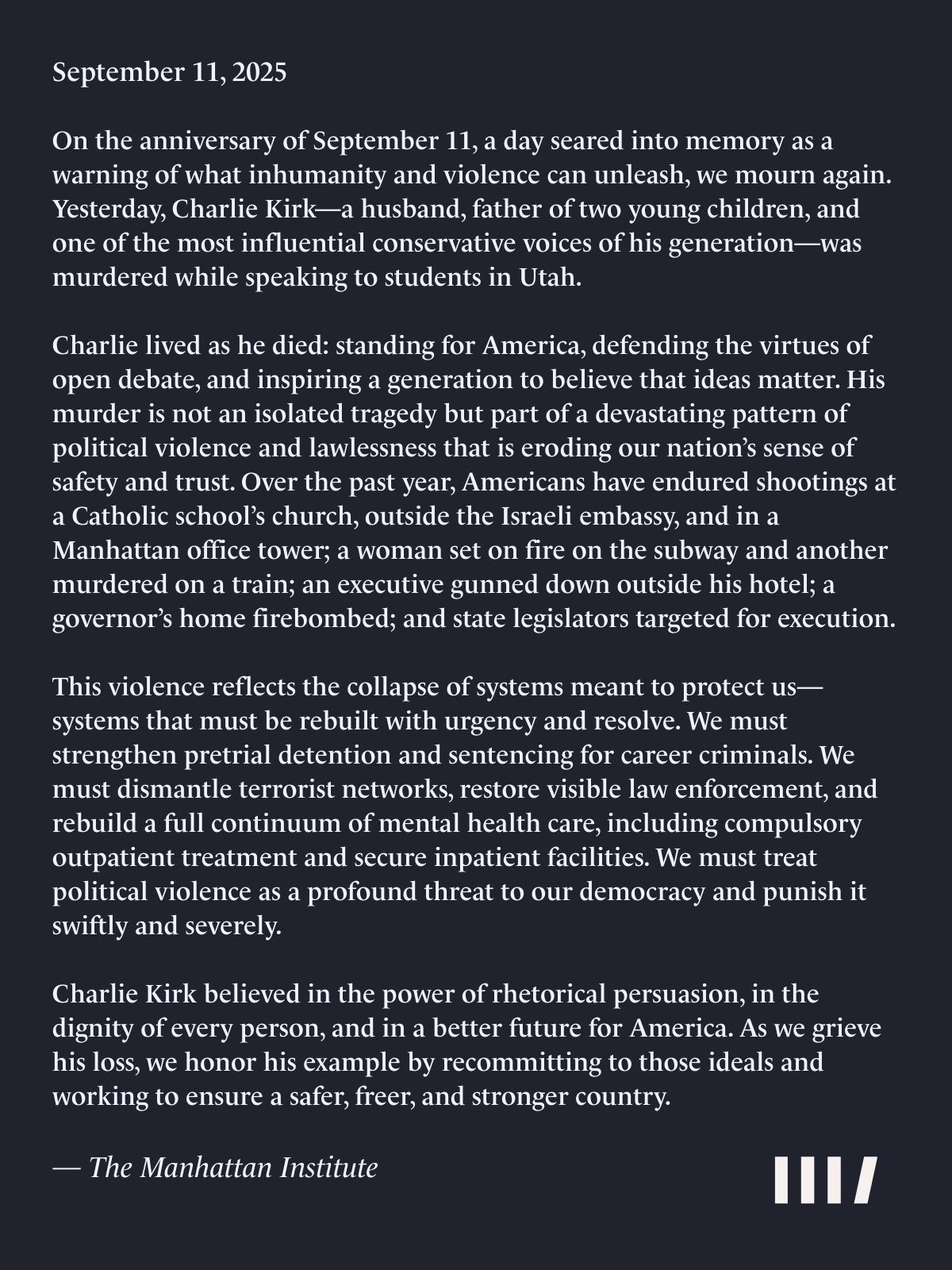
On the afternoon of Wednesday, September 10, Charlie Kirk, the founder of Turning Point USA, was assassinated.
Kirk was at Utah Valley University, the first stop on his latest nationwide campus speaking tour. He was a well-known figure on college campuses across the country, posted under a modest collapsible canopy in the open air and willing to talk and debate with anyone who stepped up to a microphone.
As the innumerable tributes to his character and influence attest, Kirk had a larger-than-life role in shaping the modern conservative movement, especially among young people. Kirk wasn’t a politician, or a lawmaker, or a government official. He spoke for a living. He persuaded. His shocking murder should be watershed moment in America’s commitment to punish political violence and restore the institutions and principles of a safe, free society.
Kirk’s alleged killer is only 22 years old, a young man. At this point, we have no reason to think his upbringing was anything but normal and respectable. But something clearly went wrong with the young man’s moral education. In The Free Press, Abigail Shrier urges parents to confidently and seriously take responsibility for transmitting their beliefs and values to their children. Radicals, influencers, colleges, and the innumerable bad actors targeting our children won’t be shy about inculcating every young mind they can find with the beliefs and motivations that may have led to the murder of Charlie Kirk.
Good people and good Americans must not be embarrassed or hesitant to pass on their values to their children. Otherwise, we will lose our political, intellectual and moral inheritance.
The murder of Charlie Kirk should be a wake-up call for us to embrace the ideals of the American Founders, writes Josh Appel in City Journal. The American Revolution led to the creation of the world’s most prosperous and free nation, while the French Revolution resulted in terror, chaos, and authoritarianism. That is because the American Founders were not trying to create a new world order. Instead, they acted to preserve their existing liberties and work gradually toward a more perfect union rooted in the natural law.
The alternative to working within the existing constitutional framework is intimidation, violence, and disorder. In The Free Press, Charles Fain Lehman warns that Americans are increasingly inured to seemingly random violence. But these shocking killings are the result of public policy failures and our leaders’ poor decisions—the decision not to incapacitate and deter criminals, the decision not to assert that the law should be followed.
Part of this reluctance of our policymakers to enforce the law comes from a misguided impulse to not stigmatize the lawbreaking and seriously mentally ill. But the public has a better understanding of the true connection between untreated mental illness and violence than the activists and the ideologues, Stephen Eide writes in City Journal.
Before we go, the Manhattan Institute is proud to announce that senior fellow and director of Legal Policy James R. Copland has been appointed to the Securities and Exchange Commission’s Investor Advisory Committee. This committee advises the Commission on priorities to protect investors and strengthen U.S. securities markets. There are many more insights from our scholars, including Allison Schrager on the American retirement system and Danny Crichton on autonomous vehicles, in the newsletter below.
Kelsey Bloom Editorial Director |
|
|
Rethinking Retirement: A Four-Pillar Framework for Security and Sustainability
By Allison Schrager | Manhattan Institute
Americans are entering retirement with more wealth than any previous generation—yet most still worry that they will never have enough. This widespread anxiety stems from an outdated and unsustainable retirement system. Social Security is running out of money, 401(k)s aren’t designed to provide steady income, and many older Americans who want to work face needless obstacles.
In a new Manhattan Institute issue brief, Allison Schrager proposes a modern, four-pillar model for retirement security: - Mandatory state benefit (Social Security): Stabilize the program by gradually raising the retirement age, slowing benefit growth for high earners, and modestly raising taxes—while preserving its role as a universal, redistributive safety net.
-
Secure income from retirement accounts: Make it easier for workers to turn 401(k)s and IRAs into annuities or bond ladders that deliver steady, inflation-protected payouts.
- Market-based savings: Preserve flexibility to keep some assets in riskier, liquid investments for discretionary spending, medical expenses, or inheritance—while helping households weigh the right balance between risk and security.
-
Part-time work: Remove regulatory and tax barriers that discourage older Americans from working part-time, as contractors, or in flexible arrangements.
These reforms don’t require massive new spending. With smarter design and modest policy changes, the U.S. can deliver greater stability, choice, and opportunity for retirees—while putting the entire system on a more sustainable fiscal path. |
|
|
Parent Your Kids By Abigail Shrier | The Free Press
“By all accounts, the parents of the man who allegedly murdered Charlie Kirk are good people, decent enough that the suspect’s father reportedly helped turn in his own son to the authorities. The father’s act was righteous and, very likely, excruciating. ... The single most important job of any parent—to raise good people—is one so many of us are failing. ... “If you catch your own child at a prestigious university marching for hate or the destruction of the United States, don’t act as if you’re helpless. Stop sending tuition checks. Stop paying for that smartphone. If your child is already a young adult and intent on promoting hate, tell them: I’ll no longer be paying for it. “Want good, strong kids? Show them what self-respect looks like. It is still a free country. Show them what it means to be free.” |
|
|
Don’t Tolerate Disorder
By Charles Fain Lehman | The Free Press
“Millions of Americans were shaken last week by two horrific videos, which seemed to play in an endless loop on social media. The first was camera footage of last month’s fatal stabbing of Ukrainian refugee Iryna Zarutska on a Charlotte, North Carolina, train by a schizophrenic repeat offender. The second, of course, was the assassination of Charlie Kirk on Wednesday. ...
“Civility is only possible if we are civilized. Charlie Kirk was assassinated because his killer believed that violence was an appropriate retort to arguments. ... Political violence cannot coexist with the speech and debate that are the lifeblood of a functioning democracy. Either you have a ballot box or you have a bullet. You can’t have both. “Promoting civil discourse—as Kirk did, and as many Americans now claim to want to do—means promoting civility. Until we stop defining deviancy down, we should expect violent death to remain horrifyingly normal.” |
|
|
America’s Mental-Health System Betrayed Iryna Zarutska
By Stephen Eide | City Journal
“Charlotte appears to be a case where mental illness directly caused murder. While mental illness sometimes plays an indirect role in such crimes—by destabilizing someone’s life and putting him in circumstances, such as street homelessness, where violence is more likely—in other cases it inspires a person to act violently in response to a delusion. ...
“The link between serious mental illness and violence is clear to researchers and the public. Advocates reject it, however. They argue that perpetuating myths about the connection between mental illness and violence causes stigma, which in turn explains why mental illness often goes untreated.
“That’s doubly misleading. First, the mentally ill fail to seek treatment for many reasons other than stigma. Second, to the extent stigma is a problem, it’s caused by truth, not fiction. No one who viewed the video of the stabbing that Charlotte city government tried to repress will believe that Iryna Zarutska died because of society’s bigotry towards the neurodivergent.”
|
America Must Choose Reform Over Radicalism By Josh Appel | City Journal “Today’s political violence carries the same revolutionary fervor of eighteenth-century France. The disparate acts of violence across the country reflect a deep disdain for American institutions and the desire to transform American society.
“Whether an assassin targets a conservative commentator like Kirk or a health-care executive like (Brian) Thompson, the underlying motivation is the same: violence has become a moral imperative. The lesson is that when we lose faith in our institutions and political leaders, we reject the ideology behind the American Revolution and instead resort to the politics of bitterness—the violent French Revolution. ... “The choice before us is stark. We can follow the American model—defending our institutions while working to reform them, preserving the constitutional framework that has delivered unprecedented prosperity and freedom. Or we can slide into the French pattern—viewing violence as justified when institutions fail to meet our expectations, treating every political opponent as an enemy to be eradicated.” |
|
|
“Autonomous vehicles have shown across millions of driven miles that they're statistically safer than humans, particularly in dense urban environments where pedestrians, bikes, buses, delivery trucks, and cars readily intermix.” |
|
|
For more information and media requests, please contact
communications@manhattan.institute.
Are you interested in supporting the Manhattan Institute’s public-interest research and journalism? As a 501(c)(3) nonprofit, donations in support of MI and its scholars’ work are fully tax-deductible as provided by law. |
|
|
Photo Credits: adamkaz/E+/Getty Images; Noah Berger/AP Photo; Anadolu/Getty Images; Wong Yu Liang/Getty Images; Catherine McQueen/Getty Images; Probal Rashid/LightRocket/Getty Images |
|
|
The Manhattan Institute works to keep America and its great cities prosperous, safe, and free. Manhattan Institute 52 Vanderbilt Ave. 3 floor New York, New York 10017
Want to change how you receive these emails?
Unsubscribe | Subscription Preferences
Copyright © 2025 Manhattan Institute, All rights reserved. |
|
|
|