Good morning:
Today, the Manhattan Institute published a new report by fellow Carolyn Gorman on the use—and misuse—of campus mental health services in the United States. Gorman investigates the roots of these services and finds them distinctly rooted in Progressive-era movements that believed society could be improved through psychological intervention and mental hygiene. That’s as nebulous as it sounds and, consequently, mental health services expanded dramatically over the recent decades. But don’t misunderstand what support this includes: Mental health services offered on college campuses today generally are more akin to a student experience amenity than to health care.
Colleges and universities must make it clear to students that higher education is not a stress-free experience. The intellectual life is a contact sport. While schools must meet their legal obligations to serve students with genuine disabilities, school administrators must tell scholars and their families that a college experience is one that expects students to be able to overcome and work through challenges.
Indulging and pacifying the false belief that college students and young Americans are psychologically fragile has political consequences, especially for traditional American ideals including free speech and reasoned debate. The culture of campus life may be, in part, what leads to the conclusion in senior fellow Robert Henderson’s recent column in the Wall Street Journal, that the most empathetic people also have lower emotional stability and are more likely to see themselves as victims in everyday life. Henderson highlights a study that finds “people higher in the belief that words can harm tended to be younger, female, non-[w]hite, and politically liberal.” These supposed empaths “rated themselves as higher in intellectual humility, empathy, moral grandstanding, and the belief in the importance of silencing others.”
In other words, people who believe words can be harmful are likely to support policies that limit speech they disagree with and support censorship.
When the Manhattan Institute’s Adam Smith Society attempted to host writer and conservative commentator Ben Shapiro at the University of Pennsylvania earlier this year, the students ran into bureaucratic hurdles that they report seemed like efforts of censorship. Thankfully, the remarks—title “Why Capitalism Makes America Great”—proceeded last week. You can watch the full address below.
Elsewhere in this newsletter, fellow Charles Fain Leham writes in the Washington Post about supervised drug consumption sites, also known as “harm reduction centers,” and why providing people a place to ingest a user’s illegal drug of choice (including across the street from a day care, in the case of one such site in East Harlem) breaks federal law and does not prevent as many overdoses as the supporters claim.
Finally, in City Journal, Ken Girardin and Jared Walczak debunk the arguments in favor of New York Governor Kathy Hochul and NYC Mayor Zohran Mamdani’s new pied-à-terre tax. And Christopher F. Rufo and Susan Crabtree investigate how California Gov. Gavin Newsom used the 2 million unlawful immigrants as pawns in an effort to not only advance an open-borders political agenda but also maintain the flow of funds to left-wing activists.
Continue reading for all these insights and more. Kelsey Bloom Editorial Director |
|
|
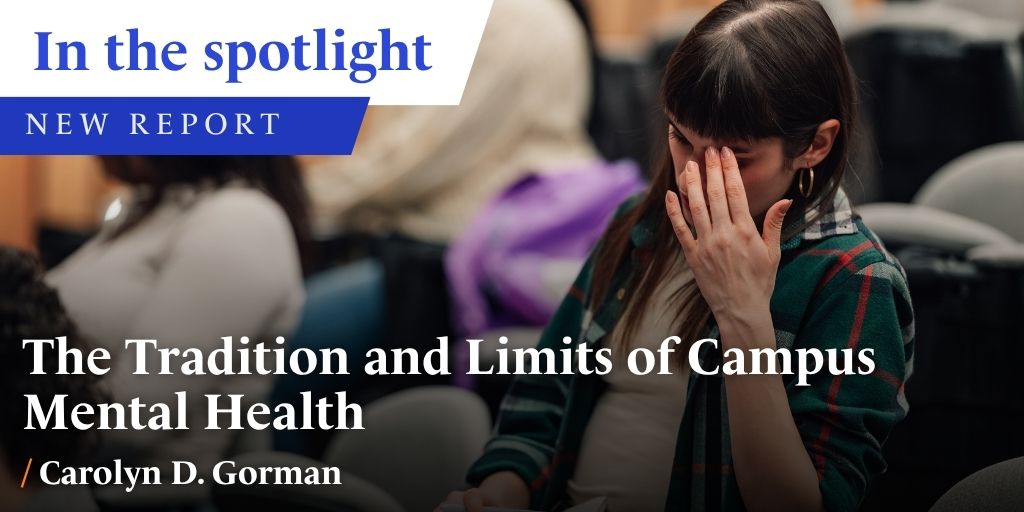
The Tradition and Limits of Campus Mental Health
By Carolyn D. Gorman | Manhattan Institute | Photo by Noko LTD/E+ via Getty Images
Campus mental health services have expanded dramatically in recent decades, becoming a near-universal feature of American higher education. But despite their prominence, these programs have unclear goals and little evidence of broad effectiveness.
In a new report, Carolyn Gorman traces the roots of campus mental health services to Progressive-era movements that emphasized prevention, adjustment, and vocational guidance rather than treatment of serious mental illness. As a result, today’s counseling centers largely focus on everyday “problems of living,” offering talk therapy and wellness programming to a minority of students, often without a clear, unified purpose or standard of success.
There is little indication that these services have improved overall well-being or academic outcomes. Indeed, the modern emphasis on mental health may be counterproductive, encouraging students to interpret normal challenges as clinical issues. At the same time, broad mental health frameworks create legal risks by expanding institutions’ exposure to disability claims. Colleges, Gorman concludes, should reconsider the services that they offer and focus instead on academic rigor, civic development, and measurable outcomes.
|
|
|
‘Safe Drug Sites’ Don’t Work. The Data Proves It.
By Charles Fain Lehman | The Washington Post | Photo by Kent Nishimura / Los Angeles Times via Getty Images
“As America’s drug crisis has claimed the lives of nearly a million people over the past decade, cities and states, supported by the federal government under the Biden administration, have embraced ... supervised consumption sites. Also known as harm reduction centers, these facilities provide people with a place to use their drug of choice in the presence of staff armed with overdose-reversing naloxone. ... The problem is these facilities don’t work, disrupt communities and are clearly illegal under federal law. ...
“Defenders of the facilities generally point to the number of overdoses reversed at the centers as evidence that they save lives. ... [But] a death delayed is not a death prevented. If someone overdoses at a site and is revived, but then overdoses elsewhere later in the day, the site did not have a protective effect. ... This reality helps explain why a large body of research has found that the sites have no effect on the rates of non-fatal overdoses or overdose deaths.” |
The Empathy of the Intolerant
By Robert Henderson | The Wall Street Journal | Photo by Alina Barilo via Getty Images
“People who believe words can harm report stronger concern for others and a greater desire to protect the vulnerable. At the same time, they exhibit lower emotional stability and a greater tendency to see themselves as victims in everyday conflicts. Moreover, they report higher levels of anxiety and depression.
“In other words, people who view themselves as highly compassionate also tend to be more volatile and psychologically fragile. This combination has real effects on society. The researchers [of one study] find strong links between believing that words can harm and supporting policies that limit speech. ...
“There is a certain irony in the finding that the most empathic people support the least tolerant policies. Compassion, expressed through a broad and ever-expanding conception of harm, becomes a mechanism for control. The path forward requires something other than empathy: the willingness to let others be offended.” |
|
|
Why the Pied-à-Terre Tax Misses the Real Problem
By Ken Girardin & Jared Walczak | City Journal | Photo by Alex Brandon-Pool/Getty Images
“Governor Kathy Hochul and Mayor Zohran Mamdani celebrated Tax Day last week by jointly announcing plans to hike taxes. The pair’s proposal would let New York City impose a new surtax on houses and apartments valued at over $5 million if their owners don’t list them as their permanent residence. ...
“Property taxes are a mainstay of local government finance in part because of their stability. ... A pied-à-terre tax, however, introduces volatility because it’s binary: if values fall and a home previously subject to the tax slips below $5 million in value, that home is exempted from the tax. That creates an incentive for challenging valuations or gaming the system. ... A pied-à-terre tax is also the sort of tax residents are likely to change their behavior to avoid. ... “Until the mayor can make a compelling case that New Yorkers are getting their money’s worth from existing municipal taxes, residents will rightly worry that city officials are cooking up more new taxes.” |
How Gavin Newsom Subsidized the Migrant Invasion
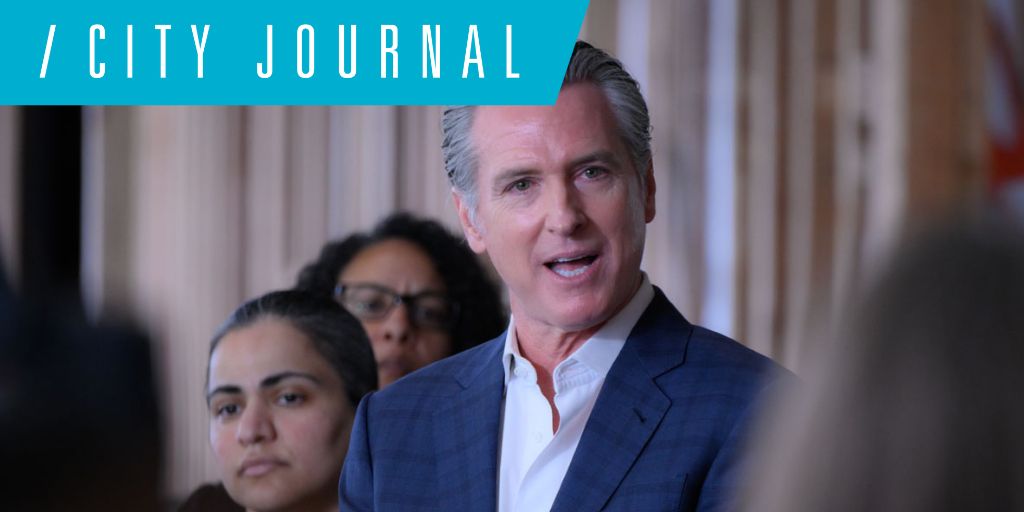
By Christopher F. Rufo & Susan Crabtree | City Journal | Photo by Tayfun Coskun/Anadolu via Getty Images “California was ground zero for the Biden-era migrant wave. The state saw an enormous number of people cross its border, including more than 400,000 illegal immigrants between 2021 and 2023 alone. ...
“Once unauthorized people have crossed the border, Governor Newsom has sought to ensure that they don’t get turned away. Since the beginning of his term, he has granted more than $100 million to nonprofits that fight deportation orders—sometimes even for clients with criminal convictions. ... The final part of Newsom’s illegal immigration machine is the activist element, which is designed to resist federal authorities who would challenge California’s status as a ‘sanctuary state.’ ... “Who benefits from this system? Certainly, the migrants who entered the United States without documentation and would like to stay. But also, and perhaps more importantly, the army of nonprofits, lawyers, activists, and bureaucrats who keep the system running—and keep politicians like Newsom in power.” |
|
|
The Case for High IQ Conservatism
By Adam Smith Society in collaboration with YAF/Young America's Foundation Last week, the Adam Smith Society's Penn (Wharton) chapter, in partnership with Young America's Foundation, welcomed The Daily Wire co-founder Ben Shapiro for a thought-provoking keynote titled “Why Capitalism Makes America Great.”
The event concluded with a live audience Q&A, giving attendees the opportunity to engage directly with the ideas and arguments presented. |
|
|
For more information and media requests, please contact
communications@manhattan.institute.
Are you interested in supporting the Manhattan Institute’s public-interest research and journalism? As a 501(c)(3) nonprofit, donations in support of MI and its scholars’ work are fully tax-deductible as provided by law. |
|
|
Photo Credits: adamkaz/E+/Getty Images; Noah Berger/AP Photo; Anadolu/Getty Images; Wong Yu Liang/Getty Images; Catherine McQueen/Getty Images; Probal Rashid/LightRocket/Getty Images |
|
|
The Manhattan Institute works to keep America and its great cities prosperous, safe, and free. Manhattan Institute 52 Vanderbilt Ave. 3 floor
New York, New York 10017
Want to change how you receive these emails?
Unsubscribe | Subscription Preferences
Copyright © 2026 Manhattan Institute, All rights reserved. |
|
|
|