Portland City Elections Toward Two Parties, More, or None?

Photo: EyeWolf / Moment via Getty Images
This paper was originally published by the American Enterprise Institute.
Introduction and Key Points
- Portland, Oregon, first used its new proportional ranked-choice voting electoral system to elect city council members in November 2024.
- A variety of groups endorsed candidates in this nonpartisan election.
- Analyses of these groups’ endorsements point to the emergence of four political blocs: national progressivism, pro-business pragmatism, local progressivism, and laborism.
- It is not yet clear what style of politics will emerge in future elections. Possibilities include local multi-partism, local bi-partism based on coalition parties, and continued fluidity, including within the blocs themselves.
- Portland’s urban politics may prove unstable and feature shifting alliances among these groups in the run-up to subsequent elections.
In November 2024, voters in Portland, Oregon, elected their first city council under a system of proportional ranked-choice voting or single transferable vote (STV). Other than in Cambridge, Massachusetts, this was the first election in a major US city using such a system since the early 1960s.[1] This new system, which emerged from a 2022 charter revision process, also increased the size of the council from four legislators (plus a mayor) elected citywide to 12 council members elected from four districts.[2]
What kind of coalition politics might Portland’s new electoral rules produce? This question is worth asking because electoral systems shape party systems, including at the local level and even where elections are nonpartisan on paper.
Years ago, systems like the one now used in Portland were central to a debate about how to structure local elections. That debate ended with experts concluding that STV (then called “proportional representation”) “breaks down party control of nominations and permits mavericks who owe nothing to party leaders to win office.”[3] One can question the merits of having “party leaders” run local politics, but the broader point was about cities’ ability to make and implement potentially controversial policies. Portland’s use of STV brings these issues back into focus.
To get a sense of the current situation, this report analyzes the endorsements of interest groups and political parties in the November 2024 elections. Such entities have a long history of structuring local politics, including under nonpartisan elections, as exist in Portland.[4] Our analysis suggests two axes of electoral competition, plus potential cooperation between some business and labor groups. That kind of cooperation has precedent in urban politics and public policy.[5]
It is too early to predict the style of coalition politics this new system will foment. In the short run, its central features—an expanded city council, multi-seat electoral districts, ranked voting, and nonpartisan elections—may well produce unstable politics with shifting alliances among interest groups. In what follows, we refer to clusters of similarly behaving interest groups as blocs. These may or may not represent formalized alliances. Blocs, then, may add up (or not) to majority-seeking coalitions.
In the long run, other American cities’ experiences with STV suggest three possible political trajectories. A city’s politics might evolve into a two-party system that does not track the Democratic-Republican divide typically found in state and national politics. This could involve the formation of one or more local coalition parties that unite blocs. Another possible future is the emergence of multiparty competition. A third trajectory is that the STV system could get repealed quickly or significantly altered should political parties, party factions, or interest groups find that the electoral system frustrates their pursuit of power and policymaking.[6]
Portland’s New Election System
STV is popular among reformers as a form of proportional representation that accommodates nonpartisan elections. This is mainly because it does not make a vote for one candidate count for that candidate’s party slate. All other proportional representation systems have this property and allocate seats to preelection lists (usually parties) in proportion to their vote shares.[7]
STV first asks voters to rank candidates in order of preference. Then a quota (Q) or “victory threshold” is calculated from the total number of valid ballots (V) and the number of seats to fill (M), so that
Q = [V / (M + 1)] + 1.
Second, first-choice votes are totaled. Any candidate with more than a quota is elected. Votes in excess of a quota transfer to the next-ranked picks on each ballot. If no candidate has a quota, the trailing candidate is eliminated, and ballots in their “pile” transfer to the next-ranked pick on each ballot.[8] For any candidate with more votes than the quota, each ballot in their pile transfers to the next-ranked candidate at a fraction of its value. (This fraction represents the portion of a vote that has not already elected some candidate.) The second counting round begins by consulting the number of votes in each continuing candidate’s pile. This process repeats until all seats in the district are filled.
Portland uses STV in four multi-seat districts. Each elects three people to the 12-seat city council. From 2026 onward, elections will be staggered so that two districts elect their members every four years. The mayor is elected separately from the council.
The combination of institutions in Portland is new, but each on its own has been used with STV in the past. For example, Boulder, Colorado, held staggered STV elections in a nine-seat council-manager system from 1917 to 1947. Cleveland and West Hartford, Connecticut, used STV in multiple multi-seat districts in the 1920s, also under a council-manager form of local government. Most other historical cases used STV to elect councils of seven or nine seats in citywide districts, alongside council-manager government. Only New York City used STV with a separately elected mayor (from 1937 to 1947).[9]
The municipal party systems that resulted from STV were mostly a function of whatever coalition had imposed it. Early adopters were notable for a lack of obvious party competition, plus the occasional Socialist member of city council. These early cases were short-lived and subject to quick repeal.[10]
In later cases, STV produced two-sided competition between the remnants of displaced party machines, on the one hand, and bipartisan coalitions of pro-reform party factions, on the other. Cambridge, Massachusetts, still uses STV and followed this pattern into the 1960s at least. New York City stood out for its visibly multiparty politics. Initially, the system pitted the Democratic Party against groups that had backed Mayor Fiorello LaGuardia in his 1933 mayoral election: Republicans, Laborites, and lingering Progressive Republicans.
The literature on interest groups in historical cases is thin, but some notable themes repeat. One concerns the players: Formal party organizations, good-government nonprofits, real estate interests, industry leaders, business associations, and labor unions all appear. The other theme is political instability—some groups switch sides from election to election, and others (like labor) sometimes split their support between opposing coalitions in the same election.[11] And over the long run, the political support that led to the establishment of STV systems in major American cities crumbled. Recent analysis of roll call data from three cities suggests some conflicts turned on issues of taxation, zoning, and city planning.[12]
Emerging Political Blocs
Political blocs may form when groups find a shared, preferred candidate or issue. Hence, this report looks for coalition formation in the groups’ endorsements of candidates for the city council.
Specifically, we identified social and political organizations that play a significant role in political and governing discourse in Portland (or state and local chapters of such national interest groups) by cross-referencing organizations in Rose City Reform’s candidate endorsement data with news coverage from major publications in the region, such as The Oregonian and Oregon Public Broadcasting (Table 1).
Table 1
List of Endorsing Organizations and Acronyms
| Organization Name | Acronym |
| American Council for Palestine | ACP |
| American Federation of Teachers–Oregon | AFT |
| Independent Party of Oregon | IPO |
| International Brotherhood of Electrical Workers Local 48 | IBEW |
| Joint Council of Teamsters No. 37 | Teamsters |
| Laborers’ International Union of North America, Local 737 | LiUNA |
| Multnomah County Republican Party | MCRP |
| Oregon American Federation of State, County and Municipal Employees Council 75 | AFSCME |
| Oregon Progressive Party | OPP |
| Portland Democratic Socialists of America | DSA |
| Portland for All | PfA |
| Portland for Bernie | BerniePDX |
| Portland Metro Chamber | PMC |
| Portland Neighbors Welcome | PNW |
| Portland Police Association | PPA |
| Revitalize Portland Coalition | RPC |
| Service Employees International Union Local 503 (Oregon State Council) | SEIU |
| Sierra Club | SC |
| Sunrise Movement PDX | SM |
| The Oregonian | Oregonian |
| The Street Trust | ST |
| United for Portland | UfP |
| Washington County Democrats | WCD |
| Working Families Party | WFP |
We then accessed and tracked each organization’s endorsements in the city council election. Several organizations (e.g., Portland Democratic Socialists of America and the Portland Metro Chamber) green-lit a larger number of candidates than those they formally endorsed. Such green-lighting can be thought of as giving soft approval. Some organizations also “red-lit” candidates, meaning they did not want voters to support (i.e., rank) them at all. Our analysis incorporates all this information.
Figure 1 plots the coalitional alignment of endorsing organizations. Endorsers that appear closer together on the plot tended to endorse the same candidates. This plot is based on a principal components analysis of the endorsement data.[13] Readers may find it useful to think of this as similar to methods that measure left-right ideology in Congress and other legislative bodies. Such measures use legislators’ observed positions on issues to place them on a scale that often gets interpreted as running from liberal to conservative.
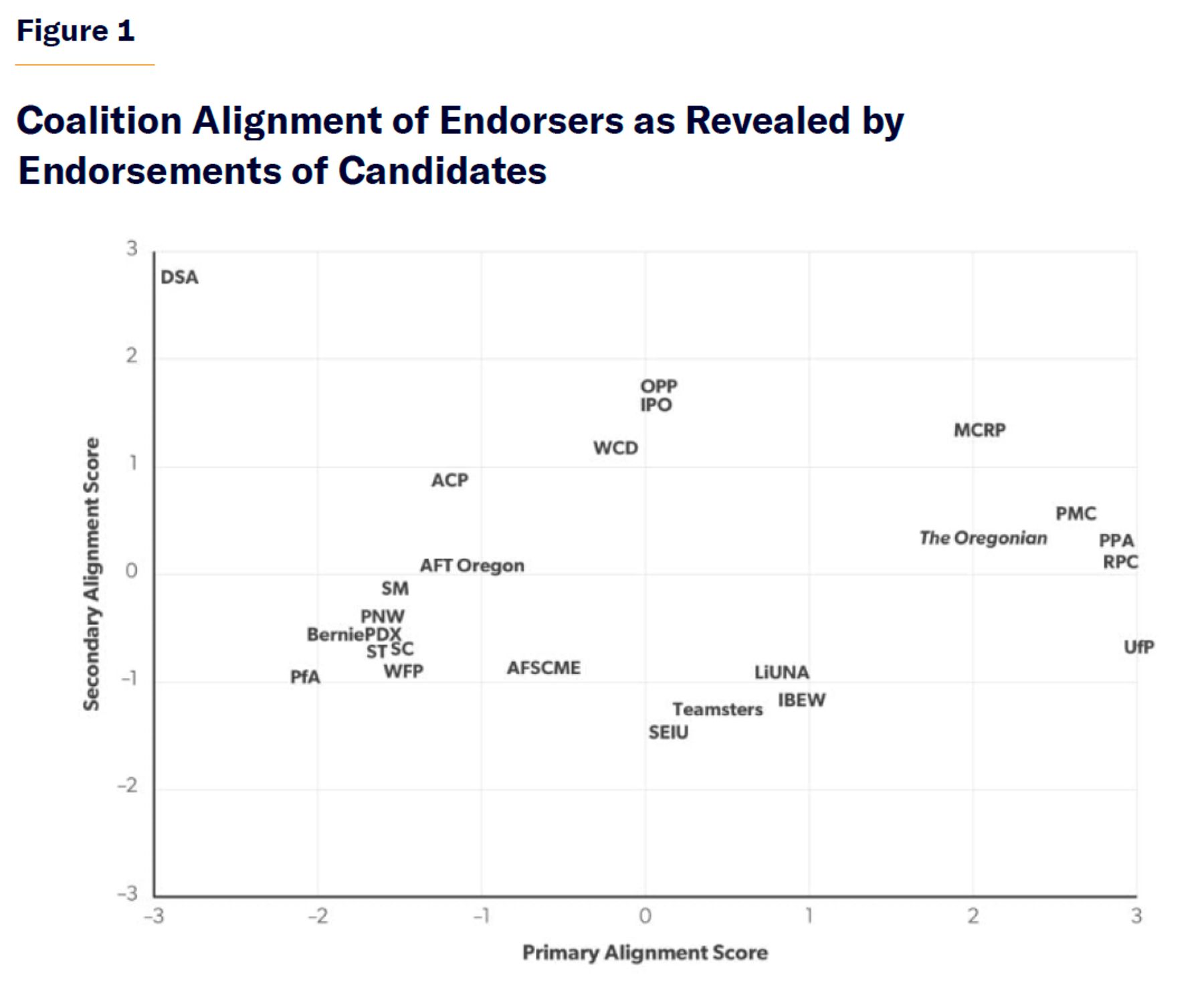
Figure 1 reveals a clear left-right divide among the organizations. For example, the Multnomah County Republican Party and numerous business associations and pro-business organizations land toward the right (represented by scores above in the direction of 3), while a variety of social and political organizations and unions fall on the left (represented by scores toward −3). Scores themselves should not be interpreted as concrete measures of ideology. For example, the SEIU’s first-dimension score just to the right of zero does not mean that it is “centrist” in any objective sense of the term. Rather, the scores taken together capture organizations’ positions relative to each other, given the set of candidates they could endorse.
The figure also captures divisions, particularly among left-of-center organizations, between those that focus on national versus local issues. High scores reflect a heavier focus on nationally salient political issues, while lower scores indicate a focus on issues salient in local Portland politics. For example, the Oregon Progressive Party scores highly on the y-axis, advocating for national issues like campaign finance reform and national, single-payer health insurance.[14] Lower-scoring groups, such as the Service Employees International Union’s Oregon State Council, by contrast, emphasized alignment with their local policy and outcome desires (e.g., better pay, benefits, and working conditions for their members) as a key consideration in their endorsement process.[15]
Some groups may list priorities on issues that have national salience but propose implementation tailored to local conditions. Portland for All, for example, lists as a priority supporting climate resilience and the need for a Green New Deal in Portland. But this policy priority is locally focused because it manifests in support for programs that provide air conditioners and increase homes’ weather resilience.[16]
Table 2 introduces bloc-level success in seating candidates on the city council. Table 3 lists the success rates at the organization level. These rates gauge each bloc’s centrality to a potential emerging majority coalition. In both tables, blocs with higher success rates may be viewed as more central to whatever majority-seeking coalitions might be emerging.
Figure 1 also suggests four general blocs. One comprises the Portland chapter of Democratic Socialists of America, the American Council for Palestine, the Oregon Progressive Party, the Independent Party of Oregon, and the Washington County Democratic Party.[17] This grouping can be thought of as representing the national progressive left. These organizations tend to focus on issues salient in national politics or on local issues in ways that extend beyond the scope of local Portland politics.[18] While the Independent Party of Oregon—which fashions itself as a centrist political alternative to the Democratic and Republican Parties—appears in the scatterplot to be aligned with this bloc, the three candidates it endorsed were also endorsed by the Oregon Progressive Party. Organizations in this bloc endorsed 32 candidates, eight of whom won (26 percent), the lowest of the four coalitional blocs (Table 2).
Table 2
Success Rates of Endorser Blocs
| Bloc | Description of Political Coalition | Organizations in Bloc | Endorsements Made | Winners | Success Rate (Percentage) |
| 1 | National Progressivism | American Council for Palestine, Democratic Socialists of America, Oregon Progressive Party, Independent Party of Oregon, Washington County Democratic Party | 31 | 8 | 25.8 |
| 2 | Pro-Business Pragmatism | Portland Metro Chamber, The Oregonian, Portland Police Association, Revitalize Portland Coalition, United for Portland, Multnomah County Republican Party | 89 | 28 | 31.5 |
| 3 | Local Progressivism | American Federation of Teachers–Oregon, The Street Trust, Portland Neighbors Welcome, The Sierra Club, Sunrise Movement–Portland, Portland for All, Portland for Bernie, Working Families Party | 112 | 45 | 40.2 |
| 4 | Laborism | Oregon American Federation of State Council 75, County and Municipal Employees– Oregon; Service Employees International Union Oregon State Council; Laborers’ International Union of North America–Oregon; International Brotherhood of Electrical Workers Local 48; and Joint Council of Teamsters No. 37 | 66 | 29 | 43.9 |
Source: Authors’ calculations using Rose City Reform data and Portland election results.
Table 3
Success Rate of Endorsing Organizations
| Organization | Bloc | Endorsements Made | Winners | Success Rate (Percentage) |
| ACP | 1 | 13 | 4 | 30.8 |
| DSA | 1 | 8 | 3 | 37.5 |
| IPO | 1 | 3 | 0 | 0 |
| OPP | 1 | 4 | 0 | 0 |
| WCD | 1 | 3 | 1 | 33.3 |
| MCRP | 2 | 13 | 2 | 15.4 |
| The Oregonian | 2 | 12 | 5 | 41.7 |
| PMC | 2 | 12 | 5 | 41.7 |
| PPA | 2 | 13 | 5 | 38.5 |
| RPC | 2 | 15 | 5 | 33.3 |
| UfP | 2 | 24 | 6 | 25 |
| AFT | 3 | 11 | 6 | 54.5 |
| BerniePDX | 3 | 17 | 5 | 29.4 |
| PFA | 3 | 18 | 6 | 33.3 |
| PNW | 3 | 13 | 5 | 38.5 |
| SC | 3 | 13 | 5 | 38.5 |
| SM | 3 | 11 | 5 | 45.5 |
| ST | 3 | 16 | 6 | 37.5 |
| WFP | 3 | 13 | 7 | 53.8 |
| AFSCME | 4 | 13 | 5 | 38.5 |
| IBEW | 4 | 13 | 5 | 38.5 |
| LiUNA | 4 | 11 | 6 | 54.5 |
| SEIU | 4 | 14 | 7 | 50 |
| Teamsters | 4 | 15 | 6 | 40 |
Source: Authors’ calculations using Rose City Reform data and Portland election results.
A second bloc—composed of The Oregonian and business associations such as the Portland Metro Chamber and Revitalize Portland Coalition—represents a business-friendly voice that emphasizes promoting economic growth. Along with Portland’s police union (the Portland Police Association), this bloc tended to endorse candidates who emphasized a need to reduce crime and make Portland more business friendly.
District 2 candidate and incumbent Portland City Commissioner Dan Ryan, for example, was endorsed by every organization in this bloc and provides a good example of the type of candidate that organizations in this bloc tend to endorse. As city commissioner, Ryan cast the deciding vote against an $18 million cut to the Portland Police Department.[19] His campaign criticized[20] the negative effect on public safety of Oregon’s Measure 110—the ballot measure passed by Oregon citizens in 2020 that decriminalized possession of hard drugs[21]—and prioritized the need to alleviate the tax burden on citizens and businesses while revitalizing downtown Portland.[22]
Candidates such as Ryan tend to appeal to a potential coalition that the Manhattan Institute calls the “metropolitan majority”—a racially, ethnically, and ideologically diverse set of urban residents who, in the context of local politics, care about economic and educational opportunities and public safety.[23] This political bloc endorsed 89 candidates, 28 of whom won seats (around 31.5 percent).
A third bloc captures a diverse mix of organizations, including environmental organizations with national reach such as the Sierra Club and the Sunrise Movement and local organizations such as Portland Neighbors Welcome, The Streets Trust, and Portland for All, which aim to make Portland a more accessible and affordable place to live. While similar to the first bloc in its progressivism, organizations in this third bloc tend to be more focused on issues specific to Portland—such as protecting local parks and improving public transportation—or on issues that tend to be managed by local or municipal government. Portland for Bernie is aligned more with this bloc than with the national progressives. The group was established to support Sanders’s presidential candidacy but shifted to “helping local progressive candidates and causes” after the national Democratic Party allied against Sanders’s bid.[24] This bloc was the largest by number of constituent organizations (eight) and endorsements made (112), with a 40.2 percent success rate.
A fourth bloc—composed of unions such as the SEIU, LiUNA, and AFSCME—may be thought of as a labor or “old left” bloc. Among groups to the left of center, organizations in this bloc tended to be the most focused on local bread-and-butter issues, such as infrastructure projects and labor contracts. This bloc had the highest success rate (almost 44 percent) of all four.[25] That rate is unsurprising and in line with previous scholarship on urban politics.[26]
Although Figure 1 shows four largely distinct political blocs, around one-fifth (21 of 98) of the candidates were supported by at least two organizations of two different political blocs. For example, Steve Novick, who was elected to the city council from District 3, received support from numerous organizations in both the pro-business and labor blocs. Candidates who were supported across blocs tended to perform very well (Table 4). Indeed, 10 of the 12 elected council members had support from groups in multiple blocs.[27] Candidates supported by organizations in more than one bloc, yet who did not win a seat on city council, also tended to do better, surviving more rounds of elimination and vote transfer.
Table 4
Number and Success of Candidates Receiving Cross-Bloc Support
| Winners | Losers | Total | Proportion of Winners to Total | |
| Received Cross-Bloc Support | 10 | 11 | 21 | 0.476 |
| Did Not Receive Cross-Bloc Support | 2 | 75 | 77 | 0.026 |
| Total | 12 | 86 | 98 | 0.122 |
| Proportion of Candidates Receiving Cross-Bloc Support to Total | 0.833 | 0.128 | 0.214 | — |
Source: Authors’ calculations using Rose City Reform data and Portland election results.
Cross-bloc support was most common on the “left” as conventionally understood: There were 11 candidates supported by progressive organizations and labor unions. However, this result may be due in part to the large number of organizations in the local progressivism bloc.
The second most common cross-bloc support pattern involved pro-business groups and labor unions (seven candidates). Indeed, many of the unions in the labor bloc—particularly the SEIU, IBEW, LiUNA, and the Teamsters—tended to exhibit high levels of overlap with United for Portland and the Revitalize Portland Coalition, both of which are part of the pro-business bloc (Table 5). For example, the Teamsters and United for Portland shared eight endorsements, meaning that more than half (53.3 percent) of the Teamsters’ 15 endorsed candidates also were endorsed by United for Portland.
Indeed, United for Portland tended to share endorsements with organizations in the labor bloc more than any other pro-business organization. This may be explained by United for Portland’s stated desire to “support candidates that are committed to getting things done,” a clear indication that pragmatism would be one of the most important attributes it looks for in candidates.[28] Similarly, the Revitalize Portland Coalition emphasized pragmatism and collaboration as important factors in deciding candidate endorsements.[29]
Labor-Business Endorsement Overlap
| Labor Organization | Pro-Business Organization | Number of Overlapping Endorsements | Percentage of Labor Endorsements Overlapping with Pro-Business Endorsements |
| SEIU | RPC | 5 | 35.7 |
| SEIU | UfP | 7 | 50.0 |
| IBEW | RPC | 6 | 46.2 |
| IBEW | UfP | 7 | 53.8 |
| LiUNA | RPC | 5 | 45.5 |
| LiUNA | UfP | 6 | 54.5 |
| Teamsters | RPC | 6 | 40.0 |
| Teamsters | UFP | 8 | 53.3 |
| AFSCME | RPC | 2 | 15.4 |
| AFSCME | UFP | 4 | 30.8 |
Source: Authors’ analysis using data from Rose City Reform, The Oregonian, and Oregon Public Broadcasting.
Conclusion
The adoption and use of STV in Portland is a significant development. We collected information on interest groups that were active in the November 2024 elections to see whether a local party system might be forming in response to this development and, if so, what kind. Our analysis of the interest groups’ endorsement behavior points to four discernible blocs along two key dimensions. So far, there are not two coalitions vying for majority status.
The 2022 changes to Portland’s election system were driven largely by a desire to expand the council’s representativeness, particularly in the wake of the George Floyd protests and riots in the city.[30] The increased number of elected seats, the move from at-large to multi-seat districts, and the introduction of STV elections all created greater opportunities for relatively small interests to affect the workings of government. The equity politics propelling Portland’s reforms may differ from many of the reform efforts in the early 20th century, which centered more on shrinking councils, targeting party machines, and, not least, increasing representation of a city’s nondominant major party. Whether the differing politics regarding the adoption of reforms will make Portland’s STV system more durable than other cities’ earlier reforms is unclear.
Notably, none of these other cities’ reforms were intended to alter the nonpartisan character of the city’s elections. Rather, they often introduced nonpartisan elections and STV at the same time. Reformers’ behavior generally disfavored expanded party participation (e.g., by having ballots list party affiliation) and was skeptical of multiparty governance.
The first election under the new system proceeded without significant administrative troubles or controversies, and polling indicated voters were mostly satisfied with ranking their ballots.[31] It also did expand the representativeness of the candidate pool and the resultant council.[32] “Portlanders just used proportional ranked choice voting to elect their most representative city government in more than a century,” observed researchers at the Sightline Institute. “Voters chose leaders who form a portrait of the city in miniature. The dozen councilors include three renters, five people of color, six women, eight millennials (one only 28 years old), and residents of twelve different neighborhoods.”[33]
The increase in the number of council members, as well as the creation of separate districts, can be expected to make the city council’s policymaking more sensitive to neighborhood and racial group demands, which is partly what reformers sought when they abandoned the old system of at-large elections.[34] That means that more neighborhood-based groups will likely organize in hopes of influencing city elections and policymaking.
In the short term, it might be expected that two majority-seeking coalitions could emerge from the current competition among blocs. Similarly, organizations now in one bloc could find reason to join another. One could imagine, for example, one or more labor organizations allying with pro-business pragmatists to endorse candidates who support more government spending on infrastructure and yet are running against candidates supported by environmental groups. New issues can create coalitional schisms.
Political parties, on occasion, evolve from coalitions of the kind we have tried to trace. In the long run, Portland could develop two or more formal parties. Such was the case during the 1920s in Ohio, where weakly structured politics under STV in Cleveland led later reformers in Cincinnati to take party-building seriously.[35] The fragmentation of city power among a dozen council members and a separately elected mayor might frustrate coalition building and yet make it more important to interest-group calculations. A return to staggered elections in 2026 might magnify such dynamics. On the other hand, some groups might turn against STV and attempt to alter or abolish it. Such efforts occurred in most other cities that had adopted STV prior to 1960.[36] If history and this initial analysis are any guide, the continuance of Portland’s new electoral system in its present form is interesting but not assured.
About the Authors
Kevin Kosar is a senior fellow at the American Enterprise Institute, where he studies Congress, electoral reform, and other subjects.
Jack Santucci is a professorial lecturer in political science at George Washington University and an adjunct fellow with the Manhattan Institute for Policy Research.
Jaehun Lee is a research associate at the American Enterprise Institute.
Endnotes
Photo: EyeWolf / Moment via Getty Images
Are you interested in supporting the Manhattan Institute’s public-interest research and journalism? As a 501(c)(3) nonprofit, donations in support of MI and its scholars’ work are fully tax-deductible as provided by law (EIN #13-2912529).