New York City’s Migrant Crisis A Case Study of Welfare Magnet Effects

Photo by Fatih Aktas/Anadolu Agency via Getty Images
Introduction
From 2021 to 2025, millions of migrants entered America via the southern border,[1] but the burden of accommodating them was not shared evenly by communities across the country. New York City, in particular, accepted a disproportionate number of migrants, with nearly 250,000 arriving in the city from spring 2022 through the end of 2025, mostly from Central and South America.
Conventional explanations of migrant settlement do not explain New York City’s experience. Many border cities were also burdened disproportionately, but New York City is not near the border. Cheap housing cannot easily be found in New York, nor can in-group affinity explain the city’s appeal during the recent migrant wave. New York is a sanctuary city, but so are dozens of other cities. New York is a wealthy city but not fast-growing.
The city’s uniquely generous homeless shelter system offers a more convincing explanation for the extensive migrant influx. New York provides shelter on demand, in all seasons, to families and single adults alike, regardless of immigration status. No city in America offers so expansive a “right to shelter.”
Immigration scholars have long debated whether, and to what extent, generous public benefits induce migration. The migrant crisis in New York City presents a case study of this “welfare magnet” hypothesis, demonstrating that certain benefit programs, in some situations, can indeed affect migration. The crisis also offers a case study in how state and local benefit programs can influence the movement of low-income people more broadly.
The most important decisions over immigration policy will be made at the federal level. But as American communities continue to diverge more in their approaches to immigration, the dynamics of state and local benefit programs—which, as the New York City experience shows, can exert a magnet-like effect—will be increasingly important to understand.
Evidence Concerning Welfare Magnet Effects: Immigrants and Native Low-Income Households
Immigrants everywhere use taxpayer-funded benefit programs run by host countries. In the U.S., foreign-born households use such programs at a higher rate than native households.[2] Of the 10 American states with the largest share of foreign-born residents, seven are blue states known for their commitment to social expenditures.[3] But scholars dispute the degree to which access to such programs, relative to other push-and-pull factors, influences immigration flows via so-called welfare magnet effects.
Immigration scholars who dispute welfare magnet effects use two main lines of argument. First, they argue that the pull of benefit programs is weaker than many other factors that attract immigrants, such as employment opportunities.[4] Second, they point out that benefits are typically restricted to those with a certain status or tenure in the country.[5] For these scholars, the welfare magnet effect is portrayed as either impossible because new arrivals are not benefit-eligible, or real but insignificant in accounting for immigrants’ motivations and movements.
Policy debate over immigration is informed not only by scholars’ theoretical and empirical work on welfare magnets but also by moral values. Many who contribute to that debate believe that the U.S. benefits from an expansive immigration policy and that the welfare magnet thesis unfairly stigmatizes immigrants as rent-seekers.[6] But political officials tend to take the risk of welfare magnets seriously. The fact that most governments worldwide place restrictions on immigrant benefit access suggests that magnet effects may pose a real and significant risk.
Welfare magnets have also been long debated for the native low-income population. Native low-income households move less than immigrants but face fewer barriers to benefit access.[7] Indeed, they have a right to move to access other states’ benefit programs. In Shapiro v. Thompson (1969), the Supreme Court prohibited states from imposing “durational residence requirements” on their cash welfare programs. Though such requirements were then, and are now, standard for immigrants and federal programs, the Court ruled that the constitutional right to travel bars states from requiring citizens to reside in-state for a year before accessing benefits.[8]
In the U.S., low-income natives are about as mobile as the nation as a whole.[9] Researchers who dispute welfare magnet effects for the native low-income population point out that they, like immigrants, have many reasons other than benefits for moving. Furthermore, they often move short distances, and the largest benefit differentials exist between states that are distant from one another.[10] One highly cited critical analysis of the welfare magnet thesis from the 1990s found that mobile low-income households mostly moved from one low-benefit southern state to another and rarely from a low-benefit southern state to a high-benefit northern state.[11] Of course, a principal reason for relative parity between neighboring states’ benefit levels at that time might have been states’ fear of welfare magnet effects.
Furthermore, even a relatively small number of low-income natives moving for benefit access still poses a risk to state and local budgets and economic competitiveness, because providing government services for this population is, almost by definition, expensive.
The risk of magnet effects is perhaps most acute when it comes to the homeless population. Data on the mobility of homeless Americans are more limited and less standardized than for the low-income population generally. But some communities have gathered mobility information through their regular “point in time” surveys of the homeless population and found substantial rates of non-locals.[12] Public officials tend to be, if anything, more concerned about magnet effects in the case of the homeless population than in the low-income population generally.[13] Homelessness can be very expensive to address because this population is not only extremely low-income but also beset by high rates of behavioral disorders.[14]
New York’s Migrant Crisis
Immigration scholars tend to debate welfare magnet effects in terms of national benefit programs. But as the debate in native low-income context makes clear, any analysis of immigration welfare magnet effects must account for the highly fragmented nature of the American welfare state. States and localities enjoy leeway to shape some federal programs, such as Medicaid, in addition to funding and operating their own programs.
New York City’s homeless-services system is a large local benefit program. With a population of more than 8 million, New York City is larger than many European countries. In fiscal year 2026, the city’s Department of Homeless Services had a budget of about $4 billion, about equal to the federal government’s main homelessness grant program.[15] The per-year per-client cost of shelter is $98,630 for families with children and $56,487 for a single adult.[16]
New York has traditionally not restricted homeless shelter benefits based on immigration status. Indeed, shelter is a right in New York City; unlike other cities, New York does not have waiting lists for shelters.
New York City’s shelter benefit system was placed under extreme strain by the migrant crisis, which began in spring 2022. At that time, Customs and Border Protection began releasing migrants who had recently crossed the southern border in large numbers instead of detaining them. The first major non-border city to be notably burdened by migrants was Washington, DC. But the flows soon began reaching New York City. In October 2022, New York City Mayor Eric Adams declared a formal state of emergency over the migrant crisis,[17] which afforded city government certain freedoms from regulations on the provision of homeless shelter.
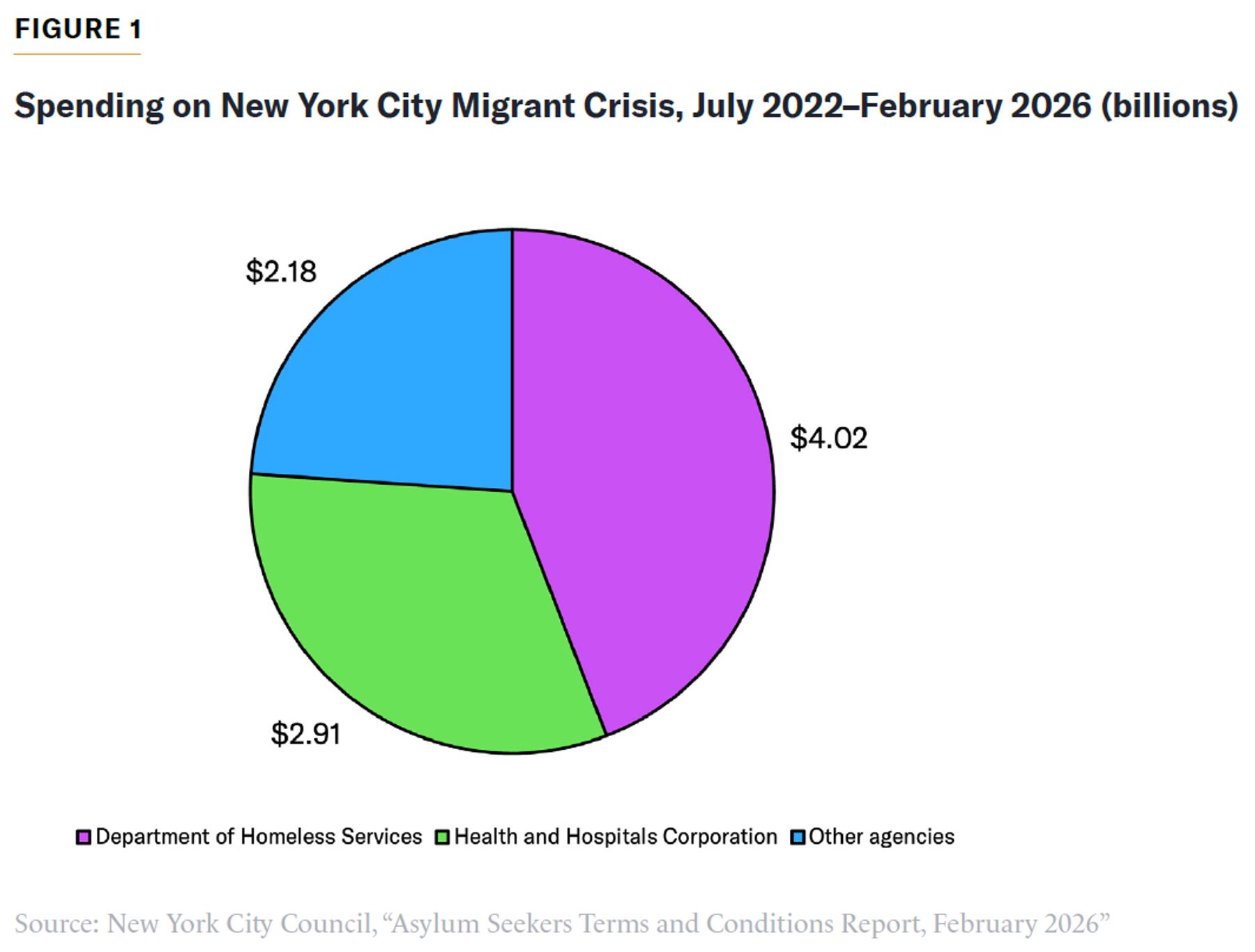
The Adams administration’s response to the migrant crisis would be wide-ranging and involve multiple service systems, including hospitals and schools. But providing shelter was the central challenge. Often, state and local governments’ immigration-related costs are concentrated in education.[18] But for New York, shelter costs (managed mainly by the Department of Homeless Services and New York City Health and Hospitals Corporation)[19] constituted the vast majority of the city’s $9 billion migrant crisis spending (Figure 1).
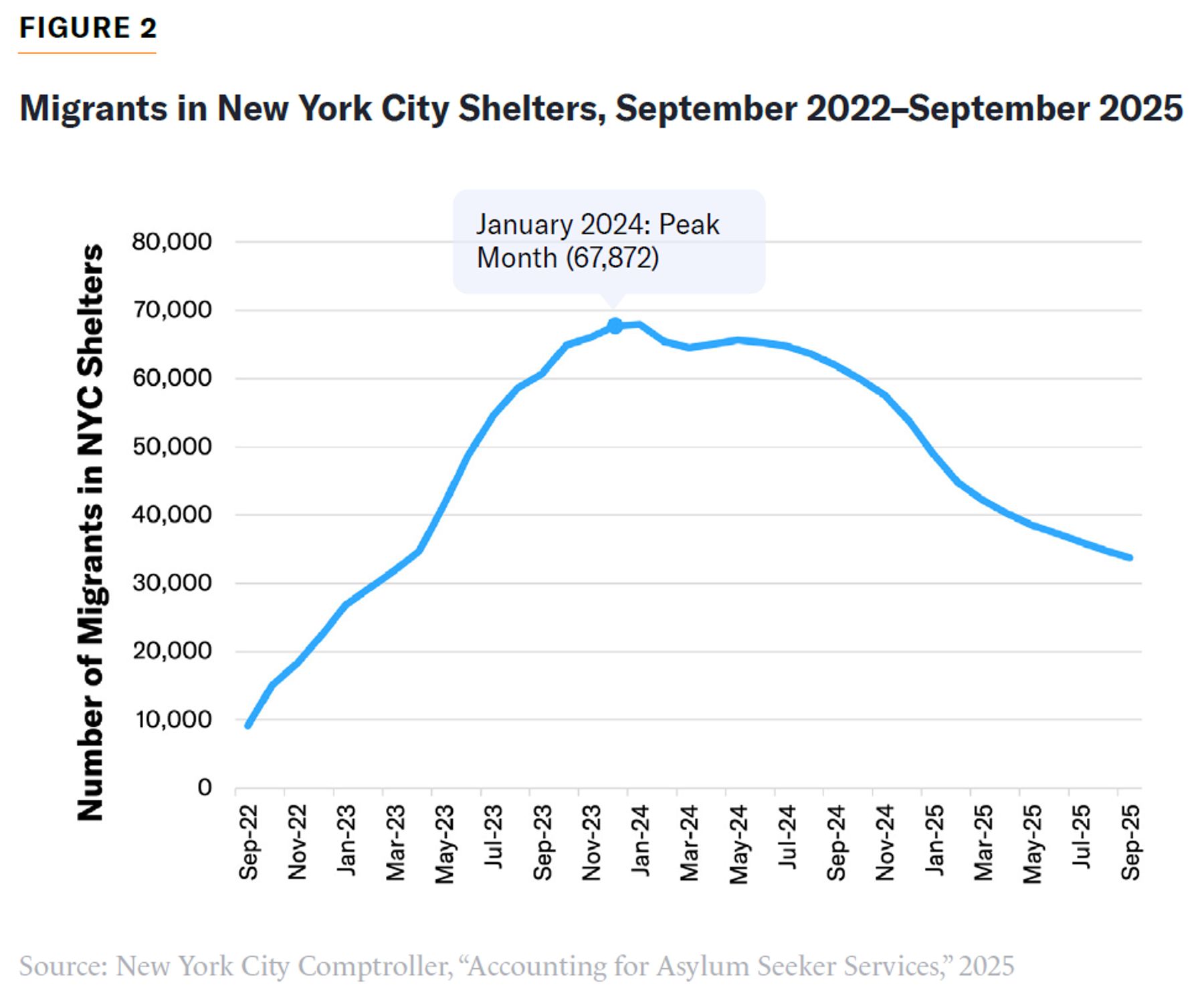
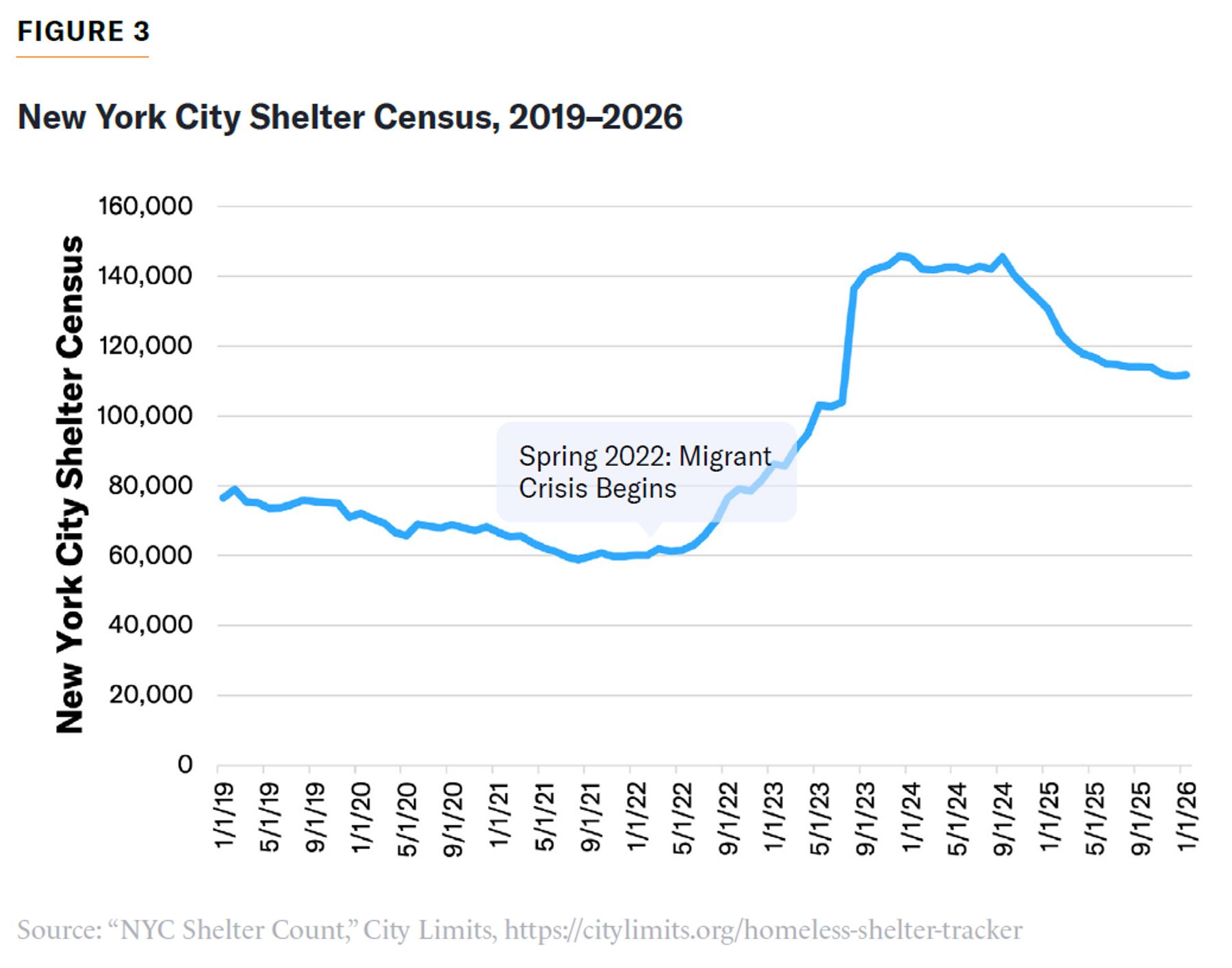
New York’s homeless shelter census, which had been declining when Adams took office in January 2022, reached historical highs in 2023 and 2024, due to migrant flows (Figures 2 and 3).
Providing shelter to migrants was a challenge for many communities nationwide throughout the crisis. Because anyone staying at a shelter is counted as part of the homeless population, per U.S. Department of Housing and Urban Development rules, the border crisis pushed homelessness nationwide to historically high levels.[20]
But New York’s situation was special because it grants shelter by right.[21] In the late 1970s, advocates sued city government, claiming that the state constitution conferred a right to shelter to single men. The case, Callahan v. Carey, was settled in 1981 when the city agreed to a consent decree. The right to shelter was subsequently extended to families. Some other jurisdictions recognize a right to shelter, but nowhere is that right as sweeping as in New York. Massachusetts, for example, limits its right to shelter to families (although the state, like New York City, placed further limits on the right in response to its migrant crisis). Washington, DC, limits its right to shelter to cold-weather conditions. New York City’s right to shelter is not limited in those ways, nor was it traditionally limited to natives.
Potential Explanations for the New York City Migrant Crisis
City officials framed the relentlessly rising shelter census as an effect of a far-off humanitarian crisis outside New York’s power to control. They described all the migrants as “asylum seekers,” conflating the difference between those genuinely “tempest-tost” cases seeking refuge from political oppression and those responding, with rational agency, to economic incentives.[22]
Even if all shelter-based migrants were primarily fleeing oppression or violence, that would not account for why they came to New York, as opposed to another city, in such large numbers. The first explanation for the uniqueness of New York’s burden—invoked by Adams in his 2022 emergency declaration and many times after—was Republican state governors’ busing programs. This thesis faltered for two reasons. First, the federal government (then led by the Biden administration) and NGOs—not just buses chartered by Republican governors—brought migrants to New York. Texas was the largest of the busing states but, as of October 2024, it only accounted for about 45,000 migrants, an estimated 10% of whom did not stay.[23] Many reached New York indirectly, after first going to another city.[24]
Second, the busing programs were voluntary. Texas Governor Greg Abbott and other Republican governors did not deny sending buses of migrants to New York and other Democrat-led cities. But the fact remains that many migrants voluntarily participated in such programs. Republican governors did focus on sanctuary cities, and New York was and is a sanctuary city. But many sanctuary cities saw far fewer migrant arrivals than New York.
In-group affinity is often invoked to explain migrant flows.[25] New York was host to many foreign-born communities in the early 2020s. But prior to the recent influx, it did not have a particularly large Venezuelan population or famous Venezuelan neighborhoods.[26] Yet Venezuela was the most common country of origin for migrants in New York City shelters in June 2024 (Figure 4).
FIGURE 4
Top 10 Countries of Origin, New York City Migrants in Shelter, June 2024
| Country | Number | Percent of Total |
| Venezuela | 23,247 | 37.6% |
| Ecuador | 11,907 | 19.3% |
| Colombia | 5,779 | 9.4% |
| Guinea | 4,347 | 7.0% |
| Senegal | 2,735 | 4.4% |
| Peru | 2,182 | 3.5% |
| Mauritania | 1,475 | 2.4% |
| Honduras | 1,367 | 2.2% |
| Russian Federation | 1,152 | 1.9% |
| Haiti | 1,131 | 1.8% |
| Total | 61,804 |
As noted earlier, in the immigration literature, employment opportunity is commonly cited as a principal motivation of immigrants. New York is a wealthy city, boasting a strong concentration of high-net-worth households.[27] But New York’s economy is not growing fast.
In 2025, the Associated Press published a ranking of the top metro destinations for migrants, on a per-capita basis,[28] between May 2021 and January 2025, based on analysis of Customs and Border Protection data. New York (the metro as a whole) ranked fifth, surpassing several metros whose job-growth rates, over the decade preceding the migrant crisis, were much more robust (Figure 5).[29]
FIGURE 5
Job Growth Experiences of Major U.S. Metros with the Largest Migrant Concentrations During the Early 2020s Border Crisis
| Migrants Received per 100,000 Residents, 2021–25 | % Jobs Change, 2010–2022 | |
| Miami–Fort Lauderdale–West Palm Beach, FL | 2,191 | 24.7% |
| Cape Coral–Fort Myers, FL | 1,782 | 54.1% |
| Salt Lake City, UT | 1,685 | 30.2% |
| Denver–Aurora–Lakewood, CO | 1,673 | 32.8% |
| New York–Newark–Jersey City, NY–NJ | 1,542 | 11.6% |
| Orlando–Kissimmee–Sanford, FL | 1,499 | 43.1% |
| Austin–Round Rock–Georgetown, TX | 1,453 | 57.8% |
| Dallas–Fort Worth–Arlington, TX | 1,412 | 35.7% |
| Houston–The Woodlands–Sugar Land, TX | 1,338 | 29.7% |
| Louisville/Jefferson County, KY–IN | 1,250 | 10.9% |
| Indianapolis–Carmel–Anderson, IN | 1,166 | 34.7% |
| Nashville-Davidson–Murfreesboro–Franklin, TN | 1,115 | 48.6% |
| Chicago–Naperville–Elgin, IL–IN | 1,077 | 10.4% |
Source: Elliot Spagat, “Where Immigrants Went During an Unprecedented Influx at the US Border, by the Numbers,” Associated Press, Oct. 1, 2025; American Community Survey, 2010 and 2022 one-year estimates; author’s calculation
A 2020 Bureau of Labor Statistics analysis ranked all major metros’ job growth record over the previous decade. New York ranked 32 out of 51.[30]
Another factor commonly believed to influence immigration flows is affordability.[31] Those who tout immigration’s potential to increase housing values and revitalize old cities emphasize immigrants’ responsiveness to cheap rents found in poor neighborhoods.[32] For the U.S. population as a whole, “housing-related reasons” are the most common reason for moving cited in census surveys.[33]
Housing in New York is famously expensive. The city has been under a formal “rental emergency”—meaning a vacancy rate among rental units below 5%, thus authorizing the use of rent regulation—for decades (Figure 6).
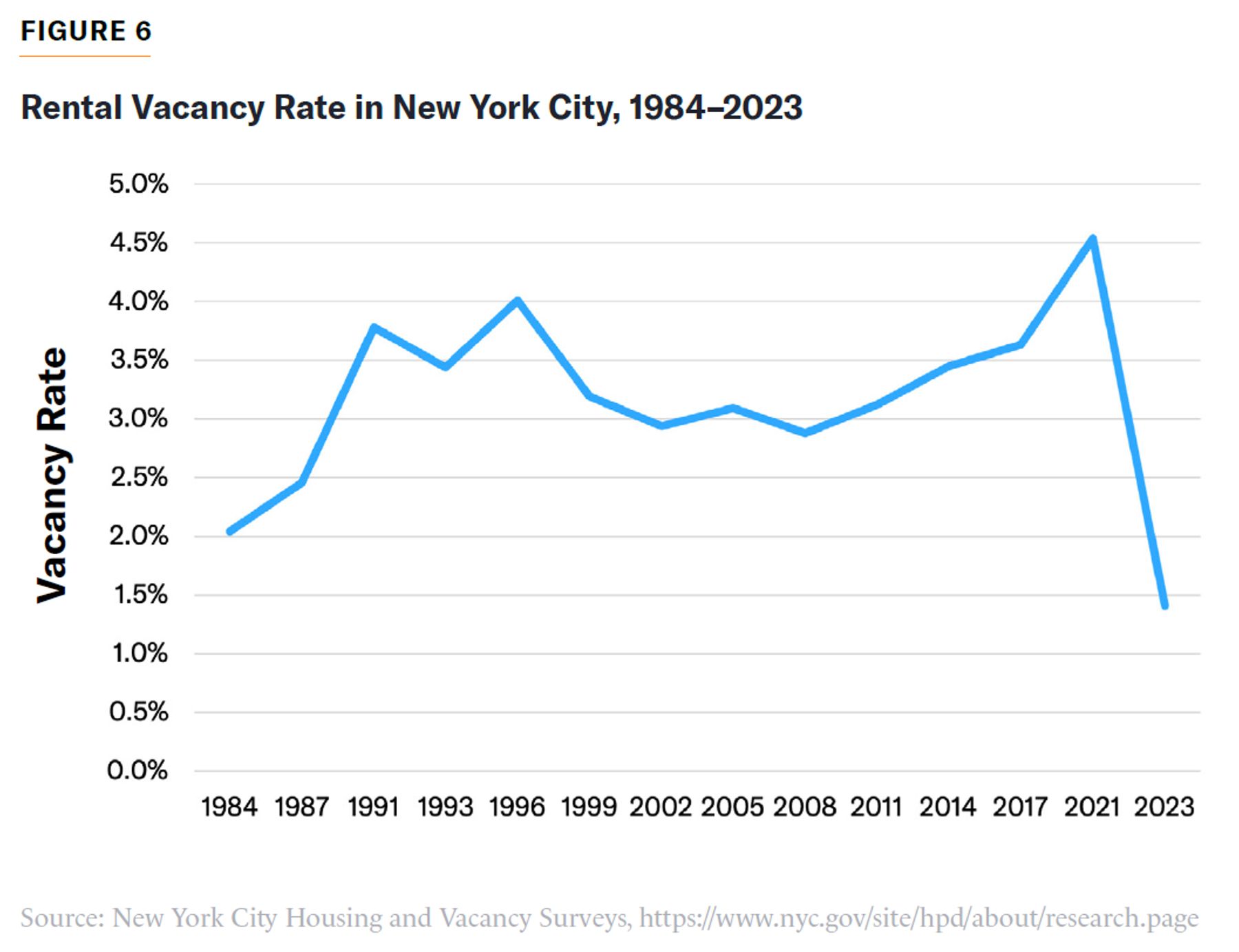
Vacancy rates at the lowest end of the rental market are especially low. The city’s 2021 “Housing and Vacancy Survey” found a vacancy rate of 0.86% for units renting below $900, and the 2023 survey found a vacancy rate of 0.39% for units renting below $1,100.[34] Many low-rent units are occupied by rent-stabilized or rent-controlled tenants who rarely move or who can pass their tenancy to family members.
New York, given its housing crisis, might be reasonably expected to have a large homeless population. It is more counterintuitive that a city facing a housing crisis would attract a large number of poor migrants who could otherwise have gone to cheaper cities that are closer to the border and have higher job-growth rates.
The dynamics of remittances complicate standard calculations about the cost of living. Immigrants participating in the remittance economy can be more attracted by high wages than deterred by a high cost of living, especially if they are willing to tolerate cramped housing conditions.[35] Still, New York stands out in its migrant burden, relative to other high-cost, high-wage places such as the Bay Area, where a right to shelter does not exist.
Why the Welfare Magnet Effect Best Explains the New York Migrant Crisis
Standard factors used to explain migrant flows fail to account for the magnitude of the New York migrant crisis. The welfare magnet thesis is more persuasive for several reasons.
The Adams administration itself was convinced that the right to shelter explained why so many migrants came to New York.[36] Accordingly, less than a year after declaring a state of emergency, the Adams administration took the bold step of seeking to impose limits on shelter for single adults, followed by limits for families. After negotiations with advocates, it eventually imposed a 60-day limit on shelter for “new arrivals” families and a 30-day limit for “new arrivals” who were single adults. When that limit was reached, migrants would have to reapply for shelter. These conditions, which were not imposed on native shelter clients, went into full effect in January 2024, and, as shown in Figure 2 above, the shelter census started dropping almost immediately (though, to be fair, Southwest land border encounters also peaked in December 2023 and went into decline thereafter).[37] But data show that New York’s migrant influx was never solely a function of national immigration policy. Since spring 2022, the migrant census in New York shelters rose consistently even as the national numbers experienced occasional dips, such as in early 2023 and early summer 2023.[38]
Adams’s claim that the right to shelter caused the migrant influx was not considered particularly controversial. His handling of the migrant crisis met with severe criticism, including from many on the left. Traditionally, in debates over social policy, left-of-center advocates and media outlets tend to be skeptical of “welfare magnet” arguments. It was therefore striking to see how many left-of-center press outlets readily accepted Adams’s claim that tens of thousands of migrants were coming to New York to take advantage of uniquely generous government benefits.[39] Left-leaning immigration experts also agreed that the right to shelter had a “magnet” effect with a “huge pull factor” that explained why so many migrants chose New York over other potential destinations.[40] Migrants themselves mentioned shelter, sometimes even the guarantee of it, directly to reporters on several occasions in discussing their motivations for going to New York.[41] Even those who criticized the mayor’s actions did not dispute the underlying point, arguing instead that Adam’s rhetoric was overblown or that modifying the right to shelter would have other more undesirable consequences, such as an increase in street homelessness so dire that it would threaten the city’s post-Covid tourism revival.[42]
New York’s shelter policy is not only uniquely generous in offering shelter on demand to anyone and in all seasons but in the quality of the shelter provided. The thought of moving thousands of miles to live in a homeless shelter may seem absurd to many; but in the New York City context, shelter can mean a private hotel room in Manhattan.[43] New York is host to many custom-designed shelter programs operated mainly by nonprofit contractors. But the right to shelter requires placement on the very day an individual or family exercises it. If the custom-designed shelter programs do not have room, the city government often turns to hotels to provide placement. At the peak of the migrant crisis, 4,000 individuals were arriving in New York every week. Thus, the city had no choice but to make heavy use of the long-standing, expensive, and inefficient practice of renting hotel rooms. The central intake center for homeless families was the 1,000-room Roosevelt Hotel, a famous midtown hotel and event space that provides notably more attractive living quarters than the typical American homeless shelter.
Discussion and Conclusion
New York City’s migrant crisis demonstrates that welfare magnet effects exist. Immigrants respond to the offer of government benefits and will relocate to jurisdictions known for their generous benefit programs. The strength of the magnet effects should be weighed against other factors in evaluating immigrant flows. But New York’s exceptional migrant-care burden, during the early 2020s border crisis, cannot be understood independently of its exceptionally generous offer of shelter benefits. During 2022–24, relative to other major cities, New York was highly unattractive with respect to housing affordability and mediocre—at best—with respect to job opportunity, but highly generous with respect to its shelter benefit program. This coincidence of factors was obvious to city officials, issue advocates, and the media. It was also obvious to border migrants, equipped with reason and agency, while making decisions about which city to move to.
New York City’s migrant crisis was an unusual case. But the immigration literature has often taken interest in unusual cases for their potentially clarifying value, such as the Mariel Boatlift—a sudden influx of workers into Miami’s labor market that illustrated the effects of an immigration “supply shock.” The New York experience, by contrast, illustrates the effects of a “demand shock.” Though other left-leaning jurisdictions may not offer as expansive a right to shelter as New York, any benefits they do offer to migrants may still exert a pull effect, albeit one that is more attenuated or obscure than that of New York’s shelter program.
Even if border crossings remain low in the near term, state and local benefit programs still create pull effects that may influence internal flows between U.S. communities, among the millions of illegal and legal immigrants already present. That pull effect may be reinforced by other state and local immigration policies, such as the issuing of municipal ID cards; declining to mandate or even prohibiting the use of E-Verify;[44] prohibiting local law enforcement from working with federal immigration authorities;[45] encouraging civil society groups to obstruct federal enforcement actions;[46] failing to impose restrictions on e-bikes, which are viewed by some as essential to immigrants’ livelihoods but also represent a nuisance and even danger;[47] and providing publicly funded legal assistance for asylum cases.[48] Though, as of spring 2026, New York’s migrant crisis is considered long over, about 30,000 migrants remain in New York City’s shelters, a number larger than the homeless population of every community except Los Angeles.[49]
The welfare magnet debate has always been concerned not only with the extent to which benefits exert a pull effect but also with whether state and local programs restrain mobility among low-income households more than would be advantageous for them and their host communities.[50] State and local benefit programs, as well as distinct state and local immigration policies, may help promote and maintain new immigrant ethnic enclaves. According to some scholars, immigrant enclaves promote upward mobility through, for example, facilitating entrepreneurship and wealth formation.[51] Other scholars argue that enclaves reduce the incentive to assimilate.[52] Enclave formation and persistence will always be dependent on several factors, such as enclaves’ replenishment rate, which is itself a function of federal border policy. But the increasing divergence of red and blue communities—as well as the increasing desire of localities to create their own distinct immigration policies—suggests that America’s immigrant populations are likely to become even more concentrated than they are now. As of the late 2010s, 60% of all illegal immigrants lived in 20 metros.[53]
Assimilation, or integration, is also a goal of poverty and homelessness policy, which could be hindered by immigrant enclave formation. Studies have consistently found that a significant proportion of even the homeless population has some recent employment history.[54] They may therefore find themselves in direct competition for jobs, to say nothing of rental housing,[55] with low or moderately skilled immigrants. Job competition between low and moderately skilled immigrants and work-capable low-income adults is likely similar to the better-studied cases of immigrants’ competition with other less recently arrived immigrants, high school dropouts, and teenagers.[56] All things being equal, low-income individuals are likely to face more competition for jobs and other opportunities in communities that are host to large immigrant enclaves than in communities without such enclaves. Thus, a blue city that expands benefits for migrants could thereby increase the burden on its homelessness-services system.
Endnotes
Are you interested in supporting the Manhattan Institute’s public-interest research and journalism? As a 501(c)(3) nonprofit, donations in support of MI and its scholars’ work are fully tax-deductible as provided by law (EIN #13-2912529).