New Report: Is Public Education Delivering a Return on Investment?
New framework suggests public schools may be even less effective than commonly believed
NEW YORK, NY – K–12 education is one of the nation’s largest taxpayer-funded expenses, yet there is no meaningful standard for assessing whether public schools deliver value for their funding. Per-pupil spending and academic outcomes are typically reported in isolation, making it difficult to determine how effectively resources translate into student success.
In a new Manhattan Institute report, William Henson, President Emeritus of Cristo Rey Brooklyn High School and a former senior investment banker, introduces a framework intended to close that gap. His Educational Return on Investment (EROI) model directly links school spending to measurable student outcomes. Henson finds that more funding does not necessarily mean better results, and that the gap is much greater than commonly understood. At the same time, meaningful improvement and viable alternatives are well within reach.
In New York City, educating a single K–12 student costs nearly $400,000 over 13 years, or about $30,000 annually. Using the EROI framework to incorporate student outcomes, Henson estimates that it costs approximately $639,000 to produce one high school graduate from a low-income background. To yield a single associate’s or bachelor’s degree recipient from that same cohort, the system effectively expends roughly $2.2 million, excluding post-secondary costs—nearly six times the per-pupil total.
These patterns are not unique to New York City. When examining public schools across New York State, with and without New York City included, Henson finds similar disparities between spending levels and educational attainment outcomes.
By contrast, Henson identifies markedly different results when comparing district public schools to one private model, which exclusively serves low-income students at the secondary level. Cristo Rey Brooklyn High School produces nearly six college graduates for the same level of funding that New York City public schools require to produce one, regardless of socio-economic status, and close to nine college graduates when looking only at students from families of modest economic means.
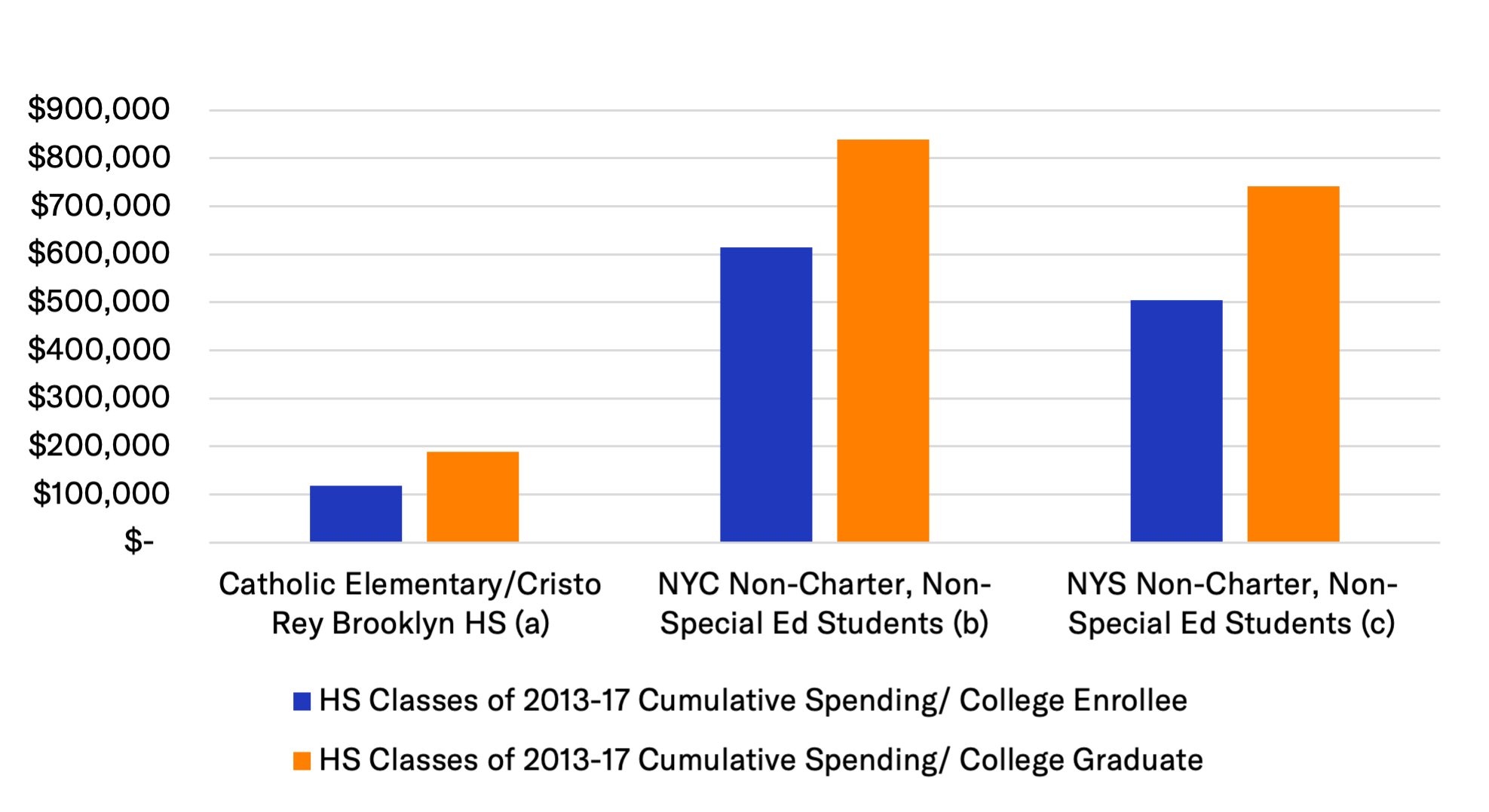
Based on these findings, Henson argues that while public schools face many challenges, a lack of resources is not one of them. Instead, the results point toward alternative practices and models that may be both more economically efficient and more educationally effective. He urges policymakers, particularly in New York, to adopt the EROI framework as a tool for evaluating school performance before expanding budgets or launching new initiatives and as an impetus for genuine reform.
Click here to read the full report.
Are you interested in supporting the Manhattan Institute’s public-interest research and journalism? As a 501(c)(3) nonprofit, donations in support of MI and its scholars’ work are fully tax-deductible as provided by law (EIN #13-2912529).