Good morning: On Saturday, a gunman stormed through a security perimeter at the Washington Hilton Hotel in Washington, D.C., where the 2026 White House Correspondents’ Dinner was ongoing.
Thankfully, U.S. Secret Service agents swarmed the suspect and took him into custody. President Donald Trump, Vice President JD Vance, and several members of the cabinet and their wives were hustled out of the ballroom, and, within hours, the president hosted a press conference at the White House’s James S. Brady Press Briefing Room. Notably, the press briefing room is named in honor of James Brady, President Ronald Reagan’s press secretary who was shot and seriously injured following an assassination attempt on President Reagan in 1981. That shooting occurred outside the very same Hilton hotel where President Trump survived his third serious assassination attempt.
In The Free Press, senior fellow Douglas Murray recounts his experience in the ballroom and warns of how easily revolutionary moments can spin out of control. Disconnected young people can become soldiers for any violent movement at all, as long as they feel it gives them some meaning.
Meanwhile, in New York City, our scholars are interrogating Mayor Zohran Mamdani’s policy proposals that will make the city more expensive and less hospitable to residents and visitors alike. In Reason, legal policy fellow Jarrett Dieterle teases out the consequences of a new bill that would fulfill Mamdani’s campaign promise to increase the city’s minimum wage to $30 per hour by 2030. Restaurants will be particularly hurt because the bill eliminates the tip credit system that workers and employers rely on to keep meals affordable and people employed. Progressive cities like Washington, D.C., and Chicago experimented with eliminating the tip credit system and were ultimately forced to reverse the policy. Hopefully New York City can learn from our sister cities’ mistakes.
In City Journal, director of Cities John Ketcham warns that Mamdani’s proposed pied-à-terre tax goes after the wrong targets—the ultra-wealthy few rather than the owners of rent-stabilized pieds-à-terre who are ignored. Owners of luxury second homes already pay property taxes, transfer taxes, among other fees. And, unlike moderately priced rent-stabilized units that should be sold at a market rate, $5 million apartments are not the type of housing most New Yorkers need.
Across the country, senior fellow Christopher F. Rufo and investigative reporter Haley Strack examine California’s deteriorating 911 dispatch system. The old system is falling apart, and the rollout of the new system is paused while too many Californians face disconnections and dropped calls in the scariest moments in their lives. Rufo and Strack point out that the endless delays and cost overruns are good for some people, however: the state officials who are never out of a job managing the system and the private companies that continue to secure never-ending contracts.
Finally, this newsletter highlights two new reports published by our Research team and scholars. First, Terrell Dunn examines the new Workforce Pell Grant program, and how it can modernize American higher education and federal financial aid. Next, fellow Robert VerBruggen publishes a new report on how to encourage marriage and help families to remain intact for the American Enterprise Institute. We are proud to republish his work here.
Continue reading for all these insights and more. Kelsey Bloom Editorial Director |
|
|
|
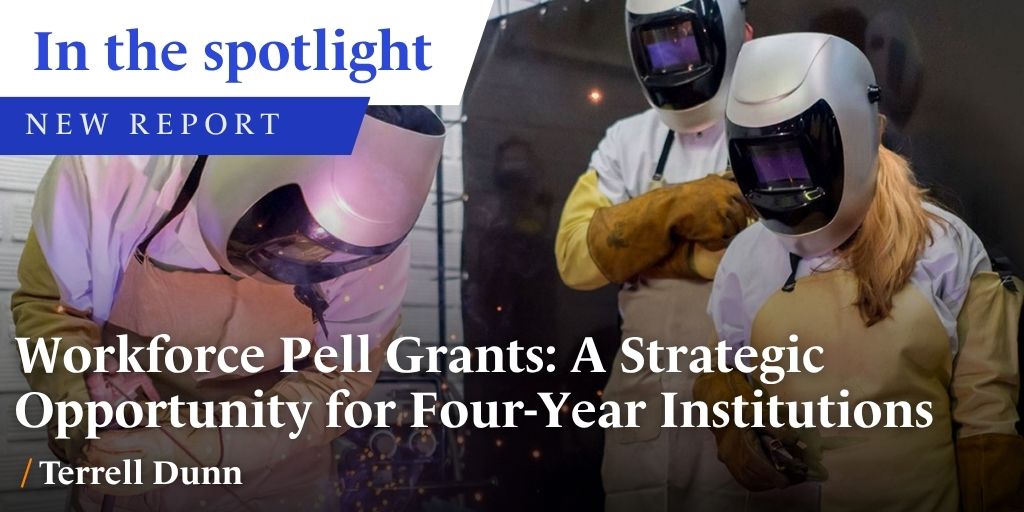
Workforce Pell Grants: A Strategic Opportunity for Four-Year Institutions
By Terrell Dunn | Manhattan Institute | Photo: andresr/E+ via Getty Images
“Nontraditional” students now make up the majority of college enrollments. These students are older, working, financially independent, enrolled part-time, and balance their education with work, family, or other responsibilities not typical to the 18-year-old fresh out high school. They often enroll in higher education looking for the tools to succeed in a modern skills-based economy. Finally, federal financial aid has been modernized to help them. Workforce Pell is a newly created program, passed into law as part of the One Big Beautiful Bill Act, that extends the traditional Pell program to short-term job-training programs of 8–15 weeks.
In a new report for the Manhattan Institute, consultant and former Education Department official Terrell Dunn shows how institutions of higher education can use the Workforce Pell program to make their colleges and universities relevant to American students today.
But, be warned: Institutions that view Workforce Pell as a quick fix for budget pressures rather than a strategic and essential part of fulfilling their mission to provide a quality education will be disappointed. And institutions that ignore the needs of today’s students while trying to fit working adults into traditional education models will fail. |
|
|
There’s a Reason the Shooter’s Manifesto Sounded Familiar
By Douglas Murray | The Free Press | Photo by DBenitostock/Getty Images “The accusations shouted by protesters outside the White House Correspondents’ Dinner didn’t stay outside. Neither did the logic behind them. “My Saturday night began the same way it did for most attendees of the White House Correspondents’ Dinner: being harangued by protesters outside the venue. As I walked up to the hotel, one woman in a keffiyeh screamed at me, ‘How could you possibly have dinner with a child rapist?’ “That was the tenor going in.
“The event itself was the normal run of things: pre-parties, pre-drinks, everyone filing into the hall. I sat with my colleagues from the New York Post, along with United Nations ambassador Mike Waltz, Treasury Secretary Scott Bessent, and others. When the president came in, there was great excitement—it was the first time Trump had attended one of these dinners. We were looking forward to him roasting the media, which was what everyone expected.” |
A $33 Burger? As New York City Eyes $30 Minimum Wage, Restaurants Brace for Impact
By Jarrett Dieterle | Reason | Photo by Javier Ghersi via Getty Images
“Perhaps no campaign promise of (Zohran) Mamdani's was as bold as his ‘$30 by '30’ plan, which called for increasing the city's minimum wage to $30 by 2030. Now that Mamdani is in office, New York City Council members have introduced a bill to turn $30 by '30 from a catchy campaign slogan into an economic reality.”
The bill’s fine print “would eliminate what's known as the tipped-wage credit for restaurants in NYC, meaning that mom-and-pop restaurants—some of the city's smallest businesses—would find themselves on the hook for paying workers $30 an hour. ...
“The tip credit system has been in place for 60 years, allowing restaurant workers to make upwards of $30 or $40 an hour—or more—once tips are factored in, while also giving owners a way to control labor costs in an industry notorious for its tight margins. ...
“Mamdani has yet to officially endorse the new legislation, although his campaign track record strongly points toward him ultimately backing it. If he does, $33 hamburgers might become the norm sooner than later.” |
|
|
New York’s Real Pied-à-Terre Problem
By John Ketcham | City Journal | Photo by Spencer Platt/Getty Images
“Earlier this month, Mayor Zohran Mamdani and Governor Kathy Hochul announced a new ‘pied-à-terre tax’ on second homes in New York City valued at $5 million or more. The proposal rests on the faulty premise that wealthy nonresidents are freeloaders, treating the city as an occasional luxury indulgence, though they pay property taxes without consuming much in city services.
“But the city’s historic housing crisis isn’t caused by the relatively few $5 million-plus units used as second homes. There is, in fact, a much bigger underuse problem: thousands of unlawful rent-stabilized pieds-à-terre, the tenants of which pay rock-bottom rates for their second home. New York City is thus poised to tax unsubsidized second homes more while continuing to underwrite their subsidized counterparts. ...
“Lawmakers should restore incentives for rent-stabilized units to be returned to the market for full-time residents. Reintroducing vacancy and improvement bonuses would not only discourage the use of stabilized units as second residences but also make it financially viable to return the up to 50,000 long-term vacant, stabilized apartments to the market. Allowing bonuses would also quickly unlock housing supply and channel private capital into maintaining and upgrading the stabilized housing stock.”
|
California’s Antiquated 911 Dispatch Is on the Verge of Going Dark
By Christopher F. Rufo & Haley Strack | City Journal | Photo by K.C. Alfred/ The San Diego Union-Tribune via Getty Images
“California once built massive infrastructure projects—dams, highways, and aqueducts—that were the marvel of the world. During the Great Depression, engineers erected the Golden Gate Bridge in four years, ahead of schedule and under budget. But those days are over. Under Governor Gavin Newsom, California has been unable to complete, and hardly able to begin, construction on its high-speed rail system. Many other government projects are beset by delays, cost overruns, and dreams that never materialize.
“Though the bullet train has become the most famous symbol of this dysfunction, Newsom has overseen an even more important system failure: the overhaul of California’s 911 emergency line. ...
“California is stuck with a 1970s-era emergency call system that is falling apart. (A) legislative analyst has warned that the legacy system is ‘in very poor condition and is subject to failure.’ And (California Governor’s Office of Emergency Services) is woefully behind on updating other parts of the state’s emergency services. As of this past February, 339 dispatch centers hadn’t undergone maintenance on their call-handling equipment in seven to ten years or more. Some equipment is built with parts not made anymore.”
|
|
|
The Unequal Erosion of Married Parenthood
By Robert VerBruggen | Manhattan Institute | Photo: Iparraguirre Recio / Moment via Getty Images
“The decline of married parenthood has had destructive effects on children and families, and the decline of fertility threatens the very future of our society. Yet unfortunately, to a large extent, these trends stem from deep, likely irreversible, and often even desirable changes in modern society.
“Such changes include economic growth, technological advancement, greater opportunities for women, and a more generous safety net. They also include steadily declining teen childbearing since the early 1990s and declining fertility among the unmarried in general since the Great Recession, the latter of which actually accounts for most of the recent birth-rate drop. Going back the way we came is clearly not an option. “But government policy can, on the margins, make married parenthood more attractive and stable. Major reforms should include addressing marriage penalties for the poor and middle class in tax and benefit programs—which will likely entail providing more generous help to married parents in this income range—and relaxing regulations that make family life unaffordable.” |
|
|
For more information and media requests, please contact
communications@manhattan.institute. Are you interested in supporting the Manhattan Institute’s public-interest research and journalism? As a 501(c)(3) nonprofit, donations in support of MI and its scholars’ work are fully tax-deductible as provided by law. |
|
|
|
Photo Credits: adamkaz/E+/Getty Images; Noah Berger/AP Photo; Anadolu/Getty Images; Wong Yu Liang/Getty Images; Catherine McQueen/Getty Images; Probal Rashid/LightRocket/Getty Images |
|
|
The Manhattan Institute works to keep America and its great cities
prosperous, safe, and free. Manhattan Institute 52 Vanderbilt Ave. 3 floor New York, New York 10017
Want to change how you receive these emails?
Unsubscribe | Subscription Preferences
Copyright © 2026 Manhattan Institute, All rights reserved. |
|
|
|
|