Good morning:
A new investigative piece by City Journal reporter Christina Buttons reveals much of the inner workings and training efforts of one of Minneapolis’s protest organizations, “Defend the 612.”
Defend the 612 oversees a large network of Signal chats, an end-to-end encrypted messaging service, that is dedicated to monitoring and protesting Immigration and Customs Enforcement (ICE) officers. “ICE Watchers,” as they are known, are untrained civilians put into dangerous and high-stakes situations to clash with and deter federal law enforcement officers. When things go wrong, like the recent killings of Alex Pretti and Renée Good, recruitment soars and, as Buttons writes, “the professional architects of the chaos remain shielded from the consequences.”
Public safety impacts more policy issues than simply law and order. Safe, functioning streets are crucial to affordability, too. Fellow Rafael A. Mangual writes in City Journal highlights the ripple effects of crime. Scholarly research finds that a lack of safety can meaningfully undermine academic success and school-level proficiency rates. Proximity to dangerous neighborhoods and crime hot spots decreases a home’s value. And retail theft is clearly connected to widely reported closures of pharmacies and big-box stores.
The events in Minneapolis began with an investigation into fraud and the misuse of taxpayer funding. In The Atlantic, senior fellow Stephen Eide explains the rise of NGOs delivering social services and warns that the opportunity for outright criminality can distract from the subtle ways NGOs improperly influence policymakers. High CEO salaries may exceed those of public servants. NGO officials are not subject to term limits. Government officials looking to join an NGO after leaving public service may avoid making enemies with nonprofits.
In an ideal world, politics would not play a role in the selection of NGOs to carry out social services. Nor would politics play a role in the selection of deans at taxpayer-funded public universities. But, as director of Constitutional Studies Ilya Shapiro and adjunct fellow Josh Blackman write in the Washington Post, conservative legislators have an oversight duty when it comes to higher education. Finally, those lawmakers are beginning to flex their oversight muscles and ensure that university officials can faithfully serve their communities and be willing to dissent from academic progressive orthodox when necessary.
Continue reading for all these insights and more. Kelsey Bloom
Editorial Director |
|
|
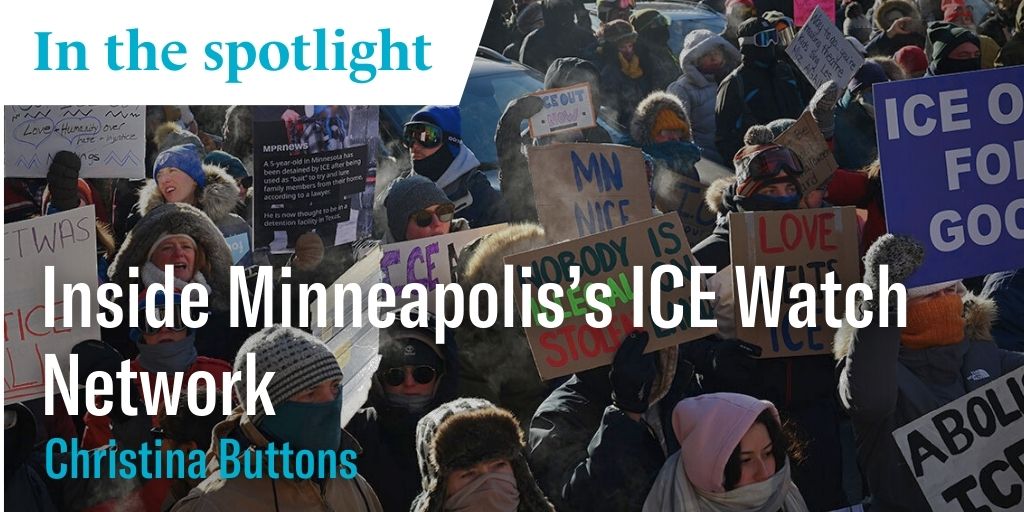
Inside Minneapolis’s ICE Watch Network
By Christina Buttons | City Journal
“In less than a month, two ‘ICE watchers,’ (Alex Pretti and Renée Good), have been shot and killed by immigration enforcement agents in Minneapolis. ... “ICE watching,” an anti-immigration-enforcement tactic that can involve tracking ICE agents, filming arrests, and alerting other activists of enforcement actions, ... place(s) untrained civilians in direct, high-stakes confrontation with armed federal agents. ...
Defend the 612 is a group that “oversees a massive network of Signal chats dedicated to monitoring and protesting ICE activity. It has become the beating heart of the city’s resistance to federal immigration enforcement. ... City Journal reviewed Defend the 612’s trainings, entered its Signal network, and traced its organizational support. Our reporting reveals that members and related officials have encouraged protesters to impede law enforcement; pushed civilians toward legally and physically risky confrontations; and helped mobilize a counterprotest that turned violent. ...
“This cycle reveals the core strategy of Defend the 612’s leadership: using casualties as a catalyst for further escalation.” |
|
|
A Hidden Lesson of the Minnesota Welfare Scandal By Stephen Eide | The Atlantic
“At the federal level and on down, American government has come to rely heavily on nonprofits to deliver public services. This dependence is in many ways understandable, but it comes with serious risks. Feeding our Future, the Minnesota nonprofit whose employees were caught billing for services they didn’t provide, was not the first instance of an NGO stealing from taxpayers, nor will it be the last. ...
“When public services are administered at arm’s length from duly constituted public authorities, organizations like Feeding Our Future can better obscure corruption. A June 2024 report ... argued that ‘inadequate oversight’ by state government abetted the fraud. Prosecutors claimed that although state agencies held ultimate power, Feeding Our Future intimidated them by wielding ‘accusations of racism.’ More than 50 individuals have been convicted; $250 million was stolen. Minnesota Governor Tim Walz last month ended his 2026 reelection campaign, and possibly his nearly two-decade political career, because of the scandal.”
|
|
|
College Deans Aren’t Protected by Academic Freedom
By Ilya Shapiro & Josh Blackman | The Washington Post
“To be sure, universities are legally bound to protect speech rights. Public institutions such as the University of Arkansas must comply with the First Amendment. ... (But) the free speech clause does not protect a dean who is appointed by a university to serve the institution’s interests. Under Supreme Court jurisprudence, government employees’ speech rights decrease as they go up the organizational chart. People tend to lose some of their speech rights as they gain managerial authority, ... so of course ideology can be considered. ...
“In an ideal world, politics would play no role in dean selection. But we’re far from an ideal world. Those who dissent from progressive orthodoxy have been excluded from legal academia for generations — we’ve both personally felt that sting in our careers. ... But as soon as one progressive dean is axed, the fainting couches come out.” |
|
|
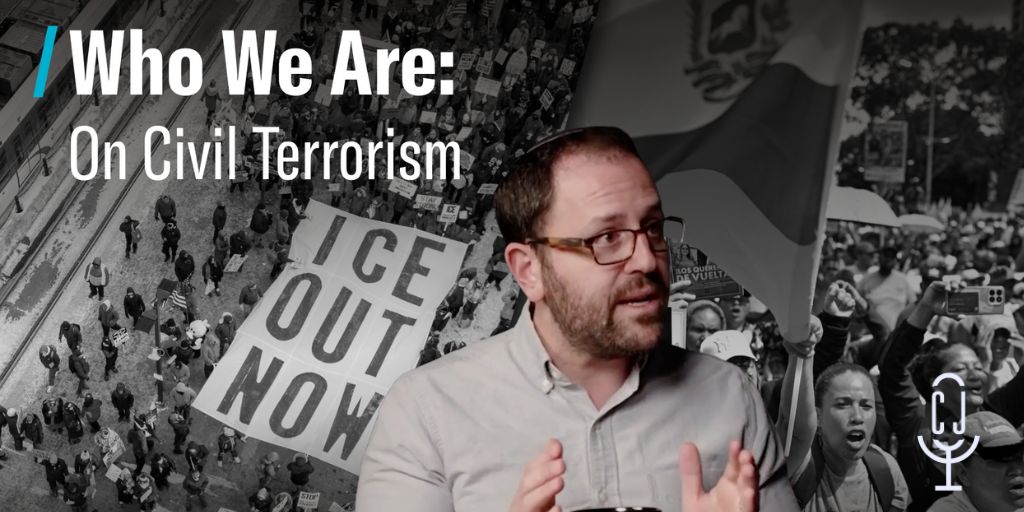
Who We Are: On Civil Terrorism
By City Journal
Tal Fortgang and Rafael Mangual explore the differences between civil terrorism and civil disobedience. Fortgang explains how some organizations exploit legal loopholes to avoid accountability for lawless behavior, and why current laws often fail to address coordinated disruption and destruction. |
Nothing Costs Like Crime
By Rafael A. Mangual | City Journal “Even before ‘affordability’ became a prominent theme in American public discourse, politicians and pundits have tracked the prices of homes, gasoline, milk, eggs, and other supermarket staples. ... “Often missing from the affordability debate is an appreciation of how public safety and order shape economic well-being. Policymakers seldom draw the connection, yet affordability and safety are tightly intertwined. When leaders fail on public safety, their constituents’ economic prospects decline with it.
“Controlling crime and disorder is often treated as a good unto itself, and rightly so. Crime affects a host of other areas: real-estate values, economic mobility, private investment, and, of course, the direct social costs of victimization. Failure to control it undermines the bottom lines of those living in the neighborhoods most affected. This point matters even more because many misguided criminal-justice reforms are justified in part on fiscal grounds. Incarceration is expensive, reformers say, so we should do less of it for taxpayers’ sake. But loosening the social controls exerted by police departments and prisons carries its own price: rising crime imposes massive economic costs.”
|
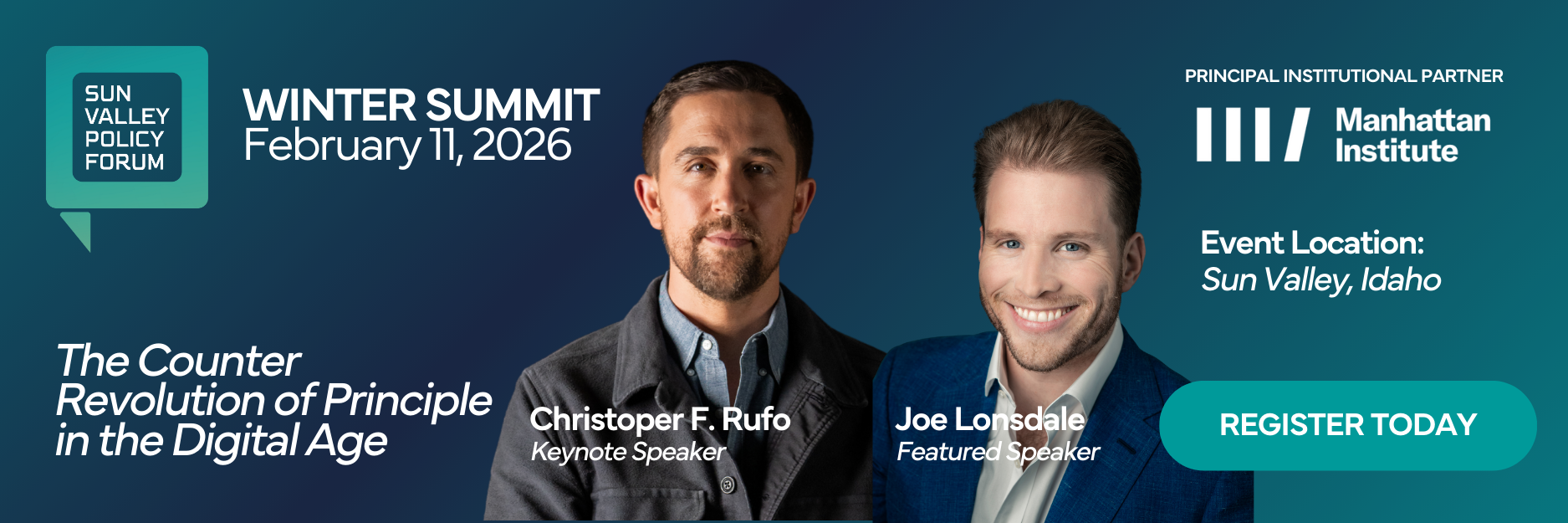
The Manhattan Institute is proud to serve as the Principal Institutional Partner for the Sun Valley Policy Forum’s 2026 Winter Summit in the iconic resort town of Sun Valley, Idaho on February 11, 2026.
We are thrilled to join Joe Lonsdale and MI senior fellow Christopher F. Rufo for an evening on principled leadership and the future of American institutions in an AI-driven era.
Please click here to learn more about the Sun Valley Policy Forum and our partnership and to purchase tickets at a discounted rate for friends of the Manhattan Institute. |
|
|
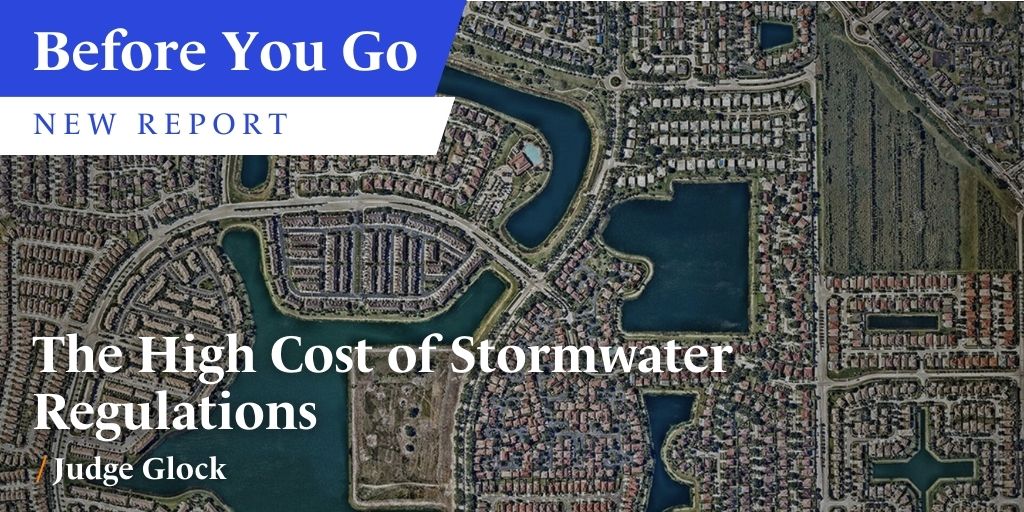
The High Cost of Stormwater Regulations
By Judge Glock | Manhattan Institute Federal stormwater regulations under the Clean Water Act significantly increase construction and housing costs while delivering minimal environmental benefits, director of Research Judge Glock finds in a new report.
Glock shows stormwater mandates can add as much as $36,000 per home depending on the mandated treatment. And costs can reach into the billions for cities like Los Angeles. Despite these costs, urban stormwater causes only 10% of river pollution—agriculture accounts for nearly half. Cost-effectiveness studies reveal urban stormwater controls can cost 100 times more per pound of pollutant removed than agricultural controls. The report recommends ending federal construction permits (which lack clear statutory authority), allowing off-site compliance options, and applying strict cost-benefit tests to regulations. Furthermore, stormwater control should return to state and local oversight, as current federal mandates impose disproportionate costs relative to environmental gains. | |
|
For more information and media requests, please contact
communications@manhattan.institute.
Are you interested in supporting the Manhattan Institute’s public-interest research and journalism? As a 501(c)(3) nonprofit, donations in support of MI and its scholars’ work are fully tax-deductible as provided by law. |
| |
Photo Credits: adamkaz/E+/Getty Images; Noah Berger/AP Photo; Anadolu/Getty Images; Wong Yu Liang/Getty Images; Catherine McQueen/Getty Images; Probal Rashid/LightRocket/Getty Images |
|
|
The Manhattan Institute works to keep America and its great cities prosperous, safe, and free. Manhattan Institute 52 Vanderbilt Ave. 3 floor New York, New York 10017
Want to change how you receive these emails?
Unsubscribe | Subscription Preferences
Copyright © 2025 Manhattan Institute, All rights reserved. |
|
|
|