How States Can Cut Rules and Regulations—and Make It Stick Idaho’s Two-Step Process That Other States Can Copy

Photo: MTStock Studio/E+ via Getty Images
Introduction
For decades, most state regulatory systems have operated on autopilot. Once a rule is adopted, it usually stays in force unless someone can marshal the time, political will, and technical knowledge to repeal it. That default favors regulatory accumulation. Agencies add rules to address new problems, implement new statutes, satisfy federal requirements, or respond to isolated incidents. But old rules rarely receive the same scrutiny. Over time, the regulatory code grows not because every rule remains necessary but because inertia protects what already exists.
Idaho broke that pattern. And that state’s example can teach a lesson to states all over the country.
Beginning in 2019, Idaho used two related mechanisms to reset and then review its entire administrative code. First, after the legislature did not enact the customary bill extending existing rules, Governor Brad Little directed agencies to republish only the subset of rules considered necessary to that agency. But crucially, these were retained as temporary rules.
Second, the governor issued Executive Order 2020-01,[1] which required executive-branch agencies to review and generally repeal and replace each remaining rule chapter on a staggered five-year schedule covering 2021–25, with a legislative review concluding in 2026.
This issue brief refers to these combined steps as Zero-Based Regulation (ZBR). Through these two steps, instead of asking only which regulations should be repealed, Idaho required agencies to justify which provisions should remain. That shift produced one of the most dramatic state-level regulatory reductions in recent memory: by the end of the ZBR cycle on July 1, 2026, Idaho had eliminated roughly half (49.1%) of its regulatory code (Figure 1). Regulatory volume fell in each of the eight annual code publications from 2019 to 2026 under ZBR.
What Idaho has done, other states can achieve as well.
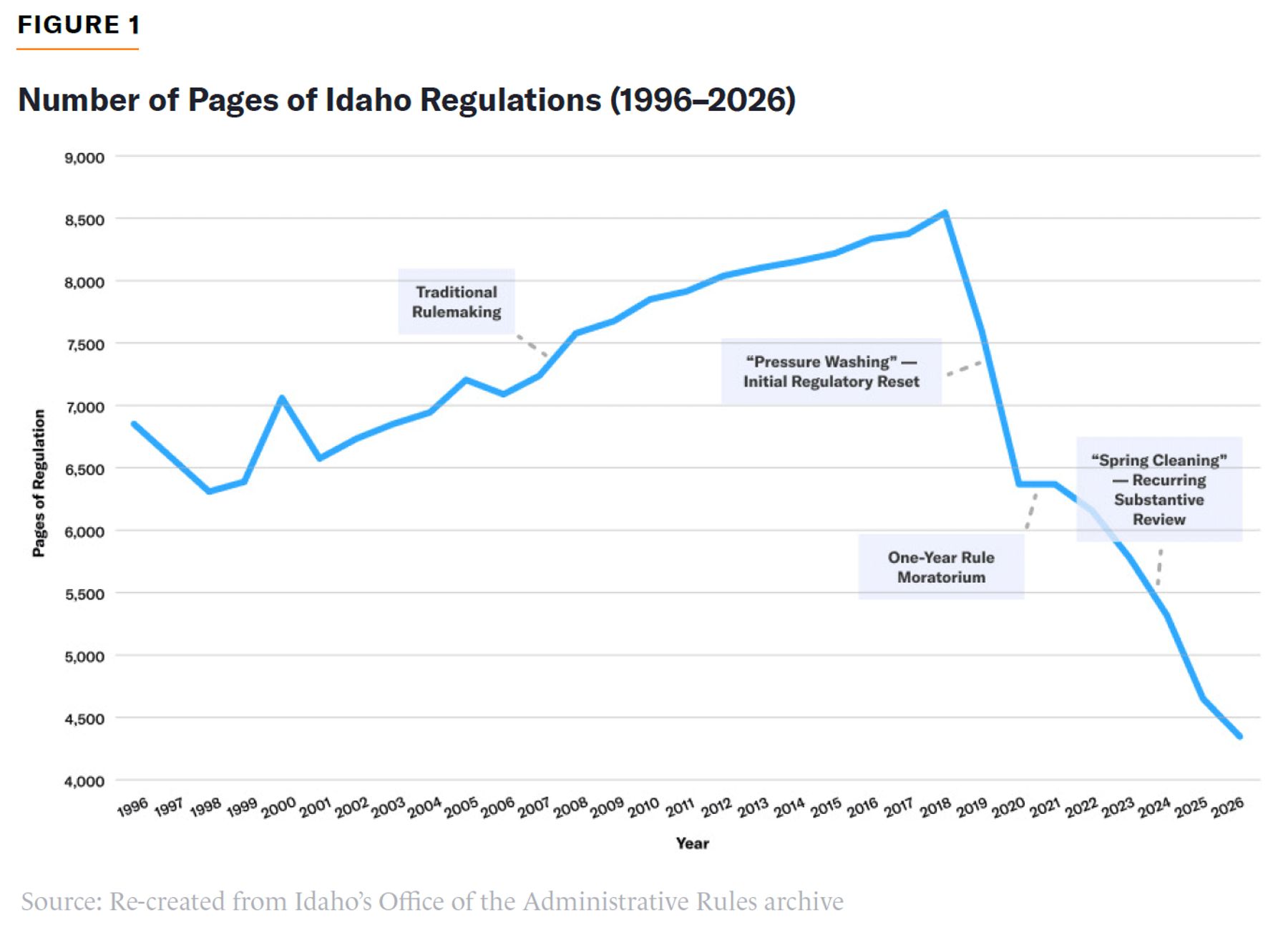
The Idaho administrative code was 4,201 pages shorter in 2026 than at the 2018 baseline.[2] However, under ZBR, the state did not simply count pages eliminated and declare victory. It built institutions that made regulatory accumulation harder and regulatory justification routine. ZBR combined sunset provisions, regulatory budgets, regulatory impact analyses, and centralized oversight into a statewide model.[3]
A Manhattan Institute issue brief published in July 2024 described Idaho’s approach as a practical model for governors seeking to reverse regulatory accumulation.[4] That initial report documented the 2019 reset and the early years of the five-year repeal-and-replacement schedule, but it could not yet evaluate the final 2025 rulemaking activity or the legislature’s 2026 review. This follow-up extends the same page-count methodology through July 1, 2026, and assesses whether the reductions persisted, which agencies sustained them, and what factors accelerated reform in Idaho.
Importantly, this follow-up brief finds that nearly half of Idaho’s total page-count reduction occurred after the initial regulatory reset and that the most substantive edits occur in the cyclical review. Thus, aligned governors and lawmakers should view regulatory reform as a marathon, not just an initial headline-grabbing sprint. Idaho’s experience suggests that durable reform is linked to core requirements: resetting the inherited stock of regulations, institutionalizing recurring review, constraining the flow of new rules, and revisiting the statutes that mandate or authorize them. Other states can follow this process to achieve lasting regulatory reform.
Zero-Based Regulation After a Full Cycle
ZBR borrows its central premise from zero-based budgeting: last year’s baseline should not be presumed to be the right starting point.
Traditional regulatory review generally asks what should be changed or repealed, if anything, from the existing code. ZBR begins with a more fundamental question: If the state were starting from scratch today, which rules would it adopt and in what form? The practical effect is to reverse regulatory inertia. Instead of requiring reformers to prove that an existing rule should be eliminated, the agency must justify why the rule should continue to exist.
Idaho’s experience shows that this work occurs in two distinct phases: a one-time regulatory reset described as “pressure washing”; and a recurring substantive review called a “spring cleaning” (Table 1). The distinction is important because the two processes solve different problems and operate on different timelines.
Pressure Washing: A One-Time Regulatory Reset
Pressure washing was the one-time reset. In 2019, the legislature adjourned without passing the usual omnibus legislation extending the existing state administrative code.[5] Governor Little then used temporary rulemaking to preserve only the rules that agencies identified as necessary, while allowing all others to expire. The episode created a broad sunset in practical effect, allowing agencies to simply let unnecessary regulations expire by default rather than undertaking action to repeal them one at a time.
Pressure washing is particularly effective against obsolete programs, stale cross-references, duplicative text, requirements superseded by statute, and provisions that would not be adopted today. Contemporary reporting identified examples involving female kickboxing attire, a snail species not found in Idaho, an unaired lottery game show, and a dress code for deputy state veterinarians.[6] Other states surely have similarly unnecessary text in their administrative codes. Because a mass sunset also creates a risk of accidental substantive repeal, the state maintained an audit trail of what expired and why, rather than treating agency inaction alone as sufficient explanation. The public record does not establish that eliminating these or other provisions caused a statewide public safety or consumer protection failure.
The virtue of an initial regulatory reset is speed and scale. Its limitation is the same. A short, high-intensity review is well suited to asking whether a rule is obviously worth keeping; it is less suited to determining whether a facially plausible rule is more burdensome than necessary. That is the role of spring cleaning.
Spring Cleaning: Recurring Substantive Review
After the initial reset, the governor directed a staggered review of all agency rule chapters over five years via executive order. The same executive order also imposed a 2020 rulemaking moratorium, subject to stated exceptions, to limit new discretionary rules while agencies prepared the recurring review. The executive order set parameters for the cyclical review, specifically requiring agencies to examine legal authority, necessity, costs, and benefits. Agencies were generally expected to repeal and replace scheduled chapters rather than simply readopt them unchanged.
Each rule chapter was assigned to be reviewed during the 2021–25 review cycle. Agencies first conducted negotiated and proposed rulemaking. Pending rules were then submitted to the germane committees of both legislative chambers during the following session for final legislative review and consideration of approval.
The recurring substantive review phase requires agencies to do more than ask whether a rule is obsolete. They must examine the problem the rule is supposed to solve, the evidence supporting it, its legal authority and costs, how other jurisdictions regulate the same activity, and whether a less restrictive alternative could achieve the same objective. That legal authority review should also determine whether the underlying statute mandates a rule, merely permits one, or contains the substantive burden itself, because those distinctions determine whether the agency can act without legislation. Agencies also operated under chapter-level regulatory budgets[7] and had to justify requirements more stringent than those in comparison jurisdictions.
The difference between ZBR phases can be stated simply: pressure washing asks whether a rule is worth keeping at all, and spring cleaning asks whether a rule that survives is actually the best rule. Pressure washing produces quick, visible reductions. Spring cleaning is more surgical. It is where an agency may discover that a license requires more continuing education than neighboring states, that a mandate is unnecessarily rigid, or that a prescriptive operating requirement can be replaced with a less burdensome standard. These spring-cleaning changes may remove fewer pages, but they can matter more to the people and businesses subject to the rules.
TABLE 1
The Two Stages of Zero-Based Regulation
| Dimension | Stage 1: Pressure Washing | Stage 2: Spring Cleaning |
| Primary goal | Rapidly remove accumulated regulatory clutter | Carefully improve the rules that remain |
| Core question | Is this rule worth keeping at all? | Is this the best and least burdensome way to regulate? |
| Method | Broad sunset or mass review | Staggered, recurring, chapter-by-chapter review |
| Pace | Fast and intensive Idaho initiated “pressure washing” in 2019 with remaining rules taking effect July 1, 2020 | Slower and continuous Idaho initiated a five-year review cycle (2021–25) with rules taking effect on July 1 of the subsequent years (2022–26) |
| Best targets | Obsolete, duplicative, unused, outdated, or unnecessary rules | Rules that remain facially valid but may be overly restrictive or poorly designed |
| Typical actions | Eliminate rules, chapters, stale references, and dead programs | Rewrite, simplify, consolidate, modernize, or replace with less restrictive alternatives |
| Main advantage | Produces large, visible reductions quickly | Reaches deeper and more consequential regulatory burdens |
| Main limitation | May leave meaningful burdens untouched | Requires more time, expertise, and sustained agency engagement |
| Institutional effect | Breaks regulatory inertia | Makes retrospective review a routine part of government |
| Idaho results | Eliminated 2,176 pages of regulations, or 25.4% of the baseline regulatory pages | Eliminated 2,025 pages of regulations, or 23.7% of the baseline regulatory pages |
| Bottom line | Clear the buildup | Improve what survives |
What Eight Years of Data Show
1. Recurring substantive review finished work that the initial purge could not
The initial regulatory reset eliminated 2,176 pages, but the five-year review cycle removed another 2,025. Thus, nearly half of all pages eliminated came after the dramatic initial purge. Just as important, 34 of the 48 agencies with rules at baseline continued cutting after the initial pressure-washing stage.
No concrete reports have been identified directly tying Idaho’s eliminated regulations to harm. To the contrary, the period coincided with rapid state growth and nationally noticed reforms in occupational licensing, charter schools, and telehealth, among other fields.[8]
Table 2 provides representative examples of regulations modified through the substantive review process. As indicated in the initial paper, much of the work of regulatory reform amounts to “hitting singles versus home runs” because often the most stringent restrictions are in the statute. Often, ZBR worked hand-in-hand with statutory updates, as routine review and cross-jurisdictional comparisons prompted statutory changes that may not have occurred in the absence of ZBR.
The lesson for other states is simple: sunsetting rules can break inertia, but recurring review is what uncovers the harder, more meaningful reforms. Stopping after the first purge would have left roughly half of Idaho’s eventual reductions unrealized.
TABLE 2
Representative Examples of Substantive Review Successes
| Theme | Representative Example |
| Improving interstate license mobility | Idaho removed the rule requiring endorsement applicants to document at least 80 hours of active nursing practice during the preceding three years. It also removed the separate requirement that the applicant’s nursing program be “substantially similar” to Idaho programs. Separately, Idaho eliminated state-specific law exams for nonlegal professions. |
| Removing agencies serving as gatekeepers by eliminating requirements for express agency permission | Prescribing psychologists previously had to submit detailed physician-supervision agreements to the relevant board and obtain approval for changes. The revised rule requires practitioners to maintain the agreement and provide it only upon request. |
| Expanding scope of practice | Idaho became the first state to allow pharmacists to independently diagnose medical conditions and write prescriptions for patients in accordance with a standard of care. It also permitted occupational therapists to perform duties formerly limited to physical therapists. |
| Removing barriers to entry into an occupation | Idaho removed the condition that an optometrist seeking licensure by endorsement must have been continuously active for three of the preceding four years. |
| Fast-tracking licenses | Idaho created an expedited renewal route for foster parents whose licenses had lapsed within the previous 12 months, provided they had been in good standing. |
| License fee relief | Idaho’s athletic commission cut application and renewal fees for amateur combatants from $100 to $50 and for managers and corners from $150 to $75. The temporary permit fee was eliminated for nursing-home administrators. Idaho also eliminated Department of Health and Welfare fees for adoption applications, adoption home studies, and related adoption services. |
| Expanding access while maintaining safety | Idaho removed the cap on the number of physician assistants who may collaborate with one physician. |
| Eliminating and consolidated licenses | Removed Idaho’s athlete-agent registration requirement, associated fees, and related licensing-board authority. Consolidated 17 commercial-motor-vehicle permits into eight. |
| Expanding education choice | Idaho repealed the Public Charter School Commission’s administrative rules and removed its rulemaking authority. The 2024 law also extended renewal terms for qualifying high-performing charter schools from five to 12 years and created a 45-day abridged application process for replicating successful schools. |
2. A recurring process can survive personnel turnover
Idaho posted year-over-year reductions throughout recurring review, with annual cuts of 3.4%–12.5% of regulatory volume. Those cuts continued despite turnover among agency directors, governor’s office staff, and rules staff that naturally occurs over the course of two gubernatorial terms. For example, Idaho had three different regulatory leaders at the central oversight agency during this period.
Personnel still affected the pace at individual agencies but not the statewide direction. The strongest institutional lesson is that people influence speed, but a recurring process determines whether the work continues.
3. Every agency had room to cut, but baseline regulatory volume shaped the percentage
Every one of the 48 agencies with rules at the 2018 baseline had fewer pages in 2026. Statewide, the reduction was 49.1%; agency-specific cuts ranged from 13% at the secretary of state to 100% at six agencies.[9]
In general, smaller rulebooks produced larger-percentage cuts (Table 3). The major exception was the largest tier (more than 500 pages), where intensive focus on occupational licensing and health and human services drove a 49% average reduction. Large agencies should therefore not be exempted; they may simply require more targeted attention.
TABLE 3
Average Reduction by Baseline Regulatory Volume
| Baseline Rule Pages | Number of Agencies in Tier (Percentage) | Average Reduction in Regulatory Pages | Interpretation |
| 20 or fewer | 16 (33%) | 62% | Small rulebooks often yielded the largest percentage cuts |
| 21–100 | 16 (33%) | 61% | Still substantial room to simplify |
| 101–500 | 10 (21%) | 38% | More complex systems reduced more slowly |
| More than 500 | 6 (13%) | 49% | Targeted attention overcame the usual size penalty |
Different state agencies should not be held to the same reduction target, however; some state regulations exist because of federal mandates and requirements necessary to preserve state regulatory primacy over a program. Table 4 shows the top-performing agencies by page-count reduction.
The contrast with the pre-ZBR reform trend is striking. From 2012 to the 2018 baseline, 60% of agencies increased regulatory volume, 24% were roughly flat, and only 16% decreased it. Changing the default changed agency behavior, with 100% of agencies cutting regulations after ZBR was instituted.
TABLE 4
Top 10 Agencies by Page-Count Reduction, 2018–26
| Agency | Regulatory pages cut from 2018 to 2026 through ZBR | Percentage cut of regulatory pages from 2018 to 2026 | Average annual change in regulatory pages from 2012 to 2018 (prior to ZBR) |
| Health and Welfare[10] | –1,156 | –62.6% | –1.8% |
| Occupational and Professional Licenses[11] | –724 | –70.6% | 28.4% |
| Agriculture | –309 | –51.5% | 1.5% |
| Insurance | –270 | –51.9% | 7.4% |
| Tax Commission | –194 | –37.9% | 5.8% |
| Environmental Quality | –184 | –18.8% | 15.8% |
| State Police | –140 | –41.5% | 3.4% |
| Water Resources | –99 | –33.2% | 15.1% |
| Office of the Governor[12] | –93 | –60.4% | 5.5% |
| Transportation | –92 | –35.8% | 3.6% |
4. Bigger rulebooks need a longer runway to achieve meaningful reform
Using 2018 as the peak year, agencies took an average of 5.5 years to reach their lowest regulatory volume. The time required to reach the trough rose sharply with baseline size (Table 5). This is a strong argument against one-year reform campaigns. The largest agencies were still reaching new lows in 2026, suggesting that the work at the top end remains unfinished even at the end of the first cycle.
TABLE 5
Time to Trough by Baseline Regulatory Volume
| Baseline Rule Pages | Number of Agencies in Tier (Percentage) | Average Years to Regulatory Trough | Implication |
| 20 or fewer | 16 (33%) | 3.2 | Smaller agencies can move quickly because of less volume for individuals to review |
| 21–100 | 16 (33%) | 5.8 | Sustained review becomes important |
| 101–500 | 10 (21%) | 7.4 | Complex agencies require a longer horizon |
| More than 500 | 6 (13%) | 8.0 | Largest agencies were still improving in the final year and would likely continue the trend with additional time and attention |
5. Backsliding was rare, but vigilance still matters
After eight years, only four agencies (Juvenile Corrections, the Public Utilities Commission, Transportation, and Water Resources) had shown regulatory growth from their post-2018 trough. Collectively, they added just 12 pages of regulations, or a 2.2% increase from their agency-specific low points.
In the cases reviewed, the additions reflected what agencies cited as new federal mandates or state legislation rather than restoration of rules previously eliminated. Even justified additions, however, accumulate. Idaho’s experience suggests that durability is achievable only if the state keeps measuring growth, asks agencies to explain additions, and enforces regulatory offsets. The same monitoring must extend to guidance documents, manuals, and incorporations by reference; otherwise, legal obligations can migrate outside the measured rulebook without actually disappearing.
What Accelerated Idaho’s Regulatory Reform
ZBR supplied the discipline, but several complementary reforms accelerated Idaho’s results. Some increased the state’s capacity to eliminate existing rules, while others reduced the likelihood that rules would simply accumulate again.
1. Central oversight made it possible to execute recurring review
Idaho assigned statewide regulatory oversight to the Division of Financial Management and designated a Rules Review Officer within each agency.[13] The central office trained, challenged, tracked, and enforced, while the agency-specific officer translated statewide expectations into program-level review. States need both levels of accountability. Without them, a recurring sunset can deteriorate into little more than periodic reauthorization of existing rules.
2. Consolidating occupational licensing changed the default
Occupational licensing was one of Idaho’s largest opportunities for reform. At baseline, 11 separate licensing agencies operated with different cultures, practices, and regulatory norms. From 2012 through 2018, those agencies collectively increased regulatory volume by 28.4%.
In 2020, Idaho used legislative and executive action to consolidate these licensing agencies into the newly formed Division of Occupational and Professional Licenses (DOPL).[14] The reorganization placed dozens of boards and commissions under common administrative leadership and a shared reform philosophy. DOPL then became Idaho’s strongest large-agency performer, eliminating 724 pages of regulations, or 71% of its baseline, and accounting for many of the wins outlined in Table 2.
The lesson for states is structural as much as substantive. Fragmented agencies can develop fragmented regulatory cultures. Consolidation created common leadership, shared capacity, and a stronger ability to challenge inherited practices. In occupational licensing, where boards are closely tied to the professions they regulate, that outside discipline was especially important.
For other states, the first question should not be only which licensing rules to repeal, but whether the institutions producing those rules are organized to favor restraint.
3. Legislative review helped deter new rule accumulation
Idaho also benefited from strong legislative review of administrative rules. Pending rules are subject to scrutiny by germane legislative committees, and agencies must defend them publicly.
Legislative review did not itself produce deregulation, because Idaho’s code grew before ZBR. Legislative review may nevertheless deter accumulation: agencies know that pending rule dockets will be examined by the subject-matter committees of both chambers. In this context, a rulemaking “docket” is the numbered administrative record for a proposed rule action, including the notice, text, justification, comments, and later pending-rule action published in the Idaho Administrative Bulletin. During 2010–19, the legislature fully or partially rejected 5.2% of rule dockets, but the larger effect may have occurred before publication as agencies anticipated legislative scrutiny.
During ZBR, legislative oversight became more consequential. The legislature further limited the circumstances in which agencies could adopt temporary rules that take effect prior to legislative review.[15] The legislature also required two-chamber approval of all regulations, whereas the bulk of regulations previously required single-chamber approval.
Legislative review did not shrink the existing stock of rules, but it helped discipline the future flow against agency backsliding and created a deterrent effect.
4. Moving mature requirements into statute can unwind delegation
Idaho used a less conventional tool: moving selected requirements from administrative rule into statute.[16]
Done carelessly, this is merely regulatory relocation. Done well, it can reduce duplication, consolidate governing requirements, limit future agency discretion, and make later changes dependent on elected lawmakers, not unelected officials. The legislation should simultaneously integrate the necessary requirement into code, repeal the corresponding rule, and rescind the delegation that would allow the agency to re-create it. The best candidates are stable, infrequently amended requirements; rules requiring frequent technical updates or emergency flexibility should generally remain delegated.
Idaho used this approach most heavily in health and human services, where the Department of Health and Welfare ran 14 rules-to-statute bills, producing a net reduction of 99 pages for topics such as permitting of tobacco product retailers and rules related to indoor smoking. This was not the default, however, as the agency ultimately eliminated 1,156 pages, or 63% of its baseline.
5. Statutory mandates set the ceiling on agency reform
Ultimately, every regulation begins with a legislative grant of authority. A statute can constrain reform in three ways: it can require a rule to exist; it can embed the substantive burden directly in code; or it can grant broad discretion that allows the burden to return later. The rate-limiting constraint is often an old “shall promulgate rules” clause that leaves even a reform-minded agency a limited lawful path to eliminate the rule.
State legislatures often pass broad policy goals and authorize agencies to fill in the details. Sometimes that is unavoidable. Too often, however, rulemaking authority becomes boilerplate. The result is a pipeline for future regulatory growth.
That creates a basic problem for ZBR: a state can spend years eliminating old rules while simultaneously passing new laws that require agencies to rebuild the code. Durable reform therefore requires both legislative restraint in new bills and systematic review of existing statutory mandates. Lawmakers should avoid granting rulemaking authority by default and should write statutes with enough specificity that agencies are not left to make major policy choices later.
Furthermore, when rules are moved into statute, the same bill should eliminate the agency’s authority to re-promulgate rules on that topic.
This may be the most important long-run lesson from Idaho. The stock of regulation is downstream from the stock of statutory delegation. A state that changes the rule-review process but never examines the legal authorities feeding that process has addressed only half the problem.
Conclusion
Taken together, the evidence points to a simple conclusion: Idaho’s achievement was not the 2019 purge alone but the sequence that followed. Pressure washing broke the inertia of the inherited code; spring cleaning removed nearly as many pages, survived personnel turnover, gave complex agencies time to go deeper, and kept backsliding rare. Complementary reforms in licensing administration, legislative review, codification, and statutory delegation helped keep the old default from returning. That is the difference between a one-time deregulation event and a living regulatory institution.
For other states, the sequence matters because each step addresses a different problem revealed by Idaho’s experience. Reset the inherited baseline, then adopt a staggered review schedule that gives complex agencies time to work. Pair reductions in the existing stock of rules with controls on the future flow, and examine the delegations of authority feeding the code. Where statute commands the rule or contains the burden itself, that review must produce a legislative proposal rather than a cosmetic agency edit. Sunset clears the buildup; recurring review improves what survives; flow controls limit backsliding; and statutory restraint addresses both the legal ceiling on present reform and the source of future growth.
Idaho’s next test has already begun. The five-year cycle has given way to a statutory eight-year review of rule chapters in effect on July 1, 2026. The statute preserves periodic review but does not necessarily preserve the discipline of the five-year ZBR process, including the same reduction targets, repeal-and-replacement structure, or cross-jurisdictional analysis. That shift—from executive initiative to recurring legal requirement—aims to make retrospective review part of ordinary government rather than a single administration’s project.
If that discipline survives changes in personnel and politics, Idaho’s legacy will be more than cutting roughly half its regulatory code. It will be changing the governing presumption: rules do not deserve to persist merely because they already exist. Government should periodically have to justify requirements as necessary, lawful, and proportionate to a public purpose.
Endnotes
Are you interested in supporting the Manhattan Institute’s public-interest research and journalism? As a 501(c)(3) nonprofit, donations in support of MI and its scholars’ work are fully tax-deductible as provided by law (EIN #13-2912529).