How New York City Taxes Residents Through Their Electric Bills

Photo: Skyhobo/iStock/Getty Images Plus via Getty Images
Executive Summary
New York City’s residential electricity rates, already among the highest in any major city in the eastern U.S., have surged in recent years. The typical Consolidated Edison (Con Ed) bill for a New York City home rose over 48% between 2019 and 2025, far faster than the national average.
One of the main drivers of this increase was city government itself, through practices and policies that long predate the current administration.
Most notably, New York City is unique among major cities in the extent to which it charges property taxes on public utility infrastructure—costs that are automatically (and stealthily) passed on to customers through state-approved delivery charges.
Between 2015 and 2025, Con Ed’s property-tax liability (for its NYC electricity facilities alone) more than doubled, from $1 billion to $2.1 billion. Con Ed now accounts for 6% of the city’s property-tax revenues, with property taxes adding over 5 cents per kilowatt-hour to the cost of electricity. In 2025, 21% of the delivery charge went to the city property tax.
Worse, the city then levies two additional layers of taxes on top of Con Ed’s property-tax-inflated operating costs. The city charges a 2.35% utility tax on Con Ed’s gross receipts, as well as a 4.5% sales tax on both the supply and delivery of electricity—all paid by Con Ed customers.
In total, city policy adds what is effectively a 36% to 43% tax on Con Ed delivery rates. That does not include more typical business taxes on Con Ed operations. By comparison, the combined state-local tax regime on marijuana boosts prices by a total of 23%.
For a typical NYC apartment, over $22 of last year’s $118 monthly bill went to pay city taxes. For a single-family house, the city’s monthly take was almost $47, or $561 over 12 months. Including the property taxes paid by power plants within the five boroughs pushes that figure higher yet.
The current tax scheme on electricity persists mainly because it is largely concealed from the public. New York City is an outlier among major cities, both in terms of the size of Con Ed’s property-tax liability and the extent to which those taxes are not immediately visible to ratepayers.
NYC’s practice directly conflicts with two major priorities: improving affordability; and promoting electrification, particularly for vehicles and heating.
Con Ed is poised, by early next year, to update monthly bill statements to show the size of its NYC property-tax burden. It is hoped that this will spark a public conversation about how the city uses the electricity system (and other utilities) as a tax-collection mechanism.
The state legislature should consider exempting electricity distribution infrastructure from the city property tax entirely and requiring Con Ed to reduce electricity delivery rates commensurately. To partially replace the lost revenue, the state could give the city permission to increase the sales-tax rate on electricity delivery. But the city should not be allowed to surreptitiously pass along billions of dollars in tax liability to electricity customers.
Background
For over two decades, New York City renters and homeowners have paid higher electricity rates[1] to the local electric utility, Consolidated Edison (Con Ed) of New York, than residents of any other major city in the eastern United States.
This disparity became even more pronounced between 2019 and 2025 as Con Ed rates, already among the nation’s highest, rose faster than the national average.
A typical apartment-dwelling family, using 280 kilowatt-hours (kWh) per month, paid $117.56 per month last year (including city sales tax), up 48% from 2019. A typical single-family house, using 600 kWh monthly, paid $227.86, a 51% increase from 2019.[2] Over the same period, the average residential rate nationally rose only 32%.[3]
Con Ed rates for these single-family houses were 36.4 cents per kWh in 2025—with a higher rate for apartments—before the city’s 4.5% sales tax on electricity supply and delivery, for a total effective rate of 38.1 cents.
That was 36% more than the residential rate (28.1 cents) for similarly situated customers in the city’s northern suburbs, served by Central Hudson Gas & Electric. Most Central Hudson customers reside in municipalities and school districts that do not tax residential electricity sales and delivery.
Many factors contribute to that disparity. This report focuses on the extent to which the City of New York has long used, and arguably abused, the electricity system as a revenue-collection mechanism.
Historically, electric utilities built and operated both major components necessary for electricity service: power plants that generated electricity; and the distribution system that delivered it. The utilities, enjoying various monopoly privileges, had to seek and win approval from state regulators to increase rates.
This regulatory arrangement has historically allowed utilities to pass along ordinary expenses, including local property taxes, as part of the cost of doing business.
New York, like many states, changed that system in the 1990s by separating the business of electricity generation from electricity delivery. That required utilities to sell off their power plants. Instead, electricity is bought and sold on as a commodity on a competitive wholesale market. The “deregulation” of electricity had substantial benefits as private investors met newly visible demand by building more efficient power plants, with ratepayers shielded from the associated risk.
Several state policies contributed to high, and growing, supply costs, including a functional prohibition on new fossil-fuel power plants. The state also participates in the Regional Greenhouse Gas Initiative, which artificially increases the price of electricity from fossil-fuel power plants. (Most of New York City’s electricity comes from burning natural gas). The supply cost also includes various state-mandated charges that, among other things, subsidize new renewable energy projects and the continued operation of three upstate nuclear power plants. In 2017, state regulators barred utilities, including Con Ed, from itemizing these on customer statements.[4]
The delivery portion of the bill, however, is the largest component, last year making up more than 56% of typical monthly customer costs in New York City.
Electric utilities such as Con Ed remain monopolies with respect to electric delivery, and the state Public Service Commission tightly regulates their operations and finances. The commission decides how much profit Con Ed can make, and it has a large say in which grid-related projects Con Ed must undertake or otherwise fund.
The 1990s-era deregulation limited the state-regulated portion of customer bills to the cost of delivery but allowed the utility to continue passing on property-tax bills to customers. Under this arrangement, normal operating costs imposed on Con Ed by local governments, such as New York City, are essentially passed along to ratepayers automatically.
Wired to Tax
Con Ed’s $11.7 billion in 2025 electric-related revenues included over $2.4 billion for power purchased on customers’ behalf, on which the utility is not allowed to profit.
From the remaining $9.3 billion, Con Ed last year paid $2.3 billion in property taxes to NYC and local governments and school districts in Westchester County. To put this number in perspective, that was almost triple the $820 million that Con Ed spent on its entire customer account-management and customer-service operations.
The bulk of the property-tax cost was incurred within the five boroughs: New York City charged Con Ed over $2.1 billion in property taxes in 2025, more than double the $1 billion that the city charged in 2015 (Figure 1).
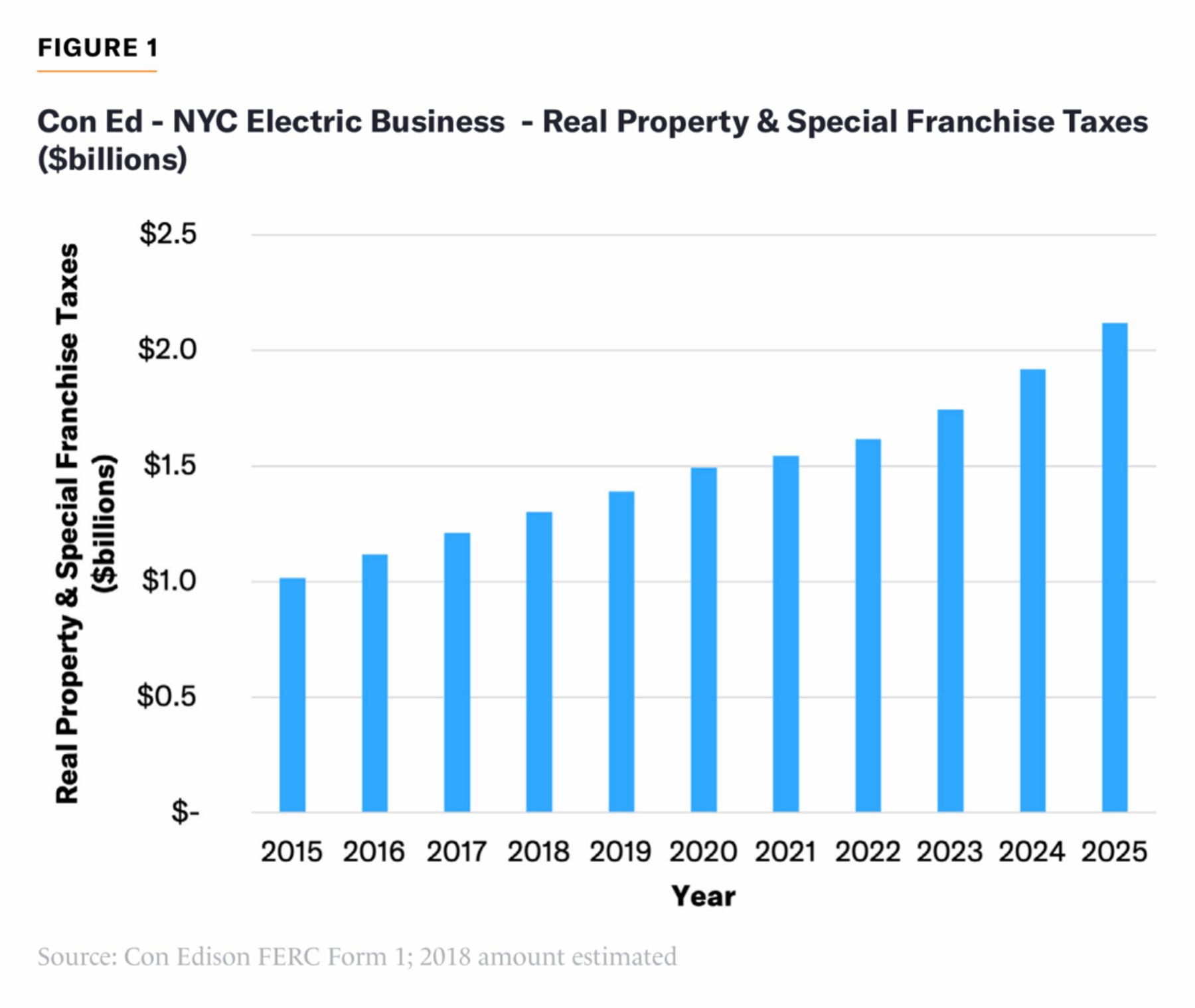
Last year, this meant that NYC customers paid about 5.4 cents in property tax for every kWh of electricity they used. Ignoring all other city taxes, a typical apartment averaging 280 kWh per month paid over $15 per month (21% of delivery charge) toward Con Ed’s property-tax bill. A typical single-family house in the city (using 600 kWh per month) paid almost $33 (25% of delivery charge), or $391 per year.
Con Ed ratepayers saw large increases in their bills, thanks to the convergence of three separate factors: rising component costs; the Climate Leadership and Community Protection Act (the state’s 2019 climate law); and the property-tax system itself.
Component Costs
Property taxes on real estate are, in theory, based on the market value as reflected by the sale price of a property (NYC’s extremely unique system limits the extent to which this is the case).
Unlike offices or houses, though, utility properties such as substations rarely change hands, making price data scarce.
Instead, the property tax on much of Con Ed’s physical property (its wires and grid components) is calculated with a method known as “Reproduction Cost New Less Depreciation.”
The replacement cost of key grid equipment, the basis for this calculation, ballooned amid Covid-19-related supply-chain disruptions and state and federal energy policies that goosed demand. The producer price index for electric power and specialty transformer manufacturing—which measures the cost of making key grid components—jumped 75% between 2019 and 2025 (Figure 2).
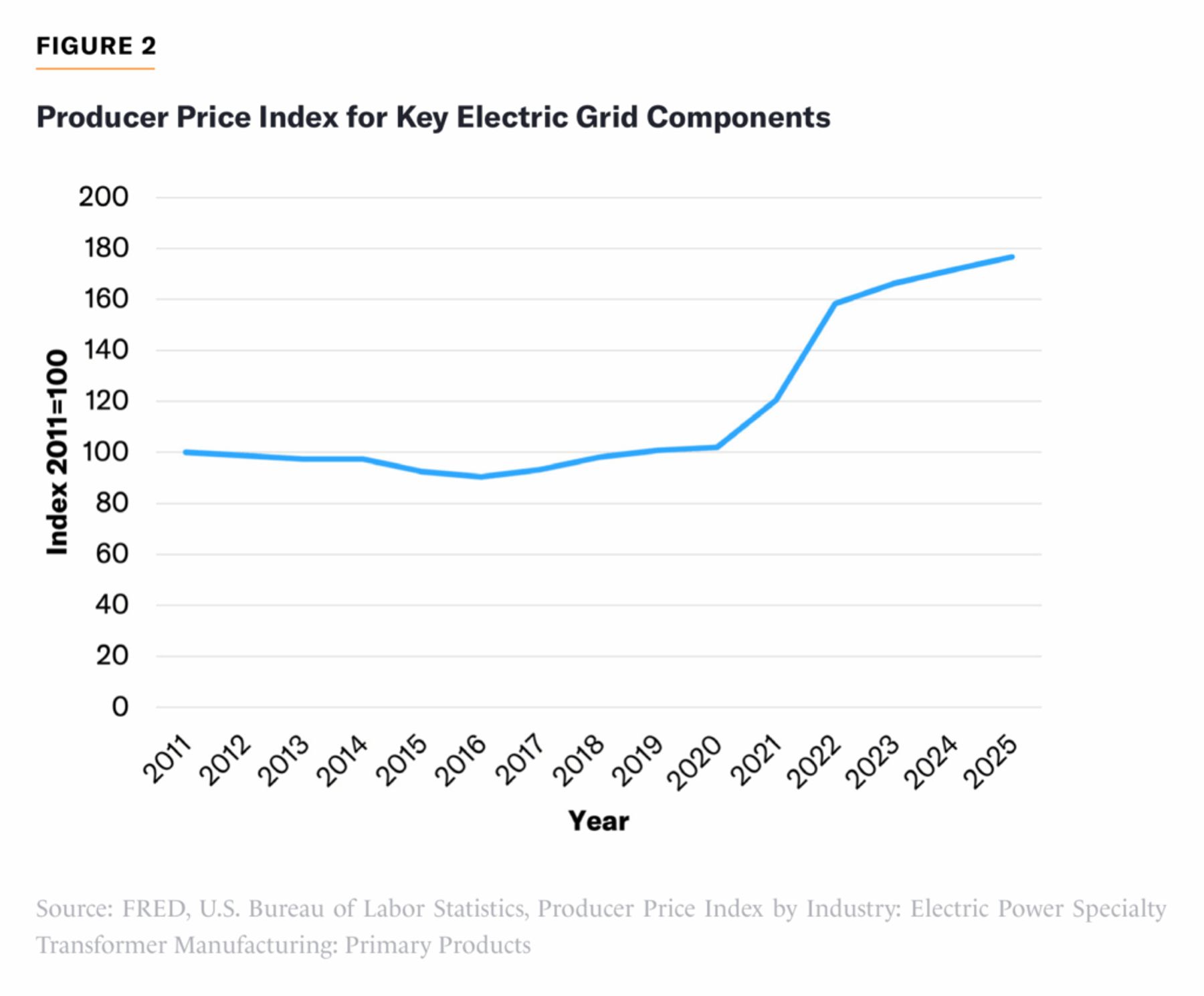
According to an index of utility costs published by the engineering firm Whitman, Requardt and Associates, “total distribution plant” costs rose 88% between July 2015 and July 2024, with the costs of line transformers more than doubling and pad-mounted transformers almost quadrupling during the period.[5]
Con Ed customers felt this hit twice: rates rose to cover rising equipment costs; and then they rose to cover the increased property tax on this higher-value equipment.
New York’s Climate Act
New York’s 2019 Climate Leadership and Community Protection Act (CLCPA) requires the state’s electricity grid to become “zero emission” by 2040 and envisions widespread electrification across the economy.
The legislation required electric utilities to undertake major upgrades to their transmission and distribution systems. In its 2019 capital planning report, the last one filed before CLCPA, Con Ed expected to invest $1.3 billion in its transmission and distribution infrastructure that year, with outlays rising to $1.8 billion by 2023. Those outyear projections rose in subsequent forecasts, as both component costs and obligations on the company swelled. In its most recent filings, the company expected to spend $3 billion in 2026 (rising to nearly $5 billion by 2030).
The cost of this expansion was, and will continue to be, passed on to ratepayers. What’s more, the bulk of the expected upgrades to the Con Ed system is occurring within New York City. That will further inflate how much of Con Ed’s property value that NYC can tax, further pushing up the utility’s property-tax bill and therefore customer bills.
New York City’s Property-Tax System
The city’s largest taxpayer, by far, has long been Con Ed. The utility’s combined electric, gas, and steam properties last year made up 8.5% of all taxable assessed value in the city, 23 times the next-largest property owner (Verizon, another utility).[6]
NYC’s property-tax levy (its total tax receipts) grew 54% between fiscal years 2015 and 2025, much faster than the period’s 32% inflation.
The unique structure of NYC’s property tax gave officials a mechanism to influence how that rising tax burden was distributed. The city does not tax property at a uniform rate. Instead, state law allows NYC (and Nassau County) to tax property at four different rates:
- Class 1: single-, two-, or three-family residences, including some mixed-use properties
- Class 2: multifamily residences with four or more units
- Class 3: most utility properties (Con Ed’s properties make up the overwhelming majority of the Class 3 tax roll)
- Class 4: commercial and industrial properties (including some utility-related facilities)
Since the 1980s, state law has limited how quickly the “class share,” the proportion of the city’s property tax collected from each class, can change. State lawmakers, nearly every year since 1995, have given the New York City Council discretion to further limit the extent to which each class’s share can increase or decrease.[7] The council in most years has exercised that power.
Classes 1 and 2 are owned or occupied by voters, which creates an incentive for elected officials to shift costs away from them and on to the other two classes. Class 3 revenues, by contrast, come primarily from Con Ed but are then passed along to ratepayers (primarily electric customers).
In the 2010s, the city economy—and with it, property values—surged. Even with the city council’s interference, the city’s property tax was booming so much that the share of taxable value in class 3 slowly shrank, from just over 7% in fiscal year 2014 to just under 6.5% in the last property-tax roll approved before the Covid-19 pandemic (Figure 3).
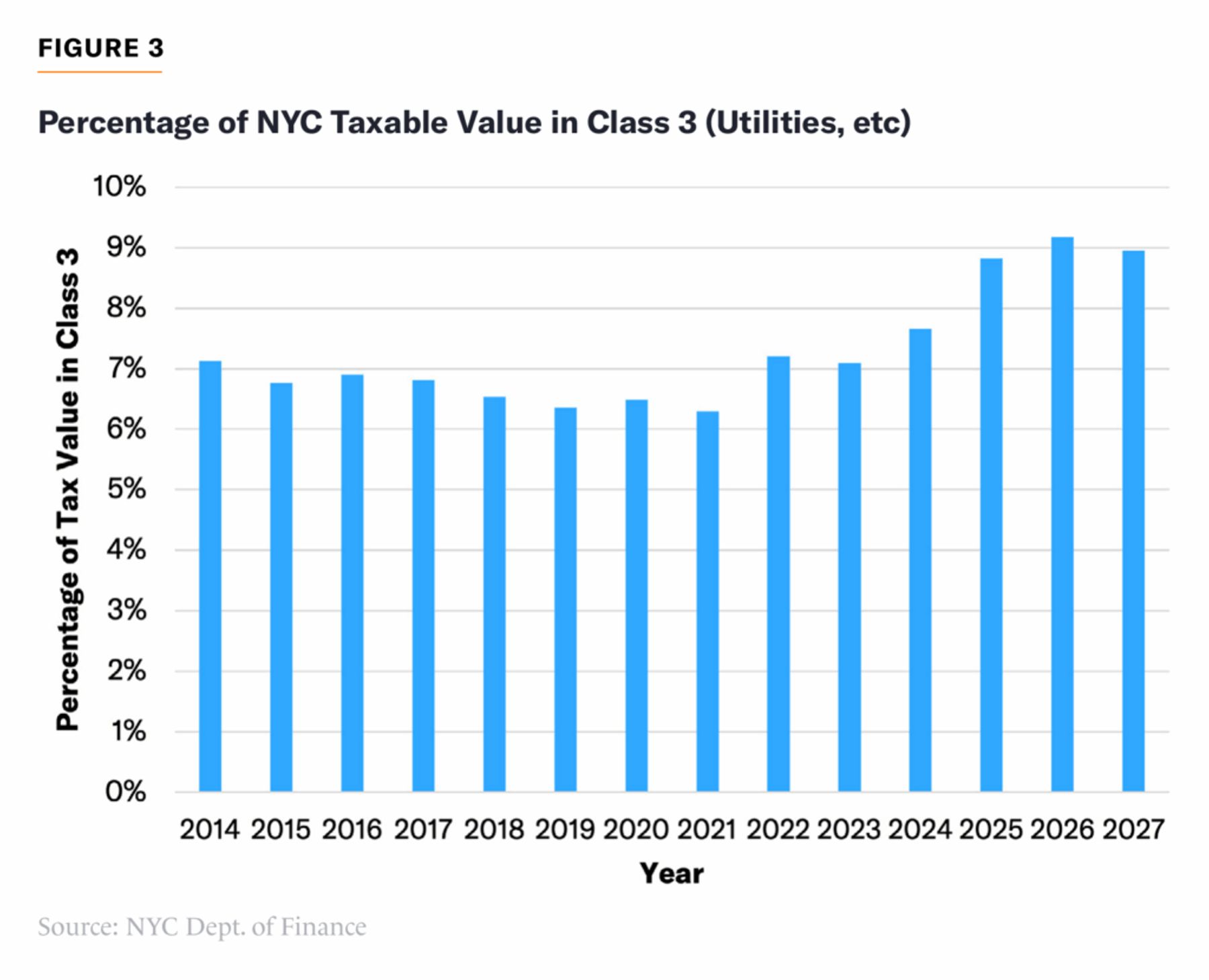
The pandemic rocked the city economy and the estimated market value of the city’s commercial and industrial properties (class 4) plunged 17% between fiscal years 2021 and 2022. City officials shielded residences from making up some of the difference by having utilities pick up an outsize share.
Going into fiscal years 2023[8] and 2024, the city did not allow the relative shares of the classes to shift at all.[9] With house and apartment values rising, and commercial properties rebounding, the result was again to shift more of the burden onto class 3. By fiscal year 2026, class 3 properties made up 9% of the city’s tax base.
The sponsors of the state legislation[10] that froze fiscal year 2024 class shares warned that, without a change, tax rates on residential properties “may increase uncontrollably” and “cause significant increases in the tax bills for residential homeowners.”
Now-retired Assemblyman Andy Goodell of Chautauqua County was the only lawmaker to speak against the bill, noting that most New York communities tax all property at a single rate. “And that’s fair,” he said, “because if you have a higher property value, you’d pay a higher amount of taxes; if you have a lesser value of property, you pay less, but you all pay the same rate.”
The measure passed the state assembly 140 to 6. It passed the senate unanimously.[11]
These interventions by Albany led directly to higher electricity bills for NYC homeowners to partially offset whatever savings the class-share freeze accomplished.
Between 2015 and 2025, Con Ed’s NYC tax payments (on its electric properties alone) went from equaling 4.4% of the city’s property-tax receipts to 6% (Figure 4).
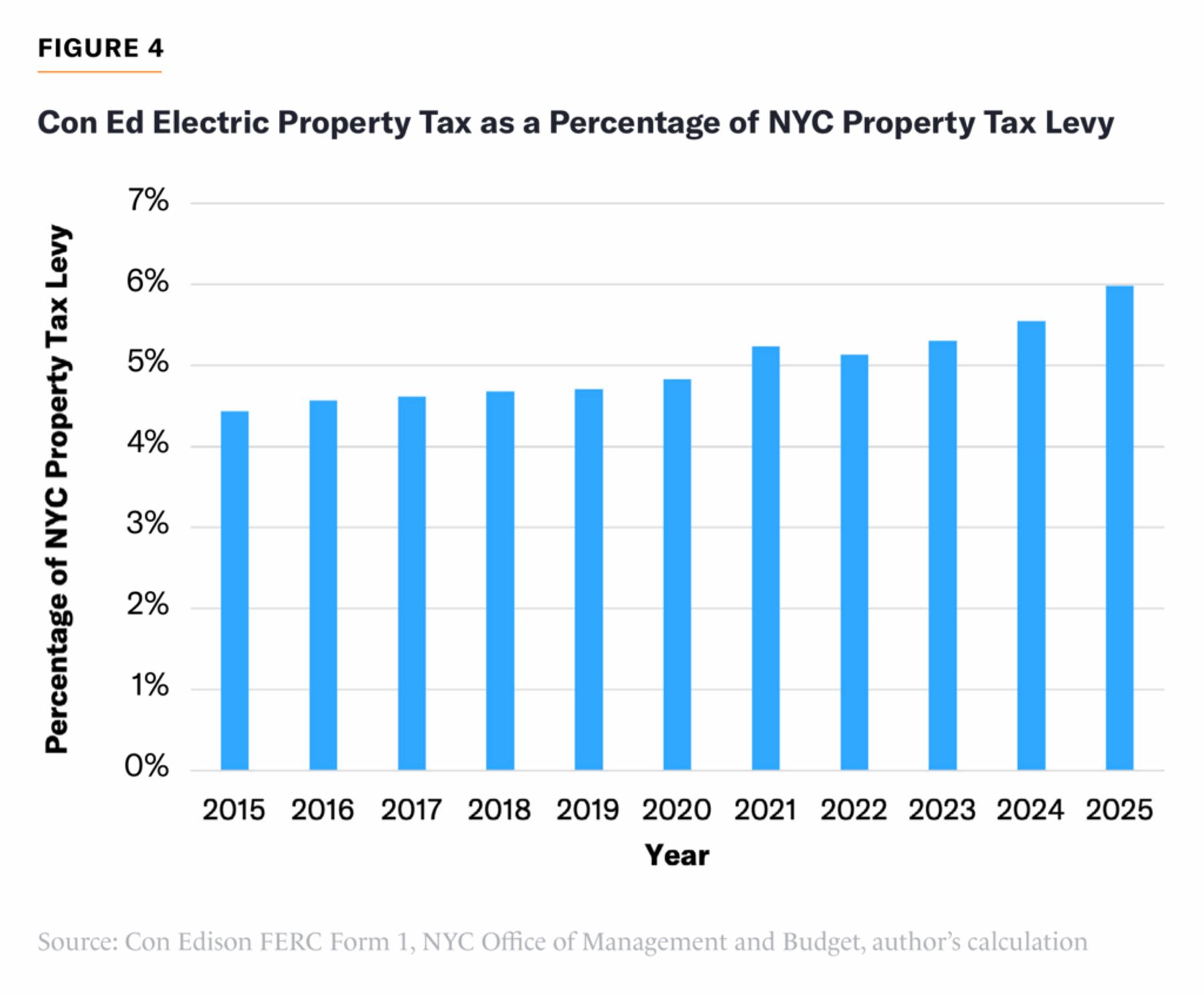
Con Ed’s electric territory covers virtually all of New York City and part of Westchester County. For several reasons, between 2015 and 2025, Con Ed’s NYC property tax rose 108%. The taxes paid to municipalities outside the city rose only 51%.
“A Tax-on-a-Tax-on-a-Tax”
The property tax is the largest mechanism that the city uses to extract taxes through electricity bills, but it is not the only one.
The city has purposefully taxed residents and businesses through their electric bills since the Great Depression. With permission from Albany, New York City in 1934 enacted a 1.5% tax on the gross receipts of regulated utilities “to relieve the people of the city of New York from the hardships and suffering caused by unemployment and the effects thereof on the public health and welfare.”[12]
This utility excise tax (known as UXT) subsequently became permanent. Mayor Robert F. Wagner signed, as part of his last budget, legislation that ultimately hiked the rate to 2.35% in 1966, where it remains today—almost a century after the “emergency” that justified its creation.
Con Ed’s property-tax costs are not deducted from its gross receipts liability, meaning that they are part of the base on which customers are taxed.
In addition, the city charges a 4.5% sales tax on the supply and delivery of electricity. (The state, by comparison, exempts residential customers from both the state sales tax and the related MTA sales tax).
This is not a new problem. Frederick J. Hunziker Jr., Con Ed’s General Tax Counsel, lamented in 1982 the way New York City was shifting the tax burden on to utility bills:
On the surface, such enormous utility tax increases permit the city to claim stability of those residential real estate taxes paid directly by voters or their landlords.
In reality, residential property taxes and residential utility bills are paid from the same checkbook. But when large property tax increases are hidden in bills for “energy,” and when gross receipts and sales taxes are superimposed on “utility” real estate taxes, the residential property owner pays a tax-on-a-tax-on-a-tax.[13]
Unlike the property tax, UXT and the sales tax appear on Con Ed statements as “GRT & other tax surcharges” and “Sales tax @4.5%,” respectively. Customer bills do not explicitly explain that these are almost exclusively city-imposed charges (Figure 5).
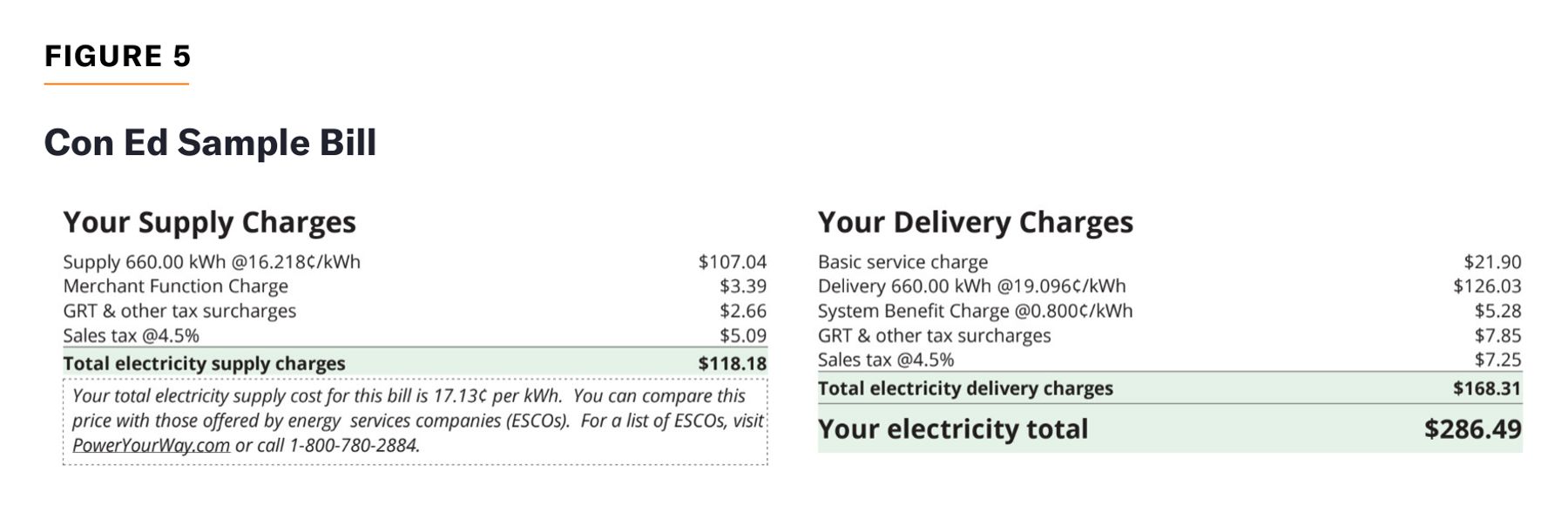
To put NYC’s unique relationship with Con Ed in perspective, the typical NYC apartment dweller (who last year paid $117.56 per month, including sales tax) paid 8 cents per kWh, or $22.52 monthly, to cover the combined cost of Con Ed’s property-tax liability, its utility excise tax, and the related sales tax. For single-family houses, city taxes totaled $46.75 per month. That also does not include the extent to which city property taxes on power plants are passed along to customers as higher supply charges.
Even ignoring Con Ed’s ordinary tax obligations (such as payroll and business income taxes), NYC is imposing an effective tax rate of 36.1% (apartments) or 42.7% (houses) on the delivery portion of electricity service—which is generally considered an essential service.
By comparison, New York levies two excise taxes on recreational marijuana: a 9% tax on distributors; and a sales tax up to 13% of the retail price that flows to the state and municipal governments, for a combined total of just 23.2%.
No major city in the nation, and likely no local government anywhere, relies as heavily on any combination of taxes, let alone property taxes, levied on its electricity system as New York City.
Chicago
The Windy City is notorious for fiscal gimmickry, but its officials do not use its similarly situated (and similarly named) Commonwealth Edison (“ComEd”) electric utility as a piggy bank.
Last year, ComEd paid $41 million in property tax for its offices and other real estate in Illinois while delivering twice as much electricity as Con Ed. ComEd’s effective property-tax rate was $0.00046, or less than one-twentieth of one cent, per kWh. Put another way, this is less than 1% of the tax rate that NYC levies on Con Ed.
Why the difference? The Illinois Constitution of 1970 required state lawmakers to abolish personal property taxes (PPT) by 1979. Unlike real property taxes on land and buildings, PPT extend to what are often mobile (and expensive) equipment. Besides being more difficult to assess, the presence of a PPT regularly causes businesses to relocate assets to different jurisdictions or out of state entirely.
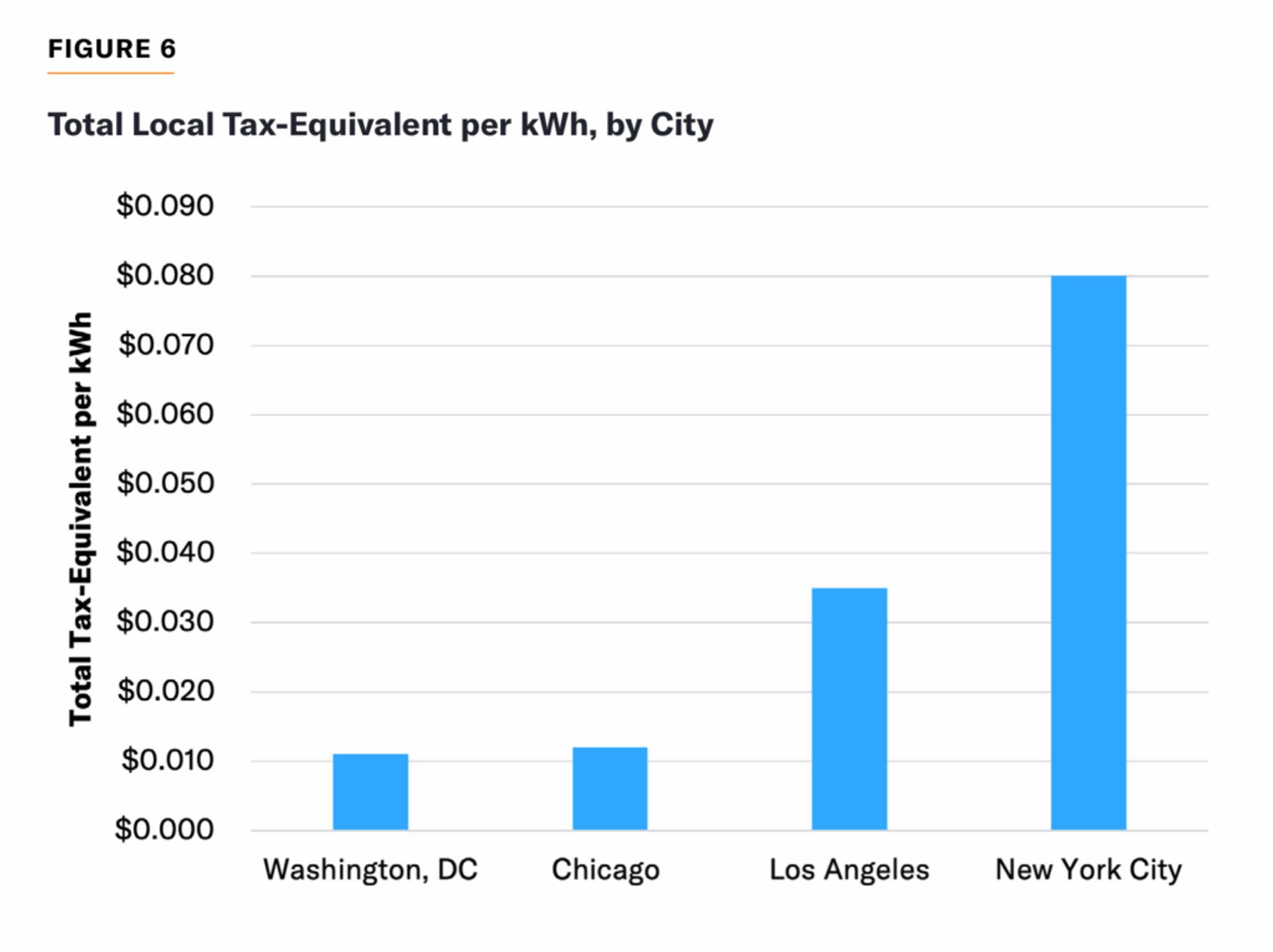
The state allows local governments to tax electricity delivery two ways: an “infrastructure maintenance fee” analogous to a franchise fee; and an electricity tax, both based on usage.[14] In Chicago, these rates totaled 1.2 cents per kWh for a typical residence (Figure 6).
Residential electricity purchases, notably, are not subject to sales tax.
Los Angeles
Electricity in Los Angeles is distributed mainly by the government-owned Los Angeles Department of Water and Power (LADWP). LADWP, in lieu of taxes, makes an annual contribution to the city’s general fund. The most recent data (fiscal year 2025) show $244.7 million in transfers. Even combined with the $18.6 million in property taxes that LADWP pays to other jurisdictions (for properties outside the city), the total property-tax equivalent was 1.1 cents per kWh served.
Instead of a sales tax, Los Angeles levies a “telephone, electricity and gas users” tax, with a 10% rate for electricity.[15] That tax, adding about 2.4 cents per kWh, is shown on customer bills.
Washington, DC
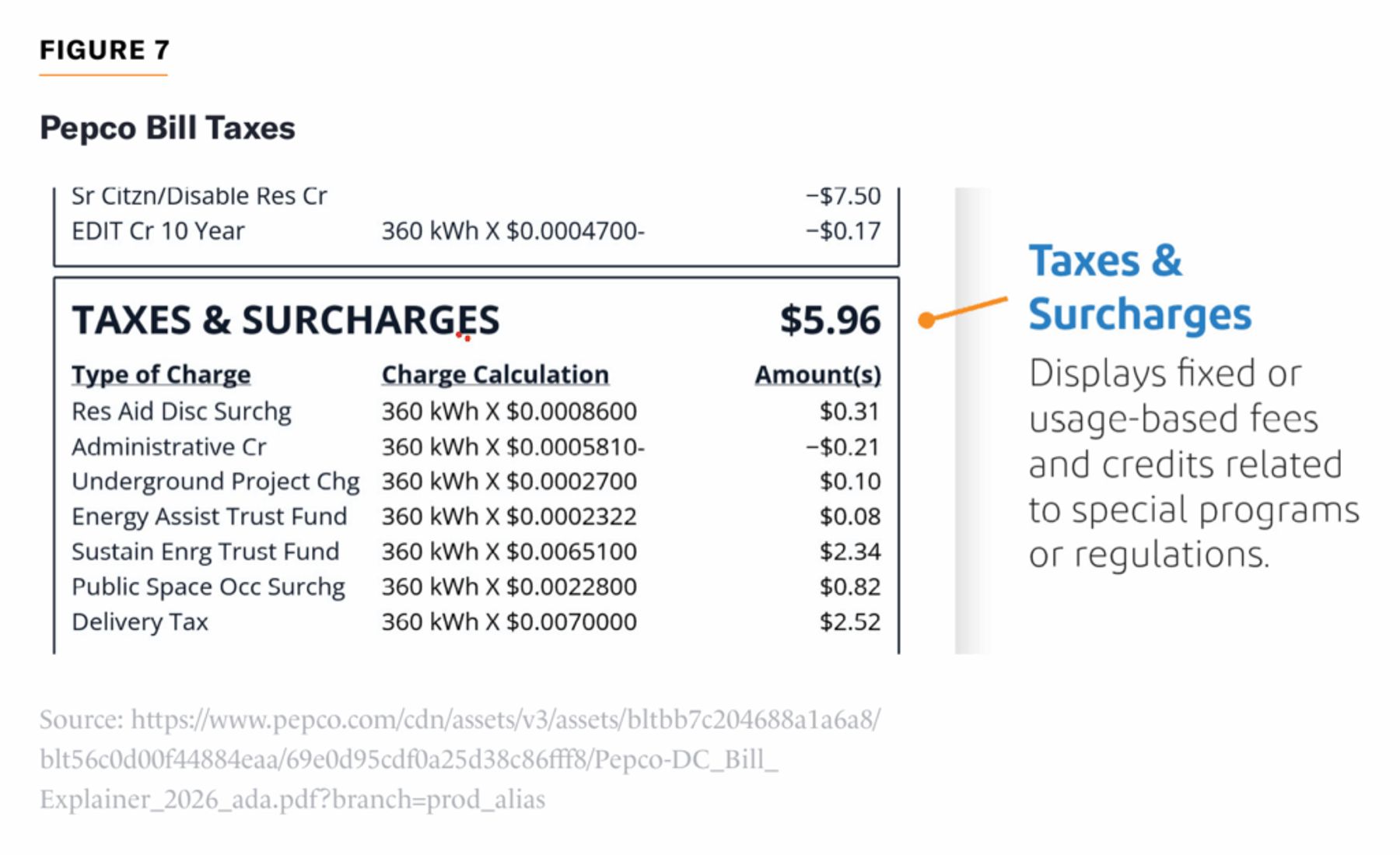
The Potomac Electric Power Company (Pepco), serving Washington, DC, paid the district government about $109 million in 2024. The company’s property tax made up only a small fraction, about $10 million. Instead, Pepco paid $23 million for a “public space occupancy surcharge” and a “delivery tax” totaling $76 million. Both are shown on customer bills (Figure 7).
All told, the district government collects about 1.1 cents per kWh through Pepco. Residential electricity is exempt from the district’s sales tax.[16]
Short-Circuiting Other Goals
Electricity costs flow to every facet of life in New York City. They affect, at several levels, the cost of food, shelter, health care, and other essentials.
Mayor Mamdani last year said, “Politicians are not bystanders to the affordability crisis.”[17] But city officials are partially responsible for NYC’s high electricity rates, if only to the extent to which they have been increased, through taxes, to finance general-fund operations.
More specifically, the city’s tax-the-grid posture directly conflicts with its policy of encouraging residents and businesses to swap fossil fuels for electricity. The city’s electricity tax regime drives up the operating costs of everything from electric vehicles to heat pumps, often making it more cost-effective to continue burning natural gas, diesel or other fuels and investing in fuel-burning hardware.
NYC has an official goal of reducing its greenhouse gas emissions from all sources by 80%, compared with 2005 levels, by 2050.[18] The city has gone further to restrict emissions from buildings, with the goal of reaching “net-zero” emissions for many of them by mid-century.
The extent to which the city’s tax and spending decisions are undercutting this push toward electrification is coming into view as building owners, including co-op tenants, opt, in some cases, to make penalty payments instead of upgrades that the city council has insisted on in various electrification policies.
The bottom line: the high electricity rates stemming from the city’s electricity tax scheme make recouping the up-front cost of electrification less practical.
Stopping the Electric Shock
The problem for Con Ed ratepayers boils down to the fact that NYC has the power to squeeze extra revenue through its unique property-tax system; and the usual check against this sort of abuse, the Public Service Commission, does not have authority to directly prevent it.
State lawmakers should reform this dynamic by considering the following principles:
- Taxes should be visible and easy to understand. In late 2025, the state Public Service Commission and Con Ed agreed to a landmark “bill transparency” provision requiring the company to “itemize on customers’ bills the dollar amount attributable to municipal property taxes” by the beginning of 2027.[19] This will be a good first step toward allowing New Yorkers to see the extent to which utilities have been conscripted to act as tax collectors. Residential customers will at least know that they are paying three discrete taxes to the same entity, the City of New York. This transparency requirement should be the law, not just the product of a temporary settlement with regulators, and it should apply to all public utilities whose rates are subject to Albany’s approval.
- The property-tax system should not be used as a utility tax. The legislature can exempt the value of utility equipment on class 3 properties subject to state rate-setting from NYC property tax, and instead have the city tax the land as if it were any other commercial and industrial property (class 4) and authorize the city to apply a uniform usage tax. This would involve amending the state law that now limits the city’s sales tax on electricity to 4.5%. Lawmakers can also require utilities to pass along the resultant property-tax savings to ratepayers.
- Spending drives taxes and threatens affordability. The city’s faster-than-inflation budget growth propelled the growth of property taxes on utilities and, with it, electric rates. The looming $6 billion mismatch between revenues and expenses in next year’s FY28 city budget highlights the difficulty in reducing the city’s reliance on electricity-related taxes.[20]
- Electrification requires spending restraint. If the city is to have any hope of meeting its electrification goals, it will need to meaningfully reduce the cost of electricity, which now makes electrification unattractive for many applications.
Endnotes
Are you interested in supporting the Manhattan Institute’s public-interest research and journalism? As a 501(c)(3) nonprofit, donations in support of MI and its scholars’ work are fully tax-deductible as provided by law (EIN #13-2912529).