Good morning:
Do you ever notice that supposedly organic street protests seem to have coordinated placards and posters, a network of pre-existing media and social media outlets, and what appears to be a plan for closing roads and causing disruption? This week, legal policy fellow Tal Fortgang and investigative analyst Stu Smith released a new City Journal investigation into one of the leading groups in what they call “a demonstration-industrial complex” that is closely linked to foreign funders and actors.
“There is nothing illegal about astroturfing protests,” they write, but when organizations with foreign ties and a tendency to break the law hide behind the First Amendment’s protection of the right of free assembly, perhaps Congress ought to take a closer look.
Also in City Journal, senior fellow Christopher F. Rufo and investigative reporter Kenneth Schrupp dig into the waste of a Governor Gavin Newsom’s $114 million butterfly bridge that is over budget and behind schedule. Unfortunately, this is a boondoggle Californians can’t afford.
Nor do many Americans feel they can afford to give children the extracurricular-packed, sports-filled, experience-heavy upbringing they wrongly think parenting requires, writes senior fellow Rob Henderson in the Wall Street Journal. But inflated “cost of living” is not the real hindrance young people face having children. Instead, writes Henderson, “the real cost today is social rather than material.” Today, parents are judged by what cultural elites try to give their children. When people don’t think they can keep up, they sadly opt out of the children they otherwise would have had.
Elsewhere in this newsletter, MI president Reihan Salam writes the inaugural essay in a new partnership between The Daily Wire and the Manhattan Institute. He warns Republicans that if they hope to succeed in the 2028 presidential election, the GOP must maintain President Trump’s broad coalition that overperformed with black and Latino voters, and reject more radical platforms from the online right.
Finally, the Research team published a new paper today about how government contracts are awarded in New York City. Policy analyst Josh Appel finds that the cost-based model of awarding contracts, in which NGOs receive payment for their expenses even if they fail to accomplish their goals, is unstainable, bloated, and expensive. He proposes another solution. Continue reading for all these insights and more. Kelsey Bloom Editorial Director |
|
|
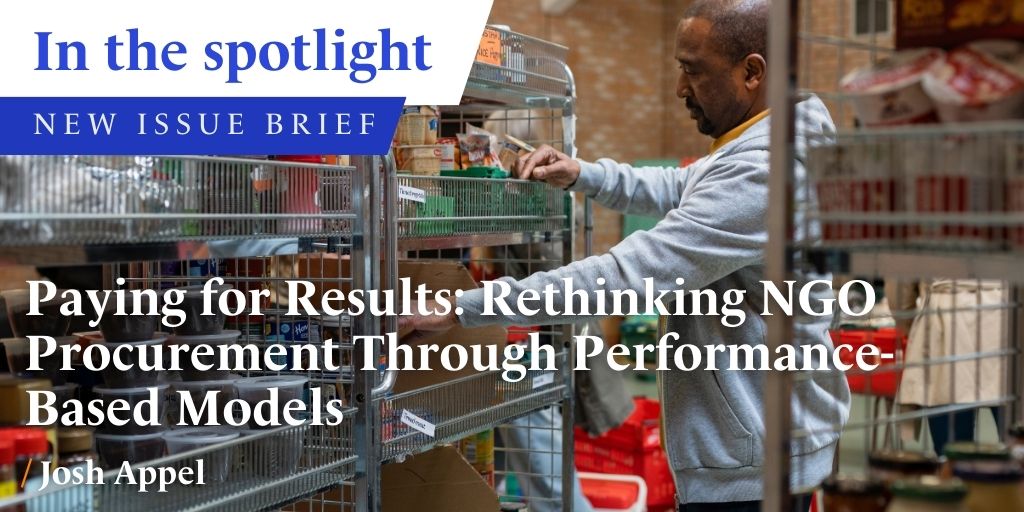
Paying for Results: Rethinking NGO Procurement Through Performance-Based Models
By Josh Appel | Manhattan Institute | Photo by SolStock/Getty Images
New York City spends roughly $8 billion annually contracting with nonprofit organizations to deliver a vast array of social services — more than the entire NYPD budget. Yet according to a new Manhattan Institute paper by policy analyst Josh Appel, the city gets remarkably little accountability for that investment.
NYC has a cost-based contracting model, which reimburses nonprofits for expenses rather than outcomes. Organizations can exhaust their budgets without producing the desired results and still receive full payment from taxpayers. The system also generates massive bureaucratic overhead, chronic payment delays, and $4.6 billion in contracts are awaiting registration.
Appel argues that piecemeal fixes—partial payments, deadline enforcement, technology upgrades—won't solve the underlying structural flaw. Instead, NYC should transition to a hybrid performance-based model, where a modest upfront payment is followed by milestone-tied disbursements. Case studies from Oklahoma, Illinois, and Minnesota demonstrate that tying payments to outcomes consistently improves results while reducing costs. |
|
|
The Class Wars Come for Fertility
By Robert Henderson | The Wall Street Journal | Photo by Marc Elias/Getty Images
“Babies have always required food, shelter and love. What’s changed is the definition of successful parenthood. In past generations, families raised children according to what they could afford. Today, parenting is judged according to what cultural elites consider acceptable. This shift matters more than people realize. ...
“Many parents feel pressure to provide their children with a full schedule of extracurriculars, travel sports, private tutoring and tuition for an expensive college. Add to that list a smartphone and travel experiences.
“Parents who don’t provide these things risk feelings of inadequacy. The question for young adults, then, isn’t whether they can afford to raise children. It’s whether they can afford to raise a child in the ‘right’ way. When the answer is no, many delay parenthood or skip it altogether. ... If childbearing is a status competition, the logical move for those at the top is to succeed at it while persuading others to opt out.” |
How (Not) to Win in 2028
By Reihan Salam | The Daily Wire | Photo by Alexi J. Rosenfeld/Getty Images
“Republicans look likely to lose the House of Representatives in November, which will almost certainly bog down the rest of Trump’s administration in interminable impeachment hearings. ... This raises the question that has for years felt unthinkable: what comes after Trump? To an increasingly loud faction on the online right, the answer is a noxious blend of extreme ideologies. But that would be a mistake. Keeping the Trump Train going means embracing Trump’s 2024 strategy: playing to the majority of Americans on issues on which the right can win. ...
“Trump secured an Electoral College landslide and popular-vote plurality in 2024 by pivoting toward the center, not away from it. He took advantage of Democrats’ unpopular positions on the border, gender, and runaway inflation, aligning himself with the median voter fed up with the status quo. ... These voters didn’t vote for Trump to be radical; they voted for Trump because they were against radicalism.” |
|
|
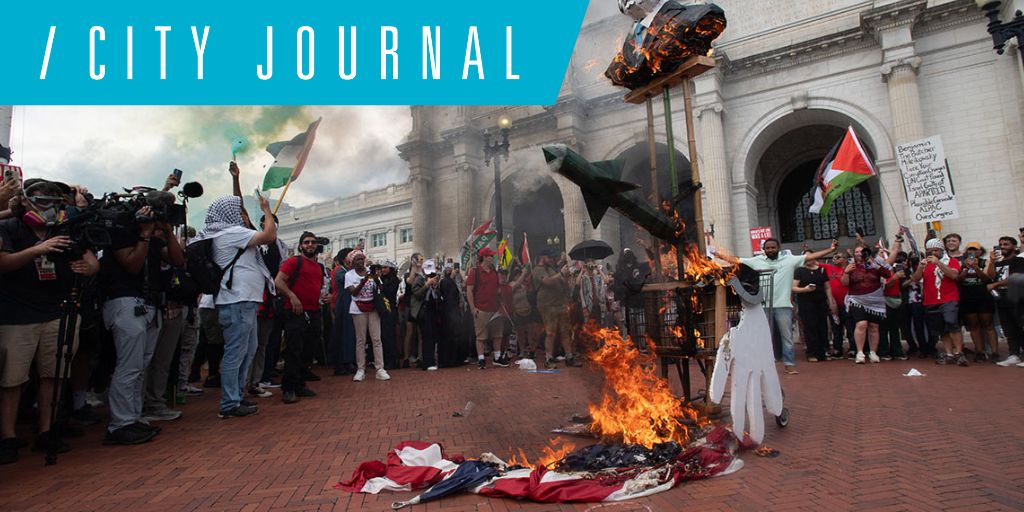
What the Pro-Iran Protests Reveal About Foreign Influence
By Tal Fortgang & Stu Smith | City Journal | Photo by MATTHEW HATCHER/AFP via Getty Images
“Mere hours after the bombs began to fall (on Iran), leftist activists took to the streets with signs and chants denouncing American ‘imperialism.' ... It’s no coincidence that these protests bear similarities with the sometimes-violent ... rallies that have dotted the country in recent months. Behind many of these disruptions is the ANSWER Coalition—Act Now to Stop War and End Racism—an umbrella organization composed of various far-left groups. ... “When a polarizing event erupts, ANSWER often coordinates the protests: setting time and location, promoting the gatherings through affiliated media outlets and social media channels, ... and coordinating the messaging that makes fringe leftist positions appear mainstream. ANSWER’s activities can and sometimes do turn from peaceful protest into civil terrorism. ... “Though it hides behind the banner of free assembly, the demonstration-industrial complex is far from a benign presence. There is credible reason to believe its members actively seek to subvert America’s interests at home and abroad.” |
Gavin Newsom’s $114 Million Butterfly Bridge
By Christopher F. Rufo & Kenneth Schrupp | City Journal | Photo by The Wallis Annenberg Wildlife Crossing (Kevin Carter/Getty Images)
“In 2022, California Governor Gavin Newsom broke ground on the Wallis Annenberg Wildlife Crossing (WAWC), a project featuring an overpass for animals atop ten lanes of the 101 Freeway in Southern California. ... Nearly four years after the ceremony, the bridge is past due and the project some $21 million over budget. ...
“Why has a project primarily consisting of a bridge for animals cost over $100 million? One reason is that Newsom and WAWC’s philanthropic supporters apparently don’t mind it becoming a patronage program. As the WAWC-endorsing Wildlife Crossing Fund notes, citing the California Department of Transportation’s estimate, ‘for every $1 billion spent’ on wildlife crossings, ‘13,000 jobs are created.”’ “Some of these jobs are absurd. The National Wildlife Federation’s WAWC website claims that ‘[o]ur Native Plant Nursery’ ... ‘has prioritized hiring Indigenous team members to help steward the plants that will vegetate the bridge.’ The nursery’s co-manager said she makes an ‘offering’ after collecting seeds, sometimes including pieces of her hair.” |
|
|
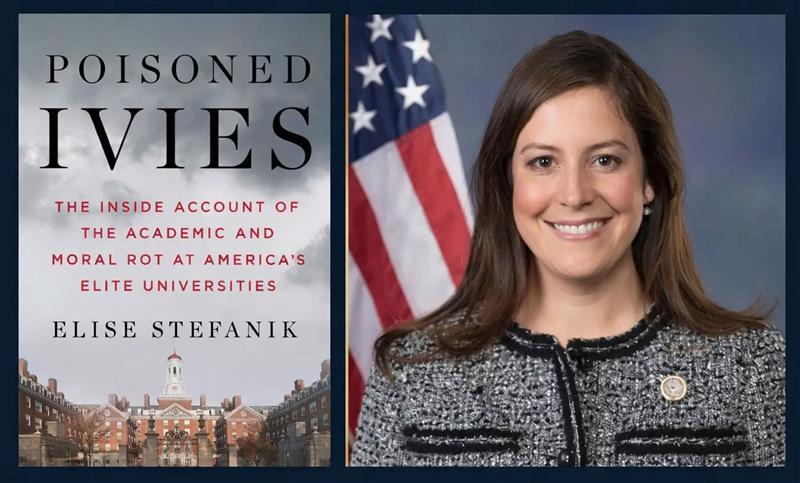
Elise Stefanik Book Event—Poisoned Ivies By Manhattan Institute
In her new book, Poisoned Ivies, Rep. Stefanik examines the ideological transformation of America’s elite universities and the broader consequences for academic freedom, intellectual diversity, and civic culture. Drawing on her experience as a Harvard graduate and as a leading voice in Congress on higher education oversight, Stefanik argues that many of the nation’s most prestigious institutions have strayed from their founding missions. The book explores concerns about viewpoint discrimination, the rise of politicized campus bureaucracies, and the impact of these trends on students, faculty, and public trust in higher education.
Rep. Stefanik has represented New York’s 21st Congressional District since 2015 and is a member of House Republican leadership. She has been a central figure in national debates over campus governance, free speech, and accountability in higher education. |
|
|
For more information and media requests, please contact
communications@manhattan.institute.
Are you interested in supporting the Manhattan Institute’s public-interest research and journalism? As a 501(c)(3) nonprofit, donations in support of MI and its scholars’ work are fully tax-deductible as provided by law. |
|
|
Photo Credits: adamkaz/E+/Getty Images; Noah Berger/AP Photo; Anadolu/Getty Images; Wong Yu Liang/Getty Images; Catherine McQueen/Getty Images; Probal Rashid/LightRocket/Getty Images |
|
|
The Manhattan Institute works to keep America and its great cities prosperous, safe, and free. Manhattan Institute 52 Vanderbilt Ave. 3 floor
New York, New York 10017
Want to change how you receive these emails?
Unsubscribe | Subscription Preferences
Copyright © 2026 Manhattan Institute, All rights reserved. |
|
|
|