Good morning: This week, the MI Research team published two new reports on education in America.
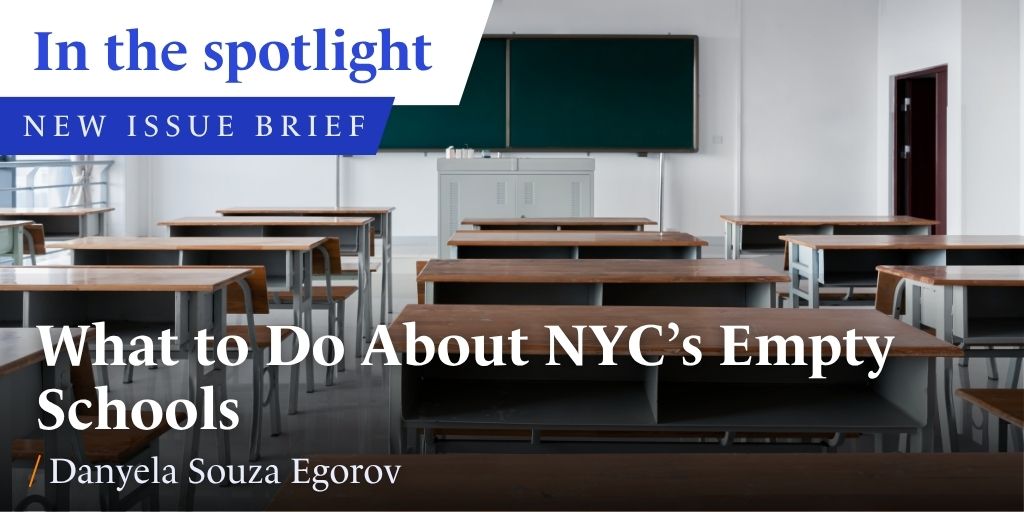
First, fellow Danyela Souza Egorov examines empty school buildings in New York City. This year, 112 public schools have fewer than 150 students enrolled. Next year, the projected number of schools with so few students increases to 134. With that small of a student body, it is hard to justify the minimum number of non-teaching staffers that each school is required to employ.
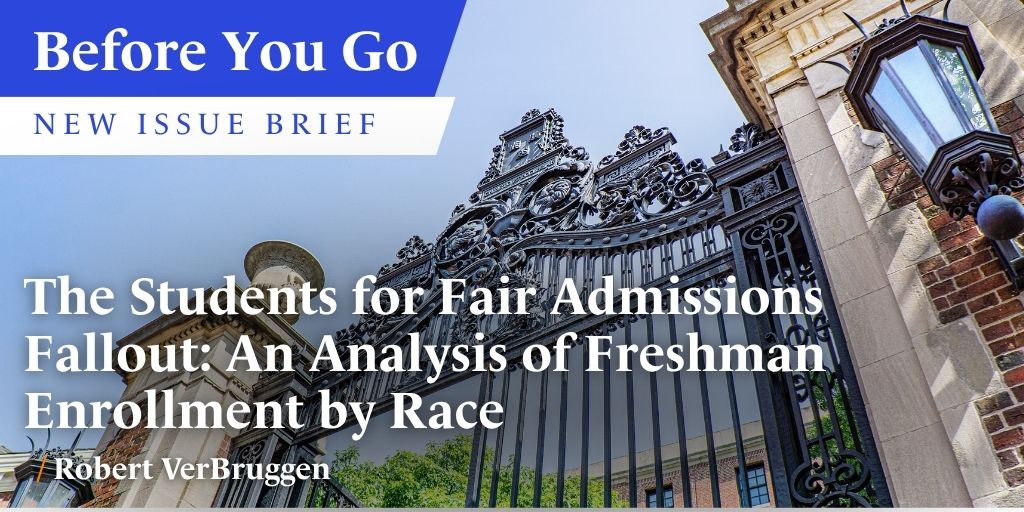
Second, at the level of higher education, senior fellow Robert VerBruggen analyzes federal data on the first class of freshmen affected by the Supreme Court’s Students for Fair Admission ruling, which banned racial preferences in college admissions. It is still early days, and the fallout appears to be mixed, but VerBruggen identifies some significant trends.
In the New York Post, senior fellow Charles Fain Lehman lays out the timeline of another preventable murder in New York city. Ross Falzone, 76, was entering a subway station recently when Rhamell Burke, 32, allegedly shoved him down a flight of stairs. The elderly man later died from his injuries and Burke, who appeared in court the day after the shoving on different charges, was allowed to walk free. Burke’s story is one of a repeat offender—he’s been arrested four times in the last four months—being released under New York’s permissive bail laws. A revolving door like that eventually leads to innocent people getting hurt.
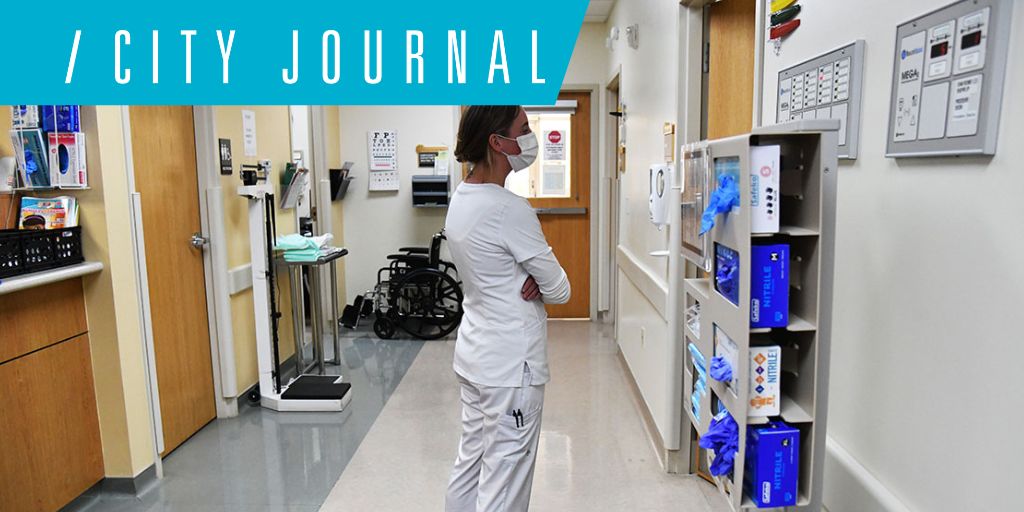
Another serious problem in New York is electricity prices, and lawmakers who will not seriously address why costs are increasing, writes senior fellow Ken Girardin in City Journal. Residential electricity rates jumped an average of 8% in 2025, more than the 5% national average. This is nothing new; due to tax and regulatory policies, New York City has long had some of the nation’s highest electricity rates. But for the last half decade those prices have risen almost twice as quickly as inflation. Girardin writes that New York officials are too quick to reach for gimmicks, like income-based credits and renewable energy mandates, and the only solution is to put them all on the chopping block.
Also in City Journal, senior fellow Chris Pope warns against blaming health-care consolidation for rising health insurance premiums. He evaluates Sen. Elizabeth Warren’s new bill, which intends to stop large insurance companies from steering enrollees to medical providers they own. Pope writes that average annual premiums have increased, but “most economists believe that hospital-centric integration”—meaning, there are fewer physicians in private practice because they are employed by hospitals—“is more problematic as a cost driver, but Warren’s bill ignores it entirely.”
Continue reading for all these insights and more. Kelsey Bloom Editorial Director |
|
|
|
What to Do About NYC’s Empty Schools
By Danyela Souza Egorov | Manhattan Institute | Photo by LAW Ho Ming Getty Images
Public-school enrollment is falling across the country, and New York City is being hit especially hard. In a new Manhattan Institute issue brief, Danyela Souza Egorov argues that NYC’s school system is saddled with too many under-enrolled schools—many of which are both financially inefficient and academically ineffective.
In the upcoming school year, 134 NYC public schools are projected to have fewer than 150 students enrolled. City schools of this size spend over $40,000 per pupil on average, well above the citywide average. Many of these schools are also struggling academically, with dozens reporting fewer than five students proficient in math or English.
The enrollment declines are likely to continue, given charter school growth, declining birthrates in the city, and outmigration. Rather than continuing to prop up shrinking schools through “hold harmless” funding policies, she recommends merging or closing the weakest and smallest schools, which she estimates could save the city over a hundred million dollars annually while concentrating resources in stronger schools. |
|
|
New York Crime ‘Revolves’ Around Recidivists — as State’s Laws Release Danger onto Our Streets
By Charles Fain Lehman | The New York Post | Photo by Jack Berman Getty Images
“Another New Yorker was made the victim of the city’s revolving-door criminal justice system last week. Ross Falzone, 76, was entering a subway station in Chelsea when Rhamell Burke, 32, allegedly shoved him down a flight of stairs. Falzone later died from his injuries.”
“In spite of this, somehow Burke appeared in court on a completely different charge the next morning. Even more shockingly, he was allowed to walk free. … according to New York state data, 88% of those who have a misdemeanor assault charge and another open case are rereleased.” |
The Covid Talent-Agent Bailout
By Judge Glock | The Wall Street Journal | Photo by Mario Tama/Getty Images “The federal government says it handed out more than $180 billion in improper payments last year, largely through major entitlement programs such as Medicare and Medicaid. Yet the program with the highest rate of bad payments by far received little attention. …
“The government is on a campaign to stamp out fraud and waste. But too many people benefit from government largesse, including wealthy talent agents and celebrities. When politicians and the press push the government to hand out more cash without strings, ordinary Americans pay for it.” |
|
|
Neither Party Offers Any Help for New York’s Electricity Cost Crisis
By Ken Girardin | City Journal | Photo by Spencer Platt/Getty Images
“New York has a serious problem with electricity prices, and its political class seems incapable of talking seriously about it. … Electric utilities have substantially hiked spending to comply with the climate law, passing on the costs to ratepayers. …
“Until Albany gets focused on making electricity less expensive, the bills landing on kitchen tables will grow bigger and hit harder.” |
Breaking Up Big Medicine Won’t Make Health Care Cheaper
By Chris Pope | City Journal | Photo by Andrew Harnik/Getty Images “Americans are desperate for relief from rising health insurance premiums. Average annual premiums for single-coverage plans have risen from $7,491 in 2020 to $9,325 in 2025. For family plans, the cost increase was steeper, from $21,419 to $26,993 over the same period. … “What’s mainly responsible for the rising cost of health insurance? The growing use of increasingly sophisticated medical technologies. Serious attempts to reduce costs would present painful trade-offs that politicians prefer to avoid.” |
|
|
The Students for Fair Admissions Fallout: An Analysis of Freshman Enrollment by Race By Robert VerBruggen | Manhattan Institute | Photo by: Spencer Grant/GHI/UCG/Universal Images Group via Getty Images
In 2023, the Supreme Court's Students for Fair Admission ruling put a stop to race-conscious admissions at colleges and universities. Now, federal data is available on the first class affected by the ruling—and a new Manhattan Institute analysis by Robert VerBruggen offers a comprehensive review of the case's influence on the demographics of incoming freshmen. Drawing on federal enrollment data from over 1,000 colleges, VerBruggen finds that at elite schools, black and Hispanic enrollment shares declined modestly while white and Asian shares grew. Within the Ivy League, the black share fell from roughly 11% to 8%. Yet the changes varied dramatically by school — with some institutions, like Northwestern, actually increasing minority enrollment.
The report also examines the return of standardized testing requirements, finding they may produce demographic shifts similar to the admissions ban itself. As federal and judicial enforcement is still evolving and universities are adapting their practices, this report is the beginning of researchers monitoring these trends. |
|
|
For more information and media requests, please contact
communications@manhattan.institute.
Are you interested in supporting the Manhattan Institute’s public-interest research and journalism? As a 501(c)(3) nonprofit, donations in support of MI and its scholars’ work are fully tax-deductible as provided by law. |
|
|
|
Photo Credits: adamkaz/E+/Getty Images; Noah Berger/AP Photo; Anadolu/Getty Images; Wong Yu Liang/Getty Images; Catherine McQueen/Getty Images; Probal Rashid/LightRocket/Getty Images |
|
|
The Manhattan Institute works to keep America and its great cities
prosperous, safe, and free. Manhattan Institute 52 Vanderbilt Ave. 3 floor New York, New York 10017
Want to change how you receive these emails?
Unsubscribe | Subscription Preferences
Copyright © 2026 Manhattan Institute, All rights reserved. |
|
|
|
|