Good morning: University grading practices deserve a failing score.
In a new paper for the Manhattan Institute, Neetu Arnold digs into the history of grade inflation, by which academic institutions boost students’ grades without an accompanying improvement in achievement or course mastery. There is an established culture of grade inflation at American colleges and universities, even at top institutions that are supposed to be the best of the best, and purportedly the most challenging. But at Harvard, A’s and A-minuses account for 85% of all letter grades. At Yale, that figure was 79% in recent years.
Part of the problem is the corrosive relationship between the grades issued by professors and the class evaluations issued by students. Another problem is that many students enter college without adequate academic preparation, putting additional strain on faculty and their attempt to maintain high standards.
Some institutions do seem desperate to improve their reputation and maintain the value of their degrees. Harvard—home of the famed professor of government Harvey Mansfield, who issued two grades to his students, an official grade that went on a college transcript and a true grade that represented what the student should have earned—announced last month it will cap the number of A’s to 20% of letter grades awarded in a course. And other institutions are racing to reinstate standardized testing requirements for applicants in an effort to improve the quality and preparedness of their student body.
In addition to other suggestions made in the new paper, Arnold has another, novel suggestion for combating grade inflation: an inflation-adjusted GPA. This new tool would reformulate a student’s GPA in such a way that adjusts for the differences in grading strictness (or leniency) across courses and over a student’s academic career. Employers, graduate schools, and other audiences would immediately understand, from one statistic, each student’s academic performance in a way that is not contaminated by grade inflation or easy courses. Check out her full report below.
Also in this newsletter, MI president Reihan Salam writes about young American Muslims today and the two ideological tendencies he sees “within the American Muslim population that are distinct in their character, different in their dangers, and yet mutually reinforcing.” The essay is an essential read for understanding the appeal among some of Islamism, a revolutionary ideology that collapses the distinction between religious authority and political power; and Third Worldism, an anti-Zionist, anti-West, anti-capitalist fusion that appeals to secular young Muslims who otherwise appear highly integrated into American society.
In City Journal, fellow Carolyn D. Gorman warns that New York residents and political leaders alike are at risk of normalizing mental illness-related violence in such a way that lets officials avoid all accountability and also leaves the mentally ill to deteriorate on the street.
Also in City Journal, investigative reporter Stu Smith reports on the recent public panel hosted by the “community defense” subgroup of the Democratic Socialists of America. As Smith reports, members of DSA organizations are highly concerned with maintaining their tax-advantaged status. But with some of their security preparation bordering on arguably illegal activity, they may be putting their larger political mission at risk.
Continue reading for all these insights and more. Kelsey Bloom
Editorial Director |
|
|
|
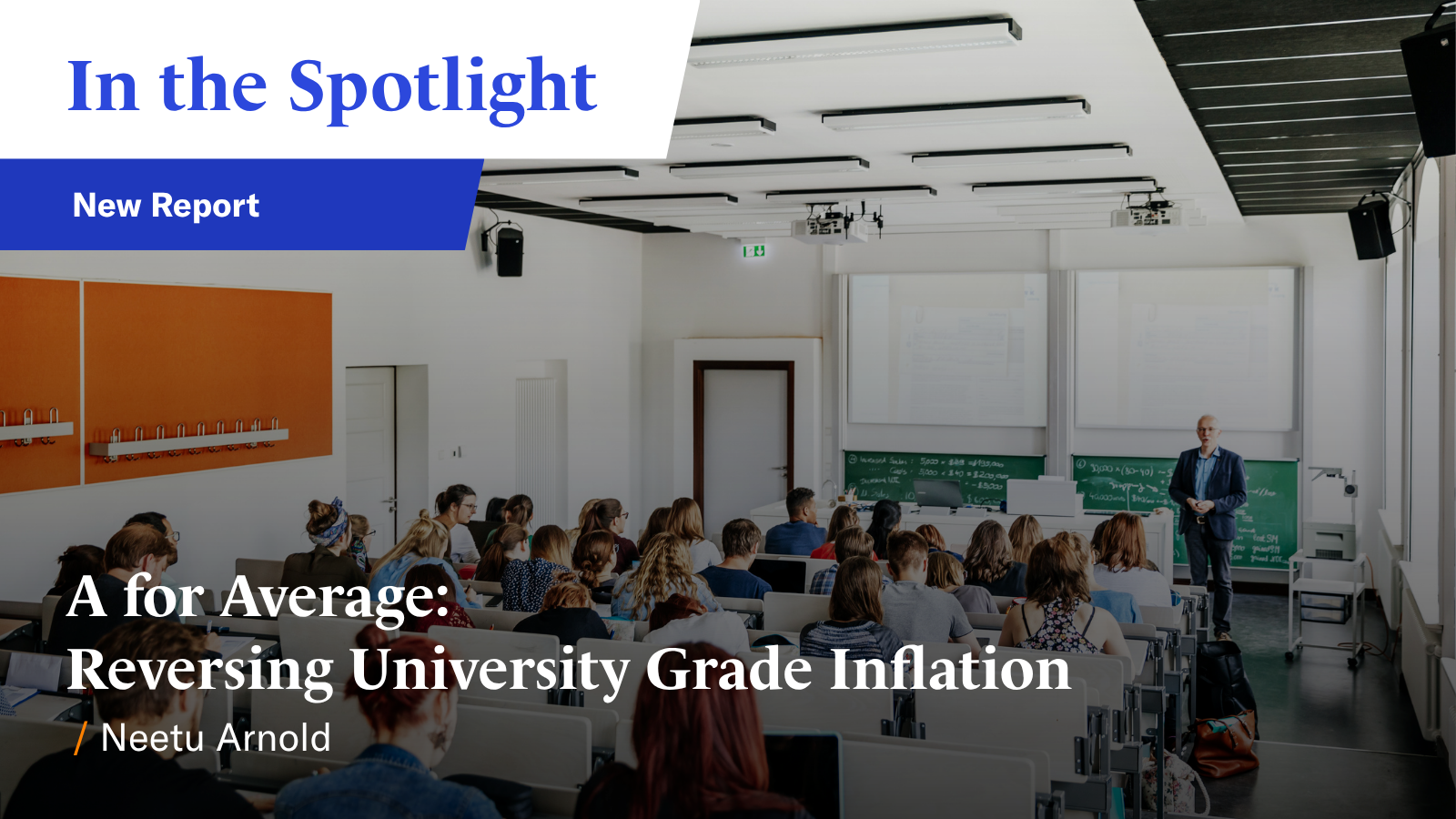
A for Average: Reversing University Grade Inflation
By Neetu Arnold | Manhattan Institute | Photo by Tom Werner/DigitalVision via Getty Images
At the collegiate level, and especially at top colleges, an “A” grade use to mean achievement. Now it means the average. For example, at Harvard, A-range grades now make up 85% of all letter grades, up from 62% just over a decade ago. Grades are crucial because they are the key signal used to communicate a student’s mastery of course material to professors, graduate schools, and employers. What is causing that signal to be subject to interference? In a new paper for the Manhattan Institute, Paulson policy analyst Neetu Arnold finds that misaligned incentives are changing the meaning of college grades. Faculty face pressure from students and administrators to grade leniently, while universities compete for enrollment by making coursework feel and look more rewarding.
Past reform attempts — including grading caps at Princeton and Wellesley — showed promise but were ultimately abandoned when students complained of competitive disadvantages. Arnold argues that voluntary university-level reforms are not enough. Among her proposals, she calls for increased state regulation and an "inflation-adjusted GPA" that discounts grades earned in easy-grading courses, giving employers a clearer signal of student ability and motivating students to demand more rigorous instruction.
|
|
|
Islam in America
By Reihan Salam | SAPIR Journal | Photo by Douglas Sacha/Moment via Getty Images
“Mamdani’s belief that modern America is rife with Islamophobia is ascendant among younger American Muslims. In conversations with Bangladeshi Americans a generation younger than myself, I’ve been surprised by how estranged from America many of them feel, and how natural and even ennobling that estrangement seems to them. ...
“Having successfully navigated the institutions of American meritocracy, many young American Muslims have rejected the quiet gratitude that one associates with immigrants and their children of earlier eras. Instead, they have undergone what the political scientist Robert Leiken has called ‘anti-West westernization’ or ‘adversarial assimilation’: a process by which incorporation into American institutions produces not attachment to patriotic narratives of American freedom, individualism, and benevolence but hostility toward them. ...
“It is in this restless, estranged population — secular in practice, Muslim in political identity — that Third Worldism finds its most fertile ground.” |
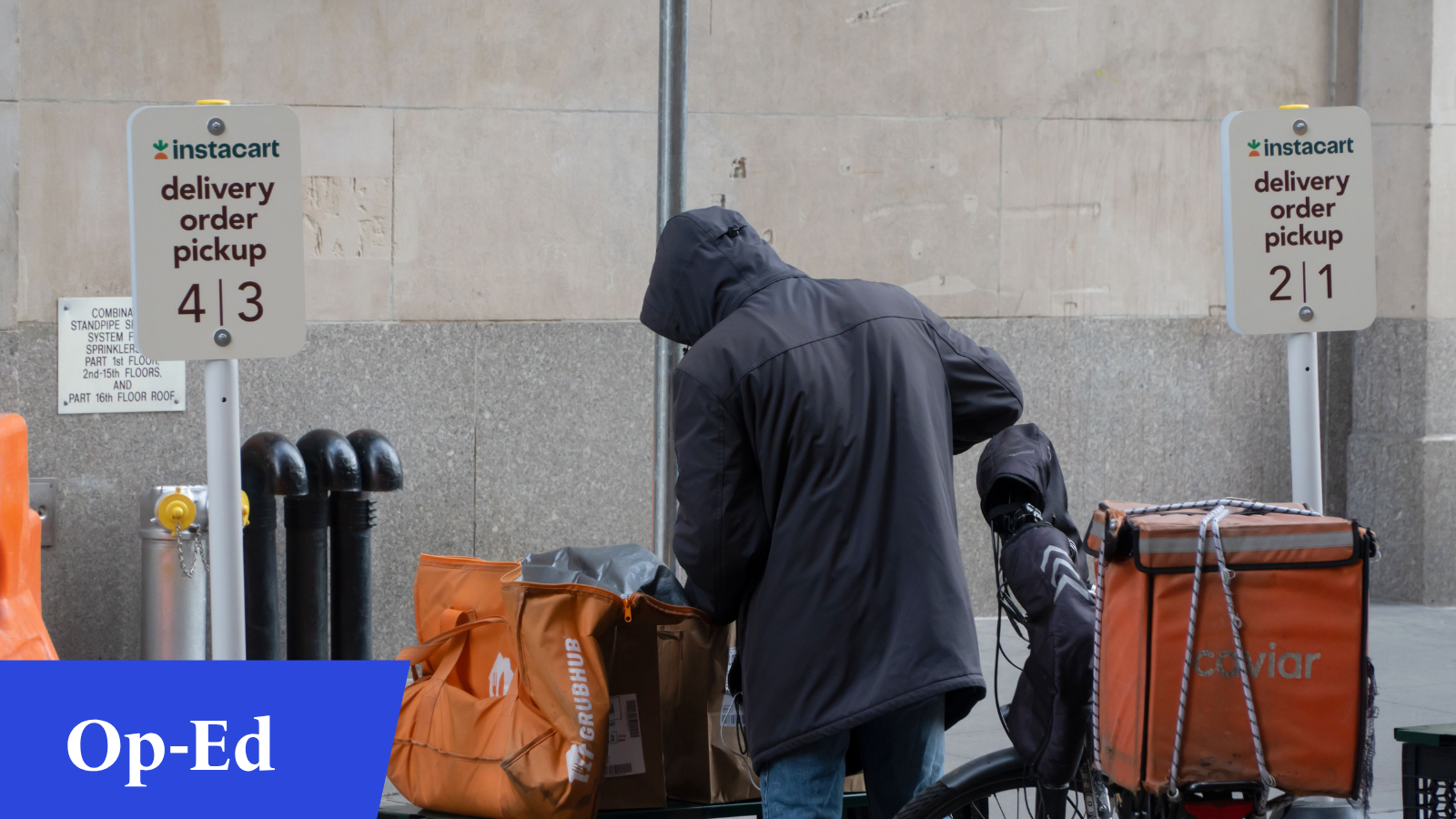
Instacart Is Suing New York City over Its $22.13 Minimum Wage for Delivery Drivers
By Jarrett Dieterle | Reason | Photo by John Senter/UCG/Universal Images Group via Getty Images
“In recent years, several large progressive cities have begun pushing aggressive minimum wage policies for food delivery and rideshare. The results have been predictable: A decline in the number of gig tasks being performed, an increase in prices for consumers, and a reduction in drivers as platforms restrict access to aspiring gig workers.
“But in addition to the economic fallout, these policies also may run afoul of the law. In response to New York City's recent expansion of its delivery driver minimum wage, the gig company Instacart has sued the city. Instacart's lawsuit argues that NYC's minimum wage ordinance is preempted by federal law—an argument that, if it prevails, could send shock waves through progressive city councils across the country. ... “A fair reading of the city's own evidence therefore shows that its minimum wage ordinance should be preempted by” existing federal law. |
|
|
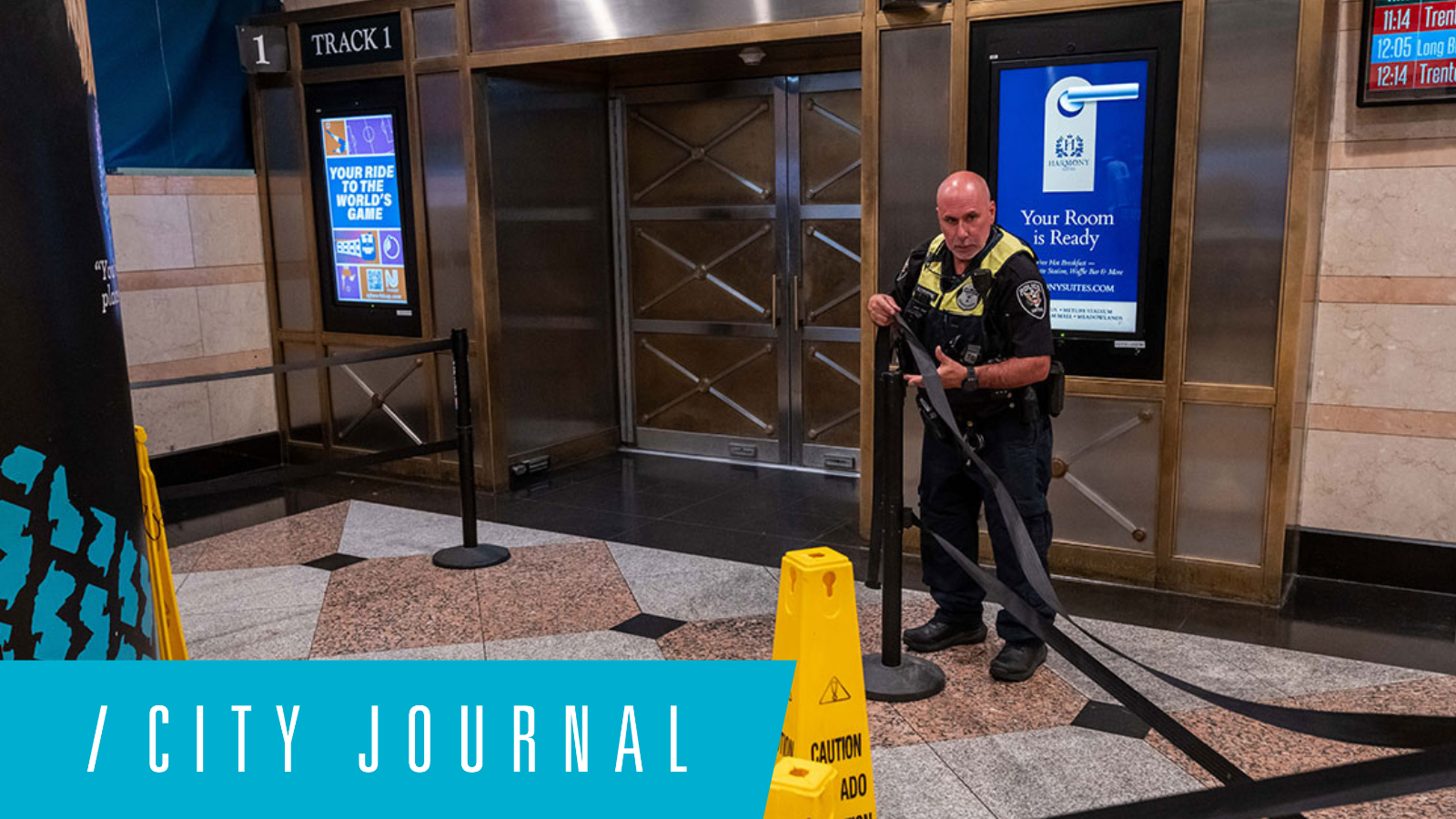
Nothing About the Penn Station Slashing Is Normal
By Carolyn Gorman | City Journal | Photo by Adam Gray/Getty Images
“On Sunday, at least five people were hospitalized after a seriously mentally ill suspect with a criminal record reportedly went on a ‘frenzied’ slashing spree at Penn Station. The incident comes exactly one month after another mentally ill repeat offender was arrested for allegedly pushing an elderly man down the subway steps, killing him, mere hours after being released from a hospital psych evaluation. ... “Some New Yorkers are so desensitized to mental illness-related violence that they hardly see the point in trying to prevent it. ‘It’s New York City. Things like that happen,’ a Penn Station worker (said). ‘I’m just glad it wasn’t anything crazier than what it was.’ “Crazier than five people being slashed? ...
“Their blasé posture enables city officials like Mayor Zohran Mamdani to justify their inattention. ... Mamdani emphasized voluntary services on the campaign trail, as if every man deteriorating on the sidewalk with untreated schizophrenia is capable of making a rational decision about elective health care.” |
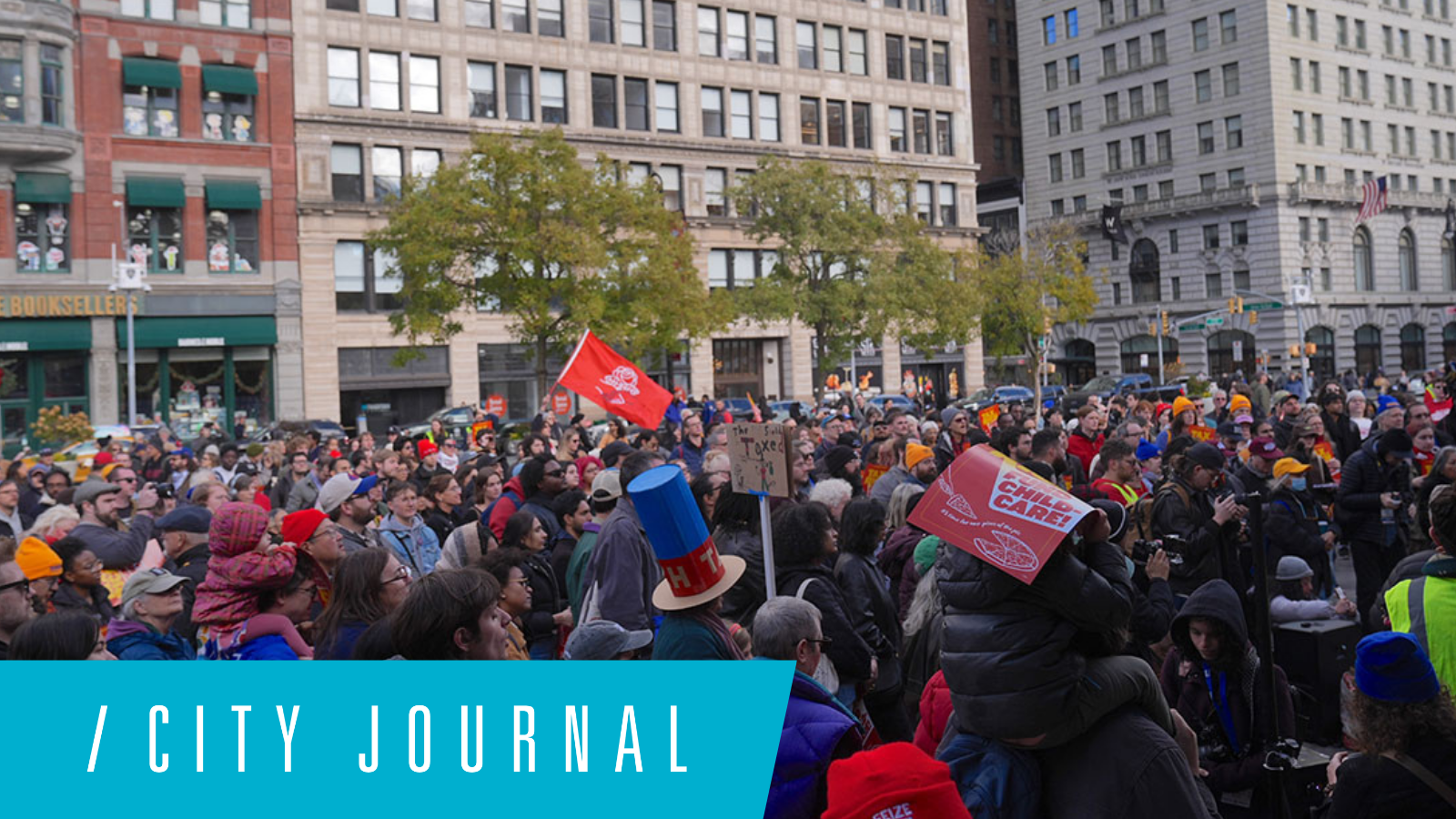
Inside the DSA’s Emerging Militant Network
By Stu Smith | City Journal | Photo by Selcuk Acar/Anadolu via Getty Images
“As its national influence has risen, the Democratic Socialists of America (DSA) has simultaneously grown more extreme. Nowhere is this more apparent than in the group’s ‘Red Rabbits’ initiative. The Red Rabbits Security Commission, a subgroup within the DSA focused on ‘community defense’ efforts, is, according to its authorizing resolution, preparing for a ‘national uprising against federal agents and police brutality.’ In practice, that means training cadres in tactics like armed and unarmed self-defense, blocking intersections, and fighting ‘fascists’ with umbrellas. ...
“Because they may be outside DSA’s mandate as a 501(c)(4) ‘social welfare’ organization, the Red Rabbits trainings could invite legal scrutiny and jeopardize the tax-exempt status of its sister 501(c)(3), the DSA Fund. ...
“The DSA has largely avoided scrutiny, despite its increasingly extreme rhetoric and practices. ... If Republicans, Democrats, and state and federal authorities keep ignoring these red flags, they may eventually find themselves living under one.” |
|
|
Judith Miller: An Extraordinary Career
By Manhattan Institute What did journalists know about terrorism before 9/11? How has national security reporting changed over the past several decades? In this compelling episode, Pulitzer Prize-winning journalist Judith Miller reflects on her extraordinary career covering global conflicts, terrorism, intelligence, and the Middle East.
Drawing from decades of frontline reporting, Judith discusses her experiences covering major events in the Middle East, the growing threat of terrorism before the September 11 attacks, and the complex relationship between journalism, government policy, and national security. She also reflects on her time in jail and defending the First Amendment, shares her perspective on how the media landscape has evolved, the challenges facing modern journalism, and the responsibility of reporters covering high-stakes international issues.
|
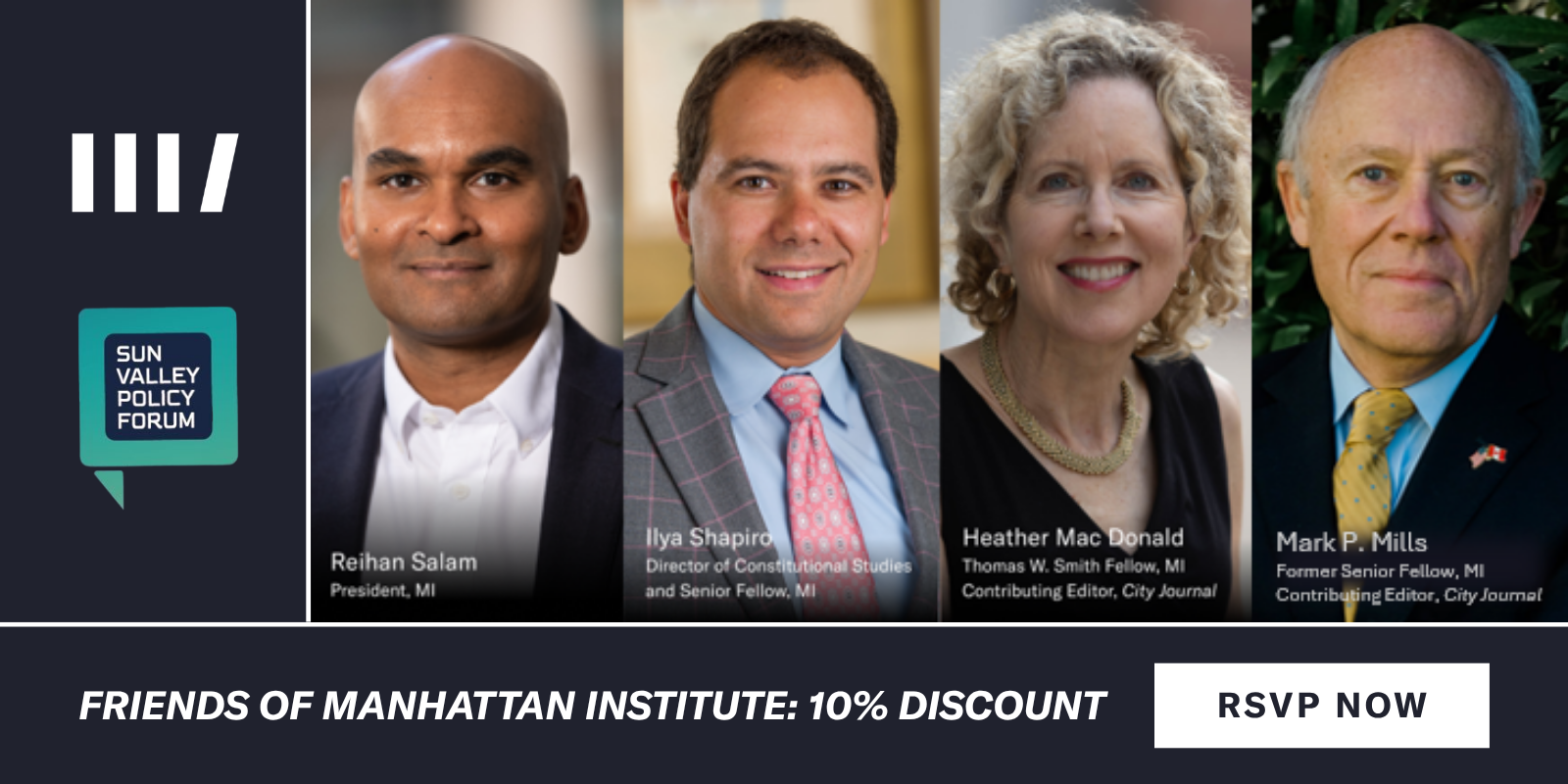
We are pleased to announce our partnership with the Sun Valley Policy Forum (SVPF) and to invite you to join the 5th annual three-day Summer Institute featuring many of your favorite MI scholars.
Friends of Manhattan Institute are eligible for a special perk: a 10% discount on the All-Access Pass or Silver Access Pass. The Manhattan Institute will be well represented at the Sun Valley Policy Forum this year, with presenters including: Reihan Salam: Renewing the Promise of America and its Great Cities: From Institutional Decay to Dynamism Ilya Shapiro: The Supreme Court and the American Experiment Shawn Regan: Burn Out: America’s Wildfire Crisis – Are We Managing Our Forests or Letting Them Burn? Judge Glock: Freedom to Teach: Building a Flexible, Innovative Education Workforce
Other MI scholars and staff will be present as well, including Heather Mac Donald, Sanjana Friedman, Jesse Arm, and more.
Outside speakers at this year's Summer Institute include Scott Jennings, Michael Knowles, Lord Andrew Roberts, General David Petraeus, Josh Wolfe, Elliott Abrams, and our friends from The Free Press, The Daily Wire, Palantir, and Lux Capital. |
|
|
For more information and media requests, please contact
communications@manhattan.institute.
Are you interested in supporting the Manhattan Institute’s public-interest research and journalism? As a 501(c)(3) nonprofit, donations in support of MI and its scholars’ work are fully tax-deductible as provided by law. |
|
|
|
The Manhattan Institute works to keep America and its great cities
prosperous, safe, and free. Manhattan Institute
52 Vanderbilt Ave. 3 floor New York, New York 10017
Want to change how you receive these emails?
Unsubscribe | Subscription Preferences
Copyright © 2026 Manhattan Institute, All rights reserved. |
|
|
|
|