Good morning:
As quickly as the American data center building boom appeared, a counterreaction assembled, capitalizing on anxiety over the new technology and its transformation of communities and economies.
At the Manhattan Institute, we have documented some of the real benefits of data center construction but have also acknowledged political challenges that champions of this industry face.
Last week, in our own backyard, New York Governor Kathy Hochul issued an executive order implementing the first statewide ban on new data centers, prohibiting state lawmakers from approving the environmental permits necessary for large facilities. The executive order pauses construction on new data centers for one year. So, at least in New York, the ban is supposed to be temporary.
But as investigative analyst Stu Smith reports in City Journal, resistance to data centers has become an effective left-wing rallying point that is spreading nationwide. The Democratic Socialists of America (DSA) link opposition to data centers, and the technological and economic booms they seem to promise, to their broader “anti-imperialist” goals. For DSA chapters in Seattle, Washington D.C., Arizona, and elsewhere, data centers are another tool for American hegemony that must be resisted because, in the words of one activist Smith quotes, “whoever controls technologies maintains military and economic domination in the world.” For the DSA, that dominance is an abhorrence.
DSA activists are not the only people skeptical of AI and data centers, however. As senior fellow Allison Schrager writes in Bloomberg, we can likely expect more moratoriums on new data centers in the short term. These bans certainly reduce economic growth because they slow down development and economic activity but, as Schrager explains, that may be part of the point. Americans generally want to slow down unusual, new, and possibly threatening technologies, so the fear is understandable. But Americans may be trading the illusion of control for very real economic and geopolitical consequences.
The construction and operation of AI data centers rely, like all engines of economic growth, on staggering amounts of energy—natural gas, oil, coal, electricity. In City Journal, contributing editor Mark P. Mills shows how both the AI boom and the ongoing crisis in the Strait of Hormuz expose that the much-vaunted transition to renewable energy is largely an illusion. Worldwide use of natural gas and coal is far greater than two decades ago. Global oil use per capita is almost unchanged. In fact, “The only consequential structural change in energy markets over the past two decades,” writes Mills, “has been the emergence of the United States as the world’s biggest producer and exporter of natural gas and oil.” If there is a change in energy production to respond to the new global realities of constrained shipping in the Middle East and increased demand driven by AI, the energy transition of the future may be to a more familiar form: nuclear.
Meanwhile, back in New York, lawmakers are ignoring another serious challenge. The state comptroller warned again this week that New York State is not prepared to close its significant budget gap before next year. Comptroller Tom DiNapoli finds that “[i]ncreased spending pressure continues to strain the State’s ability to find structural budget balance and puts into question the State’s future ability to make important investments.” In the New York Post, fellow Ken Girardin lays out some of the state’s largest expenditures and warns New Yorkers to prepare this summer before the coming fall.
Continue reading for all these insights and more. Kelsey Bloom Editorial Director |
|
|
|
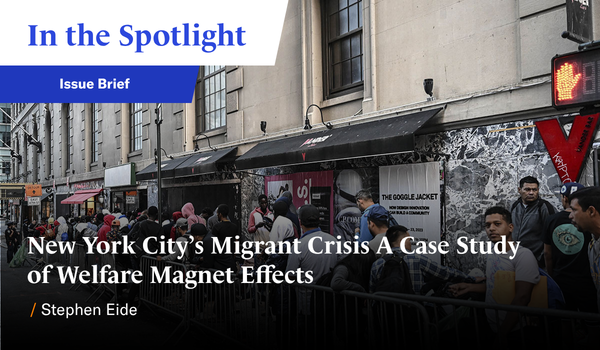
New York City’s Migrant Crisis: A Case Study of Welfare Magnet Effects
By Stephen Eide | Manhattan Institute | Photo by Fatih Aktas/Anadolu Agency via Getty Images
From spring 2022 through the end of 2025, nearly 250,000 migrants arrived in New York City, overwhelming its shelter system and costing the city nearly $9 billion.
In a new Manhattan Institute issue brief, senior fellow Stephen Eide asks why so many migrants chose to come to New York, despite its distance from the border, high housing costs, and middling job growth. One popular explanation—Republican governors’ busing programs—also cannot explain the influx, since they accounted for only a fraction of the total arrivals and participation was voluntary.
Instead, Eide argues that New York’s uniquely expansive right to shelter created a powerful “welfare magnet.” New York provides shelter on demand, in all seasons, to families and single adults alike, regardless of immigration status—which, during the height of the crisis, often meant placement in a private hotel room. Migrants themselves frequently cited the availability of shelter when explaining why they came. After the city imposed time limits on shelter stays, the number of migrants in shelters began to fall, though declining border crossings also played a role. New York’s experience, Eide concludes, shows that generous state and local benefits can shape where immigrants settle.
|
Expect More Data Center Moratoriums — and Slower Growth
By Allison Schrager| Bloomberg Opinion | Photo by Thomas Simonetti / AFP via Getty Images
“If you are an AI doomer, as a majority of Americans are, then you might find New York’s one-year moratorium on new data centers reassuring: No matter how fast technology progresses, humans will do all they can to slow it down.
“Restrictions on data centers, which are almost certainly coming in other states as well, illustrate what we economists call friction. As usual, it comes from a place of fear — in this case, that data centers harm the environment or increase electricity prices. Friction is also enabled by a belief that government can exert some control over technology. At least when it comes to data centers, the control is largely an illusion; if one state doesn’t build data centers, another will. … “Make no mistake: Friction reduces economic growth. Friction is anything that may slow, divert or stop economic activity. The US has a capitalist economy, and market activity is routinely diverted by frictions we choose to adopt. …
“The backlash against data centers suggests that Americans prefer greater friction over higher growth. Maybe the illusion of control is more appealing than no control at all.” |
|
|
New York Politicians Ignore the Budget Disasters Ahead
By Ken Girardin | New York Post | Photo by Lev Radin/Pacific Press/LightRocket via Getty Images
“New York’s gubernatorial election is less than 16 weeks away, but both Gov. Kathy Hochul and her GOP challenger Bruce Blakeman have largely escaped questions about one of the most substantial tasks New York’s governor will face next year: how he or she will balance the budget. Because with outlays soaring on the state’s priciest programs — Medicaid and school aid — the state is in dangerous territory. “The spending plan approved in late May, nearly two months after the official deadline, continued Albany’s multi-year practice of hiking expenditures substantially faster than inflation. …
“Ignoring the avalanche of federal aid coming from Washington, about half of state tax receipts are flowing to just two programs: Medicaid, the joint state-federal healthcare program meant to serve the poor and disabled, and aid payments to New York’s costliest-in-the-nation schools.
“A good swath of Democrats in the Senate and Assembly is worried he or she will lose their next primary to socialist challengers, and most Republicans are terrified of offending the public employee or healthcare unions invested in the status quo. Forget the Eastern Bluebird. New York’s state bird should be the ostrich.” |
The Myth of an Energy Transition
By Mark P.Mills | City Journal | Photo by Mario Tama/Getty Images
“Today, we’re facing two simultaneous energy shocks: one of supply and one of demand.
“The supply shock, the Battle of Hormuz, is centered on oil as well as its derivative products and natural gas. The demand shock comes from the explosive growth of artificial intelligence that has upended the best laid plans in electricity markets. Both epitomize a reality that hasn’t gone away. And each exposes the bankrupt ideology of an energy transition. …
“Oil is essential for all commerce because it powers the transportation of all goods and materials as well as the people who enable all services. Without the physical availability of oil, all commerce stops. …
“Natural gas will supply most of the electricity needed to power data centers in this first phase of the AI revolution. That’s not speculation; it’s already happening. But energy markets prefer fuel diversity. Odds are that in the near future, nuclear energy will emerge as the next dominant new form of energy addition. ... That’s already happening, too, and it epitomizes the reality of energy additions—not the ideology of an energy transition.”
|
|
|
Inside the Rise of the Anti–Data Center Movement By Stu Smith | City Journal | Mikala Compton/The Austin American-Statesman via Getty Images
“The boom in data-center construction is one of the most important economic developments in recent history, helping to power the promise of AI-enabled growth. Yet opposing data centers has rapidly become a unifying cause across a broad coalition of some of the nation’s most ardent left-wing activist groups. …
“In Seattle, (activists called) for a statewide moratorium on AI development, targeted at Microsoft and Amazon facilities in particular. In the Washington, D.C., region, Metro DC DSA has focused on blaming facilities in Maryland and Virginia for rising utility costs while advocating for community control of electrical infrastructure. A similar effort is underway in Arizona, where DSA activists are pushing to take over Tucson Electric Power, which has shown a willingness to work with data-center developers. …
“To the activists behind these campaigns, data centers are not just critical digital infrastructure. They have become symbolic targets into which to pour broader anxieties about capitalism, technology, and power. That all-purpose role, more than problems with the technology itself, is what makes the movement against the facilities politically potent.” |
|
|
What Christopher Nolan Couldn’t Bring Himself to Do
By Rob Henderson | The Daily Wire | Heritage Image via Getty Images
“In Homer, the great flaw of Odysseus is hubris. In (Christopher) Nolan’s film, it’s moral injury.
“Some viewers have described Nolan’s version of Odysseus as suffering from post-traumatic stress disorder. But moral injury is the more accurate term. It overlaps with PTSD, but it’s not the same thing. Moral injury occurs when a person commits, witnesses, or fails to prevent an act that violates his moral convictions. In war, moral injury can arise when a person does something that violates his own ideals, loyalties, or sense of right and wrong. The result is lasting guilt. …
“Fortune favors those who act rather than wait, who impose themselves on events rather than submit passively to them. Nolan gives Odysseus this Machiavellian impulse. He does not trust omens, sacrifices, or the goodwill of the gods. He believes that fate can be bargained with and contested. Yet the film also gives him a Christian conscience that judges the methods he uses to contest it.” |
|
|
A few more things ... “Goodbye Darkness, My Old Friend” by James B. Meigs in the Wall Street Journal
“A Step-by-Step Guide to AI in Schools—How Much to Use and When” by Jennifer Weber in The 74
"Two Cheers for Mamdani’s Bus Plan" by Adam Lehodey in City Journal
"Why America Keeps Choking on Wildfire Smoke" by Shawn Regan and Sean Speer in City Journal
Come work with us! |
|
|
|
For more information and media requests, please contact
communications@manhattan.institute.
Are you interested in supporting the Manhattan Institute’s public-interest research and journalism? As a 501(c)(3) nonprofit, donations in support of MI and its scholars’ work are fully tax-deductible as provided by law. |
|
|
|
The Manhattan Institute works to keep America and its great cities
prosperous, safe, and free. Manhattan Institute
52 Vanderbilt Ave. 3 floor New York, New York 10017
Copyright © 2026 Manhattan Institute, All rights reserved. |
|
|
|
|