A for Average: Reversing University Grade Inflation

Photo: Everyday better to do everything you love/iStock/Getty Images Plus via Getty Images
Introduction
An A in a college class used to mean achievement. Today, an A means the average.
Grade inflation—the phenomenon whereby universities increase students’ average grades without a corresponding increase in achievement—has been a persistent issue in American education since at least the 1960s. Grades matter because they are the primary metric intended to communicate a student’s mastery of classroom material to faculty, graduate schools, and employers. But grade inflation distorts the signaling value of grades, making it difficult for people evaluating from the outside to distinguish between average and exceptional students.
It is possible for universities to address grade inflation. This brief finds:
- Universities that institute some kind of grading reform, such as Wellesley and Princeton, successfully reversed some grade inflation.
- Reforms that directly address grading standards, such as caps, are effective at addressing grade inflation. Reforms that disclose grade distributions should be viewed as transparency measures, but transparency alone does not stop grade inflation.
Reversing an established habit or culture of grade inflation, however, is difficult for an institution. While individual instructors confer grades, faculty face many pressures from university administrators and students to maintain high averages. Universities also face a collective-action problem: it is not enough for a handful of universities to adopt stricter grading policies if peer institutions continue to inflate.
This brief argues that reducing grade inflation requires changing the incentives that shape grading practices. It evaluates policies that states could pursue, such as including median class grades on college and university transcripts and instituting grading caps, and makes two key recommendations:
- Implement state regulation of grade inflation at public universities. This is necessary because institutional incentives discourage serious internal reform.
- Institute inflation-adjusted GPA. This novel idea realigns students’ and professors’ incentives to reverse grade inflation.
The Origin and Causes of Grade Inflation
The story of grade inflation is one of universities making concessions of varying degrees that, over time, have compromised academic standards.
The onset of rapid grade inflation was in the 1960s (Figure 1). One theory for this unusual increase is that professors awarded higher grades to prevent students from failing out of school and being drafted into the Vietnam War.[1] Another theory points to the rise of anti-elite and anti-grading movements of the 1960s, in which proponents believed that issuing grades was degrading to students and their efforts.[2] A 1975 study of nearly 550 universities found that 77% had adopted some kind of grading innovation that included using Pass/Fail, eliminating Fs, or refusing to keep records of grades below C.[3] As part of a simultaneous trend to expand student participation in university matters, students and some faculty supported introducing teaching evaluations, a practice that many faculty today say creates incentives to grade students more leniently to avoid negative reviews.[4]
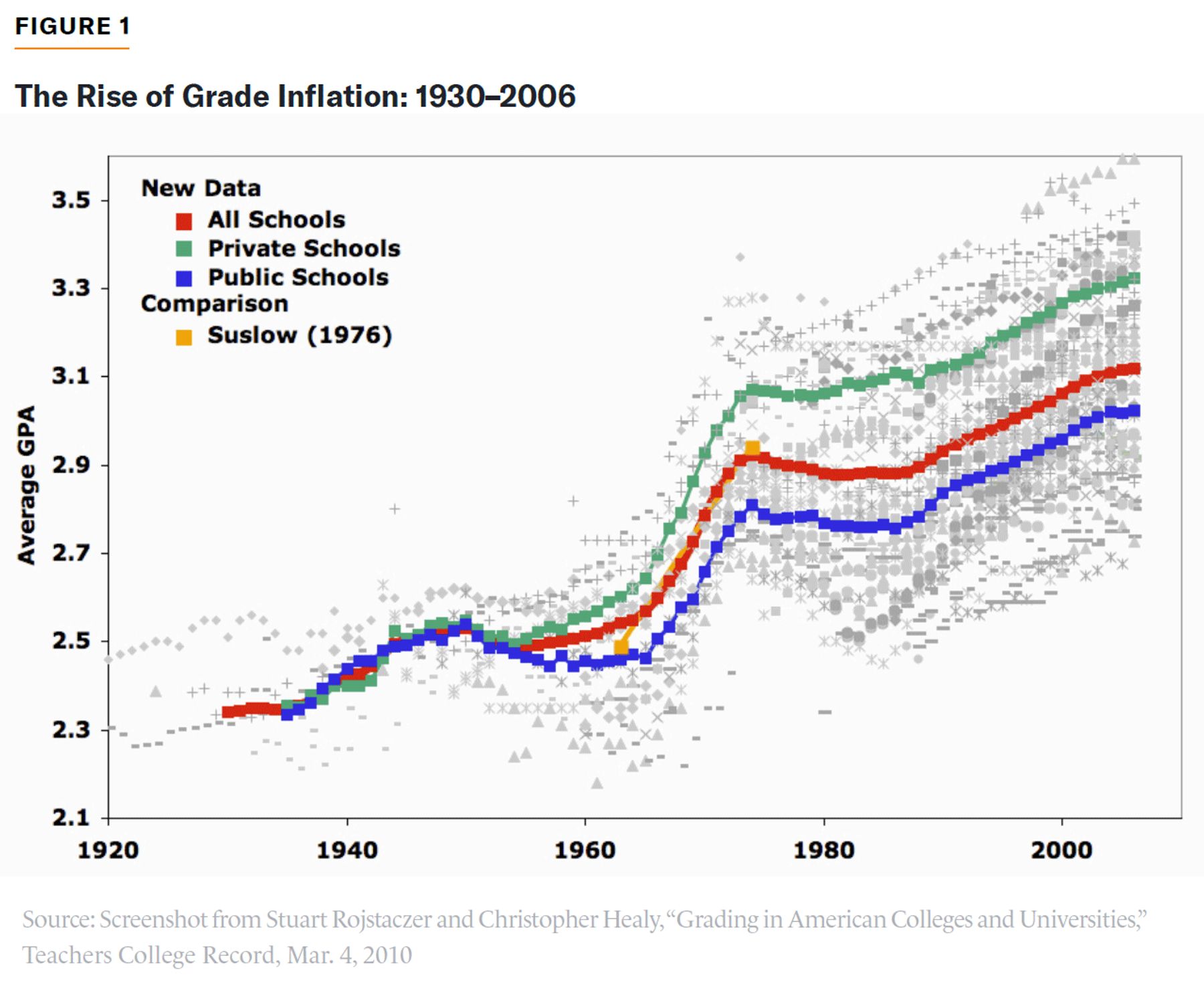
Grade inflation appeared to slow down during the 1970s. But with university administrators worried about an enrollment crisis spurred by high inflation and about the end of the college-age baby boom cohort, they needed to find ways to attract students.[5] According to one historian,“The worsening economics of higher education in the 1970s incentivized raising grades to avoid losing money from students who did not want to take classes from tough graders.”[6] In a competitive market, universities and faculty could make courses, majors, and entire institutions more attractive to students by grading more leniently. These competitive pressures made their way inside individual universities and appeared among the different departmental offerings, where students looking to maximize their grades could opt for easier elective courses.[7]
The second wave of grade inflation occurred during the 1980s and was both more gradual and more persistent. As in the previous decade, one way to compete against other universities for enrollment was to relax grading standards. Also, the seeds of the student-participation movement were beginning to bear fruit. By this time, student evaluations of professors became more prevalent and had much more serious stakes. In 1973, only 29% of colleges used student evaluations. In 1983, that share had increased to 68% of colleges, and by 1993 the figure was 94%.[8] Low professor ratings could mean reduced enrollment in courses or even entire departments. In some cases, student evaluations became tied to tenure and promotions. In a 1997 paper, University of Washington researchers Anthony Greenwald and Gerald Gillmore found that UW professors could get higher ratings by giving students higher grades:[9]
Instructors of science and math suffer the worst under the current evaluation system and are at the bottom of the ratings because they teach tough courses, give lower grades and demand a lot of hard work. Our research has confirmed what critics of student ratings have long suspected, that grading leniency affects ratings. All other things being equal, a professor can get higher ratings by giving higher grades.
Grade inflation continues to be a persistent problem at many universities, including the most prestigious. At Harvard College, A-range grades (A’s and A-minuses) accounted for 85% of all letter grades in 2024–25, up from 62% in 2012–13.[10] Yale University shows a similar pattern, where nearly 79% of students received A-range grades in 2022–23, up from 67% in 2010–11.[11] The share of Emory College students who had a 3.5 GPA or higher went from 41.5% in 2005 to more than 70% in 2025.[12]
There are various forces that universities today must deal with when addressing grade inflation. Many students enter college without adequate K–12 academic preparation,[13] which pushes universities to lower the rigor in their academic courses. A 2025 University of California, San Diego report, which found that many admitted students struggled with middle-school math, wrote: “Admitting large numbers of students who are profoundly underprepared … puts significant strain on faculty who work to maintain rigorous instructional standards.”[14] As universities admit more students who fall below college readiness standards, some departments have used these gaps to justify adopting easier grading practices in the name of equity.[15] Furthermore, the expansion of elective courses has allowed students to select courses that they think will maximize their GPAs. In response, faculty and departments face incentives that discourage rigorous grading to maintain enrollment numbers and favorable student reviews.
With more students attending graduate school as a way to set themselves apart in competitive job markets and with many employers relying on GPAs as a screening tool, grades have consequences beyond the university.[16] Unfortunately, grades are now an ineffective or even misleading tool for communicating readiness and a student’s academic performance. This makes it harder to distinguish excellence from mediocrity. But asking universities to solve grade inflation on their own is a difficult task.
The Challenge of Solving Grade Inflation
Traditionally, universities leave grading up to faculty. Professors are most likely to know to what extent a student has mastered the material, and having grading be the responsibility of faculty preserves academic freedom. But grade inflation is getting worse, and the reluctance of administrators to intervene allows the problem to persist.
University “leadership nationwide created the incentives that caused A’s to become the most common grade. They need to be the ones to create incentives to bring back honest grading,” wrote Stuart Rojstaczer, one of two researchers who documented the widespread prevalence of grade inflation at more than 170 universities throughout the 2000s.[17] But getting administrators to regulate the grading of professors is a hard task.
In 1975, Harvard government professor Harvey Mansfield, an outspoken critic of grade inflation at the Ivy League school, suggested that an enforced “grade quota, or semi-curve,” could reverse grade inflation. But as The Harvard Crimson reported at the time, university officials lacked the willpower to seriously address the issue, relying on voluntary efforts by faculty. Dean Whitla, a university administrator, told the Crimson that “nobody wants to legislate grade distributions, really,” believing effective reforms would come “through voluntary faculty adherence to some general established standards of grading.”[18]
Mansfield, for his part, conferred two grades on each student: the official grade that went on a transcript and the true grade that the student should have earned. But even his high-profile efforts alone could not fight Harvard’s grade inflation machine.[19]
Although Harvard officials hoped faculty could turn around grade inflation, Harvard’s own practices failed to incentivize its faculty to grade rigorously. In fact, the median GPA increased from 3.49 in 2005 to 3.83 in 2025. A 2025 report by the university found that faculty were pressured by both students and administrators to give higher grades.[20] The university “exhort[ed] faculty to remember that some students arrive less prepared for college than others,” placing pressure on faculty to relax their grading standards. Some faculty even gave A’s to students just for completing assignments. Faculty were uncertain that administrators would “have their back” if students complained about the grades received. Non–tenure track professors feared negative student course reviews, which could harm their job security.
After years of deliberation, Harvard decided in May 2026 to cap A’s for undergraduate courses beginning in fall 2027. But Harvard’s policy would not apply to grades below an A, such as A-minus or B-plus.[21]
How Harvard has previously handled grade inflation is reflective of similar struggles across many universities. The constraints under which universities work make it very difficult to correct grade inflation internally, which is why past reform efforts produced temporary or limited results.
Policy Attempts by Universities
Universities have taken a variety of approaches to address grade inflation with varying degrees of success. Some universities have tried imposing letter grade caps, in which the share of specific grades that may be awarded within a course or department is restricted. In 2003, Wellesley instituted a policy that limited class average grades in lower-level courses to be no higher than a B-plus. Within two years, Wellesley reduced its average GPA from 3.55 to 3.28. According to Stuart Rojstaczer, Wellesley “essentially set its GPA clock back twenty years.”[22]
In 2004, Princeton University adopted a policy under which each department limited A grades to 35% for undergraduate course work and to 55% for junior and senior independent work. As a result of this policy, Princeton reduced the distribution of A’s from 47% in 2001–04 to 41% in 2010–13.[23] Despite the policy’s success in reducing grade inflation, encouraging other universities to voluntarily adopt grading caps is difficult. Cornell faculty dean Charles Walcott, for instance, said that the university would not follow Princeton’s lead because “Cornell is very fierce in that the grades that a faculty member gives are that faculty member’s responsibility and nobody can interfere with that.”[24]
Both Wellesley and Princeton eventually discontinued their respective policies. The policies were unpopular with students, who said that they were at a disadvantage when applying to graduate schools or jobs because other schools were not following the same practice. And as a Wellesley professor put it, “we were just not important enough to blaze that trail.”[25]
Another approach that universities have taken is to report a class’s median grade alongside a student’s course grade on official transcripts. But so far, this method has failed to show success in reversing grade inflation.
Cornell took a two-pronged approach: in 1998, the university published an online report of median class grades; in 2008, it placed median class grades next to a student’s course grade on their transcripts.[26] Cornell discontinued its online median grades report after a 2009 study found that availability of this information led most students—aside from the high-ability students—to take easier classes, which accelerated grade inflation.[27] Cornell faculty used this study—along with student feedback that the median grades were leaving them at a competitive disadvantage—to eliminate median grades on transcripts in 2022.[28] It is worth noting that Cornell faculty misapplied the research to justify eliminating median grades on transcripts.[29] The study looked only at the effects of median grades posted online for each class, not median grades on individual student transcripts. The online availability of median class grades primarily impacts students, who often use this information to choose easier classes. Furthermore, the 2009 study did not definitively dismiss the effectiveness of median grades on transcripts, though it also said that this practice might not stop students from enrolling in easier classes or seeing average grades increase.
It is unclear whether putting median grades on transcripts reduced A’s at Cornell. Cornell students have recently averaged between a 3.4 and 3.5 GPA,[30] up from 3.36 in 2006.[31] Since GPA data are not publicly available for the years where median grades on transcripts were in effect, we do not know if average grades dipped or remained stable during that time. We also do not know if grades increased due to other factors, like grading equity considerations or the dissemination of course median grades through informal student networks.
Dartmouth College has reported median grades on transcripts since 1994, but the distribution of A’s has still increased. Dartmouth increased A’s by 10% between the 2007–08 and 2017–18 academic years, and GPAs increased from 3.42 to 3.52.[32] As Dartmouth professor Andrew Samwick wrote,“the policy doesn’t stop grade inflation” because “there is no consequence on campus of having a course with a high median grade.”[33]
Some conclude from past efforts that anti–grade inflation policies place their students at a competitive disadvantage. Legislators in Texas, for instance, have repeatedly proposed legislation to add median grades on transcripts since 2013. The House often unanimously supports the bill, but it dies in the Senate, due to concerns over competitive disadvantages for Texas students and supposed “undue burden” on university registrars.[34]
But these concerns may be overstated in the context of statewide reforms. Students who attend public universities are likely to be in-state students, and the majority are likely to remain in the state when they graduate.[35] Using data from the American Community Survey and the Texas Higher Education Coordinating Board, I estimate that 53% of college-educated workers in Texas attended a Texas four-year public university.[36] This means that many graduates who remain in the state primarily compete against other graduates of Texas public universities. In this context, grading reforms would strengthen the credibility of academic credentials for Texas employers and support the state’s workforce needs.
Regarding undue burden, the Texas Legislative Budget Board determined that median grades on transcripts, despite imposing new data reporting and formatting requirements for transcripts, would not pose a significant financial burden. State universities have the data infrastructure and administrative systems to implement such changes to transcripts.[37]
These examples show that even well-designed policies cannot overcome the institutional incentives that drive grade inflation. Grade inflation persists due to misaligned incentives and, therefore, requires top-down reforms.
Solutions to Grade Inflation
Restoring genuine meaning to grades is possible. But universities struggle to maintain strong policies on grading reform because institutional incentives discourage serious internal reform. State legislatures are uniquely positioned to correct the problem at public universities.
To address grade inflation, lawmakers and university leaders must win over three key groups: students, faculty, and employers. Students, particularly high-ability students, want to know that their grades mean something and want a way to communicate context, particularly for difficult classes. Most faculty want the freedom to grade fairly and accurately but face constraints when administrators fail to support them, especially when grading decisions come at the expense of student evaluations. Finally, employers are looking for information to ensure they are hiring the best workers.
This brief proposes a menu of policy solutions that lawmakers could pursue, evaluating the benefits and trade-offs of each. Public universities that significantly and successfully reverse grade inflation will provide a blueprint for other universities to follow and create market pressure for private universities to follow suit.
1. Introduce Grading Caps
Grading caps are a proven method to reduce grade inflation, and universities could consider adopting caps (e.g., limiting A-range grades to no more than 35% of grades awarded in lower-level courses). Caps would reduce the share of high grades and help bring distinctions in academic performance.
Although caps are effective, they are controversial and typically face strong opposition from faculty. This resistance has historically made imposing grading caps—and maintaining caps once they are implemented—difficult when reforms originate from universities. For this reason, state lawmakers may be better positioned than universities to implement and sustain caps at public universities.
2. Report Median Class Grades on Transcripts
Median grades on transcripts should be viewed as a transparency measure that communicates the context of a student’s academic performance to employers. But as Dartmouth shows, median grades on transcripts do not necessarily constrain the upward drift of grades. Median grades should, therefore, be viewed as a complementary solution rather than a stand-alone answer to grade inflation.
3. Reduce the Weight of Student Evaluations of Teaching
Student evaluations of teaching can create incentives for faculty to grade more leniently to appeal to students. Reducing the weight of student evaluations in personnel decisions, such as tenure or promotions, would relieve this pressure while keeping the tool for instructional feedback. Limiting student review of faculty should be done alongside broader efforts to restore rigorous grading and standards.
4. Institute Inflation-Adjusted GPA
An inflation-adjusted GPA is a reformulation of a student’s GPA that adjusts for the differences in grading strictness across courses and over time. To make this adjustment easily accessible to employers and others who are evaluating student performance, this number would appear next to a student’s traditional GPA on official transcripts. Employers can then immediately understand, from one statistic, each student’s academic performance in a way that is not contaminated by grade inflation or student selection into easier courses.
Universities could use the formula below to calculate the inflation-adjusted GPA, anchored at a B-minus (2.7) for all grades aside from an F, which is still zero. See the Appendix for more illustrative examples of how this formula works. The formula is easy to implement because it uses data on course grade distributions that most universities already collect.
As an informational intervention rather than a grading rule, the inflation-adjusted GPA bears significant resemblance to displaying median grades on transcripts, a more common anti–grade inflation policy. In fact, the inflation-adjusted GPA can easily be adopted along with median grades on transcripts if policymakers believe both to be useful. If not, inflation-adjusted grades for individual courses could be made available to students on their unofficial transcripts through their student accounts.
What makes this proposal different from other grading reforms, such as median grades on transcripts, is that it better addresses the incentive and political problems that make grade inflation difficult to reverse.
An important consequence of the proposed inflation-adjusted GPA formula is that the maximum grade points a student can earn in a class with a median grade of A is 2.7. Under a typical grading system, lenient classes with median grades of A are desirable to students: taking such classes all but guarantees them a high GPA. But with the inflation-adjusted GPA, high-achieving students would want to avoid such classes or encourage the professors to grade more rigorously so that they have a chance to earn a 4.0 GPA. This flips the typical incentive for students on its head: students would be the ones pushing for more rigorous grading instead of professors or administrators.
It might seem at first glance that median grades on transcripts create a similar incentive for students, but the inflation-adjusted GPA is likely to be more effective for two reasons: it overcomes certain cognitive biases that dull the effect of median grades on transcripts, and the inflation-adjusted GPA more effectively communicates information to external parties, such as employers.
On cognitive biases, the key issue with median grades on transcripts is that without an explicit penalty for a high-median-grade course, students care much less about their high grades being devalued by high course medians than they do about falling below the course median. Such behavior is a prediction of prospect theory: a framework from behavioral economics that shows that people evaluate outcomes relative to a benchmark and tend to react more strongly to losses than to equivalent gains.[39] However, the inflation-adjusted GPA breaks this asymmetric reward system by directly penalizing high grades in courses with high median grades. High median grades cause the inflation-adjusted GPA to fall significantly below the traditional GPA (e.g., traditional = 4.0; adjusted = 3.0), even if the student has earned all A’s. This gap undermines the perception that such students are performing exceptionally well. It creates incentives for students—particularly high-achieving ones—to push for more rigorous grading standards so that they can have the opportunity to earn a high inflation-adjusted GPA.
On communication to employers, while having a median grade beside each course on a transcript technically provides the same information as an inflation-adjusted GPA, this information requires time for an employer to properly interpret. Employers have very little time to evaluate individual applications[40] and are likely to ignore most of the information provided by median grades.[41] On the other hand, the inflation-adjusted GPA summarizes the entirety of the information provided by median grades into one number. It is easy to understand, as it follows the same scale as the traditional GPA. If employers then respond to this policy by preferentially hiring those with higher inflation-adjusted GPAs, this provides stronger incentives for students to both demand more rigorous course grading and take courses headed by professors who grade more strictly.
As opposed to mandated curves or grading caps that are politically difficult to implement due to faculty opposition, the inflation-adjusted GPA preserves faculty autonomy in grading. Since it is not a grading mandate, faculty have the flexibility to continue their current grading practices or to be more rigorous. Even so, faculty would likely have a strong incentive to make their grading more rigorous, since students would not want to take a course that offers them no chance of earning a 4.0 GPA.
Similarly, the inflation-adjusted GPA preserves freedom for employers when evaluating candidates for jobs. Both the traditional and inflation-adjusted GPAs would be provided on each student’s transcript, and the employer could choose which one to use. If employers compare students from universities that do not report an inflation-adjusted GPA, they may rely more on the traditional GPA. However, employers may find a student who has a high inflation-adjusted GPA to be a more attractive prospect than a student with only a high traditional GPA.
Finally, a beneficial side effect of this proposal would be that students who perform well in difficult classes with low course medians would experience a boost in their adjusted GPA (illustrated by Scenario 3 in the Appendix). The inflation-adjusted GPA would therefore reward students for academic risk-taking.
Conclusion
Grade inflation has contributed to the significant erosion in credibility of academic evaluation in higher education, with grades now serving as weak signals of student performance for employers, graduate programs, and students themselves. Addressing these distortions requires changing the grading incentives at universities. For public universities, state policymakers have both the authority and the responsibility to act by realigning those incentives through transparency and accountability measures that restore meaning to grades. If states act now, they can restore trust in academic evaluation at public universities and provide a model for other institutions to follow.
Appendix
Scenarios to Illustrate the Inflation-Adjusted GPA
Scenario 1 shows a student who receives A’s in lenient grading courses. Under the current system, that student has a 4.0. But after adjusting for grade inflation, that student would receive a 3.03. Large differences would communicate to employers that the student’s 4.0 overstates academic performance.
Large gaps between raw and inflation-adjusted GPAs give top-performing students the motivation to pressure their professors to grade more rigorously. Professors who fear student complaints would have a reason to change their practices in response.
Under a fully normalized grading system, where the median class grades are closer to the anchor of a B-minus, the raw and inflation-adjusted grades would have a narrower gap (Scenario 2).
Scenario 3 shows an instance where the class medians are lower than the anchor of a B-minus (2.7). Professors who try to grade strictly are often discouraged from doing so because they fear losing students to easier courses. But under this model, where the class medians are a C, students who receive the same grade as the class median get curved up to the B-minus. Students who perform better than the class median receive an extra boost. For these students, they could communicate that they are performing better than the median.
Endnotes
Are you interested in supporting the Manhattan Institute’s public-interest research and journalism? As a 501(c)(3) nonprofit, donations in support of MI and its scholars’ work are fully tax-deductible as provided by law (EIN #13-2912529).