A Constructive Land-Use, Housing, and Economic Development Agenda for Mayor Mamdani

Photo: James Andrews / iStock / Getty Images Plus
Introduction
Many policies advocated by Zohran Mamdani as a New York City mayoral candidate were viewed skeptically by commentators who do not share his democratic socialist politics.[1] Within my own areas of expertise—land-use, housing, and economic development policy—I’ve shared that skepticism.[2] Now that he has won, however, even skeptics should hope that he succeeds in making the city more affordable. This report therefore looks at beneficial policies in areas that Mamdani could plausibly adopt, notwithstanding his socialist ideology and his loyalty to left-leaning constituencies.
Unlike Mamdani, as well as his recent predecessors Bill de Blasio and Eric Adams and concurrent city council majorities, I believe that the best way for the city to be prosperous and equitable is to allow the free interplay of market forces in the use and development of land. The government’s role should be to build, operate, and maintain public infrastructure while facilitating private investment. True market failures that require public intervention are much easier to address when the government takes a hands-off approach to matters that the private market can handle on its own.
New York City is far from this ideal, and it is unlikely that the city will abandon its heavy-handed regulation of real-estate development and business investment during Mamdani’s four-year term. Sadly, the new mayor’s city-hall staff is likely to include people who think that the city’s housing-supply crisis and economic stagnation are the result of insufficient regulation of the private sector. It’s important, however, to encourage those who may advise him to be more flexible.
Mamdani and his appointees need to distinguish between those regulatory interventions that are important to Mamdani’s core constituencies and those that are not. Many damaging city regulatory interventions reflect concessions to special interests—including wealthy preservationists, small homeowners, and auto owners—whom the new mayor might be willing to confront. As a comparison, consider the city council’s 2017 repeal of the Cabaret Law during the mayoralty of de Blasio, no deregulatory zealot.[3] The law, which required any business establishment that allowed dancing to be licensed by the city, lasted for 91 years despite repeated attempts at repeal. The Cabaret Law—as well as associated zoning regulations, which were not repealed until Mayor Adams’s term in 2024[4]—made it difficult to open nightclubs. That appealed to voters mainly concerned about nighttime noise in a crowded city. The laws seemed untouchable for decades, until a new pro-nightlife constituency gained ascendancy. Mamdani’s coalition, which includes newcomers to NYC interest-group politics, could make possible some reforms that were heretofore unthinkable.[5]
Mamdani will also be able to take advantage of city charter amendments that were approved by NYC voters in the 2025 general election.[6] These amendments shift power over land use from the city council to the mayor and other city officials, thus ending the council’s practice of “member deference,” which gives individual council members a veto over zoning changes affecting their districts. The upshot is that Mamdani, if he wishes, can push through pro-housing-development zoning changes that his predecessors could not.
Finally, there is the question of ideology versus pragmatism. Even a strongly ideological mayor should want his initiatives to be successful. A remarkable aspect of New York’s swing to the left—at the city level, with de Blasio’s election in 2013, and at the state level, with the Democratic capture of both legislative houses in 2018—is the consensus around rigid ideologically driven policies and the hostility toward private real-estate developers and landlords, which have led to disastrous results. Mamdani could tinker with these policies to make them less damaging while preserving their ideological core.
Housing-Supply Crisis and Economic Stagnation
At the time of Mamdani’s election, NYC had long been in a self-inflicted housing crisis, in which the supply of housing is consistently unable to satisfy demand. The crisis is a consequence of misguided policies that pump up demand for housing as well as discourage the supply of both existing and new housing.
Housing demand is created by those who are not existing tenants but wish to move to the city from elsewhere in the U.S. or outside the country, usually to take jobs or to study at local colleges and universities, as well as by current residents who wish to form new households or move into units that better suit their current needs.
Housing demand is inflated by rent regulation, which, by suppressing rents, squashes the price signal that would induce some households to move to cheaper housing or to cheaper parts of the country. This situation was exacerbated by the 2019 amendments to the state’s rent stabilization law, which eliminated most of the avenues by which rents in regulated units could rise close to market levels. Consistent with the objectives of the law’s proponents, households that might have moved under the previous regulatory regime instead stayed in place. By 2023, this had caused the rental vacancy rate—as measured by the city’s triennial Housing and Vacancy Survey—to drop sharply, to 1.4%.[7]
It is, in principle, possible to combine strict rent controls with a permissive new construction regime that satisfies demand in a reasonably satisfactory manner. NYC, in fact, had such a combination of policies in the 1950s and early 1960s.[8] That ended with the effective implementation of the new, much more restrictive, 1961 zoning resolution in the mid-1960s.[9]
The 1961 zoning resolution has been amended many times to allow more housing—most recently under Adams, who has pursued an ambitious rezoning agenda. Adams and de Blasio both devoted substantial city resources to subsidizing affordable housing.[10]
These efforts have not been in vain. Under former mayor Michael Bloomberg (2002–13), new housing completions in NYC peaked at 26,454 in 2007. The years 2018, 2021, 2023, and 2024 saw more completions, reaching 33,974 in 2024.[11] Data for the first half of 2025 indicate that an even larger number of housing units will be completed for the full year.[12] The high number of new units in 2025 reflects the completion of many buildings resulting from the rush to vest development rights under the “421a” tax exemption for new housing, which expired in 2022. Such buildings had to have a full building permit and commence construction by June 2022.[13]
Notwithstanding the rise in completions, demand has steadily pushed up rents for market-rate units. In August 2025, the median rent in Manhattan was $4,600,“the third highest on record and 8.4% higher than the same period last year,” according to the brokerage Douglas Elliman.[14] In Brooklyn, according to Elliman, the median rent that month reached a record $3,950. In western Queens, the median rent stood at $3,775, lower than the August 2023 record but 6.6% higher than the same month last year.
Moreover, new housing completions will begin to fall, since new housing permit totals dropped off after 2022.[15] The Adams administration’s zoning changes may ultimately spur increased housing construction. In December 2025, the mayor’s office reported that “New York City permitted 22.8 percent more new homes in 2025 than the same time period in 2024 (through October 23).” That increase was driven by both increased new construction and conversions of office space to housing.[16]
The housing crunch affects the broader economy, which is moving sideways as businesses look to expand employment not in NYC but in other places where newly hired workers can more easily find housing. An August 2025 report[17] from the Partnership for New York City, a business advocacy group, finds that private-sector employment growth in the city had stalled, often a harbinger of a coming recession. While employment growth has also slowed nationally, the decline has been sharper in NYC, which faces significant headwinds. The partnership concludes that:
- New York City and State will likely struggle to regain significant momentum in private-sector employment, given the overreliance in recent years for job gains in the health-care sector, which now faces significant funding cuts.
- Employment in the construction, professional services, education, and health-care sectors drove gains in the top five states by employment growth: Texas, Ohio, Florida, North Carolina, and Pennsylvania. In NYC, only the health-care and education sectors saw jobs gains overall.[18]
Mayor Mamdani will have a considerable interest in reigniting job growth. That requires a coordinated approach to reduce the burden of unnecessary regulations on both housing and employers. The actions that he takes to reinforce his socialist bona fides—raising taxes, increasing public spending and debt, and pressuring the Rent Guidelines Board to freeze regulated rents—will likely make the city’s economic stagnation and housing-supply crisis worse. This report addresses actions that he could take to help him appear pragmatic to voters skeptical of socialist policies. These actions comprise three categories: deregulatory interventions, zoning changes that take advantage of the city charter changes approved by voters concurrently with Mamdani’s election, and pragmatic policy changes to mitigate the adverse consequences of past left-leaning policies.
Deregulatory Interventions That Could Make Sense for Mamdani
City of Yes Revisited
In 2024, the city council approved “City of Yes for Housing Opportunity” (COYHO) zoning reforms to encourage more housing construction. Unfortunately, the council scaled back the more aggressive changes approved by the City Planning Commission (CPC), including by reinstating off-street parking requirements for new housing in much of the city.[19]
The Mamdani campaign’s brief and, for the most part, impractical housing manifesto expresses support for “[e]liminating parking maximums. The city should be building housing, not parking lots.”[20] He’s right about that. The only reason to have off-street parking requirements is to ensure that housing developers build more parking than they want to. That pumps up the supply of off-street parking, makes it cheaper to lease parking, and encourages car ownership and use. At the same time, it forces prospective renters and condo buyers to bear the high cost of building parking in enclosed garages beneath apartment buildings.[21] That makes housing more expensive to build and, on the margins, financially infeasible, exacerbating the supply crisis. Mamdani should take another shot at persuading the new city council to eliminate parking requirements for new housing.
Commercial Parking Requirements
New York City zoning also includes off-street parking requirements for new commercial and industrial developments[22] in most areas outside Manhattan, downtown Brooklyn, and Long Island City. These requirements mostly date back to the 1961 comprehensive revision of the city’s zoning resolution. In his preface to the 1958 planning report that introduced the city’s zoning proposal, then-CPC chair James Felt explained that one major goal of the reform was to create a viable framework for requiring nonresidential developments to provide off-street parking.[23]
The report stated:
Parking regulations are proposed to cope with the complex parking problems in this huge metropolis in an era when the automobile has become one of the most important influences on the character of residential neighborhoods and the efficiency and stability of commercial and industrial areas The problem of parking the automobile at the end of the journey to work, shopping, or recreation is dramatized by the fact that 900,000 persons—about half of the people who are employed outside Manhattan’s Central Business District—now drive to work. . . .
[T]he proposed regulations are designed to recognize the wide variation in automobile use in different parts of the City and the great differences in the traffic generating characteristics of commercial uses The flexibility required to obtain adequate parking facilities where needed without penalizing the areas and uses with low parking needs is obtained by establishing parking levels which vary by district depending on location and by the traffic-generating characteristics of the various types of uses.[24]
The problems with this framing are immediately apparent. The demand for parking at a place of business is not exogenously determined by mysterious forces over which the government has no influence. As with residences, requiring more parking at a business than the business would provide on its own encourages more people to drive there, rather than walk, bike, or use public transit. Improving the pedestrian experience and providing better access by bicycle or transit encourages people not to drive.
Moreover, the off-street parking requirements in many commercial areas serving residential neighborhoods outside Manhattan are so impossibly high that redevelopment of existing buildings is precluded by the impracticality of fitting the required parking into a limited urban site. To address this problem, COYHO initially eliminated or reduced the required off-street parking for ground-floor retail in apartment buildings, but this change was reversed in part by the council.[25]
Mamdani’s plan for free buses may not be fiscally practical but does indicate that he understands that the city can influence its residents’ choice of travel mode. He promises not only “free” buses but “fast” ones, “by rapidly building priority lanes, expanding bus queue jump signals, and dedicated loading zones to keep double parkers out of the way.”[26]
In October 2025, the Illinois legislature made a similar attempt to influence travel mode choices with its “People over Parking Act,” which formed part of broader transit governance and financing legislation.[27] The Illinois law aims to encourage transit ridership and bolster the system’s finances by prohibiting local governments from requiring off-street parking for both residential and commercial developments (except hotels) that are either within a half-mile of a “public transportation hub,” defined as a rail transit station or intersection of two bus lines with frequent service; or within one-eighth of a mile of a “public transportation corridor,” defined as a street with frequent bus service. The state law builds upon a Chicago local reform, which was also enacted in 2025.[28]
New York City should not want to be outdone by other large cities in progressive reform. Mamdani’s administration should pursue the repeal of zoning off-street parking requirements for nonresidential uses as well as residences. That could free large tracts of land now tied up in parking lots for both housing and new businesses.
Supermarkets in M Zones
Mamdani’s platform includes a promise to create “a network of city-owned grocery stores focused on keeping prices low, not making a profit.”[29] As mayor, Mamdani has other choices to bring the cost of groceries down. Food retail is a difficult, low-margin business in which sales volume is the key variable. NYC’s long-standing retail food-cost problem is the consequence of the non-car-owning public’s dependence on small neighborhood food stores. These stores do not have the wholesale buying power or operational efficiencies that enable large regional supermarket chains to offer significantly lower prices. (Nor, of course, would Mamdani’s proposed network of city-owned stores. His proposal is thus a recipe for losing a great deal of money, which the city probably will not be able to afford.)
Any effort to encourage the region’s large low-cost food retailers to expand within NYC runs into two issues: zoning and union representation. Large supermarkets typically have upward of 40,000 square feet of floor space on one level. In NYC’s tight street grid, sites of that size are available mostly in manufacturing zoning districts, where new supermarkets are limited to 10,000 square feet of floor area.[30] That restriction dates to 1974 and was originally enacted to protect the availability of sites for the city’s now-largely-disappeared manufacturing sector.[31] The size restriction can be modified by special permit, requiring approval by both CPC and the city council.
Mamdani’s administration could bring more competition to NYC’s food-retail sector by lifting off-street parking requirements for supermarkets, as discussed above, and by eliminating the size restriction in manufacturing zones. In select areas with special zoning provisions that had accommodating city council members, the “FRESH” program allows for an increased cap of 30,000 square feet, but this is still not adequate for some of the most efficient retailers.[32] While large supermarkets are unavoidably auto-oriented, given the bulk and weight of typical purchases, they can also serve customers who do not have cars but use delivery services, or arrive by transit and take car-hire services home. The presence of low-cost food retailers can also induce neighborhood stores to price their offerings more competitively.
Probably the biggest obstacle to such a change is the city council’s unwillingness to give up “member deference” on special permit applications. Deference gives individual councilmembers control over projects within their districts, which allows them to demand costly concessions from applicants. The very threat of such demands deters retailers from proposing new stores in locations that require council approval.
One common demand from councilmembers is for new stores’ operators to agree not to contest an employee vote on union representation. While many of the city’s large supermarkets are unionized, lifting the size restrictions as-of-right and permitting applicants to escape “member deference” do raise the possibility of new nonunion stores, particularly those operated by Walmart, which is both the nation’s largest and most efficient food retailer and adamantly antiunion. Walmart currently has no stores in the city but has a significant presence through online order fulfillment, where it faces no regulatory barriers.
Mamdani is obviously pro-union and thus faces a retail food affordability dilemma. He cannot make much of an impact with his city-owned stores. He can, instead, help the unionized regional retailers overcome regulatory hurdles and grow, making low-cost food more widely available to New Yorkers. However, this opens the door to efficient, low-cost nonunion national retailers as well.
Rezone Non-Priority Industrial Areas
In September 2025, I wrote for City Journal about the draft NYC Industrial Plan, which proposes a revised framework for identifying priority industrial areas in the city. That framework, if adopted by Mamdani, would allow for rezoning to permit housing in large swaths of existing manufacturing zones where industrial activity has declined.[33]
Properly coordinated with the elimination of nonresidential off-street parking requirements, industrial-area rezoning can open land to both housing and retail services. For example, the Adams administration has proposed the development of 3,000 new housing units on the city-owned site of the former Flushing airport in College Point, Queens.[34] That project is a long way from approval and raises many issues.[35]
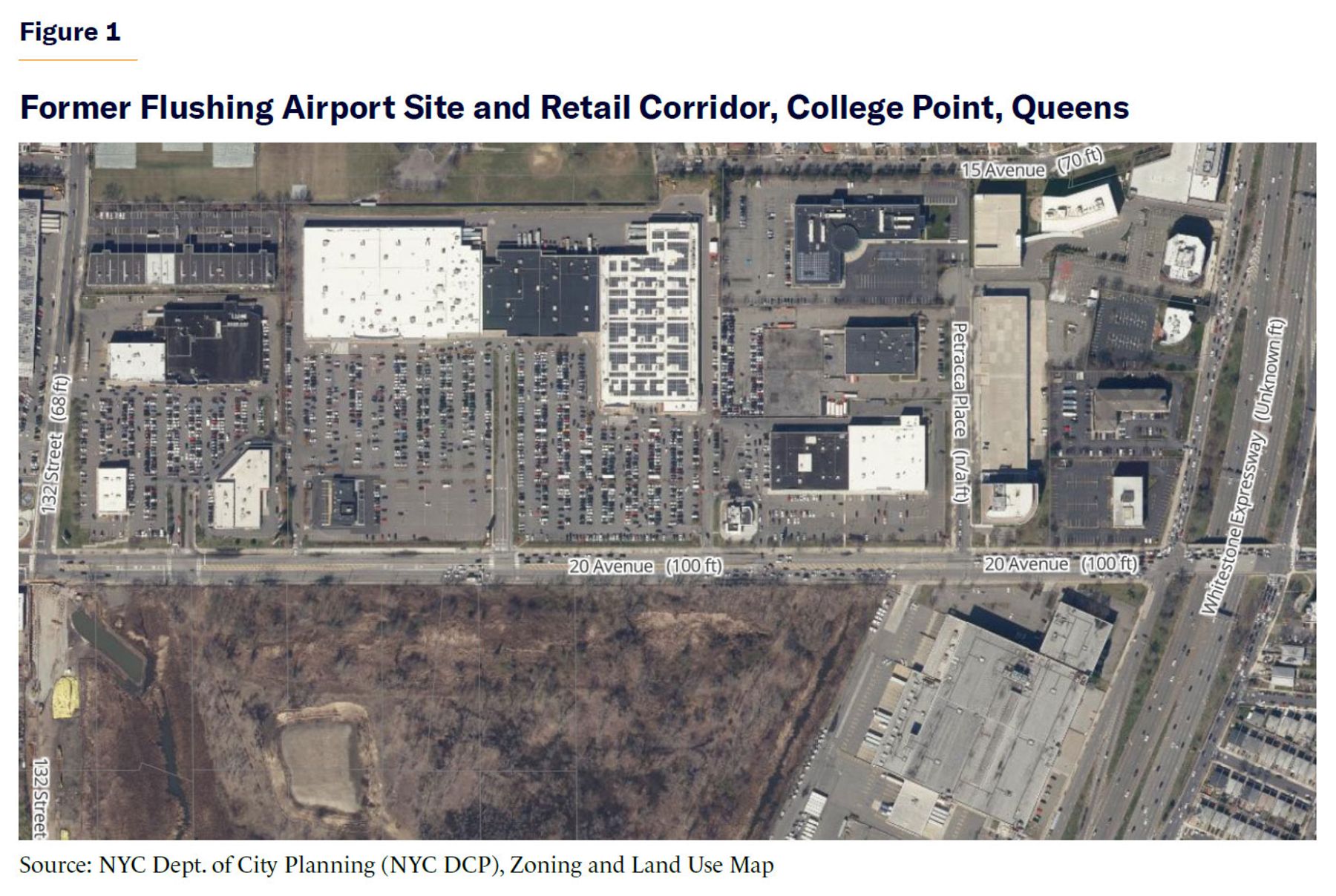
Across 20th Avenue from the vacant former airport site, however, is a line of manufacturing-zoned large shopping centers with vast parking fields (Figure 1). At least as many new housing units could be developed on those sites. Mamdani’s administration should seize the opportunities here and in other locations rather than maintaining unattractive and underutilized exclusively retail sites.
Restoration of Street Dining
The proliferation of street-dining installations throughout the five boroughs was among the few positive consequences of the Covid-19 pandemic. Street dining allowed restaurants to stay in business during the emergency and to serve more customers and employ more staff once it ended. Furthermore, street dining activated the city’s commercial streetscapes and made the pedestrian experience more inviting.
Street dining also reduced the number of on-street parking spaces, which perturbed the city council. In 2023, the council passed legislation[36] that prohibited dining structures on city streets between December and March. By requiring costly disassembly, storage, and reassembly, the law ensures a steep decline in street-dining options.[37]
In October 2025, a new bill[38] was introduced by Councilmember Lincoln Restler and others to restore year-round street dining and allow retail food stores to provide such dining facilities as well. NYC restaurant employment has yet to regain the level of 2019.[39] Mamdani’s campaign platform pledges to “make it faster, easier, and cheaper to start and run a business.”[40] Enacting this legislation is a good way to do so.
Taking Advantage of the City Charter Changes
The 2025 election included not only the mayoral race but also several ballot initiatives involving land-use-related changes to the city charter. Mamdani’s very late endorsement of these initiatives—on Election Day—is indicative of the cross-pressures that he is under.[41] The new mayor will need to sustain a working majority within a city council that has just seen its power diminished by these charter changes. The likely consequence is that local members will continue to have a voice in negotiations over proposed zoning changes—if not a veto, as prevailed in the past. Additionally, he will want to maintain the support of construction unions that seek wage concessions from developers. These cross-pressures may limit his willingness to use his new powers. Nonetheless, there is much he can do.
Mapping R5D Selectively
The recently enacted Ballot Question 3 creates an expedited approval process for zoning changes defined as “modest.” This expedited process for modest changes would end at CPC, without requiring approval by the city council.
The change thus gives the mayor enhanced ability to achieve zoning changes in locations where opposition from local councilmembers would have doomed zoning proposals in the past. The change has most effect in low-density areas.[42] In those areas, the expedited process applies to any remapping to a new zoning district that allows a floor area ratio (FAR)[43] not greater than 2.0 and a height less than 45 feet. Since these parameters describe a specific zoning district, R5D, the charter amendment is likely to encourage selective mappings of this district.
The charter change applies only to zoning changes that do not require an Environmental Impact Statement (EIS) under state law. That limits the administration to changes that do not create the potential for adverse environmental effects. There is no specific definition of when a change requires an EIS, and planners have some flexibility in administering the city’s guidelines for how to implement the state’s law. However, some ambitious initiatives would be precluded.
Within this constraint, much can be accomplished. In my recent brief, I cited a neighborhood in the eastern part of Community District 7 in Queens, near the Broadway Long Island Railroad station and a short bus ride to the Main Street terminus of the No. 7 subway line.[44] The area is currently mapped with an unsatisfactory mix of zoning districts, many of which do not allow small apartment buildings permitted under the R5D designation. In such an area, the charter change offers an opportunity to rationalize the zoning and create new transit-served housing in areas of high demand.
Replacing Single-Family Zoning with Two-Family Zoning
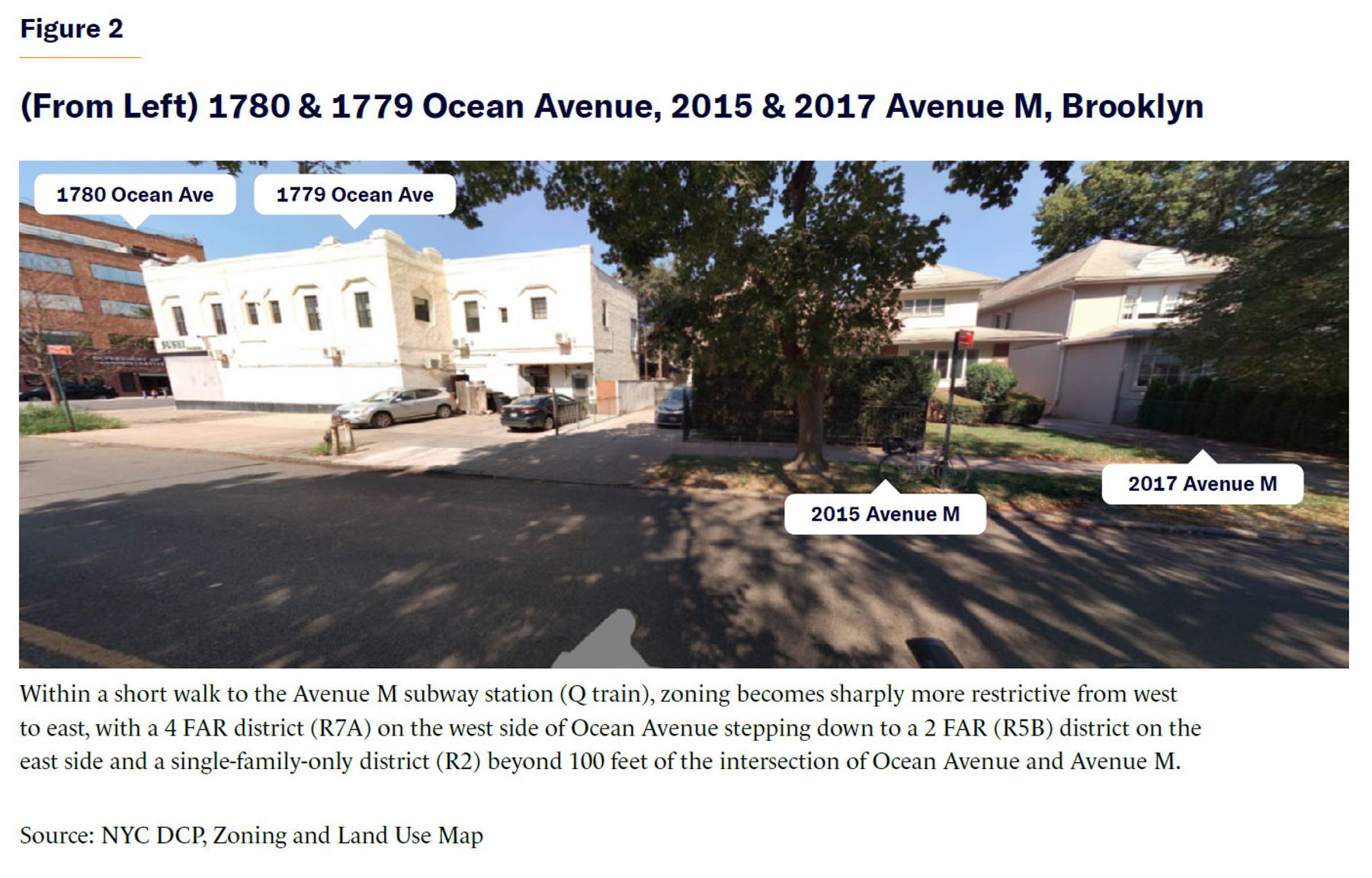
About 15% of NYC’s land area is zoned for single-family homes only.[45] Some of those areas are environmentally sensitive, or subject to flood hazards, and should have restrictions on development. However, in many areas, single-family development restrictions simply indicate the past political clout of affluent homeowners. Allowing small numbers of additional units on each lot would create investment opportunities for property owners and allow for more housing choice for New Yorkers, without creating adverse land-use impacts (Figure 2).
Recognizing this, COYHO legalized “ancillary dwelling units” (ADUs) in 2024.[46] The city’s ADU provisions, however, limit ADU size and require owner-occupancy at the time of application to construct an ADU.
New York City’s zoning resolution has a range of districts permitting up to two units per home.[47] The two-unit districts all fall within the parameters of the charter’s fast-track process. Allowing two units per home, without restrictions, provides additional opportunities for housing investment by property owners. ADUs are still permitted. Mamdani’s administration should take advantage of the opportunity that this change allows to provide more housing options in neighborhoods where existing housing is often very expensive to buy or rent. Because construction of one-, two-, and three-family homes is an exempt action under state environmental review regulations,[48] no EIS would be required.
Facilitating Affordable Housing in the 12 Community Districts with an Expedited Process
Mamdani’s administration should be enthusiastic about affordable housing projects in the 12 community districts that will now be subject to an expedited approval process without city council review, thanks to the recently enacted Ballot Question 2. The process will apply in the 12 districts with the lowest rate of affordable housing construction over a five-year period. Although precisely which districts will be included will not be definitively known until next year, a recent NYU Furman Center analysis[49] suggests that the two community districts south of the Staten Island Expressway and community districts in outlying parts of Brooklyn and Queens will be included, along with three districts in affluent parts of Manhattan.
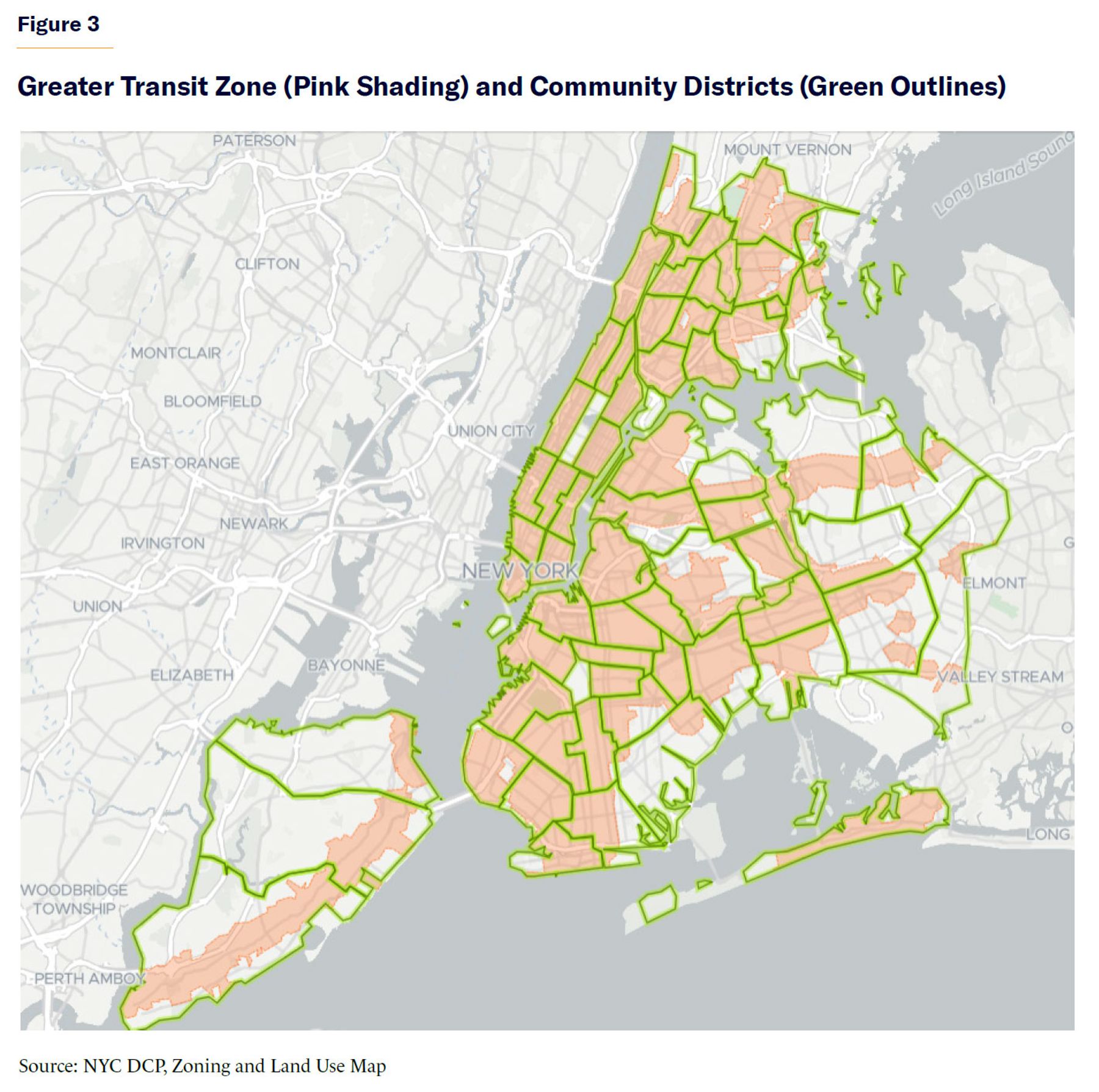
Unlike the Ballot Question 3 expedited process, this one is not constrained by prospect of environmental review, allowing proposals for higher densities in currently low-density districts even if significant environmental impacts are possible. However, because of the political constraints of maintaining a working majority on the council, the scale of new affordable housing projects is likely to be moderate. Importantly, the Greater Transit Zone—the area close to subways and commuter rail lines designated under COYHO for special zoning rules that allow more floor area in new residential buildings and less off-street parking—exists in every community district (Figure 3). That designation provides likely target areas for zoning changes that facilitate new affordable housing developments. In these areas, low-income residents are more likely to be able to access employment and services without needing to own a car. For example, in a 2022 Manhattan Institute report, I flagged the potential for new housing development in two areas within the Greater Transit Zone in Staten Island Community District 2: Grasmere and the New York City Housing Authority’s Berry Houses campus.[50]
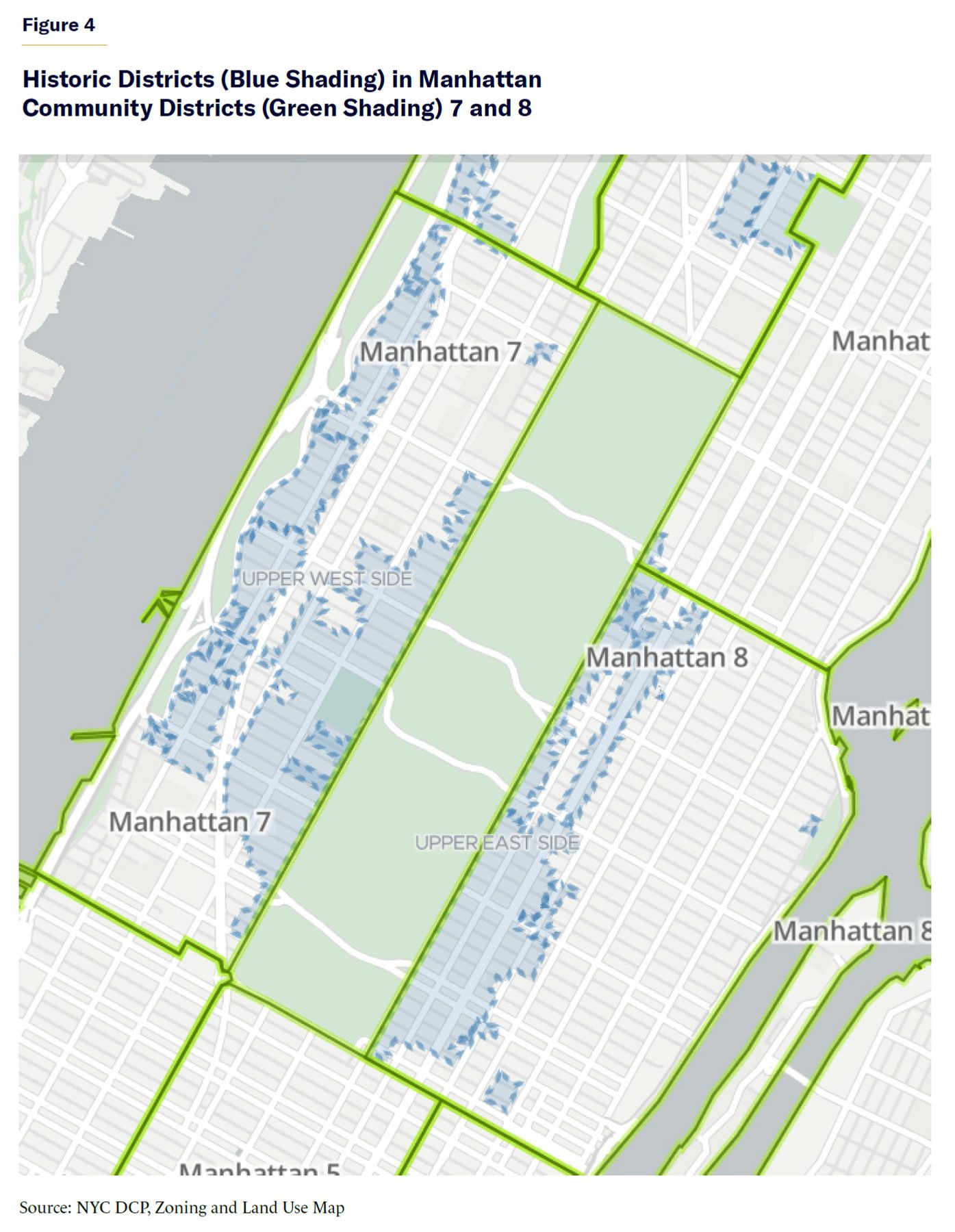
The three potential Manhattan community districts include District 5 (Midtown), 7 (Upper West Side), and 8 (Upper East Side). Potential zoning changes for Midtown are discussed in the next section of this report, but because these changes would require amendments to the text of the zoning resolution modifying the terms of the Mandatory Inclusionary Housing (MIH) program, they would not be eligible for the fast-track process. In the 2022 report, I also suggested zoning changes that could facilitate new housing in Community District 8. The referenced zoning map amendments would be eligible for the fast-track review process. In Community District 7, potential zoning map changes that would facilitate significant new housing construction would, in some cases, also require reconsideration of historic-district boundaries. These are also extensive in Community District 8 (Figure 4).
Environmental Review Reform
New York State law mandates expensive and time-consuming environmental reviews for any proposed residential construction project that requires some kind of discretionary action by state or local government, such as a zoning change. The charter amendments that shorten the city’s public review process do not affect the requirements for state environmental review, which usually takes longer than the city’s review, even if an EIS is not required.
For NYC to realize the potential of the 2025 city charter amendments, environmental review reform is needed. Pursuing such reform in the state legislature is a good way for Mamdani to build credibility with the real-estate industry while also facilitating his affordability goals. Because the environmental review is so time-consuming, COYHO was the only citywide pro-housing zoning initiative that Mayor Adams could enact in his four-year term. Mamdani should strive to do more.
New York’s legislature has failed to enact legislation that, as I evaluated in an earlier brief, represents a promising start to environmental review reform.[51] The state should follow the example set by California’s legislature, which in 2025 enacted a robust exemption from environmental review for “urban infill” residential projects.[52] At a preelection mayoral forum sponsored by Crain’s New York Business, Mamdani expressed skepticism about the value of environmental review in the context of the city’s housing-supply crisis.[53] Mamdani, Governor Kathy Hochul, and legislative leaders should make getting the reform bill over the finish line a priority in 2026.
Being Pragmatic About Left-Wing Ideology
R12 in Midtown and Lower Manhattan
In 2024, the New York State Legislature repealed the 12 FAR cap on new buildings in the state Multiple Dwelling Law.[54] New York City created new zoning districts—R11 with FAR of 15 and R12 with FAR of 18—to take advantage of the change to state law. These districts were then mapped in the Midtown South rezoning, which was approved by the city council in August 2025.[55]
In a brief that was critical of aspects of the Midtown South proposal, I suggested that the R12 zoning district would be more appropriately mapped in Midtown Manhattan, rather than in portions of the Midtown South area.[56] The reason it was not so mapped relates to how the law was drafted and the ideological stances that hamper the effectiveness of NYC’s land-use initiatives. The 2024 state law requires any new residential building over 12 FAR to comply with terms of MIH, which requires that a portion of the building (generally 25%–30%) be affordable at below-market rents. The city’s policy since the program was enacted in 2016 is that such restrictions apply in rezonings to medium- and high-density districts[57] to new buildings with more than 10 units.
Midtown Manhattan and Lower Manhattan, the borough’s other major office district,[58] currently allow new residential buildings at 12 FAR, the previous maximum under state law. Such buildings can be rentals or condominiums and, in each case, entirely market-rate.
MIH, in a de facto sense, is linked to the availability of property-tax exemptions, known as Section 485-x, which are also provided in state law as part of the same 2024 legislation that raised the FAR cap. These tax exemptions can effectively be used only for rental housing. Furthermore, for buildings of more than 100 units, the exemptions include “prevailing wage” requirements for construction labor, which makes project feasibility uncertain, even in very high-rent areas like Midtown Manhattan and Lower Manhattan.[59]
Mapping the current standard MIH provisions in Midtown and Lower Manhattan would mean that all new housing in the area would have to be rentals that qualify for Section 485-x, thus depriving property owners of existing and very lucrative development options. Property owners are likely to object to such a proposal. There is, however, a pragmatic alternative that Mamdani’s administration should propose in both special zoning districts: allow property owners to keep the zoning that they now have for buildings up to 12 FAR and, in addition, allow residential buildings greater than 12 and up to 18 FAR, if they comply with state law (e.g., meet the requirements of the MIH program). That would require a modest amount of ideological flexibility but would be good pro-housing land-use policy.
Vacancy Increases Within Applicable Income Bands
In a September 2025 article for Vital City,[60] my former NYC Department of City Planning colleague Howard Slatkin (currently executive director of the Citizens Housing and Planning Council) detailed the financial plight of 100% rent-stabilized buildings in lower-income parts of the city. He notes that the situation was exacerbated by the 2019 Housing Stability and Tenant Protection Act, which eliminated most of the routes by which stabilized rents could rise.[61]
To remedy the problem, Slatkin proposes a reform that would apply to owners of publicly assisted housing developments that are subject to regulatory agreements with a government agency.[62] Many of these regulatory agreements specify that below-market units are subject to rent stabilization. Slatkin’s suggestion, which would require state legislation, is that these buildings be allowed to raise rents on vacancy, provided that they stay within the constraints of the regulatory agreement.[63]
That’s a good suggestion for publicly assisted housing, and Mamdani’s administration should pursue state legislation that achieves that change and goes even further. Privately owned rent-stabilized housing that has no current regulatory agreement should be able to opt in to an agreement to keep apartments affordable within the 60% AMI band, if the rent-stabilized rent is below that level now, or within the 80% AMI band, if the rent is higher than the 60% AMI maximum but below the 80% AMI maximum. Landlords could then raise rents on vacancy, but not higher than the maximum rent for the applicable income band. That would allow both publicly assisted and private rent-regulated landlords to achieve additional income while assuring continued affordable rent levels.
Demolition of Rent-Stabilized Buildings for Redevelopment
In 2024, I discussed the challenge faced by Manhattan developers who own properties that, in theory, are zoned for high-density development but, in fact, are occupied by small, antiquated apartment buildings whose tenants are rent-stabilized and thus difficult to evict. I pointed out that, given the high land values involved, predictable rules that provide generous payments to tenants could spur development while ensuring that tenants have the resources to find new housing.[64] Rezonings in high-density areas that currently see little new housing, such as Manhattan Community Districts 7 and 8, will produce housing more effectively if the Mamdani administration pursues this change to state law.
Workable MIH Economic Feasibility Waiver
Explicit references to the city’s MIH program not only in state legislation but also now in city charter amendments likely settle the question of whether the city will continue to mandate affordable housing in areas rezoned to medium- and high-density zoning districts. Given Mamdani’s ideological predispositions, that was probably not much in doubt during his mayoral term.
Still, it is important that Mamdani and his appointees understand the flaws in the MIH program. MIH was described at its enactment by CPC as “a thoughtfully designed and adaptable policy well suited to achieve its objectives across the city’s diverse range of neighborhoods and housing market conditions, so more affordable housing can be created without stifling residential development overall.”[65] Unfortunately, this was never the case. MIH was dependent on tax-exemption programs authorized by state legislation. Where the net present value of tax exemptions on market-rate units exceeded the cost of providing mandated below-market units, new housing could proceed without additional cash subsidies; where it did not, the city provided cash subsidies or no new housing could be financially feasible.[66]
The upshot of the MIH tax-exemption dependency is that the city effectively outsourced its housing policy to the state legislature, which does not necessarily share its housing goals. This problem is highlighted by the 485-x program approved in 2024, which, as described earlier, includes not only affordability requirements but also “prevailing wage” provisions for buildings of 100 units or more. As I noted in 2024, this creates a de facto 99-unit cap on new buildings in most of the city, except for those that are 100% affordable, heavily subsidized, and qualify for tax exemptions under other provisions of law.[67] This has been confirmed by more recent data.[68]
It’s a big lift to ask Mamdani to seek changes to state legislation, thereby taking on politically powerful construction unions. Moreover, it seems unlikely that the legislature would reconsider its 2024 legislation. Unfortunately, that presents a challenge for Mamdani’s new housing goals. It’s hard, for example, to cap an 18-FAR building at 99 units, unless the units are very large. But that is at odds with the goal of making some units affordable.
Developers need a predictable route to waive economically infeasible affordability requirements. MIH, in fact, came with a waiver provision, in the form of a special permit from the Board of Standards and Appeals (BSA).[69] That waiver has never been used. One likely reason is that the language of the special permit requires that BSA consult with the city’s Department of Housing Preservation and Development (HPD). However, HPD has never provided guidance as to the circumstances in which it might recommend a reduction or waiver of MIH requirements. Undoubtedly, this is because city officials do not want to encourage applications for waivers.
The result, unfortunately, is that economically infeasible sites are left with no practical development options other than waiting, perhaps for many years, for public subsidies to be made available. The city should not be placing such burdens on property owners with no effective recourse. The Mamdani administration should study the history of MIH, now nine years old, and identify the circumstances where mandated affordability requirements are not adequately offset by tax subsidies. In those cases, it should identify the relief that property owners can expect HPD to support through the BSA process.
Conclusion
Without expecting Mamdani to veer away from the likely damaging ideology and policy priorities that he campaigned on, this report finds that he can still pursue many land-use, housing, and economic development policy changes that would benefit New York City. These changes can help expand the city’s economy, enable the supply of housing to keep pace better with demand, and demonstrate the new mayor’s pragmatic side to the business community.
To achieve these goals, Mamdani will, in many cases, need support from the city council and the state legislature, both of which in recent years have, at best, a spotty record of supporting the city’s need to prosper and grow. Political moderates cannot and should not expect a miraculous change of heart from New York’s very left-leaning Democratic politicians. NYC will still be, at the end of Mamdani’s four-year term, a high-tax, high-spending, highly regulated municipality. However, if Mamdani pursues the initiatives outlined in this report, the city could be more affordable for its residents, provide more economic opportunities, and allow a better quality of life.
Endnotes
Photo: James Andrews / iStock / Getty Images Plus
Are you interested in supporting the Manhattan Institute’s public-interest research and journalism? As a 501(c)(3) nonprofit, donations in support of MI and its scholars’ work are fully tax-deductible as provided by law (EIN #13-2912529).