A Bad Bet: Why Sports-Gambling Tax Revenue Disappoints

Photo: krisanapong detraphiphat/Moment via Getty Images
Executive Summary
Many states are facing a backlash to the recent and rapid legalization of sports gambling. Some legislatures are considering regulations meant specifically to curb addiction and game-rigging. Opponents of regulation point to the promise of added tax revenue, a major reason that states legalized in the first place. Sports gambling generates tens of millions of dollars for legalization states, cash that budget-conscious state lawmakers are unwilling to forgo.
But is legal sports gambling actually a net positive for state budgets? This report argues no, because:
- The tax revenue generated by sports gambling is relatively small, representing roughly 0.2% of all state tax receipts on average.
- In many states, that revenue is likely being “cannibalized” from other sources, such as lotteries and sales-tax revenue. This means that added dollars may be illusory, taken from one pot to place in another.
- The well-documented social costs of legalization inevitably end up on states’ balance sheets, generating costs that, under reasonable assumptions, well exceed revenue.
Advocates of regulating sports gambling should not allow the revenue argument to deter them. Rather, sports-gambling taxes should be set to minimize harms—not to maximize revenue.
Introduction
Sports gambling is everywhere. Since the Supreme Court ended the federal prohibition of sports gambling in 2018, 39 states have created legal markets. In the remaining prohibition states, prediction markets claiming preemption from state law under federal regulation offer sports “contracts.” As a result, Americans bet $167 billion in the legal marketplace last year, generating roughly $17 billion in revenue for the industry.[1] Half of American men under 50 now have a sports-betting account.[2]
The sudden, widespread, and largely unregulated legalization of gambling has created social and individual consequences. As research detailed in this report shows, sports-gambling legalization is connected to increases in bankruptcies, defaults, and other financial problems, as well as antisocial behavior such as crime and child maltreatment. Perhaps due to these harms, nearly half of Americans now say that sports gambling is bad for society and sports. Most feel negatively about America becoming “more permissive” toward gambling.[3] Majorities endorse tighter regulation at both the federal and state levels.[4]
Yet state legislators are struggling to implement gambling regulations. A major barrier to their efforts is the revenue generated by sports gambling, which most states tax at relatively high levels. Regulation, critics argue, would cut into this flow of funds—a major concern for cash-strapped states trying to make budgets balance.
Is added revenue a strong argument for gambling legalization? This report argues that it is not, for three reasons:
- The revenue generated by sports gambling is surprisingly small, accounting for a tiny fraction of total revenue raised in most states.
- That revenue is often “cannibalized” from similar services like state lotteries; rather than raising new funds, states may just be taking dollars from one pot to place in another.
- Even when sports gambling is a net revenue generator, it imposes substantial costs, at least some of which end up on state balance sheets. Under reasonable assumptions, these costs can consume most or all of the revenue that sports gambling creates.
As a result, policymakers should not feel beholden to revenue concerns when making sports-gambling policy. Rather, they should set tax rates and impose regulations that further states’ long-standing interest in public health, welfare, and morals—including by raising sports-gambling taxes and imposing regulations that are reasonably related to preventing addiction and associated harms.
Sports-Gambling Legalization and the Search for Revenue
In 1992, a bipartisan majority of the U.S. Congress passed, and President George H. W. Bush signed, the Professional and Amateur Sports Protection Act (PASPA). PASPA essentially banned sports gambling nationwide, preserving limited carve-outs only for Nevada and limited legal sports-betting schemes in three other states.[5] The act received the full support of the major sporting associations, counting former professional basketball player Bill Bradley among its cosponsors. Advocates cited the need to preserve the integrity of sports, as well as concerns about sports gambling’s addictive nature and attractiveness to minors.[6]
PASPA did contain a separate carve-out provision, §3704(a)(3), designed to permit New Jersey to legalize sports gambling in Atlantic City within a year of the law’s passage. But the state ignored that provision until 2011—after the statutory window had elapsed—when state voters amended the state constitution to permit the legalization of sports gambling. The major sport leagues and the National Collegiate Athletics Association sued, alleging violation of PASPA. New Jersey argued that PASPA itself was unconstitutional. In 2017, the dispute made it before the Supreme Court as Murphy v. National Collegiate Athletic Association. In a 6–3 ruling the following year, the Court sided with New Jersey, concluding that PASPA violated the “anticommandeering” doctrine that forbids the federal government from forcing the states to enforce or enact laws.[7]
In the time between New Jersey’s legalization and the Supreme Court’s ruling, the nascent sports-gambling industry had already laid the groundwork for legalization. Daily Fantasy Sports—which exploited a dubious loophole in federal law to allow players to conduct “fantasy” games at an accelerated, less-than-season-long pace—became the corporate vehicle for legalization.[8] With Daily Fantasy Sports, major providers DraftKings and FanDuel established gambling infrastructure that could easily be converted to operate in a fully legal market.[9]
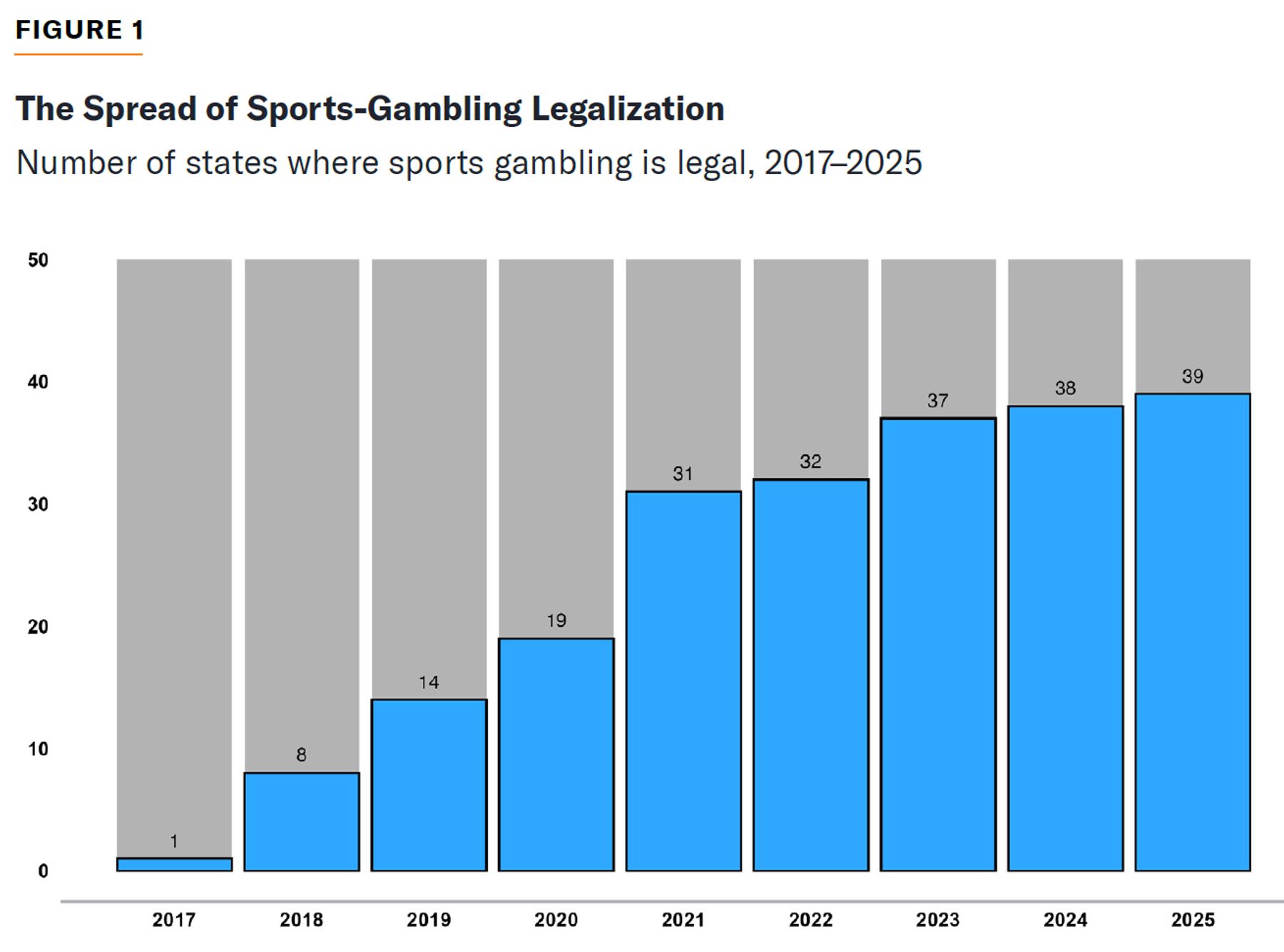
After the Supreme Court ruling, sports gambling spread rapidly and with relatively little regulatory pushback. Before legalization, sports gambling was essentially legal in only one state (Nevada). In the six years following Murphy, another 38 states legalized sports gambling in some form or another (Figure 1). Today, 39 states permit legal sports betting, including 31 that permit online sports betting (OSB).“In much of the country,” Jonathan D. Cohen writes in his book on the phenomenon, Losing Big, “this rapid pace was facilitated by the gambling industry, which not only lobbied for legalization but helped write the bills and the regulations governing its own behavior.”[10]
A principal argument of the gambling industry was that legalization would bring significant tax revenue, which every state legislator likes to hear. As the Tax Foundation put it, “tax policy was the key to the development of legal sports-betting markets. Tax revenue was the carrot many state policymakers needed to support legalizing sports betting.”[11] In New York, for example, then-Governor Andrew Cuomo reversed his opposition to legalization in the name of revenue.[12] Illinois Governor J. B. Pritzker demanded the state legislature legalize sports gambling to raise what he expected to be $200 million in revenue.[13] In Colorado, legalization sailed through on the promise of more funding for water availability.[14]
Revenue concerns remain an effective brake on efforts to regulate sports gambling. In Ohio, for example, legislation meant to curb the harms of OSB faces stiff opposition, partly driven by concerns about lost revenue. Similarly, in Colorado, an attempt to ban prop bets was defeated by revenue-based objections.[15]
Sports Gambling–Related Tax Revenue Has Been Anemic
Despite claims of revenue windfalls, sports gambling–related tax revenue remains a very small part of most states’ fundraising.
According to data from the Census Bureau’s Annual Survey of State Government Tax Collections, sports-gambling tax revenue totaled about $3.3 billion in 2025. By comparison, all state governments collected about $1.5 trillion in taxes that year. Sports gambling generates not only less money than sales, income, and property taxes but also less than alcohol ($8.3 billion, not counting license taxes) and tobacco ($14.8 billion). Total revenues are similar to those generated by marijuana, which is legal in 16 fewer states,[16] and about on par with the amount that states raised from licensing motor-vehicle operators.
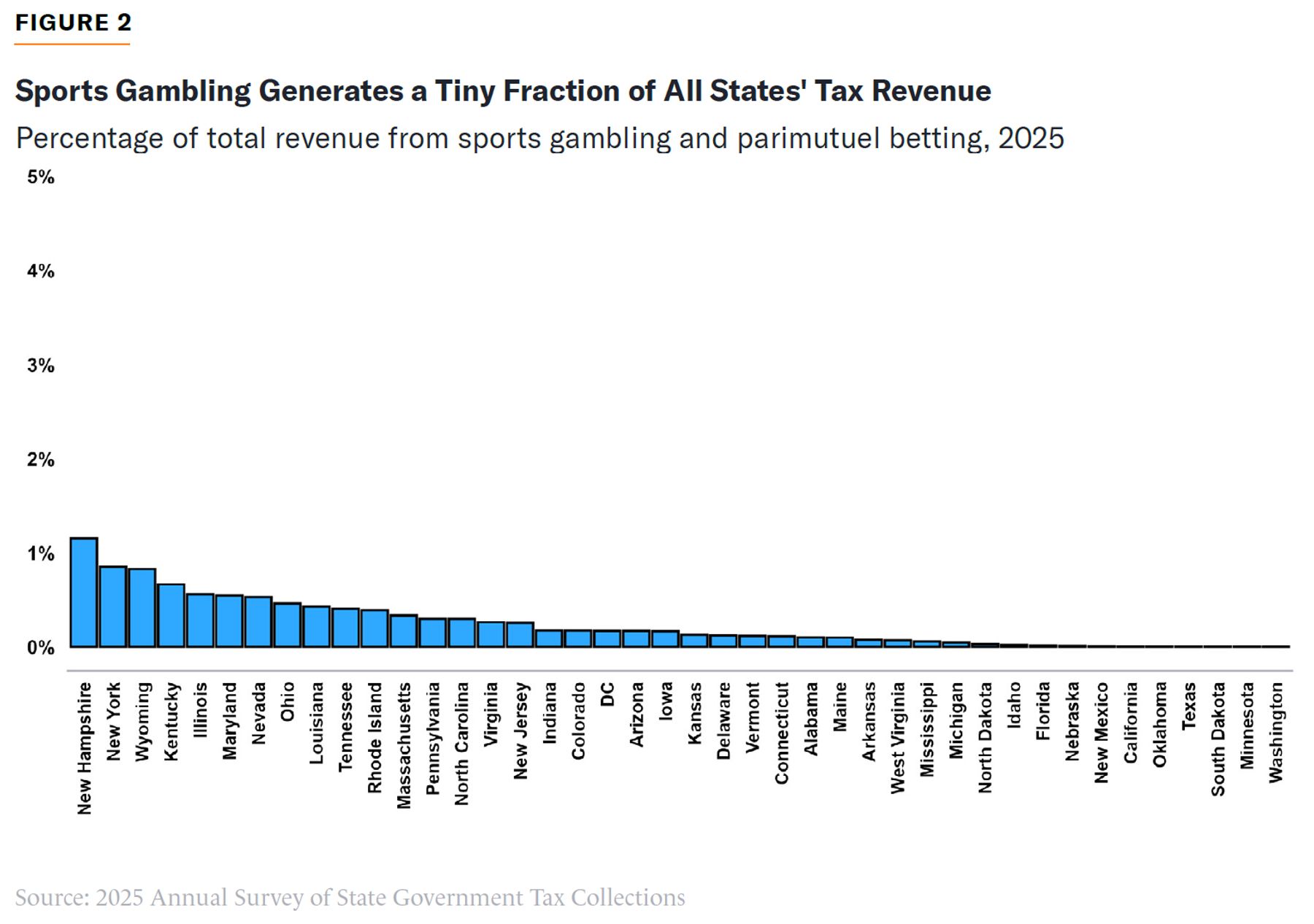
Nor is sports gambling particularly essential to any one state’s receipts. As Figure 2 shows, revenues exceed 1% of total tax receipts in only one state: high-gambling-tax New Hampshire. Even in New York (which has the same high tax rate), gambling generates less than 1% of revenue. On average, sports gambling accounts for roughly 0.2% of state tax revenue.
In its analysis, the Tax Foundation estimated that legalization by the remaining holdout states would add only about $1.5 billion in total revenues, for total annual revenue of just under $5 billion across all 50 states.[17] That’s a minuscule fraction not only of total revenue but also of total spending, which totaled $3 trillion in 2024.[18]
Another way to measure the effect of legalization is to observe consumer spending before and after legalization. Economists Daniel McCarthy, Wayne Taylor, and Kenneth C. Wilbur use consumer-level finance data in 11 treatment and 12 control states before and after legalization.[19] They estimate that legalization causes an increase in state tax revenue of just $0.78 per person per month, or just shy of $10 per year. That represents, for example, an additional $369 million in California, the largest holdout state, versus state expenditures of $452 billion.
Raising tax rates on gambling, moreover, may not yield much more money. Demand for gambling is elastic in the long run, so increasing taxes will tend to drive down rates of gambling and thus revenues.[20]
The Cannibalization Problem
Compared with total outlays, gambling revenue may be small, but it isn’t nothing. A few hundred million dollars can make a big difference at the margin, particularly for states obliged to balance their budgets and therefore constantly searching for extra revenue. In this way, legal sports gambling ensures its own perpetuation, by creating a line item that cannot be struck without eating into apparent available revenue.
But in many states, legal sports gambling may not even be increasing total revenue. There is evidence to suggest that sports gambling often simply cannibalizes revenue from other sources, bringing in the same dollars by other means. In such cases, overall revenue remains constant, with the increases from sports gambling offset by losses elsewhere.
It is easy to understand intuitively how cannibalization might occur. People have a fixed budget, and money they spend on sports gambling is not spent on another taxable activity. Different forms of gambling can substitute for one another.[21] The money that a user bets on a sports-betting app might have otherwise been spent on the lottery or video poker. Depending on the relative allocation of funds and the different tax rates applied to different activities, the shift in activity can result in no net increase in revenue or even a reduction overall.
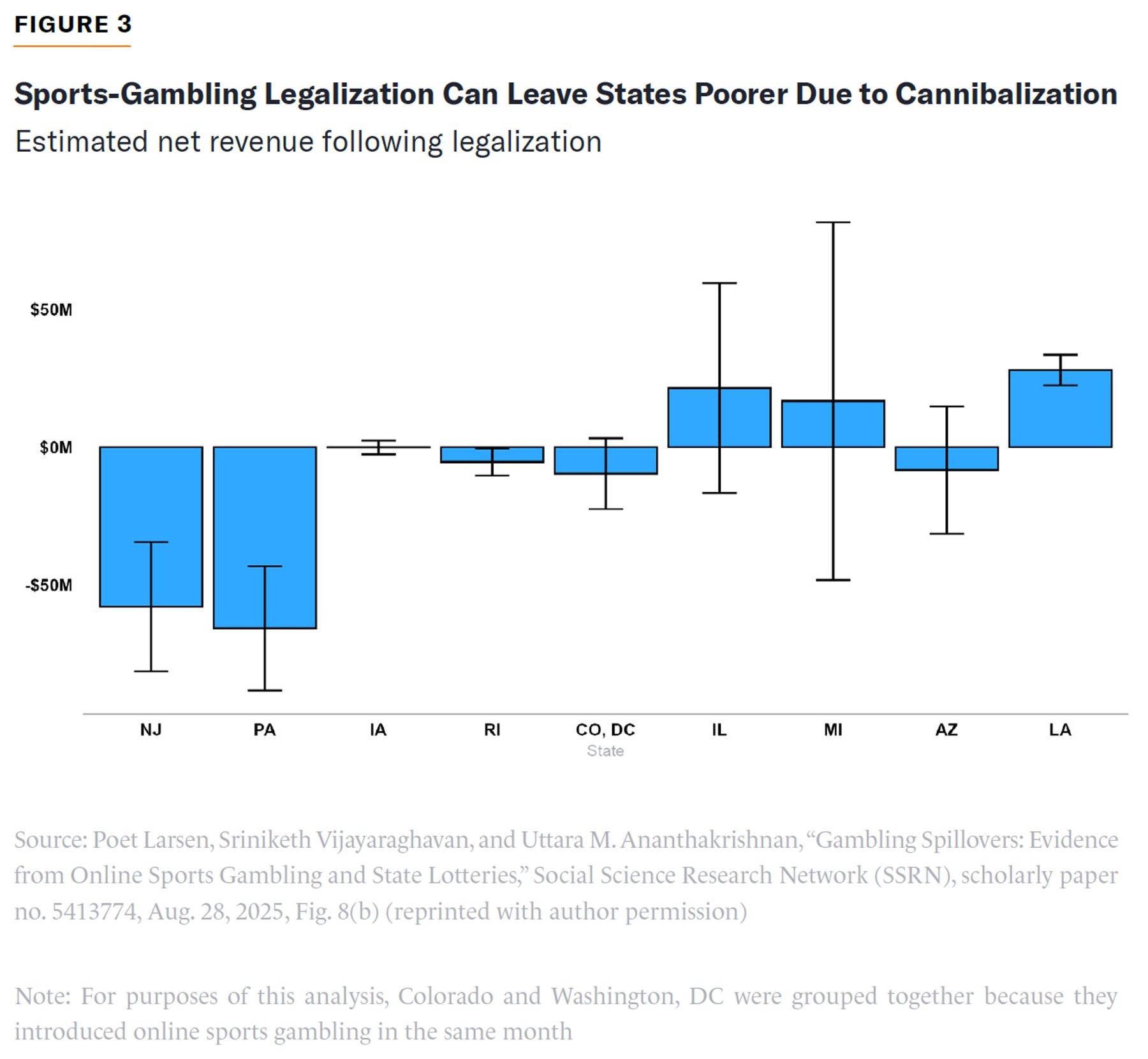
The most systematic analysis to date suggests that legalized sports gambling has led to substantial cannibalization of other revenue sources. In a 2025 working paper, economists Poet Larsen, Sriniketh Vijayaraghavan, and Uttara M. Ananthakrishnan investigate how the legalization of OSB affects revenues generated by state lottery sales.[22] Using two data sources—county-level lottery sales across 17 states and the District of Columbia plus transaction-level data on 80% of independent convenience stores in the U.S.—they show that OSB legalization significantly reduces state lottery sales, by 5.4%–6.2% in the 16 months following legalization. In their 17-state dataset, the result is a cumulative net state revenue loss of over $100 million. That result is driven by large declines in net revenue in New Jersey and Pennsylvania, with most other states more or less breaking even (Figure 3).[23]
Larsen et al. argue that, given these tax-policy trade-offs of legalization, states should try to set OSB taxes optimally to counteract the tendency to cannibalize lottery revenues. However, it is not obvious that such optimization is possible, for the reasons discussed in the previous section and for technocratic reasons—dynamically adjusting tax rates to compensate for demand is beyond the competency of most state lawmakers and gambling regulators.
Other estimates have provided further evidence of cannibalization. In West Virginia, one analysis found that the substitution from video lottery to sports gambling resulted in a net loss of $42.8 million in tax revenue for the state.[24] In Tennessee, roughly $100 million in revenue from sports gambling has reportedly been offset by an $80 million deficit in the state’s lottery-funded scholarship fund.[25] Another estimate from New York found that legalization of OSB cost the state $151.4 million in annual revenue. That was offset by an added $626.9 million in sports-gambling tax revenue—but, the paper’s authors note, the situation would not be the same in a state with a lower tax rate than New York’s (which has the nation’s highest).[26]
State lotteries are not the only revenue source at risk of being cannibalized by sports gambling. Whatever their other demerits, in-person casinos and racetracks keep money in state, creating further opportunities for taxation as it circulates to other points of sale. Money spent on OSB, by contrast, flows almost entirely out of state without any further opportunities for generating revenue. The Center for Addiction Science, Policy, and Research has estimated that some states may be losing hundreds of millions of dollars per year in taxable spending, thanks to OSB.[27]
To be fair, not all states have come out net-neutral or negative. A separate analysis of Pennsylvania found no short-term signs of cannibalization, although there is some evidence of longer-term effects.[28] There may also be variation in the effects of OSB versus retail sports betting. Another paper, from NYU’s Anthony Adam Sy and Masakazu Ishihara, uses data on 2,000 convenience stores to analyze the effects of each separately on lottery sales. They find that OSB leads to an increase in lottery sales, while retail sports betting leads to a reduction—on net, the two cancel out. Sy and Ishihara do not report estimated effects on tax revenue, which is a function not just of total spending but also of the tax rate on each product.[29]
The evidence, in other words, does not suggest that cannibalization of revenue after legalization is automatic. But it makes clear that severe cannibalization is possible—and that, when it is factored in, sports gambling generates little to no additional net revenue in many states. The already-small revenue generated by sports gambling may thus be even smaller than it first appeared to be.
The Costs of Legal Sports Gambling
All this would be moot if legal sports gambling were free—if, that is, it imposed no fiscal burdens on legalizing states. But, as a large and growing body of research indicates, legal sports gambling generates significant social costs. And at least some of these social costs turn into fiscal costs that show up on state balance sheets. Because the revenue generated by sports gambling is so small—even before accounting for cannibalization—it is likely that, in most states, the costs of legalization outweigh the benefits.
As the American Institute for Boys and Men typologized in a recent report, the high-quality (i.e., quasi-experimental) research on the effects of sports gambling can be divided into two categories: financial and socio-emotional.[30] A brief review of the research on each is presented below.
Financial
- Hollenbeck, Larsen, and Proserpio use a rolling difference-in-difference scheme exploiting variation in the rollout of legalization. They find that OSB increases the risk of bankruptcy by about 25% and credit-card delinquencies by 27%, among other indicators of worsening financial health.[31]
- Baker et al. use a similar setup with different data. They find that any legalization of sports betting reduces investment (as measured by deposits in brokerage accounts) by about 20% among frequent bettors—in turn, significantly reducing savings, particularly in low-income households.[32]
- Goss and Mangrum use data from the New York Fed Consumer Credit Panel in a two-way fixed effects model. They find that OSB legalization causes a 3% increase in loan delinquencies, driven by a 1% increase in credit-card delinquencies. They find larger effects for those under 40, including a 5.6% increase in auto-loan delinquencies and a 7.9% increase in credit-card delinquencies.[33]
- Brownen-Trinh, Orujov, and Pedio find that legalizing sports betting causes mutual-fund managers to increase the proportion of high-risk “lottery” stocks they hold by 9% and reduce fund alpha by 0.3%.[34]
- Guo, Peng, and Meyerhoefer use high-frequency data from the Census Bureau’s Household Pulse survey to estimate the effects of legalization in a difference-in-difference framework. They find that legalization reduces food sufficiency among households with working age adults without a college degree by 2.1%, equivalent to 10.5% among active bettors. Declines are concentrated among households with younger adults and racial or ethnic minorities.[35]
Socio-emotional
- McCarthy, Taylor, and Wilbur use generalized synthetic control methods to analyze data on individual consumers in 11 OSB states and 12 control states. In supplemental findings, they determine that legalization increases mass-market alcohol consumption by 19% and calls to the National Council on Problem Gambling’s help line by 79%.[36]
- Wilken uses data on Child Protective Services cases in a difference-in-difference framework. He finds that legalization of any type of sports betting increases the number of screened-in child maltreatment investigations by 5%–7%.[37]
- Earlier research has found that sports teams’ upset losses causally increase domestic violence.[38] Matsuzawa and Arnesen extend this work, finding that sports-gambling legalization increases the intensity of the effect, specifically increasing domestic violence by 8.5%–9.6%.[39]
- Wang and Gong use data on crime around sporting events in a difference-in-difference design. They find that legalization increases crimes from a game’s start to four hours after its conclusion by 60%–70% in that specific period, depending on the crime.[40]
- In a pre-post analysis, Yeola et al. find that searches for gambling-addiction help increased 23% following the Court’s ruling in Murphy, a share that consistently rose over time.[41]
- Orujov, Forrest, and Narita use data on suicide by age and sex in a staggered difference-in-difference design to estimate the effects of legalization on suicide. They find a significant increase in suicide rates among young men aged 15–34 (+2.4 suicides per 100,000 people), only partly offset by a reduction in older men aged 35–54 (–1.3 per 100,000).[42]
- Muniz-Fernandez, Humphreys, and Ruseski use a similar difference-in-difference strategy to observe the effect of legalization on divorce. They find that legal sports betting increases the divorce rate by 0.107% and increases the share of divorced men by 0.276%. Those effects “accumulate gradually over the post-treatment period, consistent with a mechanism operating through the slow deterioration of household finances and marital relationships.”[43]
Importantly, not all the costs of these harms show up on the balance sheets of states that legalize. For example, much of the administrative cost of bankruptcy is handled at the federal, rather than the state, level. More abstractly, lower rates of investment mostly harm the investor but may have some attenuated effect on state revenues through reduced capital-gains taxes. Other channels pose potential risk but are hard to estimate or attribute: Will legalization reduce state pension fund revenues? Unclear. Still others are too small to be measured—the domestic violence and crime results, for example, cover only specific, rare events (game days, especially those in which the home team unexpectedly loses), telling us more about gambling’s effects on human behavior than about its effects on crime and violence per se.
Still, there are a few clear mechanisms by which legalized gambling could increase states’ costs:
- There are no good estimates of the effects of legalization on rates of problem gambling specifically, but Yeola et al. suggest a 23% increase in searches for gambling addiction;[44] McCarthy, Taylor, and Wilbur find a 79% increase in calls to a problem-gambling hotline and estimate that legalization causes the share of the population spending over 1% of income on gambling—a threshold for problematic gambling in Canada—to increase more than fivefold (from 0.17% to 0.95%).[45] As of 2021, 15 state Medicaid programs cover treatment for problem gambling directly.[46] A 1999 estimate suggests that the cost of treating pathological gambling[47] is about $1,000 per person, equivalent to $2,003 after inflation adjustment.[48]
- Psychological comorbidities of problem gambling also create financial costs. Data from 2009 to 2012 show that pathological gamblers’ average insurance costs ranged between $7,993 and $10,054—equivalent to a range of $12,607–$15,452 in current dollars.[49] The average non-disabled, non-senior Medicaid enrollee costs an estimated $5,122 per year,[50] suggesting that problem gambling’s comorbidities increase costs by a net $7,485–$10,330.
- Wilken estimates that legalization increases child maltreatment investigations by 5%–7%. Fang et al. find that spending on such investigations is about $7,728 per child in 2010 dollars, equivalent to $11,877 today.[51] They also find that maltreatment increases a child’s risk of juvenile criminal-justice involvement and utilization of special education, at costs of $24,513 ($37,673 today) and $7,791 ($16,055), respectively.
The financial cost of these harms may not be very high. But as the preceding sections demonstrate, legal sports gambling does not generate significant additional revenue. In other words, costs do not need to get much bigger for the whole of the added revenue to be offset.
The intuition is straightforward: if a given harm costs a state $10,000 per person or incident and it affects 10,000 citizens or results in 10,000 incidents, the total added cost runs up to
$100 million. That is a drop in the bucket compared with total state spending but large relative to total gambling revenue. The concentrated harms of gambling need not have much impact on states’ bottom lines in order to make the juice not worth the squeeze.
Is that likely the case? The next section applies this framework to one state that has recently struggled with its legal regime: Ohio. It shows that, under reasonable assumptions, the state is coming out a net loser from sports gambling.
Is Legal Gambling Worth It? The Case of Ohio
Ohio legalized sports gambling in 2023. Since then, residents have wagered nearly $30 billion on sports. But legalization has not been without its hiccups, including a major cheating scandal that has engulfed the Cleveland Guardians.[52] Governor Mike DeWine has since called legalization a mistake.[53] Earlier this year, Ohio state legislators introduced legislation to impose regulations on the legal sports market, including bans on online betting, in-game wagers, parlays, and prop bets.[54]
That bill is likely to face stiff opposition, however, partly because of concerns about tax revenue. The state taxes sports gambling at 20%, yielding $209 million in tax revenue from over $1 billion in gambling revenue last year;[55] 2% of that money flows to problem-gambling prevention, while the rest goes to the General Revenue Fund for schools.[56]
There is no definitive evidence that sports gambling is cannibalizing other revenue, but there are suggestive indicators. The state lottery generated $4.38 billion in sales last year, down from $4.54 billion in FY 2024. Ohio Lottery director Michelle Gilchrist said that the lottery had experienced “a challenging year” as “lottery products faced competition from new gambling products,” among other concerns.[57] Ohio uses about 24 cents out of every lottery dollar for the state education fund, with the rest covering payouts and administrative costs.[58] Assuming that all that forgone revenue ($160 million) is attributable to cannibalization, the state is $38.4 million short, thanks to sports-gambling legalization. The state also lost money on its sports-gambling “kiosk” program in 2023, which cost about $650,000 to run but generated only $304,000 in revenue.[59] That kicks the total estimated fiscal cost of legalization up to $38.7 million.
That estimate does rely on the suspect assumption that 100% of the decline in lottery sales is attributable to sports-gambling legalization. But even assuming zero cannibalization, the $209 million in revenue that the state is generating is likely offset by additional fiscal costs from the harms of gambling. Many of those costs are hard to estimate, but even those identified above are likely sufficient to offset sports-gambling revenue.
Addiction Treatment and Comorbidities: 2.8% of Ohioans were problem gamblers in 2022, the year before legalization, according to the state’s gambling survey. Another 6.1% were identified as being at moderate risk of problem gambling, and a further 10.9% at measurable but low risk.[60] As mentioned above, there are no reliable and precise estimates of the effect of legalization on problem gambling,[61] but there are estimates of the effect on demand for problem-gambling services. We can make a conservative estimate that sports-gambling legalization increased problem gambling by just half a percentage point (from 2.8% to 3.3%), which amounts to an additional 46,523 people with gambling problems.
Ohio Mental Health and Addiction Services cover problem-gambling treatment costs separately from the state Medicaid program.[62] As for non-problem-gambling costs—the comorbidities that come with problem gambling—many of these people are likely covered by private insurers, but 21% of Ohioans are on Medicaid.[63] (Because lower socioeconomic status is correlated with both Medicaid receipt and problem gambling, likely the share of problem gamblers on Medicaid is higher.)[64] Assuming that an additional 9,770 Ohioans need Medicaid-funded treatment, that generates an additional $19,569,310 in treatment costs for gambling disorder and $73,128,450–$100,924,100 in treatment costs for comorbidities. That implies that total added health costs could be $92,697,760–$120,493,410.
Child Maltreatment Investigations: In 2023, Ohio reported 72,709 cases of child maltreatment that were screened for investigation.[65] Assuming that legalization increased maltreatment by 5%–7% relative to the counterfactual, that implies that, absent legalization, the state would have seen 67,952–69,247 cases, a difference of 3,462–4,757 added cases. Assuming that each case costs $11,877 to investigate, that implies $41,118,174–$56,498,889 in added costs.
Wilken does not report estimates of the effect of legalization on the actual number of victims of abuse and neglect, leaving it necessary to impute rates. In 2023, about 28% of Ohio cases identified victims of abuse or neglect.[66] Jonson-Reid et al. estimate that about 24.2% of maltreated children receive special education.[67] Assuming that 28% of our added cases yield actual abuse, and 24.2% of these incur additional special-education costs at $16,055 per case, that adds $3,766,264–$5,175,077.[68] This implies total added costs from child maltreatment of $44,884,438–$61,683,966.
These figures are back-of-the-envelope estimates, covering only the most readily quantifiable costs of legalized sports gambling. They do not represent the many harder-to-quantify costs discussed above. And, based as they are on the best available estimates in a relatively poor-quality literature, they should be taken as a suggestion of orders of magnitude of costs, rather than precise figures.
The general implication is that while Ohio has taken in $209 million from legal sports gambling, it has also cost the state between $134 million and $182 million simply from added medical and child maltreatment costs. Adding in the possible lottery losses of as much as $39 million brings these totals to between $173 million and $221 million.
Even when accounting for only a few potential fiscal effects of legal sports gambling, it is entirely possible that all or almost all of the revenue that legalization has generated is consumed by increased costs. Ohio might even have emerged as net-negative, relative to not legalizing at all.
Again, this is possible because sports gambling generates relatively little revenue. Even relatively small added costs associated with a relatively small number of citizens can entirely offset the added revenue. Because sports gambling is socially and individually harmful and because such harms invariably end up on the balance sheets of modern states, it is all but guaranteed that at least some offsetting will occur.
Implications for Sports-Gambling Regulation
The social harms of legalized sports gambling, especially OSB, are increasingly recognized, both in the academic literature and in public opinion. There is a growing popular mandate for lawmakers to do something about these harms.[69] Yet state lawmakers eager for reform keep confronting the argument that regulation will harm the tax revenue that sports betting generates and on which budget-constrained states putatively depend.
As this report shows, the revenue argument for legalization is unsupported. Revenue generated by sports gambling is very small, a minuscule fraction of total state revenue or spending. That is likely to remain so, as higher taxes may reduce play or shift users to untaxed, unlicensed products. Moreover, in many states that revenue is likely being cannibalized from other equivalent services such as the lottery, meaning that sports gambling may be revenue-neutral. The individual and social costs of legalization inevitably end up on state balance sheets, resulting in additional costs that likely offset whatever revenue that legalization actually generates.
As a result, states should not allow revenue concerns to stop them from regulating sports gambling. Legislators and regulators should make decisions on the basis of public health and the prevention of addiction, not on trying to maximize revenue.
A second, but equally important, implication pertains to optimal sports-gambling taxation. In essence, taxes on addictive, harmful products (i.e., “vices”) can involve optimizing a trade-off between revenue and public health. It may be that higher tax rates deter use—in turn, potentially leading to lower revenue but also less use; lower tax rates make use more attractive, potentially leading to more revenue.[70] Yet if sports gambling is an unreliable and poor source of revenue, tax rates should be set to optimize public health—at much higher rates. The median sports-gambling tax rate was just 15% in 2024; just 12 states tax sports gambling at or above 20%, and only five tax at or above 50%.[71] An optimal tax regime almost certainly shifts toward the higher end of this distribution, even assuming that revenue tends to fall when tax rates exceed a certain level.
The core justification for the legalization of sports gambling is normative and democratic: where adult voters want to be allowed to do something, there is a strong presumption that the state should not get in their way. At the same time, policymakers can and should recognize that sports gambling is an addictive, harmful product that can and does ruin lives. Reasonable regulation of that practice is therefore a must. Concerns about revenue should not stand in the way.
Endnotes
Are you interested in supporting the Manhattan Institute’s public-interest research and journalism? As a 501(c)(3) nonprofit, donations in support of MI and its scholars’ work are fully tax-deductible as provided by law (EIN #13-2912529).