Good morning:
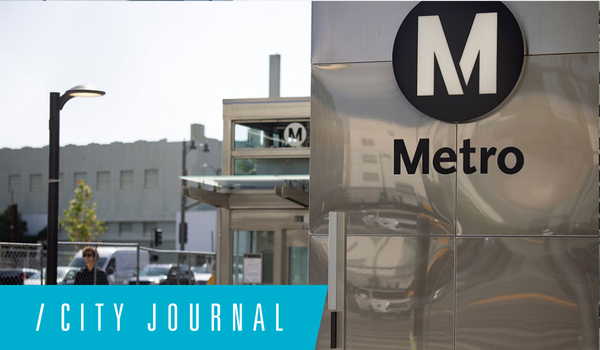
For a functioning and modern city, safe public transportation is a non-negotiable. That’s one reason our City Journal writers and Manhattan Institute scholars have spent months battling with Los Angeles bureaucrats over information related to a 2019 murder on the L.A. Metro. Despite our requests, city officials claim that footage of this murder is not in the public interest. We strongly disagree. From the unprovoked murder of Iryna Zarutska on the Charlotte, NC, metro, to Los Angelenos risking stabbing attacks on their daily commute, subway violence puts some of the most vulnerable people in our cities at risk and discourages ordinary citizens from participating in public life.
“Anyone who uses public transportation in the United States knows that evidence of an innocent bystander’s unprovoked, violent murder on a train is of undeniable public interest,” writes Christopher Rufo and Haley Strack in City Journal. “Angelenos should know what they’re up against every time they step on public transit. But Metro has refused to give them the full and uncensored truth.”
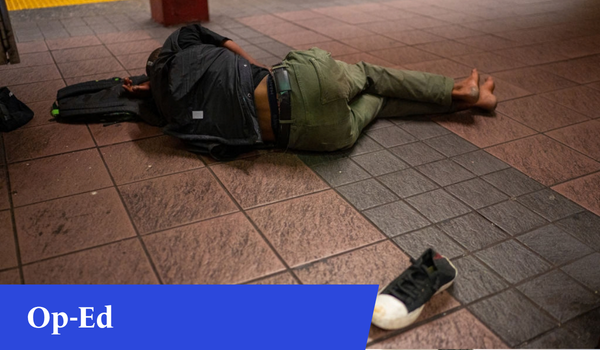
Unfortunately, similar incidents happen in New York City with far too much regularity. Nicole Gelinas writes in the New York Post that the six murders on the NYC subway so far this year is another reminder that subway violence remains far worse than it was prior to 2020. “The pervasive atmosphere of violence has impacted subway staff, too.” Through July, subway workers on the job "have suffered 42 assaults, up from 37 for the same period last year, and skyrocketing from just 16 in the first seven months of 2019.” Like in Los Angeles, government officials in Albany and New York City could cut crime and protect transit workers. But they choose not to.
Elsewhere in this newsletter, Tal Fortgang in City Journal reflects on the third anniversary of the Hamas attack against Israel, and the state of American students who wrongly celebrate it. In the Daily Wire, Adam Lehodey investigates the rise in crime in Portland, and the resource-constrained police bureau that is struggling to respond to a city abundant in conditions that produce crime, including drug addiction, homelessness, and a sense that one can get away with it.
Finally, if you missed last week’s event on the fight for education freedom and school choice, featuring former Virginia governor Glenn Youngkin and MI president Reihan Salam, you can see the full event below. Together, Youngkin and Salam discussed the lessons from education reforms in Virginia, the importance of giving parents more choices, and the national effort to expand educational opportunity.
Continue reading for all these insights and more. Kelsey Bloom Editorial Director Manhattan Institute |
|
|
|
Paying More for Less Care: Maryland’s Hospital Payment Regulations
By Chris Pope | Manhattan Institute | Photo by SDI Productions/E+ via Getty Images
Maryland’s system of hospital payment regulation, which caps hospitals’ total revenues and imposes state-set rates on payments from Medicare, Medicaid, and private insurers, may be the closest things in the U.S. to single-payer health care. Advocates of the system tout large savings. But in a new MI report, senior fellow Chris Pope shows that any savings are mostly the result of Maryland’s hospitals delivering less care—while charging more for the care that is provided.
Since Maryland adopted global hospital budgets in 2014, inpatient admissions in the state have fallen compared to the nationwide average. This is largely driven by declines in costly procedures. Kidney transplant rates, for example, fell from well above the national average to far below it. Emergency-room wait times are now the longest in the country, and common inpatient procedures are now 7%–34% more expensive than nationwide. Maryland’s system, Pope argues, relies on the state’s survived in large part because of an unusually generous deal with the federal government that gives the state increased added Medicare and Medicaid. As that windfall is phased out, Maryland itself may retreat from its hospital payment regulation. Maryland’s experience, then, casts doubt on the idea that centralized control of hospital payments can reduce costs without sacrificing access to care.
|
Why We’re Suing the L.A. Metro
By Christopher F. Rufo and Haley Strack | City Journal | Photo by Kayla Bartkowski / Los Angeles Times via Getty Images
“After Mirna Arauz Soza clocked out of her overnight shift at Original Tommy’s Hamburgers in April 2024, she boarded the L.A. Metro red line as part of her usual commute. The 67-year-old mother of three didn’t make it one stop before Elliot Tramel Nowden crept from behind and stabbed her in the neck. …
“Five months ago, we filed a public records request for information about Mirna’s murder. Metro refused, citing family privacy concerns. Later, it claimed that releasing footage of this high-profile murder on board was not in the “public interest.” We countered with a letter from Mirna’s three surviving children authorizing the release of all footage related to their mother’s death, but Metro still refused to release all the material.
“Anyone who uses public transportation in the United States knows that evidence of an innocent bystander’s unprovoked, violent murder on a train is of undeniable public interest. Angelenos should know what they’re up against every time they step on public transit. But Metro has refused to give them the full and uncensored truth.
“So we’re suing them to get it.” |
Why Students for Justice in Palestine is Celebrating October 7
By Tal Fortgang | City Journal | Photo by Michael Nigro/Pacific Press/LightRocket via Getty Images
“Across the country, Students for Justice in Palestine chapters are today commemorating the massacres of October 7, 2023. More precisely, they will gather to commemorate the lives lost among the perpetrators of the massacre—the Hamas terrorists and other Gazans who invaded Israel to rape, torture, and murder men, women, and children. They will mourn the fact that Hamas failed to achieve its goal of destroying Israel while celebrating the effort to do so.
“If SJP—an umbrella group for hundreds of anti-Israel student organizations across ‘Turtle Island (so-called North America)’—ever intended to hide its conviction that murdering Israelis is an affirmative good, it has stopped pretending. For all the posturing about Palestinian victimhood and indignant accusations over Israel’s conduct of the war, these self-styled champions of the Palestinians aren’t mourning the atrocities that invited Israel’s retaliation. They are celebrating them.” |
NYC Subway Dragging Death Reveals a Hidden Danger That Puts Every Rider at Risk
By Nicole Gelinas | New York Post | Photo by Robert Nickelsberg/Getty Images
“Gov. Kathy Hochul still can’t protect New Yorkers from subway violence, as last week’s unprovoked knifing murder on a Queens J train reminded us. And crime is magnifying another peril: the risk that a train will run you over. “To address both risks, Hochul should direct the state-run Metropolitan Transportation Authority to update union work rules and make everyone safer. “Last week, with no warning, an ‘emotionally disturbed’ person repeatedly stabbed construction worker Mesias Lojano as the train both were riding neared Woodhaven Blvd. Lojano, 59, was the subway system’s sixth murder victim of the year.
“From 1997 to 2019, the decades before Albany implemented criminal justice ‘reforms,’ New York City experienced an average of two transit murders each year.” |
The Leftist Alliance Keeping Portland From Stopping Crime
By Adam Lehodey | Daily Wire | Photo by PATRICK T. FALLON/AFP via Getty Images
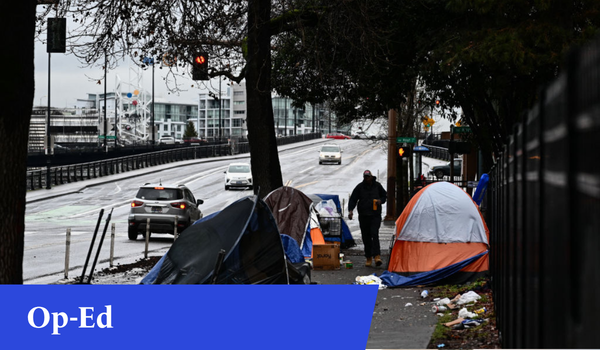
“It’s 10:30 p.m. on West Burnside Avenue in Portland, Oregon. Morbid figures drag themselves up and down the street. They have erected tents on sidewalks, where they smoke meth and fentanyl, obtained for as little as a dollar. Many hunch over, ‘nodding out’ to preserve their high. Many are in wheelchairs. Portlanders step over them on their way to a night out at the handful of bars and clubs that remain open in the area." “Scenes like these epitomize the aftermath of pandemic-era drug decriminalization, police cuts, and progressive approaches to prosecution — policies that have left Oregon’s largest city with an under-resourced, understaffed police bureau struggling to enforce basic laws. The weirdness that once attracted so many to the Rose City has devolved into pervasive disorder and squalor, turning Portland into a case study in failed urban governance.” |
|
|
Before you go: “Empowering Parents: The Fight for Educational Freedom,” with Virginia Gov. Glenn Youngkin and MI President Reihan Salam |
|
|
For more information and media requests, please contact
communications@manhattan.institute.
Are you interested in supporting the Manhattan Institute’s public-interest research and journalism? As a 501(c)(3) nonprofit, donations in support of MI and its scholars’ work are fully tax-deductible as provided by law. |
|
|
|
The Manhattan Institute works to keep America and its great cities
prosperous, safe, and free. Manhattan Institute
52 Vanderbilt Ave. 3 floor New York, New York 10017
Copyright © 2026 Manhattan Institute, All rights reserved. |
|
|
|
|