Good morning:
A trio of progressive, Zohran Mamdani-endorsed insurgents swept Tuesday’s Democratic primary for New York City House seats, ousting two incumbents from Congress, including the Congressional Hispanic Caucus chair, Rep. Adriano Espaillat.
Next week’s edition of this newsletter will have more to say from Manhattan Institute scholars about the election results and what it means for establishment Democrats—and the country—to face off against increasingly leftist voters in blue cities. For now, take just one of these future NYC-based House members, democratic socialist Darializa Avila Chevalier.
CNN recently reported that, early in the Covid pandemic, Chevalier “reposted a message calling for a sweeping government takeover of large parts of the economy. The repost advocated nationalizing utilities, hospitals and pharmaceutical companies; suspending rent and mortgage payments; dissolving private health insurance companies; and ‘seiz[ing] all properties from landlords’.”
She has a long history of anti-American social media posts. “I forgot to get napkins so I just wiped my hand on the American flag behind me,” Chevalier posted in 2019 along with a smiling face emoji, the New York Post reported.
Chevalier also rejected the argument that the call to “abolish the police” meant merely ending policing “as we know it.” She clarified: “No. It means ending policing full stop. Period. No more police at all ever.” Just days ago, when pressed by MI senior fellow Nicole Gelinas and other members of the New York Editorial Board, Chevalier declined four separate times to state what should happen to a murderer. She did not endorse incarceration.
As the number of self-identified democratic socialists in leadership and lawmaking positions increases, Americans must understand what proponents of this political ideology believe. Last week, City Journal investigative reporter Stu Smith reported on the radical new platform adopted by the Democratic Socialists of America. Smith writes:
The DSA calls for sweeping political and economic changes, including full public financing for campaigns and the abolition of the Electoral College, alongside the establishment of public ownership of the largest corporations and essential industries to ensure democratic control and accountability, and strict regulations on investment properties.
It would also defund the Department of War, close overseas bases, and end all economic sanctions—which would include those in states like Iran, Cuba, and Russia. The platform further endorses universal amnesty for illegal immigrants, and ending “restrictions on . . . marriage,” which would presumably entail the legalization of polygamy. Smith will continue to be essential reading for understanding and exposing this movement.
In this week’s newsletter, director of Research Judge Glock wonders why Americans-as-taxpayers get a lower return on investment for government spending than when Americans deal with private companies as consumers and customers, in National Affairs. Christopher F. Rufo, Jedd McFatter, and Susan Crabtree lay out the roster of criminal connections in California Gov. Gavin Newsom’s political network, in City Journal. For the Daily Wire, fellow Rafael Mangual examines the ideology of a progressive district attorney who wants a convicted murderer to go free, and how the effective truth of “social justice” is that the wellbeing of criminals is elevated over the wellbeing of victims. And Mark P. Mills offers a way forward for sensible regulation that does not cripple the burgeoning AI industry, in City Journal.
Continue reading for all these insights and more. Kelsey Bloom Editorial Director |
|
|
|
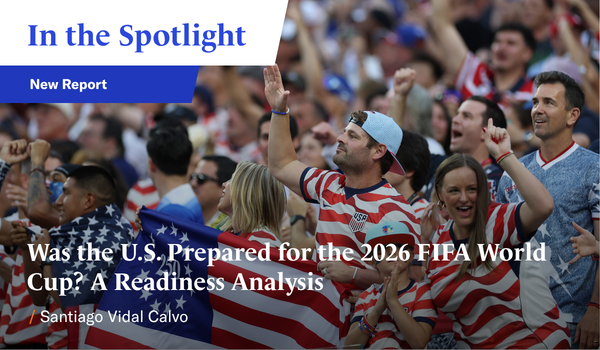
Was the U.S. Prepared for the 2026 FIFA World Cup? A Readiness Analysis
By Santiago Vidal Calvo | Manhattan Institute | Photo by Sarah Stier - FIFA/FIFA via Getty Images
The 2026 FIFA World Cup is underway. Staged in 11 U.S. host cities, the World Cup appears to be a success so far in at least the narrow sense: matches are being played (and the U.S. team is winning), stadiums are full and accessible, and basic public safety is being maintained. But how did the U.S. prepare? And can we keep up the momentum in the second half of this mega event?
A new Manhattan Institute report by Cities policy analyst Santiago Vidal Calvo offers a comprehensive readiness assessment of the 2026 FIFA World Cup. With 104 matches over 39 days and involving 48 teams, this is the largest and longest World Cup in history — and Americans entered it with enormous advantages: world-class stadiums, large hotel markets, and organized law enforcement. But the real risks lie outside the stadium walls.
Visa bottlenecks are blocking fans from Latin America, Africa, and Asia. Airport congestion may cascade across the entire national air network. Several stadiums lack reliable transit access. Police vacancies are acute in multiple host cities. Whether the 2026 FIFA World Cup concludes as successfully as it began depends entirely on the execution and coordination of city, state, and federal authorities. Read the full report for more. |
|
|
Against Government as Vanguard
By Judge Glock | National Affairs | Photo by ED JONES/AFP via Getty Images
“State capacity is best understood as the ability of the government to accomplish its goals efficiently. Thus far, state-capacity reformers have focused on removing the burdensome procedures government has placed on its own operations, from extensive public-outreach requirements to excessive lawsuit opportunities. ...
“There is, however, another significant reason for state capacity's atrophy: The federal government has placed many mandates on its own operations that it could never impose on society at large, from compulsory unionized workforces to affirmative-action goals to ‘Buy American’ requirements. ...
“The best means of improving state capacity is to stop the government from attempting to serve as a putative model for the rest of society by imposing mandates on itself. To push back against this sort of vanguardism, state-capacity reformers should work to establish a rule of equal treatment for government and private-sector projects, whereby regulators should not impose mandates on government that it does not impose on the private sector.” |
The Progressive District Attorney Who Wants a Convicted Murderer to Go Free
By Rafael A. Mangual | Daily Wire | Photo by Mark Makela/Getty Images
“Philadelphia’s recalcitrant District Attorney Larry Krasner is back in the news this week, thanks to an extraordinary ruling by the Pennsylvania Supreme Court. Invoking what’s known as ‘King’s bench jurisdiction’ — which allows the state’s high court to assume jurisdiction over a case at any stage when it involves a matter of extraordinary public importance—the justices reversed a lower court decision to grant a new trial to a convicted murderer. ... “Krasner subscribes (sincerely, one suspects) to a ‘social justice’ view that elevates the concerns of perpetrators over those of victims. He comes from a school of thought that sees the enforcement mechanisms of the criminal justice system as inherently oppressive and reflective of society’s failures to prevent lawbreaking by making society more equitable. ... “The ‘abolitionists’ and ‘reformers’ want you to believe they have somehow derived solutions to problems — like poverty, inequality, predation, greed, and violence — that have been present in every society throughout history. The hubris of this view cannot be overstated. Nor can one overemphasize how thoroughly the evidence disproves it.” |
|
|
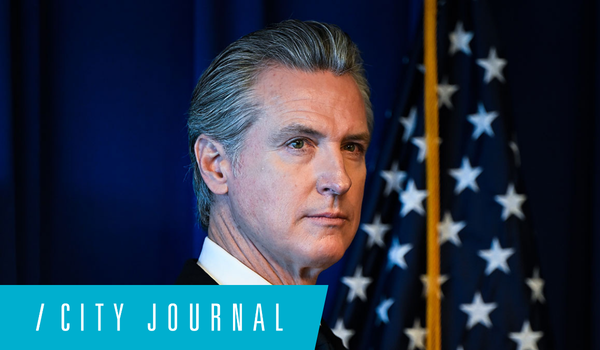
Gavin Newsom’s Circle of Corruption
By Christopher F. Rufo, Jedd McFatter, Susan Crabtree | City Journal | Photo by Adam Gray/Getty Images
“Gavin Newsom is reportedly under federal investigation. Last week, the California governor released a recorded statement claiming that federal agents are combing through records as part of an inquiry targeting him and his wife. ... As federal agents examine Newsom’s connections, we decided to do the same. We reviewed records dating back to his tenure as mayor of San Francisco. They reveal that, over nearly three decades in politics, Newsom has amassed a network of appointees, employees, and associates implicated in a range of ethical violations and criminal offenses—including, in some cases, serious felonies. ...
“Newsom has suggested he wants to improve California’s culture of self-dealing. Last year, his spokesperson said that ‘the governor expects all public servants to uphold the highest standards of integrity.’ Our review reveals that, in fact, Newsom has surrounded himself with corruption and criminals. “This is Gavin Newsom’s circle of corruption.” |
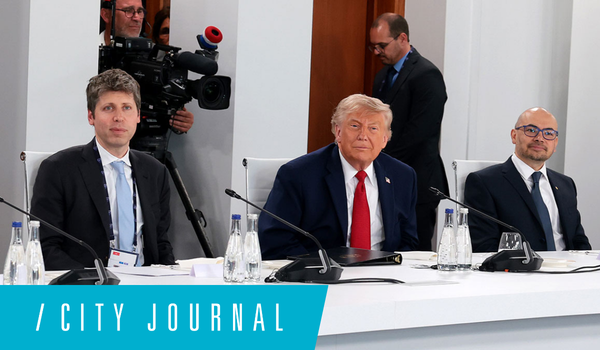
A Roadmap for Sensible AI Regulation
By Mark P. Mills | City Journal | Photo by Kevin Sullivan/Digital First Media/Orange County Register via Getty Images
“Do public school Gifted and Talented (G&T) programs improve outcomes, or unfairly favor affluent families? Last week, a viral New York article took up that question. Its author seemed to believe that G&T is mostly a way to entrench disadvantage.
“That framing, though, misses the bigger picture. The shortcomings of G&T are not unique in public education. They reflect a system designed to serve teachers, organized labor, and education bureaucracies rather than students and families. ...
“G&T programs reassure status-conscious parents that their children are on a more promising path, one that appears to lead from accelerated classes to selective high schools and prestigious colleges. This distinctive track makes G&T a political pressure-release valve, easing calls on elected officials and their allies in organized labor for more fundamental change.
“G&T programs thus survive not because they consistently deliver a superior education but because they help a failing system retain the families most likely to flee or oppose it. Their high popularity among New York City families makes them especially valuable to the public school establishment, giving dissatisfied parents a reason to stay invested in the system rather than demand alternatives outside it. Better yet for the union, G&T creates demand for more teachers—and thus more members—while thinning general-education classes and easing those same teachers’ workloads.”
|
|
|
MI has partnered with the Sun Valley Policy Forum’s Summer Institute, bringing some of your favorite City Journal contributors to Idaho’s iconic mountain town this summer: Heather Mac Donald, Reihan Salam, Ilya Shapiro, Shawn Regan, Jesse Arm, Judge Glock, Brandon Fuller, Mark Mills, and more. Friends of City Journal receive discounted registration. We hope to see you there.
|
|
|
For more information and media requests, please contact
communications@manhattan.institute.
Are you interested in supporting the Manhattan Institute’s public-interest research and journalism? As a 501(c)(3) nonprofit, donations in support of MI and its scholars’ work are fully tax-deductible as provided by law. |
|
|
|
The Manhattan Institute works to keep America and its great cities
prosperous, safe, and free. Manhattan Institute
52 Vanderbilt Ave. 3 floor New York, New York 10017
Want to change how you receive these emails?
Unsubscribe | Subscription Preferences
Copyright © 2026 Manhattan Institute, All rights reserved. |
|
|
|
|