Good morning:
Across the country, American cities have abandoned the use of Automatic License Plate Readers (ALPRs)—a popular policing technology that uses cameras and software to identify cars by their license plates—as a result of recent blow black against the tool. Calls for an outright ban gained traction online, and the cameras have been vandalized and destroyed on city streets.
But, as MI fellows Charles Fain Lehman and Rafael Mangual point out in their new report, ALPRs are not a new technology. The technology itself dates to the 1970s and American police departments started to deploy them at significant levels in the early 2000s. They argue that the case for ALPRs in policing is straightforward: In a mobile society, a significant share of crimes involve vehicles and the cameras supplant human police officers with reliable and impartial information.
The report addresses critics’ appeals to Fourth Amendment protections against unreasonable searches and seizures. It describes the relevant privacy-related court cases. There is certainly, thankfully, not a blank check for government to surveil citizens in public, but courts have repeatedly rejected the argument that the deployment of ALPR networks, or the accessing of those networks for investigative purposes, violates the Fourth Amendment.
Policymakers should be aware of sensible regulations on ALPRs, however. To that end, the report includes original model legislation to help lawmakers address citizens’ concerns about the technology, while also protecting the technology’s crime-solving advantages.
The report and model legislation build on the popular writings Lehman and Mangual have published on ALPRs. Both scholars have repeatedly urged cities to sensibly weigh the costs and benefits of this policing technology, rather than rush to ban it.
Relatedly, economic policy fellow Dario Marino writes in City Journal about the case for a left-right pro-ALPR political consensus. Just as liberals and conservatives have their separate concerns, they also have reasons for supporting the technology.
Elsewhere in this newsletter, fellows Jennifer Weber and Allison Schrager take on political developments in artificial intelligence. Weber’s column in the New York Post criticizes the decision of lawmakers in New York City and Los Angeles to insulate public school children from AI. She does not support unregulated access to AI, but favors a smarter approach that gradually introduces it to children at an appropriate age and teaches students how to use it judiciously—and only after basic mathematics and reading skills are learned.
In Bloomberg, Schrager writes that the stock market has made the U.S. rich and prosperous. But now that 60% of Americans own stock, it is important to remind market participants that investing involves risk. AI is likely to help Americans become more productive; many retirement accounts are banking on that expectation as well. Schrager weighs in on what she thinks the connection between AI and the stock market means for the future of AI policy.
Continue reading for all these insights and more. Kelsey Bloom Editorial Director |
|
|
|
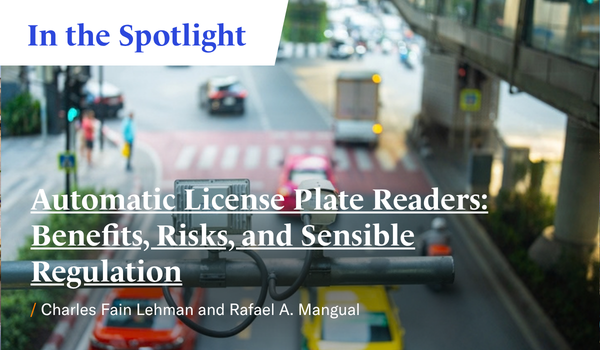
Automatic License Plate Readers: Benefits, Risks, and Sensible Regulation
By Charles Fain Lehman and Rafael A. Mangual | The Manhattan Institute | Photo by Jackyenjoyphotography/Moment vis Getty Images
Automatic License Plate Readers (ALPRs) are a popular policing technology used to identify cars by their license plates and other unique characteristics. However, the leading ALPR provider, Flock Safety, has received immense criticism from both the political Left and Right. A new Manhattan Institute report by fellows Charles Fain Lehman and Rafael Mangual explains why the backlash is misguided and why many of the criticism of this technology are mistaken.
Among the recommendations in this new report and accompanying model legislation, Lehman and Mangual suggest: - Logging all database access with individual user IDs and detailed case codes;
- Supervisory approval for non-emergency or off-duty searches;
-
A 30-day cap for data retention unless there is an active investigation;
- Criminal penalties and exclusion of future police employment for those who abuse ALPRs;
- Restricting investigative use of ALPRs to major crimes like violent felonies, thefts, abductions, burglaries, arsons, gun crimes, drug crimes, and hit-and-runs.
ALPRs themselves are not new technology. Police departments across the country have been using them for decades because the existing evidence suggests they lead to reductions in crime. Lehman and Mangual’s paper encourages lawmakers to make targeted regulatory improvements rather than outright bans. |
Panic Drove NYC and LA To Ban School AI — and That’s a Big Mistake By Jennifer Weber | New York Post | Photo by Matteo Della Torre/NurPhoto via Getty Images
“There are two ways for America’s schools to get artificial intelligence wrong. One is to hand a child a chatbot and let it do all the thinking — and the other is to ban AI and pretend it doesn’t exist. New York and Los Angeles have both chosen the second option. That means they’re setting their students up to get the first. …
“On Sept. 2, (NYC Mayor Zohran) Mamdani and (NYC public schools) Chancellor Kamar Samuels chose to go to extremes, banning generative AI in NYC public schools for every student from 2-K through grade 8 — about 600,000 kids. Later that same day, Los Angeles blocked AI on school devices in every grade — banning it indefinitely for more than 378,000 students.
“These school systems are behaving as if a kindergartener’s educational needs are the same as a 13-year-old’s, or a 17-year-old’s. But their bans fail no matter who is right about AI.” |
We’re All AI Investors Now, and That’s Risky
By Allison Schrager | Bloomberg | Photo By Michael M. Santiago/Getty Images
“Like it or not, we are all betting on AI taking over the economy. In the last 40 years, the US has become a nation of stock investors. On the whole, it has made Americans rich. Now the stock market is soaring on the hopes that AI will make everyone more productive — and if that doesn’t work out, we all may learn the definition of a bad tail risk.
“There are two forces that are not quite at odds, but in tension: On the one hand, the growth of retirement investors means more Americans own a piece of the economy, which brings them both more wealth and more stability, since they are more diversified compared to when they owned just their home or government bonds.
“On the other hand, this growth in retirement investors means more systemic risk, because if the stock market drops there is an economy-wide wealth shock that affects more than 60% of households. If markets don’t recover, it leaves some poorer in retirement. It also makes people feel poorer today because of the wealth effect. This could further depress demand and worsen a potential recession.” |
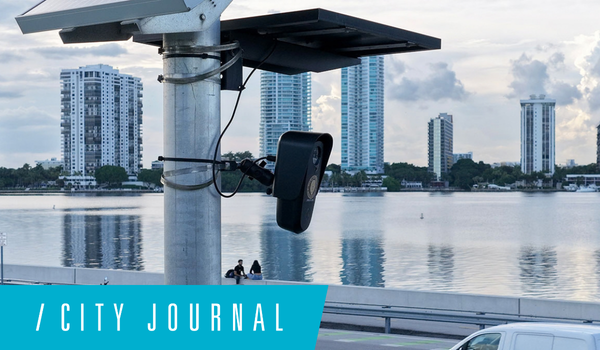
Flock Cameras: The Case for a Left-Right Consensus By Dario Marino | City Journal | Photo by Joe Raedle/Getty Images
“Accepting automation in policing in exchange for a greater probability of catching criminals should appeal to the center-Right because it offers more order without asking taxpayers to fund a police-hiring surge.
“Automation should also appeal to the center-Left because it lowers the enforcement burden on low-income and minority communities. Certainty of punishment substitutes for severity, which means fewer people going to jail for low-level property crimes and fewer of the pretextual stops that arouse progressive concerns about disparate impact. Automated surveillance technologies also reduce the risk of discrimination. ALPRs don’t flag vehicles based on an officer’s instinct; they identify vehicles directly tied to crimes. …
“If ALPR critics on the Right want more policing with less government intrusion, they should push for stronger rules governing the use and capture of camera data, especially limits on data retention. If critics on the Left want to reduce the “wrong” kind of policing, they should support the push for better targeted policing, not eliminate it altogether.” |
Why Are AP Scores Rising? The College Board’s Answers Don’t Add Up
By Neetu Arnold | City Journal | Photo by Maskot/Maskot via Getty Images
“Are the higher (AP test) scores a more accurate measure of college-level performance, as the College Board contends, or has its new methodology watered down assessment? “That possibility has been a rich topic of speculation. Some observers suspect the College Board is attempting to make the AP exams more desirable. Higher passing rates could encourage more students to participate. … “Financial pressures may also play a role. The College Board’s revenue fell from $403.6 million in 2019 to $289.2 million in 2022. … The College Board’s equity goals could also be a factor. The board has sought to diversify AP participation, recommending measures such as targeted assistance for schools enrolling underserved populations. …
“The College Board has characterized skeptics of the recent scoring changes as ‘dismiss[ing] the work of millions of students.’ But the organization is not doing much to offer clarity to the public.” |
|
|
How States Can Cut Rules and Regulations—and Make It Stick: Idaho’s Two-Step Process That Other States Can Copy
By Alex J. Adams and Adam N. Jones | The Manhattan Institute | Photo by MTStock Studio/E+ via Getty Images
“Most state regulatory systems have operated on autopilot. Once a rule is adopted, it usually stays in force unless someone can marshal the time, political will, and technical knowledge to repeal it. As a result, rules pile up and the regulatory code grows not because it is necessary, but because it already exists.
In a new issue brief, Alex J. Adams and Adam N. Jones show how Idaho broke that pattern—and that state’s example can teach a lesson to states all over the country.
Governors and lawmakers should view regulatory reform as a marathon, not a headline-grabbing sprint. Idaho’s experience suggests that durable reform is linked to four steps: resetting the inherited stock of regulations, establishing recurring review, constraining the flow of new rules, and revisiting the statutes that mandate or authorize them. This issue brief breaks down how to bring that process to every state interested in reform.”
|
|
|
For more information and media requests, please contact
communications@manhattan.institute.
Are you interested in supporting the Manhattan Institute’s public-interest research and journalism? As a 501(c)(3) nonprofit, donations in support of MI and its scholars’ work are fully tax-deductible as provided by law. |
|
| |
The Manhattan Institute works to keep America and its great cities
prosperous, safe, and free. Manhattan Institute
52 Vanderbilt Ave. 3 floor New York, New York 10017
Copyright © 2026 Manhattan Institute, All rights reserved. |
|
|
|
|