Selective Success: A Comparative Analysis of Chicago’s Selective Enrollment and Public High Schools

Photo by Scott Olson/Getty Images
Introduction
For years, progressive politicians in cities across the U.S. have tried to shut down selective enrollment high schools, which use standardized tests and grades to determine student admissions.[1] These institutions offer academically gifted, public school students a rigorous education and other opportunities typically available only in private schools. They are, in this way, a great equalizer in American secondary education, providing talented high schoolers of all racial and socioeconomic backgrounds with the tools to succeed.
Progressives and their teachers’ union allies, however, oppose selective enrollment high schools. They claim that these schools contain few, if any, so-called underrepresented minorities, take resources away from traditional district schools, and further educational inequities between white and Asian American students, on the one hand, and black and Hispanic students, on the other.
In this issue brief, I evaluate the validity of these claims and others in the context of Chicago’s selective enrollment high schools.
These schools serve as a useful case study because of their size and because, since December 2023, members of the Board of Education and Mayor Brandon Johnson have been threatening to close them. They argue that the schools further educational segregation and hold back other Chicago schools. I find, however, that:
- Chicagoans want educational choice, including the choice to attend a selective enrollment high school. During the 2022–23 school year, 76.2% of high school students chose to attend a school other than the one assigned to them by Chicago Public Schools (CPS).
- In 2025, low-income students constituted at least one-third of each selective enrollment high school’s student body.
- Almost 70% of all students at selective enrollment schools are black and Hispanic. White and Asian American students are in the minority. Among the top eight selective enrollment high schools—those that rank among Illinois’s top 25 schools—black and Hispanic students constituted a majority at three (Gwendolyn Brooks College Preparatory Academy, John Hancock College Preparatory High School, and Lindblom Math and Science Academy) and a plurality at four others (Jones College Prep, Lane Tech College Prep High School, Walter Payton College Preparatory High School, and Whitney M. Young Magnet High School).
- With the exception of Lane, Chicago’s selective enrollment high schools were established in order to integrate, not segregate, CPS.
- The black–white, Hispanic–white, and low-income–non-low-income achievement gaps in ACT English and math are, on average, significantly smaller at the city’s eight top selective enrollment high schools than at CPS overall.
- On average, CPS spends $3,285 more per student in nonselective schools than in the top eight selective enrollment high schools—and delivers far worse results.
Selective enrollment high schools in Chicago produce better results, at a lower cost, than the system as a whole. Far from being damaging to academically gifted black, Hispanic, and low-income students, these educational institutions act as a lifeline for them.
School Choice and Selective Enrollment High Schools in Chicago
Selective enrollment high schools represent a vital, yet frequently neglected, component of the school choice debate. The discourse on choice and standards often focuses on children who are struggling academically, those with special needs, or religious students; but the needs and interests of children who are academically gifted are too often sidelined. This is a problem in districts across the country, including Chicago.
CPS is an “open enrollment” or “choice” district, which means that students aren’t required to attend their zoned neighborhood schools. Instead, they can apply to schools that have open seats in other neighborhoods, schools with International Baccalaureate (IB) programs, charter schools, or selective enrollment schools.[2] During the 2022–23 academic year, 44.5% of elementary school students and 76.2% of high school students chose to attend a school other than the one assigned to them by CPS.[3]
The popularity of CPS’s choice model is long-standing. In 2017, economists Lisa Barrow and Lauren Sartain studied the enrollment decisions of first-time, ninth-grade students in Chicago from 2002 to 2016. During that 15-year period, the number of public high schools in the city grew from 76 to 138, due to reforms aimed to increase the number of high-quality public school options. Barrow and Sartain found that, during this time, the share of first-time, ninth-grade students who opted out of their zoned high school rose steadily, from 51% in 2002 to 75% in 2016.[4]
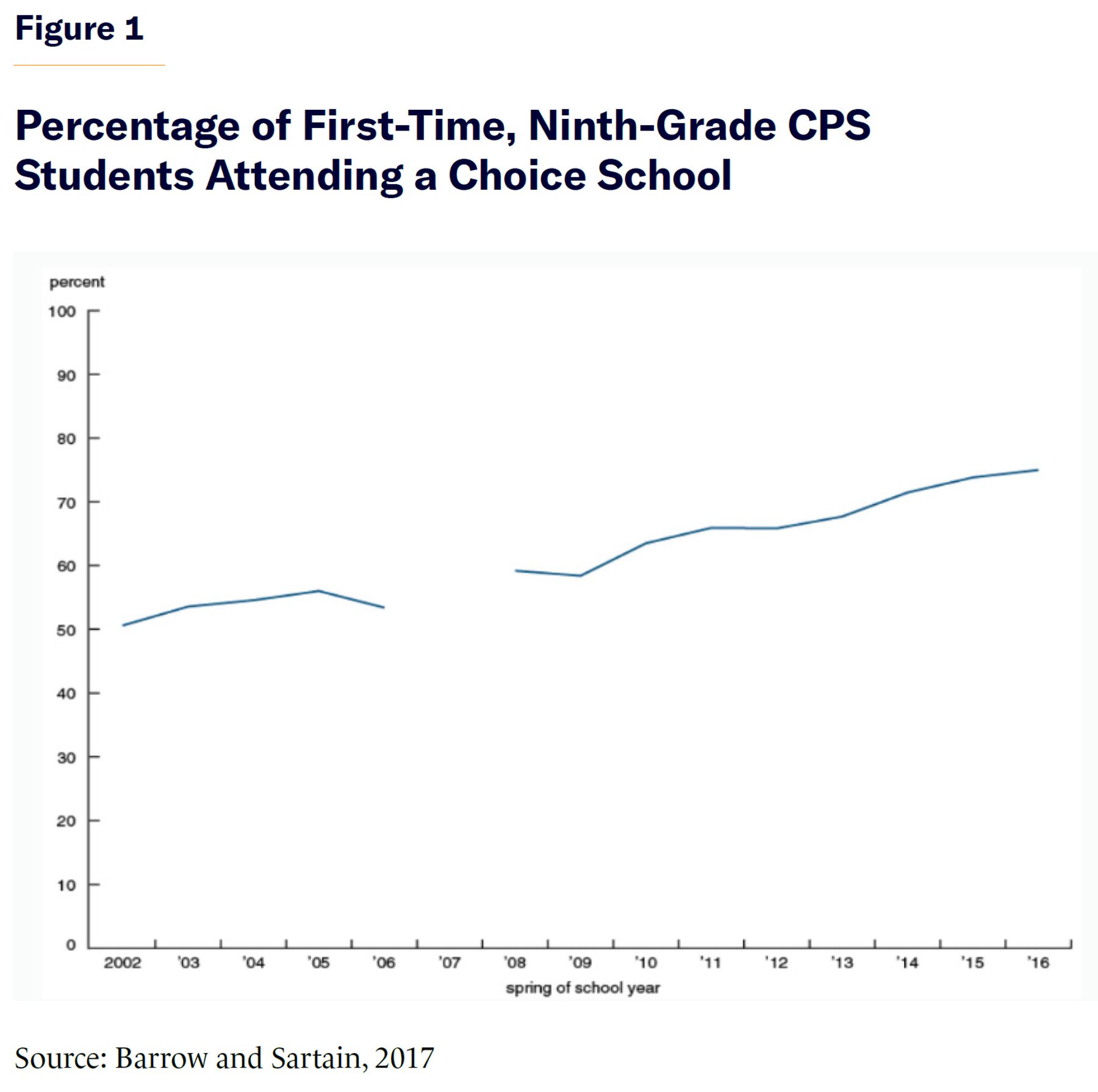
CPS families unequivocally support school choice, but that has not stopped some lawmakers and the Chicago Teachers Union (CTU) from trying to replace the district’s open enrollment system with one that confines students to their neighborhood schools. These efforts intensified in December 2023, when the Chicago Board of Education—whose members were, at the time, all appointed by Mayor Brandon Johnson—approved a resolution encouraging CPS to “transition away from privatization and admissions/enrollment policies and approaches that further stratification and inequity in CPS and drive student enrollment away from neighborhood schools.”[5] The resolution referred to the district’s choice model as “an under-resourced system that has pitted schools against each other and has had the effect of sorting students based on performance outcomes and selective admissions criteria, which ultimately reinforces, rather than disrupts, cycles of inequity.”[6]
In September 2024, the Board of Education officially passed a five-year plan to eliminate the district’s open enrollment system. The plan stated: “Equity demands that we make investments to ensure that all students have equal opportunity to succeed. To carry out our commitment, we will forge deeper partnerships with our communities and empower them to set the course for their neighborhood schools.”[7]
Allocation of school resources in Chicago is based, in part, on enrollment numbers. Thus, a plan that requires greater enrollment at neighborhood schools will result in fewer resources, or even closure, for the city’s selective enrollment high schools.[8]
In response to the board’s actions, the Illinois House of Representatives passed House Bill (HB) 0303 on April 11, 2024, which forbade CPS from closing any school until February 1, 2027, at which point all members of the board will be elected, rather than appointed by the mayor. The bill was the product of a long-standing legislative effort to remove mayoral control of CPS, which was finally accomplished by Governor J. B. Pritzker in 2021 in subsequent legislation (Senate Bill 15), and endorsed by CTU.[9]
The original version of HB 0303 prohibited the district from closing selective enrollment schools only. However, Democratic State Representative Margaret Croke, the bill’s sponsor, extended the moratorium on school closures to all schools after facing backlash from CTU. “We have a duty to protect the schools from irreversible damage until we have a fully elected school board that will have to be accountable to the voters of Chicago as well as the parents and families,” she said in an interview. CTU had called both Croke and the original version of her bill “racist—” claims that the state representative vehemently denied.[10]
While the Illinois House of Representatives passed HB 0303 by a vote of 98–2, the legislation stalled in the state senate. Indeed, in the final hours of the 2024 legislative session, Illinois Senate President Don Harmon declined to bring Croke’s bill to the floor.[11]
Harmon seemed to have succumbed to pressure from Mayor Johnson, who, like CTU, opposed HB 0303. In a letter urging Harmon not to call the bill to a final vote, Johnson said that the measure “seeks to solve problems that do not exist.”[12] Governor Pritzker, an ally of Croke, had previously expressed support for the bill and likely would have signed it, had it passed the state senate. When CTU accused Croke and HB 0303 of racism, he said: “That kind of criticism is uncalled for, and especially about the bill that was being discussed and about the person who was leading the bill. We don’t need that.”[13] Croke, who has represented Illinois’s 12th District since 2021, served on Pritzker’s transition team and was the statewide Women’s Outreach Director for his 2018 gubernatorial campaign.[14]
Since the end of Illinois’s 2024 legislative session, no other legislation to protect Chicago’s selective enrollment schools from the Board of Education and CTU has been introduced. However, the issue remains live and high stakes. The upcoming November 2026 school board elections will offer voters a clear choice: the election of a board opposed to choice and open enrollment could result in the dismantling of the city’s selective enrollment high schools.
A Brief History of Chicago’s Selective Enrollment High Schools
Chicago is currently home to 11 selective enrollment high schools:[15] Gwendolyn Brooks College Preparatory Academy (Brooks), John Hancock College Preparatory High School (Hancock), Jones College Prep High School (Jones), Dr. Martin Luther King Jr. College Preparatory High School (King), Lane Tech College Prep High School (Lane), Lindblom Math and Science Academy (Lindblom), Northside College Preparatory High School (Northside), Walter Payton College Preparatory High School (Payton), South Shore International College Preparatory High School (South Shore International), George Westinghouse High School (Westinghouse), and Whitney M. Young Magnet High School (Young).[16]
Admission to the city’s selective enrollment high schools is determined by a student’s final seventh-grade report card and score on the CPS High School Admissions Test (HSAT). Each Chicago household is assigned a socioeconomic tier from 1 to 4, with 1 representing lower-income areas and 4 representing higher-income areas. Applicants to the selective enrollment high schools compete for a seat against other students within their tier. The city awards 30% of seats based on citywide academic performance, and the remaining 70% of seats are distributed among tiers.[17] CPS’s tier system was introduced in 2009 by then-CEO Ron Huberman, who admitted that the tiers were racial proxies.[18]
Lane, originally an all-boys’ manual training school, became Chicago’s first selective enrollment high school in 1958. At the time, there was widespread concern that the U.S. was not producing enough scientists and engineers, which led CPS officials to create a high school aimed at training “budding scientists.” Accordingly, Lane looked to admit only “the students that would make the greatest contribution to American science.” It went coed in 1971.[19]
Four years later, the city’s second selective enrollment high school, Young, was founded as part of then-Superintendent James Redmond’s plan to get CPS families to voluntarily desegregate by opening magnet schools. Redmond, according to a report from WBEZ Chicago, believed that “the only way to spur school integration in a segregated city was to entice white families to send their children to schools with black children.”[20]
In 1980, Chicago was placed under a federal consent decree requiring further integration of its public schools. As part of the order, CPS agreed to set racial quotas for selective enrollment schools. Not until 2009 were these quotas and the consent decree lifted, when a judge acknowledged “the difficulties in desegregating a school system where the white population is only 8%—less than half of what it was when the order went into effect.”[21]
The number of selective enrollment high schools in Chicago rose sharply during the period of the consent decree. Paul Vallas, appointed the first-ever CEO of CPS by Mayor Richard M. Daley,[22] converted four existing public high schools—King, Lindblom, Jones, and Brooks—into selective enrollment schools and built two more, Northside and Payton.[23] He saw selective enrollment high schools as a way to keep high-performing students and their families from leaving CPS for the suburbs or private school.[24]
Other selective schools opened after the end of the decree. Two additional selective enrollment high schools, Westinghouse and South Shore International, opened between 2009 and 2011, largely at the request of black and Hispanic Chicagoans. In 2015, then-Mayor Rahm Emanuel converted Hancock, a neighborhood school, into the city’s 11th selective enrollment high school.[25]
The history of Chicago’s selective enrollment high schools disproves the myth, propagated by progressive lawmakers and CTU, that these institutions are rooted in racism and are attractive only to white families. With the exception of Lane, the selective schools were created to integrate CPS and encourage high-performing students of all racial and ethnic backgrounds to remain within the district. Chicagoans called for the creation of Westinghouse, for example, because at the time, there was no such school on the city’s West Side, which is predominantly black and Hispanic. In a similar vein, community activists in South Shore, a majority-black neighborhood, pushed to have South Shore International converted into a selective enrollment school because most of the neighborhood’s students were opting to attend high school elsewhere.[26] Today, more than two-thirds of students enrolled in Chicago’s 11 selective enrollment high schools are black or Hispanic.
Comparative Analysis
Widespread evidence shows that selective enrollment high schools benefit academically gifted CPS students, including those who are black, Hispanic, or low-income. The same cannot be said for the district as a whole, as the Illinois Board of Education’s data reveal. Tables 1–3 show the 2025 demographic breakdown of the eight selective enrollment high schools ranked among Illinois’s top 25 schools, as well as the black–white, Hispanic–white, and non-low-income–low-income achievement gaps in 11th-grade ACT English and math scores at these schools. The last row of each table lists the achievement gaps for black, Hispanic, and low-income 11th-graders in CPS generally.
Table 1
2025 11th-Grade Black–White ACT Achievement Gaps in CPS Selective Enrollment High Schools
| Selective Enrollment High School | Percentage of Black Students | 11th-Grade Black–White Achievement Gap: ACT English | 11th-Grade Black–White Achievement Gap: ACT Math |
| Brooks | 78.7 | — | — |
| Hancock | 1.3 | — | — |
| Jones | 12.7 | –24.9 | –51.0 |
| Lane | 7.4 | –18.1 | –28.4 |
| Lindblom | 66.3 | — | — |
| Northside | 6.0 | –14.3 | –27.6 |
| Payton | 9.3 | –12.6 | –6.9 |
| Young | 18.5 | –19.0 | –32.1 |
| CPS | 34.2 | –51.3 | –53.1 |
Source: Illinois Board of Education, Illinois Report Card
Note: — = data unavailable
Due to low enrollment of white students at Brooks (2.1% ) and Lindblom (2.6%) and black students at Hancock (1.3%), black–white achievement gaps in ACT English and math scores for these schools were not reported. However, the remaining five schools show gaps in ACT English and math considerably smaller than the district. The average 11th-grade black–white achievement gap in ACT English for these selective enrollment high schools is –17.8 percentage points (vs. –51.3 for CPS), while that in ACT math is –29.2 percentage points (vs. –53.1 for CPS).
Table 2
2025 11th-Grade Hispanic–White ACT Achievement Gaps in CPS Selective Enrollment High Schools
| Selective Enrollment High School | Percentage of Hispanic Students | 11th-Grade Hispanic–White Achievement Gap: ACT English | 11th-Grade Hispanic–White Achievement Gap: ACT Math |
| Brooks | 17.9 | — | — |
| Hancock | 89.3 | –2.7 | –19.8 |
| Jones | 34.0 | –7.3 | –15.2 |
| Lane | 35.4 | –11.3 | –17.9 |
| Lindblom | 29.0 | — | — |
| Northside | 28.3 | –9.5 | –26.0 |
| Payton | 26.1 | –12.1 | –16.3 |
| Young | 27.6 | –11.3 | –12.6 |
| CPS | 47.4 | –37.3 | –42.7 |
Source: Illinois Board of Education, Illinois Report Card
Note: — = data unavailable
Again, due to the limited share of white students, Hispanic–white achievement gaps in ACT English and math scores were not reported for Brooks and Lindblom. Yet here, too, the remaining schools show much smaller achievement gaps than the district at large. The average 11th-grade Hispanic–white achievement gap in ACT English for these selective enrollment high schools is –9.0 percentage points (vs. –37.3 for CPS), while that in ACT math is –18.0 percentage points (vs. –42.7 for CPS).
Table 3
2025 11th-Grade Low-Income–Non-Low-Income ACT Achievement Gaps in CPS Selective Enrollment High Schools
| Selective Enrollment High School | Percentage of Low-Income Students | 11th-Grade Low-Income–Non-Low-Income Achievement Gap: ACT English | 11th-Grade Low-Income–Non-Low- Income Achievement Gap: ACT Math |
| Brooks | 59.0 | –5.7 | –1.6 |
| Hancock | 64.6 | –6.2 | –6.3 |
| Jones | 37.3 | –7.3 | –8.7 |
| Lane | 35.0 | –9.3 | –14.4 |
| Lindblom | 57.7 | –3.3 | –21.9 |
| Northside | 36.2 | –6.2 | –17.2 |
| Payton | 33.0 | –5.1 | –6.3 |
| Young | 33.0 | –13.0 | –11.1 |
| CPS | 73.8 | –31.6 | –30.5 |
Source: Illinois Board of Education, Illinois Report Card
At least 33% of students at each of these eight selective enrollment high schools are low-income; across all selective schools, 44.5% of students are low-income. The Illinois Board of Education considers a student to be “low-income” if the student is eligible to receive free or reduced-price lunch, lives in substitute care, or is from a family that receives public aid. In CPS schools, the low-income–non-low-income 11th-grade achievement gap in ACT English is –31.6 percentage points, and in ACT math, –30.5 percentage points; in selective schools, by contrast, the average gaps are only –7.0 (English) and –10.9 (math) percentage points, respectively. Contrary to what progressive critics of these schools allege, they seem to help, rather than harm, black, Hispanic, and low-income students.
Moreover, black and Hispanic students account for a significant share of enrollment in CPS’s top selective enrollment high schools. White and Asian American students are often a minority in these institutions, as shown in Table 4.
Table 4
2025 Racial Demographics of CPS Selective Enrollment High Schools
| Selective Enrollment High School | Share of Black and Hispanic Students | Share of White Students | Share of Asian American Students |
| Brooks | 96.6 | 2.1 | — |
| Hancock | 90.6 | 6.9 | — |
| Jones | 46.7 | 28.6 | 19.8 |
| Lane | 42.8 | 41.0 | 10.8 |
| Lindblom | 95.3 | 2.6 | — |
| Northside | 34.3 | 35.1 | 23.4 |
| Payton | 35.4 | 31.9 | 27.7 |
| Young | 46.1 | 24.0 | 24.8 |
| CPS | 81.6 | 11.3 | 4.7 |
Source: Illinois Board of Education, Illinois Report Card
Note: — = data unavailable (Redacted)
Allegations that Chicago’s selective enrollment high schools harm black, Hispanic, and low-income students are refuted by data from the Illinois Board of Education. Not only do these students represent a sizable percentage of the selective schools’ student bodies; they also experience smaller ACT achievement gaps in English and math, compared with students systemwide.
Per-Student Spending: Selective Enrollment High Schools Versus CPS
Do black, Hispanic, and low-income students at Chicago’s top selective enrollment high schools fare better academically than those in other CPS schools because the selective schools spend more per student? No.
The average spending per student at the top eight selective enrollment high schools—those that rank among the top 25 schools in Illinois—is lower than average spending per student in CPS.[27]
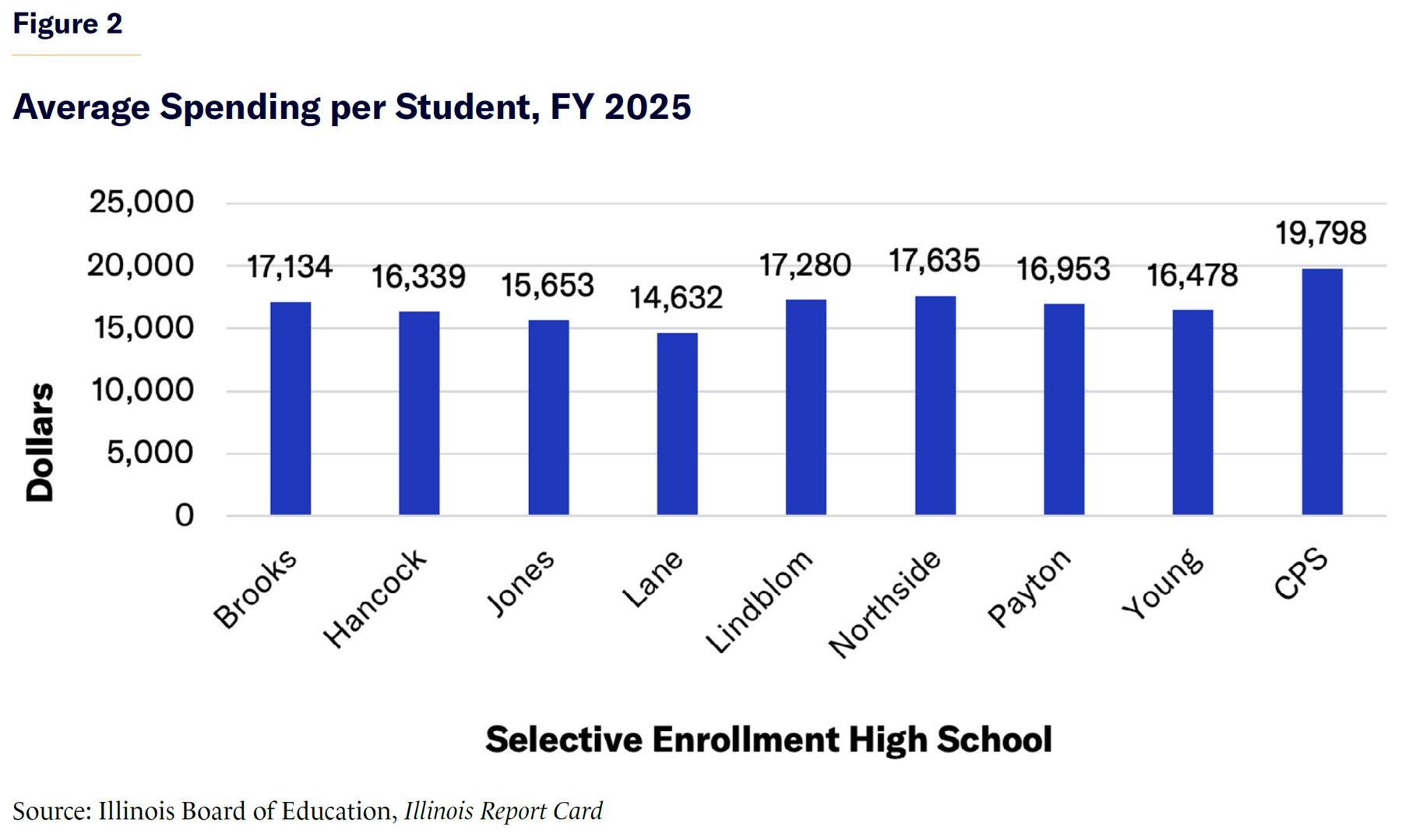
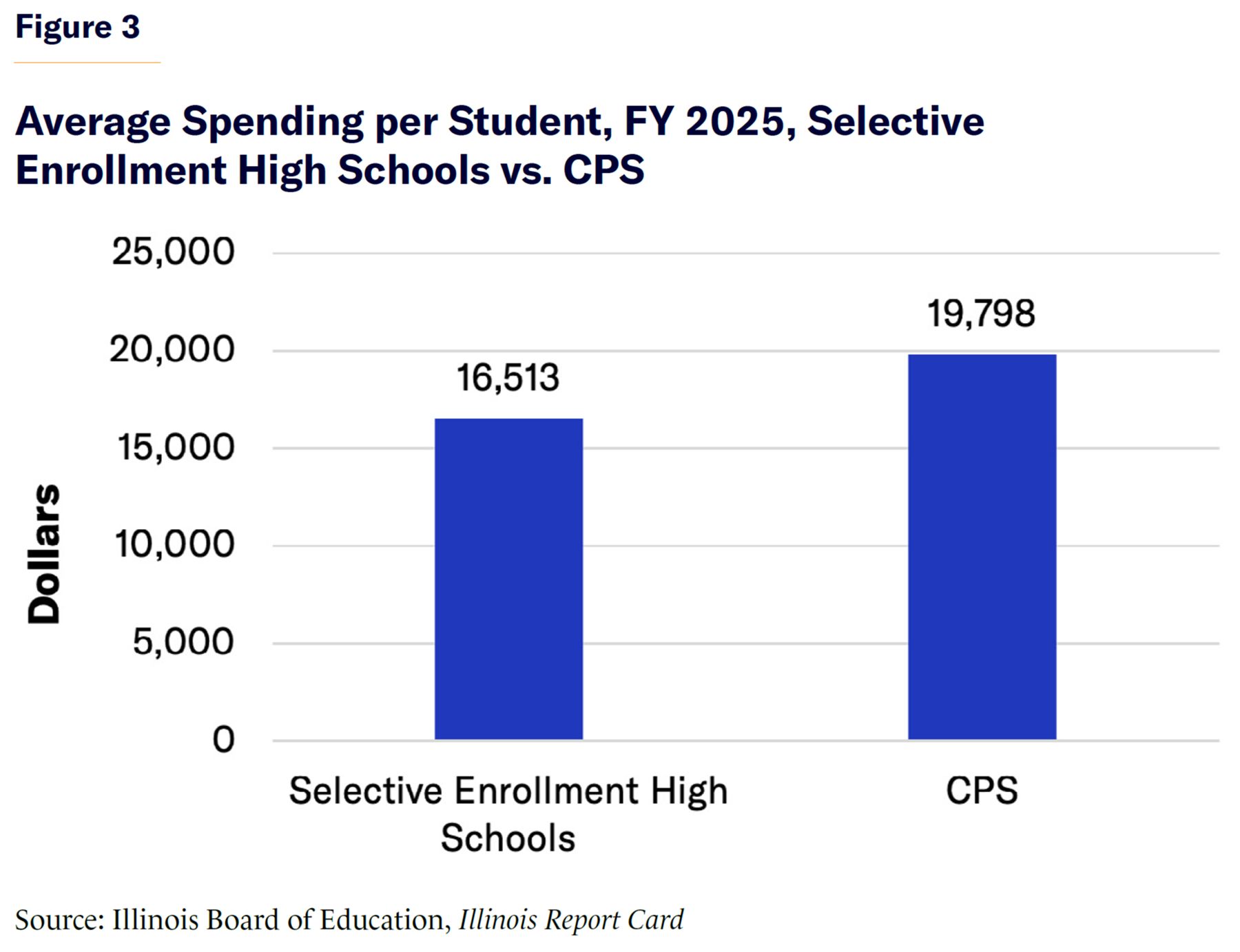
In 2025, CPS spent, on average, $3,285 more per student than its top eight selective enrollment high schools. But as detailed above, the district performed markedly worse in terms of ACT achievement gaps in English and math for black, Hispanic, and low-income students. Substantial per-student spending does not automatically translate to student success or to reduced achievement gaps.
Conclusion
Because Asian American and white students are “overrepresented” at selective enrollment high schools relative to their share of the population, progressive lawmakers across the country insist that these schools are racist against blacks, Hispanics, and other “underrepresented” minorities.[28]
This narrative ignores two central questions: Do families in cities that have selective enrollment high schools, such as Boston, New York City, and Chicago, want choice when it comes to their children’s education? And do these selective schools reduce the achievement gap for black, Hispanic, and low-income students?
Given that over 75% of high school students in Chicago choose to attend a school other than the one in their neighborhood, it is clear that Windy City families value choice, including the choice of attending a selective enrollment high school. This follows national trends, particularly among black parents. A March 2023 poll conducted jointly by EdChoice and Morning Consult found that 78% of black parents support open enrollment.[29] Similarly, a February 2024 poll of middle- to low-income black single mothers noted that six in 10 strongly agreed that they were more likely to support a candidate who pledged to give parents greater choices in where their children can go to school, while 87% rejected a “one-size-fits-all” approach to education.[30] These results reflect the history of Chicago’s selective enrollment high schools, which were founded not to keep disadvantaged students down, as progressives and the CTU maintain, but to provide them with choices and to help them flourish.
Data from the Illinois Board of Education prove that selective high schools have succeeded in this mission. Black–white, Hispanic–white, and low-income–non-low-income achievement gaps in ACT English and math are, on average, significantly smaller at the city’s top eight selective enrollment high schools than at CPS overall. This is all the more impressive, given that low-income students, who are disproportionately black and Hispanic, are advantaged in the admissions process for these via the tier system. Better still, these schools spend thousands of dollars less per student than the district does.
Chicago’s Board of Education should close only the schools that produce poor results and are costly. The eight selective enrollment high schools that rank among Illinois’s top 25, in contrast, are treasured by, and represent a lifeline to, academically gifted students stuck in a failing district. They ought to be left alone.
Endnotes
Photo by Scott Olson/Getty Images
Are you interested in supporting the Manhattan Institute’s public-interest research and journalism? As a 501(c)(3) nonprofit, donations in support of MI and its scholars’ work are fully tax-deductible as provided by law (EIN #13-2912529).