Good morning:
This week, City Journal investigative reporters took to the streets of Los Angeles to hear the origin stories of homeless people living in Hollywood, Venice, and Skid Row. Two-thirds of them, it turned out, come from somewhere other than the City of Angels. Like everyone, the homeless respond to incentives. The people Christopher F. Rufo and Kenneth Schrupp interviewed “flock to places where it is easy to camp, do drugs, and commit crimes, and where the government provides housing, benefits, and drug paraphernalia,” they wrote. If Los Angeles officials want to solve their city’s homelessness crisis, the incentives and benefits that have turned many streets into open-air homeless encampments will have to change.
In New York City, Department of Transportation officials are pushing a different set of incentives and penalties on their streets. Major arteries and side streets are set to be “narrowed, rerouted, or stripped of lanes” to reduce the number of cars on the road, writes Wai Wah Chin in the New York Post. This policy change is happening over the objections of firefighters, who point out that narrowed lanes can slow the response of emergency vehicles, and over the protests of residents, who argued additional bike lanes in their neighborhoods will eliminate the curbs senior citizens rely on for mobility and independence. Increasingly, DOT policies seem driven by ideological opposition to cars rather than a reasoned weighing of tradeoffs and transportation methods.
Similarly, objections to the Spirit Airlines’s planned merger with JetBlue had more to do with reflexive opposition to corporate mergers than a thoughtful approach to affordability in the airline industry. As Jarrett Dieterle writes in the Daily Wire, a stronger Spirit Airlines would have taken market share from the four major airlines and pushed overall costs for consumers down. Instead, Spirit Airlines has collapsed, tens of thousands of passengers lost their flights, and 17,000 people are out of a job.
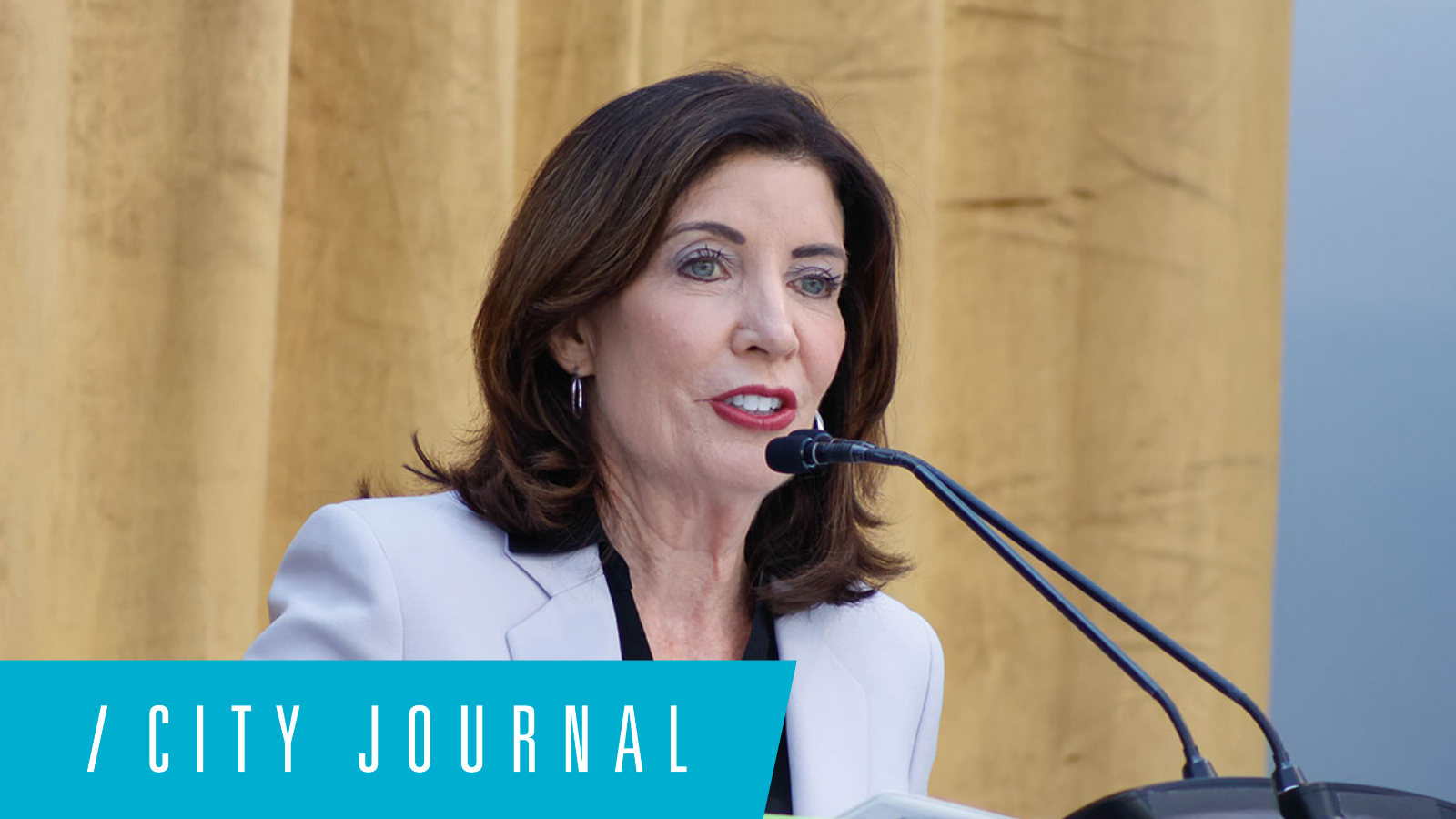
There is good news in the Long Island Rail Road strike, however. A work stoppage on the nation’s busiest transit system could have been disastrous, writes Ken Girardin in City Journal. But New York Governor Kathy Hochul did well to call the strike “reckless” and immediately stress the facts, the stakes, and the public’s interest in seeing a settlement that favored LIRR’s management rather than its union. Though full details of the new agreement are not yet released, Girardin shows how the governor seems to have avoided a much worse outcome for New Yorkers.
Finally, in a new paper for the Manhattan Institute, Alex Adams of the U.S. Department of Health and Human Services shows that “regulatory dark matter”—the technically nonbinding guidance and instructions that nevertheless are extremely influential in the running of a government agency—thrives when no one is paying attention to it. Adams uses his experience at his agency to show that regulations can be tamed. His paper is a guide for other administration officials to clear out the accumulated debris and detritus weighing down their agencies.
Continue reading for all these insights and more. Kelsey Bloom Editorial Director |
|
|
|
Bringing Regulatory Dark Matter to Light: A Case Study of Reform at the Administration for Children and Families (ACF)
By Alex J. Adams | Manhattan Institute | Photo by Simple Images via Getty Images
Federal agencies often govern not just through formal regulations but through informal, nonbinding guidance documents that shape audits, funding decisions, and compliance expectations. These directives tend to accumulate over time, leading to a phenomenon that some scholars call “regulatory dark matter.” In a new Manhattan Institute issue brief, Alex J. Adams examines an effort to reform this system at the Administration for Children and Families (ACF), a major HHS grantmaking agency.
Before reform, ACF maintained more than 4,100 guidance documents totaling nearly 56,000 pages—over 61 pages of informal guidance for every page of formal regulation. Much of the material was outdated or redundant.
Adams describes how ACF undertook a sweeping effort to identify, review, and reduce this “regulatory dark matter.” Applying a presumption of obsolescence, the agency ultimately eliminated roughly three-quarters of its guidance documents, many of which were outdated, redundant, or tied to expired programs. The reforms also established ongoing review procedures and transparency measures designed to prevent the unchecked re-accumulation of guidance in the future. |
|
|
Spirit’s Collapse Shows Why Bigger Companies Aren’t Always a Bad Thing
By Jarrett Dieterle | Daily Wire | Photo by Rebecca Noble/Getty Images
“A combined Spirit-JetBlue company, as the fifth-largest carrier, may have posed more of a competitive threat to the nation’s ‘Big Four’ airlines: Delta, United, American, and Southwest. Those airlines control around 75% of the market, which means a Spirit-JetBlue merger could have increased, rather than decreased, competition. ...
“In other words, in terms of creating competition in the industry, a slightly-less-cheap-but-still-existing Spirit-JetBlue combo airline is better than a super-cheaper-but-no-longer-existing solo version of Spirit. ...
“Larger companies are not always a bad thing. Two slightly-less-dominant companies — those that rank fourth or fifth on the list of industry players — can sometimes combine to create more significant competition for those higher up the totem pole. When such mergers are blocked, the result can be a less competitive and less affordable marketplace.
“The reasons behind Spirit’s collapse are multifaceted. But one lesson can be learned for sure: It’s time to put to bed the progressive antitrust fixation that larger companies are always bad.” |
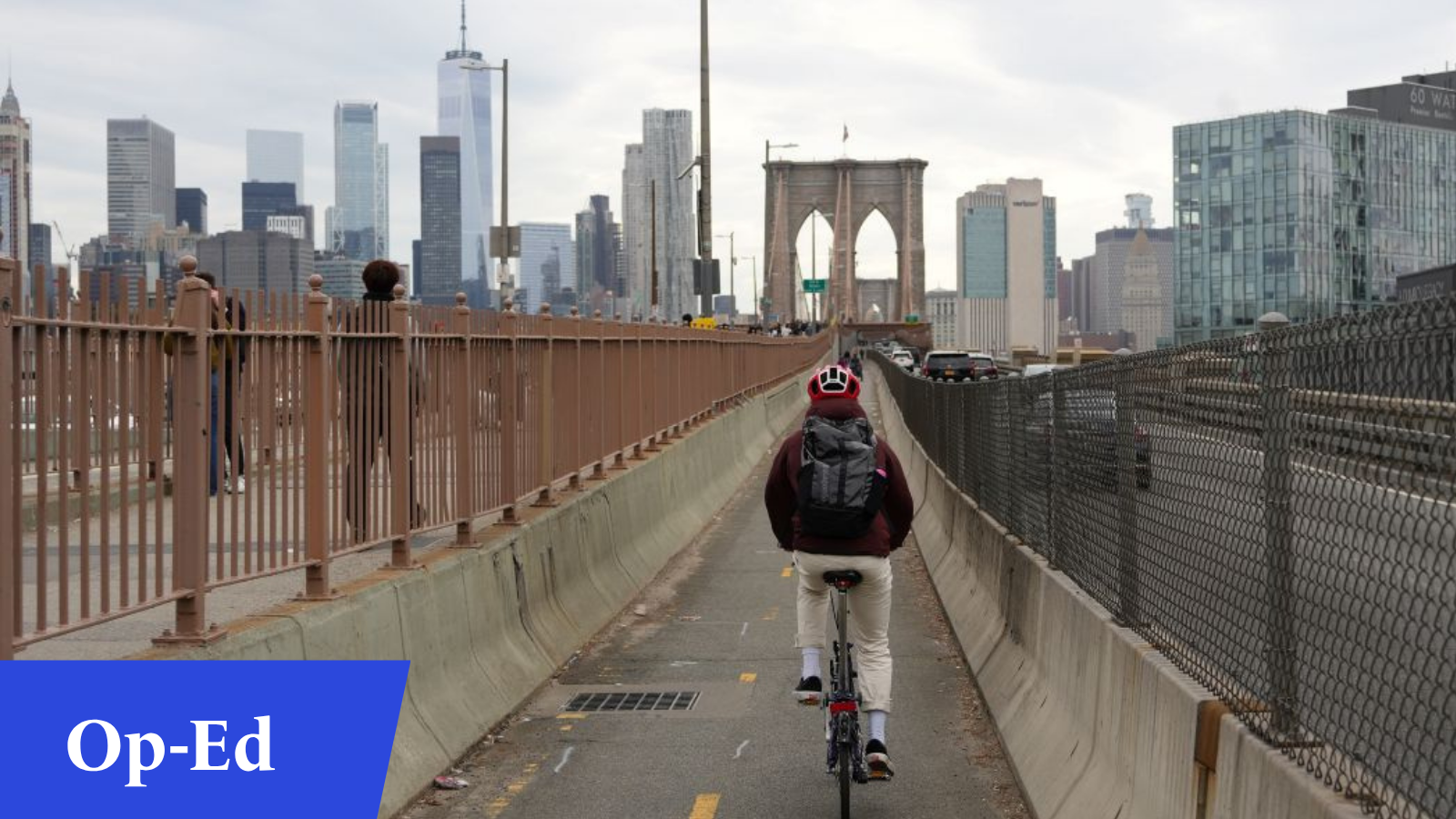
Gotham’s Tyrannical ‘Bike Kings’ Are Taking Over the City
By Wai Wah Chin | New York Post | Photo by Liao Pan/China News Service/VCG via Getty Images
“Let’s be clear. New Yorkers like bikes. Four wheels good, two wheels better. Bike lanes can be great assets, so long as they’re not at the expense of pedestrians or drivers. ... But that balance is exactly what’s missing across much of the city.
[Department of Transportation]’s ‘bike kings’ have turned street design into an ideological exercise, where the goal is not better mobility — but fewer cars, period. ... City Hall increasingly treats the removal of vehicle space as a good in itself. And the people pushing hardest for these changes are often the least affected by them — professionals who can work from home, avoid peak travel or simply absorb the inconvenience.
“Ironically, DOT is one of the top three agencies responsible for misused city-issued parking placards. They want you to take the bus while they park wherever they want. New York doesn’t need streets designed to conform to the cyclist ideology. It needs streets that make possible greater circulation, commerce and access.” |
|
|
Hayek Book Prize and Lecture By Manhattan Institute We are pleased to announce that Sean McMeekin has been awarded the 22nd annual Hayek Book Prize for his book To Overthrow the World: The Rise and Fall and Rise of Communism (Basic Books, 2025).
Mr. McMeekin will receive a $100,000 award and deliver the annual Hayek Lecture in New York City on June 4. We also extend our congratulations to the other finalists. |
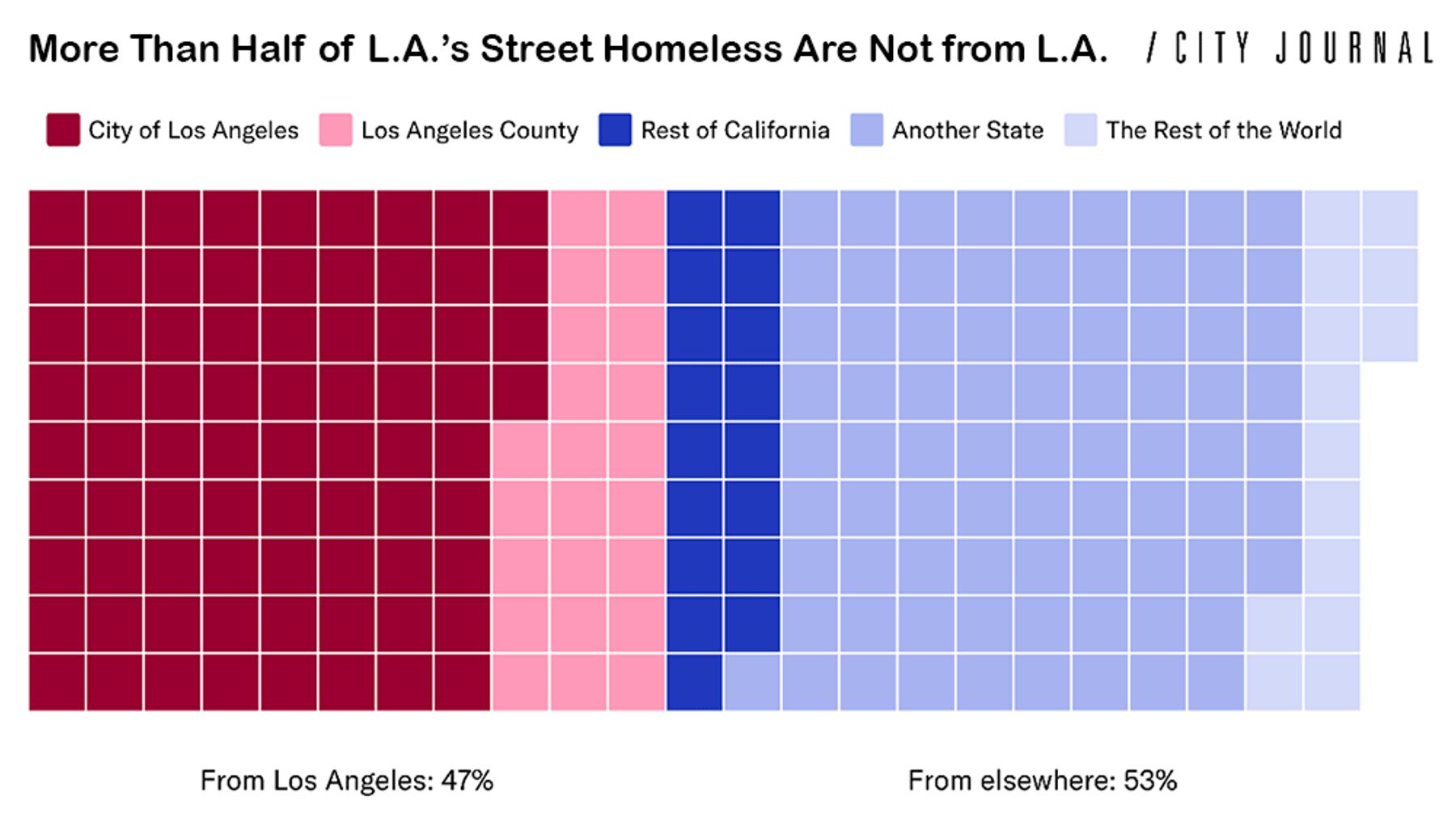
More Than Half of L.A.’s Street Homeless Are Not from L.A.
By Christopher F. Rufo & Kenneth Schrupp | City Journal | Photo by Apu Gomes/Getty Images
“Los Angeles hosts the nation’s largest unsheltered homeless population. In recent years, despite billions in city and county spending, L.A.’s once-pristine streets have become littered with tents, drugs, and feces. City leaders have made elaborate promises about managing the homeless problem, but few seem to have asked a simple question: Where, exactly, are these people coming from? ... “We approached people on the streets of the same three neighborhoods—Hollywood, Venice, and Skid Row—and, after identifying ourselves, asked more than 200 homeless a simple question: ‘Where are you from, originally?’
“The results were astounding: 64 percent of the L.A. street homeless said they were from outside the City of Los Angeles, and 53 percent said they were from outside Los Angeles County. ... Nearly 40 percent told us they were from other states, mostly from states that voted for President Trump in 2024. Six percent told us that they were from other countries, including Cuba, Venezuela, and North Korea. ...
“The implications of our survey are clear: just building housing won’t solve Los Angeles’s homelessness problem. The wrong kind of housing program might even make it worse. Giving more homeless people a permanent home, with no strings attached, simply inspires nonresidents to come here.” |
Hochul’s Measured Victory in the LIRR Strike
By Ken Girardin | City Journal | Photo by Kena Betancur/Getty Images
“The Long Island Rail Road strike of 2026 is over. The railroad, part of the Metropolitan Transportation Authority, is a New York state agency under the de facto control of Governor Kathy Hochul. For three-and-a-half days, five of the system’s unions refused to work until their contract demands were met. The exact cost and details of the deal that brought the roughly 3,500 workers back on the job are not yet available, but so far, it seems Hochul can claim at least a modest victory. ...
“The work stoppage posed two tests for Hochul. The first involved whether she was willing to risk a strike. She passed. ... The thorniness of the problem explains why standing up to the strike took some backbone. Threatened by a preelection walkout in 2014, Governor Andrew Cuomo capitulated to avert a strike. Hochul did not. ... “Now that an agreement has been signed, Hochul faces her second test: the price that she will ask taxpayers and riders to pay for labor peace.” |
|
|
Who We Are: On Therapy (with Abigail Shrier) By Manhattan Institute What does it take to write books that make the establishment uncomfortable — and keep writing them anyway?
Manhattan Institute senior fellow, contributing editor at The Free Press, and one of the most consequential voices in American cultural journalism today, Abigail Shrier and Rafael Mangual sit down for an insightful conversation. The author of two national bestsellers, "Irreversible Damage" and "Bad Therapy," Shrier has spent years investigating what's gone wrong in the institutions raising and treating America's children — and why so few were willing to say it. They discuss Shrier's intellectual journey, the ideas and experiences that shaped her worldview, her work challenging the medical and therapeutic establishment, and what it means to pursue truth in an era when the cost of doing so has never felt higher. |
|
|
For more information and media requests, please contact
communications@manhattan.institute.
Are you interested in supporting the Manhattan Institute’s public-interest research and journalism? As a 501(c)(3) nonprofit, donations in support of MI and its scholars’ work are fully tax-deductible as provided by law. |
|
|
|
Photo Credits: adamkaz/E+/Getty Images; Noah Berger/AP Photo; Anadolu/Getty Images; Wong Yu Liang/Getty Images; Catherine McQueen/Getty Images; Probal Rashid/LightRocket/Getty Images |
|
|
The Manhattan Institute works to keep America and its great cities
prosperous, safe, and free. Manhattan Institute 52 Vanderbilt Ave. 3 floor New York, New York 10017
Want to change how you receive these emails?
Unsubscribe | Subscription Preferences
Copyright © 2026 Manhattan Institute, All rights reserved. |
|
|
|
|