Paying for Results: Rethinking NGO Procurement Through Performance-Based Models

Photo: SolStock / E+ via Getty Images
Introduction
In New York City, human-services contractors, mostly nonprofit organizations, deliver a vast array of services to residents. These services, ranging from homeless shelters to senior care, come at an immense cost. They made up approximately $8 billion in city spending in fiscal year 2024 alone.[1] In contrast, the entire NYPD budget is $5.8 billion.[2] That these services incur high costs does not reflect a high demand for these services, but it is a reflection of the fact that the current system’s “carte blanche” model is unworkable. The city identifies a social-services gap, invites NGOs to bid, and—after a lengthy approval process—allocates a fixed budget to the selected vendor. Payments in this model are cost-based: NGOs front expenses for materials and staffing, and then submit for reimbursement.
The fundamental flaw of cost-based funding is that it pays organizations for spending, not for achieving results. An NGO can exhaust its entire budget without making any meaningful impact and still receive full reimbursement. There is little incentive, therefore, to deliver outcomes or drive down the cost to the taxpayer. The consequences compound over time: NGOs receive funding with minimal accountability; when problems persist, city officials respond by allocating more money.
At the same time, the cost-based approach requires extensive administrative oversight to prevent fraudulent reimbursements, which spawns a bureaucratic cascade where the NGOs prioritize regulatory compliance.
The problems with cost-based contracting can be summed as follows:
- Little incentive to be cost-effective
- Continued cash flow, even when goals are not met
- Self-imposed need for administrative oversight to ensure that reimbursements are not fraudulent
- The cost-based model creates a paradox: it generates both the inefficiency and the bureaucratic apparatus designed to control it.
This brief recommends that NYC transition from a cost-based model to a hybrid performance-based model and uses several case studies to illustrate the method. The new model will focus on incentivizing timely and efficient performance from the outset, thereby reducing the need for bureaucratic oversight, while also creating built-in systems of accountability to minimize fraud and waste.
The Contracting Process: Compliance over Performance
The purpose of NYC’s multilayered procurement and payment review processes is to prove that NGOs are reliable and legitimate recipients of taxpayer funding and that the funds are utilized for real material and services. Without such multilayered review, the risk of misallocation of funds, inflated costs, or payment for services not rendered would significantly increase. However, the current process prioritizes box-checking and administrative paperwork over efficient, cost-effective delivery of services.
The contracting process demands intricate coordination between city agencies and the contracted vendors. The primary characters in any procurement are the vendor; the city agency that seeks to contract with a vendor; the Agency Chief Contracting Officer (ACCO), who is responsible for directing and managing agency procurement activities, including overseeing the contract; the Mayor’s Office of Contract Services (MOCS), an oversight and service agency; the Mayor’s Office of Management and Budget (OMB), which is responsible for assisting the mayor in developing and implementing the city’s budget; the Department of Small Business Services (SBS), which facilitates government procurement; the Department of Investigation (DOI), which serves as the city’s inspector general; and the Procurement Policy Board (PPB), which sets the rules governing the procurement of goods, services, and construction by the city. Secondary actors involved usually include the mayor, city council, or comptroller.
The procurement process is an arduous journey through various layers of oversight bottlenecking.[3] Various types of contracting include noncompetitive, competitive, and continuation. I will give an example of a competitive bid (called a “Request for Proposal,” or RFP). Competitive bids constitute about 41% of contract dollars and cost billions per year.[4]
Let us say that the NYC Department of Health wants to address drug addiction in the community. First, in the pre-solicitation process, NYC Health would examine the existing market to determine an estimated cost for a program. In our example, NYC Health determines that a typical cost for such a project is $20–$25 million. This determination must be made under the set of guidelines set forth by PPB.[5] Next, NYC Health staffers, together with ACCO, who has final approval, summarize the estimated costs and goals before the bidding process begins.
In the next phase, vendors review the information about the project and compete to bid on the contract. The agency staff ranks the vendors before coming to a determination of whom to award the contract to. At any point, MOCS may step in to revise the initial solicitation or insert another pick for the best bid.
After the agency selects a winning vendor, the contract is initiated in the PASSPort portal while ACCO begins to record “important details”about the vendor. The vendor must submit documentation that confirms its ability to provide the necessary service (in this example, addiction services). These documents are reviewed by NYC Health in PASSPort. The vendor is then subjected to a background check and must provide documentation regarding organization history, ownership, and services. Simultaneously, the NYC Health finance team ensures that funding is in place for each pending contract in PASSPort. This involves estimating annual costs for the full contract term, setting up the budget framework, assigning the right commodity codes to specify purchases, and allocating funds so that vendors can be paid. These steps must be approved by financial managers and the chief financial officer of the agency. Early input from OMB is often needed before its formal sign-off later in the process.
The contract is drafted and reviewed by the relevant legal teams, DOI, and SBS. Still, before work can begin, the contract must be reviewed by several entities to ensure compliance with PPB rules and local laws: the mayor’s office, the Financial Control Board, the City Law Department, and OMB. Sometimes the deputy mayor of the given agency must review the contract as well. This is the first approval.
Next, NYC Health staff must review all the approvals in PASSPort to assure compliance with PPB regulations. This is the second approval. If any signatures or documents from earlier in the process are missing, the contract is delayed.
After that, there is another approval process. ACCO must approve the approval of the approval before sending it to the comptroller’s office for a final review and—you guessed it—approval.
The comptroller’s Bureau of Contracts Administration (BCA) ensures that all necessary procedures and certifications have been completed, that the contract process was free from misconduct, and that the selected vendor is not debarred. BCA has 30 days to approve the contract. This is the only deadline in the contracting process. After the contract is in place and work begins, NYC Health can legally pay the vendor’s invoices and monitor the vendor’s performance and integrity throughout the project. NYC Health may also adjust certain terms later through the official modification process.
What is clear from this long process is that NYC’s current contracting process prioritizes compliance over performance and pays up-front for promises rather than results. Oversight bodies focus primarily on administrative, legal, and procedural compliance rather than cost-benefit efficiency. Their mandate is to ensure that contracts satisfy statutory, fiscal, and accountability requirements, not to verify whether they deliver services in the most cost-effective manner. Reviewers examine corporate documents, tax clearance, insurance, Vendor Information Exchange System (VENDEX) disclosures, and budget allocations. While performance history is nominally considered, administrative compliance dominates the evaluation, creating incentives that reward documentation, not delivery.
Even where “best value” contract bidding ostensibly prioritizes effectiveness, the 2020 amendments to PPB rules allowed women and minority-owned (M/WBE) status to factor into “best value” determinations.[6] This shifts the focus of procurement further away from demonstrated capability.
Fundamentally, the cost-based funding model inverts the logic of accountability. At the bidding stage, when funds are allocated, evaluators have only paperwork and projections. There is no operational track record for the specific contract to assess. Only after services begin can cost-effectiveness be meaningfully evaluated. Yet under the current model, the city has already committed to pay for inputs and credentials up-front, with limited ability to adjust based on actual performance. Therefore, there is no motivation for NGOs to charge less than the initial evaluation from ACCO. And, as long as an NGO can show that its legitimate work requires more funding, it will likely receive it.
This creates a structural misalignment: the moment when information is most complete (during service delivery) is after the moment when funding decisions have been locked in.
The current model essentially operates as an intent to pay, provided that there is compliance with rules and regulations. Using our example, if the vendor files the requisite paperwork with HHS and continues to provide regular updates that display legitimate operations, it will receive compensation regardless of whether residents are less addicted to drugs over time or not. At no point in the process is the question of results ever tied to funding.
Additional Delays
The current cost-based model results not only in repercussions to the taxpayer but to NGOs as well.
One of the most cumbersome aspects of the current model is the interagency coordination necessary to get a contract approved. As outlined above, vendors need the approval of at least five oversight committees from entirely different offices. Requiring multiple oversight is a main driver of bottlenecking in the contracting process.
This problem is magnified by a common secondary issue: budget modifications (Table 1). When a budget is modified, the vendor is locked out of PASSPort and unable to upload any new invoices for continued services—because in the cost-based model, every detail of the reimbursement must be verified. In many cases, the modified budget must be manually approved by many of the same oversight committees. As outlined in the comptroller’s report, “modifying a contract budget, even for modest changes to line items like rent or payroll, contributes significantly to payment delays, and often completely stops the flow of money to vendors. 85% of contracts with an approved FY 2025 budget have been modified at least once.”[7]
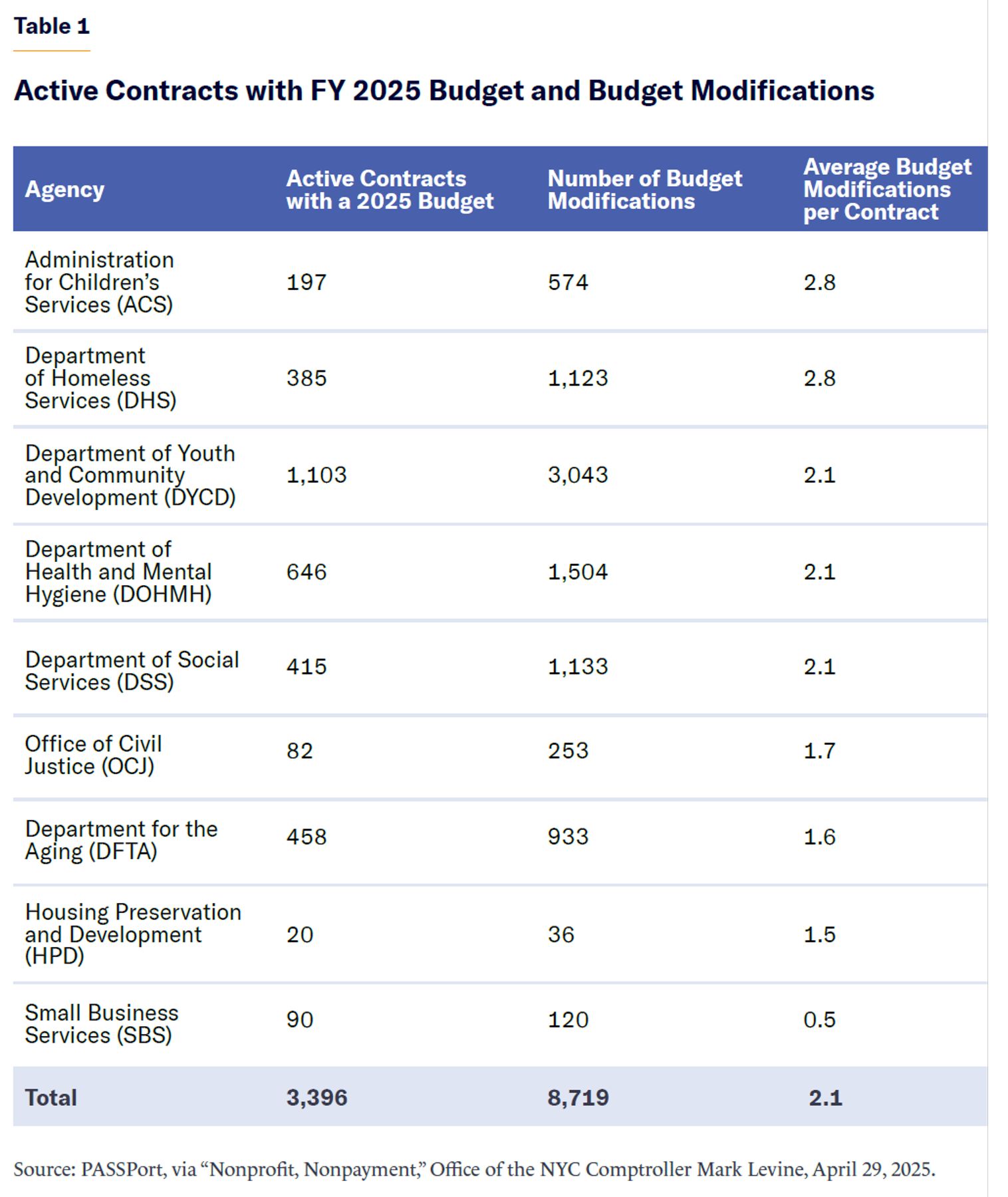
Despite being locked out of PASSPort and unable to send invoices, vendors continue to provide services, creating a backlog in payments. Furthermore, even if the vendor does not selectively modify the contract, if the cost of providing services exceeds 10% of the total approved budget, or if any single item cost exceeds 10% of the estimated cost in the original report, payment activity stops, necessitating a revised budget and another review cycle. For this reason, there is a gap between budget approval and invoice submission. In NYC, 93% of nonprofit contracts were approved for work as of March 2025, but only 54% had submitted invoices after that date.[8] This suggests an ambivalence about submitting invoices, as it involves the risk of further re-contracting and approval, despite work proceeding.
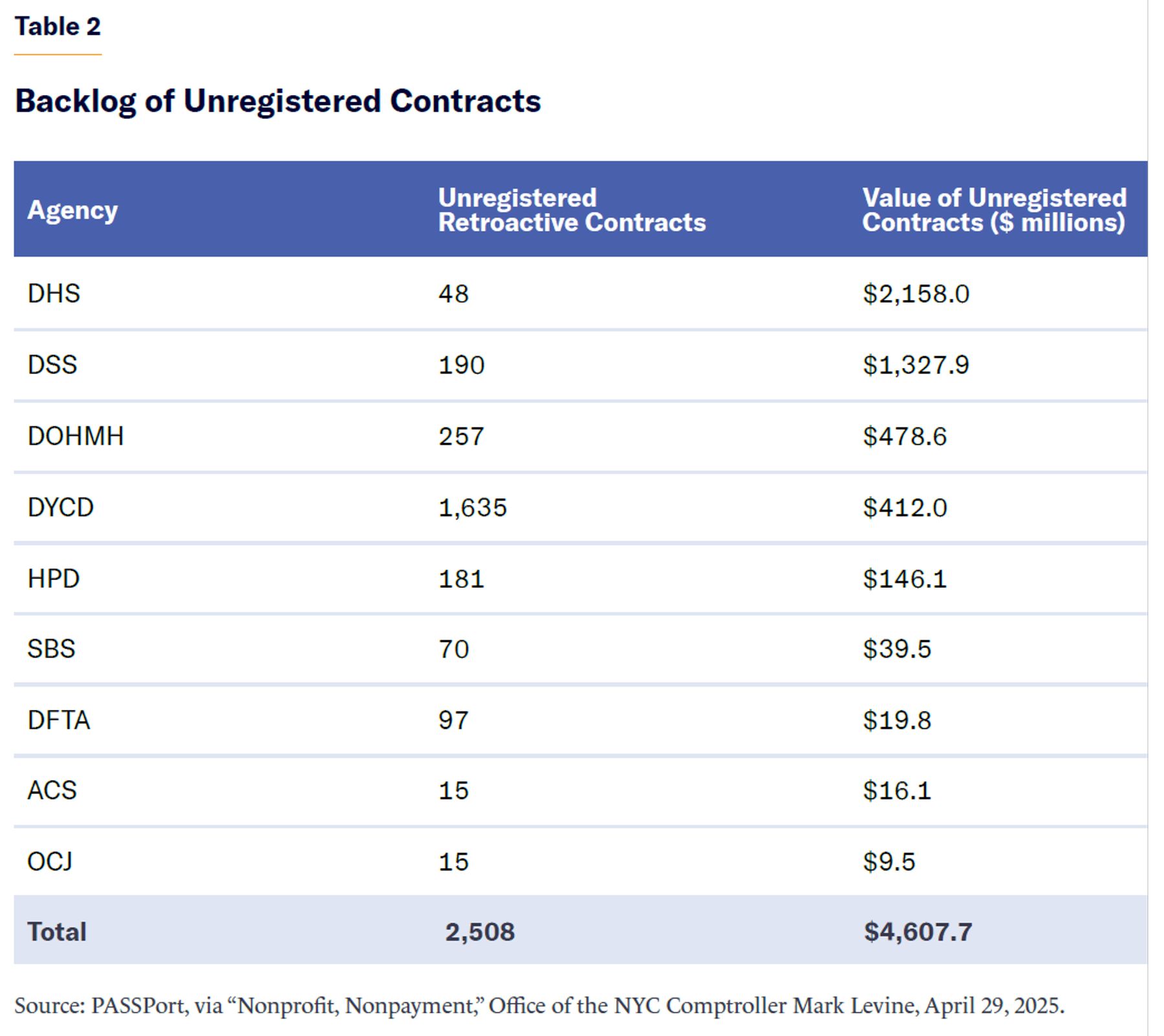
Another compounding problem is the delay in contract registration. In FY 2024, over 90% of human-services contracts were registered late.[9] As documented in the comptroller’s report from February 2025, delays are the result of the difficult contracting process that has few incorporated deadlines.[10] As a result of these delays, many essential services commence before contracts are legally approved, forcing nonprofits to perform what is termed “at-risk” work, without guaranteed payment. As of April 2025, a staggering 2,508 contracts, valued at $4.6 billion, were awaiting registration despite their official start dates having already passed (Table 2). At-risk work drives up both costs and delays, generating large backlogs and costly reimbursements.
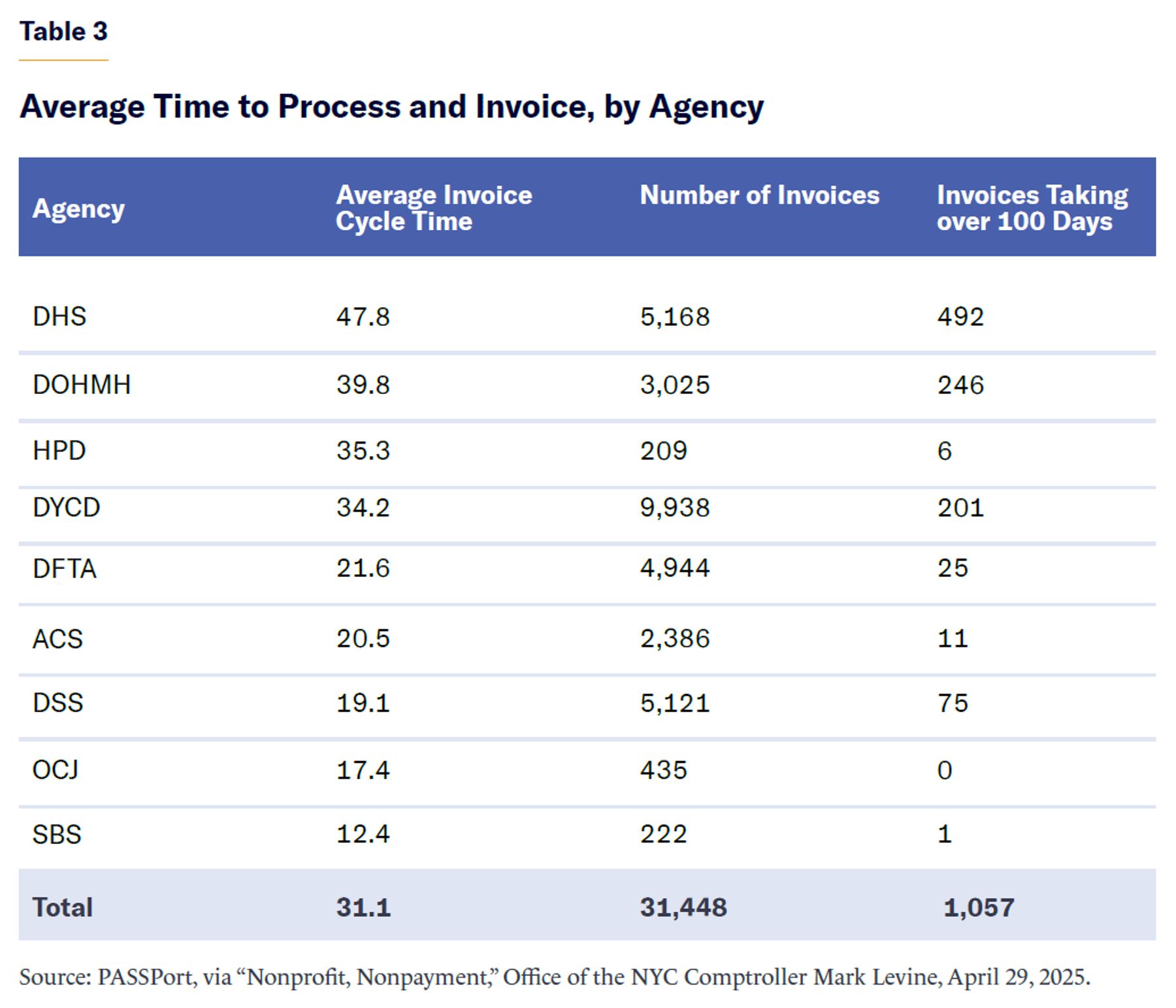
Even after contracts are registered, post-registration payment delays are widespread, as Table 3 shows. In the past year, NYC Health and NYC Department of Homeless Services (DHS) took an average of over 40 days to process invoices, with hundreds of invoices pending more than 100 days. Human-services providers at seven of eight agencies waited, on average, over 200 days after contract start dates for their first payment; at five agencies, the average exceeded a year. NYC Department of Housing Preservation and Development (HPD) was the worst, with contractors waiting 765 days—over two years—for initial payment. Overall, time to first payment in FY 2024 was 16% longer than in 2019, showing that the problem is worsening.
Two other contributing forces result in delays. The first is that the PASSPort system itself is prone to severe glitches. Contractors have reported system errors, malfunctions when uploading supporting documentation, system lockouts, and cumbersome manual steps. The 2026 budget includes $7.4 million for PASSPort “maintenance and enhancement.”[11]
A second and major impediment is that the existing backlog of unpaid or unregistered contracts slows the entire process. The scale of unpaid invoices is substantial. An April 2025 snapshot of PASSPort records indicated more than 7,000 pending unpaid invoices across all contracts, totaling over $1 billion. Of this, at least $675 million was for services rendered in 2024 or earlier. Critically, approximately 4,000 of these invoices, valued at $861 million, were associated with nonprofit organizations. As of April 2025, 2,508 contracts, collectively valued at $4.6 billion, were awaiting registration even though their official start dates had already passed. While the mayor’s 2022 “Clear the Backlog” initiative temporarily reduced some of these figures,[12] the effort did not resolve the structural causes of delay; since then, the process has grown even worse.[13]
While multilayered review intends to safeguard taxpayer money, these layers have become increasingly cumbersome, redundant, and thus, inefficient. They have been transformed from protective mechanisms into significant choke points. Necessary oversight does not necessitate counterproductivity.
Previous Recommendations
Numerous recommendations have already been made to address some of the aforementioned issues.
The NYC Comptroller’s Office attributes the delays to a combination of factors—for example, budget modifications, operational glitches within the PASSPort system, and insufficient staff capacity across agencies. The comptroller’s own proposal includes launching ContractStat, a public dashboard to track every step of the process—from contract approval to final payment—and holding agencies accountable for delays. It also recommends making partial invoice payments standard practice, so that nonprofits can keep cash flowing even if small errors hold up a full payment. Steps for such a solution have been taken in the form of the city council’s amendment that would require 50% of the contract to be paid immediately after the approval of the comptroller (with exceptions such as emergency contracts).[14] In addition, the comptroller’s office is calling to reboot the “Clear the Backlog” initiative, expanding it beyond contract registration to cover invoice and payment delays, with priority given to organizations in financial distress. To give nonprofits immediate relief, the comptroller recommends adding $500 million to the Fund for the City of New York’s loan program, which provides quick, low-cost advances while contracts are pending.
On the operations side, the comptroller’s office is pushing for more staff in agencies to speed up reviews, technical fixes to the PASSPort system to reduce glitches and paperwork, and the setting of firm deadlines for every part of the contracting process so that providers know when they will be paid. A similar recommendation for PASSPort was made by the Citizens Budget Commission (CBC).[15]
Unfortunately, partial payments, clearing the backlog, and relief payments may assuage immediate concerns but do not address the fundamental underlying problems. High costs and delayed payments are problems created by the cost-based model. Even if partial payments become the norm and stricter deadlines are imposed, that leaves more systemic issues. Altering PASSPort so that it does not lock out contractors when making budget changes does not solve the bureaucratic bottleneck of budget modifications. Furthermore, none of the proposed solutions helps ensure that taxpayer money is being spent on programs that work. Instead of trying to reduce problems on the front end, these proposals work on reducing unpaid contracts ex post facto.
Legislative Efforts at the State and Local Levels
The state assembly has proposed a bill meant to address these systemic issues. The Get Nonprofits Paid Act[16] seeks to amend the NYC Charter to mandate prompt payment for nonprofit organizations contracting with the city. Specifically, it requires that payments be made within 30 days from the execution and filing of such contracts with the comptroller. The bill also includes a limited waiver condition if the comptroller determines that a contractor offers the nonprofit contractor a non-interest-bearing short-term loan through the returnable grant fund or another financial institution, or in the event of an emergency declared by the mayor.
While commendable, this bill leaves much to be desired. For example, there already is a 30-day deadline for the comptroller to approve payments to vendors. This deadline is often not met because of the necessary coordination with other agencies.
A similar legislative effort was made in April 2025 when the city council proposed Int 1247-2025,[17] with the full title “A Local Law to amend the New York city charter, in relation to the disbursement of a percentage of awards to nonprofit organizations for contracts immediately upon registration by the comptroller.” This proposal suffers from the same problems as the state assembly’s. By not contending with the fact that the contracting process itself is too arduous, the city council and state assembly ensure that the problem of delayed payments will continue.
In July 2025, the Charter Revision Commission proposed its final report, which contained a section on delayed NGO payments.[18] The commission offered three solutions to the problem. First, expand the power of MOCS to “establish rules in particular areas of need, including the partial payment of invoices, contract renewal, and master contracts.” Second, it suggests more transparency from PPB. And third, agencies should treat smaller contracts as grants, in order to ease the backlog. Again, these proposals deal only with the problem after the fact but do little or nothing to prevent issues from arising in the first place.
Transforming NYC Procurement Through Performance-Based Contracting
There is a good reason that the government contracts with a cost-based model: many small NGOs lack the cash flow to front program costs without assured funding. But the system needs a new approach in order to deliver measurable results, save money, and help end the NGO-payment delay.
Instead of cost-based contracting, NYC should move toward a hybrid performance-based contracting. In a performance-based contracting model, funds are dispersed based on certain required outcomes. Only after vendors meet their goals are the funds delivered. This has obvious advantages. First, it incentivizes a proper cost-benefit system. Second, it ensures that NGOs that are not effective do not continue to receive funds just because of paperwork compliance. Still, given that many NGOs cannot front the cost themselves for important programs, a hybrid model combining features of both the cost-based and performance-based models will be necessary.
A hybrid model would provide a modest up-front payment to allow work to begin, with the bulk of funding tied to clearly defined performance outcomes. This structure reduces the risk of fraud and waste, since the majority of payments are contingent on results rather than promises. It also lessens the need for multiple layers of oversight, concentrating review within MOCS as a backstop. If outcome goals are not met, additional funds are withheld. Such a model eliminates the pressure for government to achieve absolute certainty before releasing funds.
In fact, MOCS recognized the advantages of a hybrid model. In a 2019 report, it called for the implementation of a more performance-based model and the challenges to doing so. “Whereas tracking deliverables is incorporated directly into the performance-based contract structure,” the report states, “cost-based contracts lack this built-in mechanism to hold providers accountable for achieving desired outcomes. Instead, the City agency must rely on such mechanisms as corrective action plans, contract discontinuation, and contract non-renewal if providers have not met their performance goals. This heightens the risk that the City agency may spend funds without fully achieving its objectives.”[19]
This method has been tried in other areas. A performance-based model is the mechanism used by charter schools. Charter schools are based only on granted their charters based on measurable outcomes for each student. Because their funding is tied to academic goals, academic standards are higher.[20] A performance-based charter, in this instance, has a built-in means of accountability without the same requirement for government interference. If a charter school fails, it loses funding; in public schools, money flows regardless of performance, leading to significant waste.[21]
Case Studies
As Lawrence L. Martin concluded in his 2005 paper,“Performance-Based Contracting for Human Services: Does It Work?,” “performance-based contracting appears to be accomplishing its primary objective: changing the behavior of contractors to focus more on performance. All of the case examples examined [in Martin’s paper] demonstrate increased contractor interest and concern with performance; some of the results noted are quite remarkable.”[22]
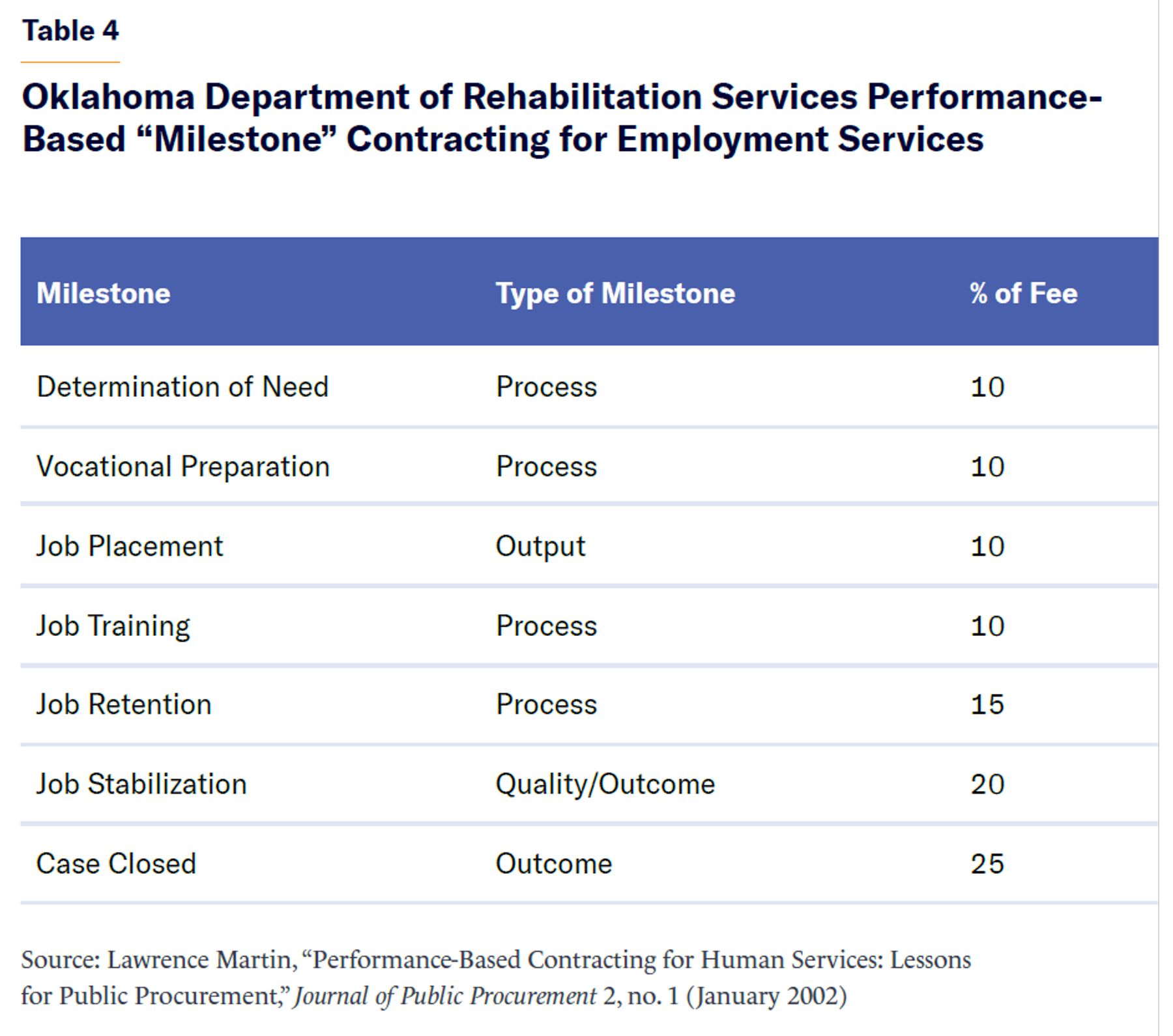
In 1992, the Oklahoma Department of Rehabilitation Services switched to performance-based contracting for a job placement program. Each client served by a contractor was treated as an individual case with a hybrid between cost-based and performance-based milestone payments. The contractor received 20% of the payment after there was a determination of need and sufficient vocational preparation. Then the contractor received increasing percentages of payment after the contractor reached certain milestones, such as job placement, training, and retention. The contractor received the bulk of the payment (45%) only after there was clear job stabilization for the future. The milestones are mapped in Table 4. Between 1992 and 1997, the wait time to receive services fell by 53%, job stabilization increased by 100%, and vendor costs decreased by 35%.[23]
In Minnesota, the Department of Human Services implemented a similar change and saw job placement rise between 1995 and 1999 by 240%.
Illinois’ Department of Children and Family Services (DCFS) switched to performance-based contracting in 1997.[24] In the Illinois DCFS model, incentives were structured as penalties and workload adjustments rather than direct payments. Caseworkers were compensated to manage caseloads of 25 foster children and were expected to place at least five children into permanent homes per fiscal quarter.[25] At the beginning of each fiscal quarter, each caseworker was assigned another five children. Accordingly, failure to meet the placement goal resulted in larger caseloads without additional compensation, while exceeding the goal led to reduced caseloads with compensation equivalent to that of a caseworker serving 25 children. If a vendor’s average caseload rose to 30 children or more per caseworker, the state retained the option to cancel the contract. Conversely, if average caseloads fell below 25 children per worker, vendors continued to receive compensation as if caseloads were 25, effectively creating a financial bonus for successful placements. The results were substantial: in 1997, the number of permanent placements was 2,220, rising sharply to 7,000 by 1999. According to the Illinois DCFS “more child permanency placements were achieved during fiscal year 1999 than were achieved during [the] seven-year period between fiscal year 1987 and 1994.”[26]
Kate Mertz, assistant director for the Government Performance Lab (GPL) at Harvard, advocates for performance-based contracting.[27] She stated:
Results-driven contracting treats procurement as a strategic function instead of the typical back-office function, whereby government can use its position as a funder to improve the results that residents are getting from any given contracted service.
By adopting results-driven contracting approaches, cities can plan ahead for the most important products and services they need to contract for, use [Request for Proposals] strategically to solicit the best ideas about how to improve outcomes, select and contract with those vendors who are most likely to deliver improved results to residents, and actively manage relationships with these vendors to improve performance over the contract term. Results-driven contracting strategies and approaches give cities the leverage to spur innovation while ensuring that every dollar counts.
We’ve seen that when governments leverage the power of procurement and contracting using results-driven contracting, the dollars they spend create greater value for their residents.
The GPL used this model in Wichita, Kansas, back in 2015. Wichita’s Parks Department faced serious problems after outsourcing grounds maintenance in 2008. Staffing was cut in half, contractor costs rose by 30% by 2015, park quality declined, and resident complaints—especially about overgrown grass—mounted. The city initially responded by imposing fines on contractors, but because performance standards were vague and penalties were applied at staff discretion with no appeal process, this approach worsened relations and did little to improve results. Wichita then shifted to a performance-based contracting approach that focused on measurable aims, better data collection, and incentives rather than arbitrary fines. The city introduced simple digital tools to track quality measures like grass height and debris and replaced fines with a 5% performance bonus for exceeding expectations. These changes stabilized costs, improved service quality, and led to a sharp decline in complaints from residents.[28]
In a 2016 report for the Manhattan Institute, Jeffrey Liebman and Hanna Azemati likewise criticized cost-based procurement. While acknowledging that such contracts can be appropriate in limited circumstances—such as emergencies or R&D efforts—they warned that they pose a significant risk of government overspending. Accordingly, they argued that these contracts should be transitioned to fixed-price or performance-based arrangements as soon as there is sufficient clarity about the resources required to complete the task.[29]
Using GPL’s principles, Liebman helped implement performance-based procurement in 2013 through New York City’s Work For Success program, which aimed to help previously incarcerated individuals find employment. Prior to the change in procurement, 23,989 individuals were released from prison in New York State. More than half were considered “high risk” for reconviction, and estimates suggested that in the five years following release, they would spend an average of 460 days incarcerated per person. [30], [31]
To address this problem, businesses were offered tax credits of up to $2,400 for hiring formerly incarcerated individuals, thus incentivizing results over compliance. In addition, Work For Success employed measurable performance metrics to reduce employers’ human resources and training costs by referring only qualified, appropriately trained applicants to fill open positions, at no cost to business owners.[32] The city partnered with more than 40 private investors, including Bank of America Merrill Lynch and the Robin Hood Foundation, to finance the training and data collection necessary to support the program. In 2017, then-Governor Andrew Cuomo stated that 18,000 people had been hired through the WFS program with little to no cost to the taxpayer.[33]
Conclusion
NYC should transition to a performance-based model over the cost-based model. This will reduce administrative burden on the front end while incentivizing improved outcomes and lower spending. Of course, the challenge will be finding the best metric to measure “performance” across the categories of nonprofit work. But certainly, even while operating the cost-based model, we should be able to measure success to some extent even if it is not a prominent factor in procurement today.
Instead of putting out the fire after it has already started—illustrated by giving more authority to MOCS, partial payments, enforcing deadlines that already exist, and even improving technology—we need to find a way to ensure that fires do not start in the first place. A performance-based model, which shifts the burden from the city to the market to account for contingencies, will help reduce spending and deliver quantifiable results for those in need, all while helping NGOs in the process. As one summary of performance-based models put it succinctly, “Prevention is cheaper and more effective than remediation.”[34] NYC’s current cost-based model is lacking on cost and effectiveness.
Endnotes
Photo: SolStock / E+ via Getty Images
Are you interested in supporting the Manhattan Institute’s public-interest research and journalism? As a 501(c)(3) nonprofit, donations in support of MI and its scholars’ work are fully tax-deductible as provided by law (EIN #13-2912529).