MI Responds: May 2016 Jobs Report
"MI Responds" features real-time commentary from Manhattan Institute scholars on breaking news and developing issues. Click here to view more.
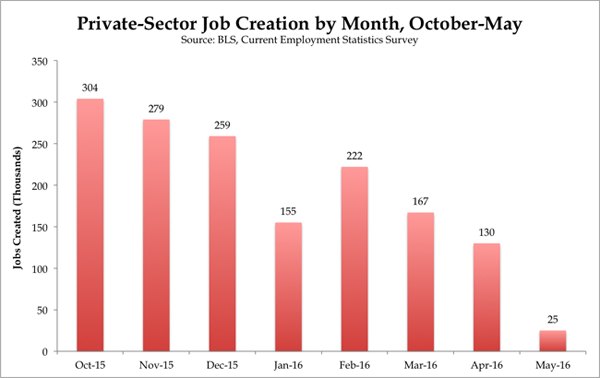
The economy created only 25,000 private sector jobs in May, a precipitous decline from prior months. That makes the seventh month in a row that job creation has declined. These data match the decline in GDP growth, from 2 percent in the third quarter of 2015, to 1.4 percent in the fourth quarter of 2015, to 0.8 percent in the first quarter of 2016, spurred by the decline in nonresidential fixed investment.
Workers are taking note by withdrawing from the labor force. The unemployment rate declined to 4.7 percent due to a dramatic exit from the labor force by mostly low-skill workers. The labor force participation rate declined to 62.6 percent in May (1977 levels) from 62.8 percent in April. It was 63 percent in March. The civilian labor force shrank by 458,000 workers, a decline of 820,000 in two months.
Slow economic growth is one cause of the lack of jobs. Another cause is increases in the minimum wage. At higher minimum wages, employers hire fewer low-skill workers. Seattle might pat itself on the back about its $15 minimum wage, but low-skill workers would be better off in Texas, where the minimum wage is $7.25. All of us have seen the tablets in restaurants that are used for ordering, instead of using servers. As minimum wages rise, automation becomes more profitable, and workers are shunted aside.
In addition, the onslaught of labor regulations is discouraging employers from hiring. Over the past year employers have seen new regulations on overtime; on whether workers can be independent contractors; and on whether franchises or the parent company are the employers of franchised workers. Employers are being asked to fill in new forms on the race, sex, hours, and pay of workers so that the Labor Department can make raids to see if they are paying workers “fairly.” In addition, employers are told that if they hire labor lawyers to advise them on workplace issues, then the names and clients of those lawyers must be made public. No wonder employers are opting for fewer workers.
Diana Furchtgott-Roth is a Senior Fellow and Director of Economics21 at Manhattan Institute