From Gold Card to Golden Auction How America Can Supercharge the Economy Through an Improved Investor Visa Program

Photo: Matt Mawson/Moment via Getty Images
Introduction
The U.S. has long offered investment-based immigration pathways. For over a century, treaties with certain countries have allowed some immigrant investors to obtain a visa; and, since 1990, the EB-5 visa (green card) program[1] has been open to would-be migrants worldwide. But these investment visas are underutilized and outdated. As a result, the U.S. is missing out on valuable revenue, innovation, and job creation from many entrepreneurs and high-net-worth individuals (HNWIs). Moreover, the complexity of current investment immigration programs allows a cartel of real-estate investors and immigration lawyers to capture billions in benefits. President Trump has shown interest in welcoming wealthy foreigners to the United States through his “gold card” proposal, an old excellent idea,[2] but few have pursued that option because of the high price and potential legal issues.[3]
Congress and the president now have a once-in-a-generation opportunity to reform the existing investor visa program because the most frequently used type of investor visa—the EB-5 regional-center program—is set to expire in September 2027. Rather than simply extending the program, Congress should work with Trump to build upon his gold-card proposal by repealing and replacing the existing EB-5 visa program with a visa auction.
This issue brief proposes two reforms to America’s investor visa program. First, Congress should allocate the existing 9,940 annual EB-5 visas to the highest-bidding applicants in quarterly auctions, allowing demand to determine the price. The funds should be deposited in the U.S. Treasury to reduce the budget deficit. Second, Trump should welcome more temporary investors and entrepreneurs through the existing E-2 Treaty Investor visa by adding more countries to the treaty list, and Congress should expand eligibility to more investors through this visa category.
The Flaws of the EB-5 Program
How the Program Currently Works
Congress created the EB-5 program in the Immigration Act of 1990. The original design required a foreign investor to commit $1 million—or $500,000 in a Targeted Employment Area (TEA)—to a new commercial enterprise that would create at least 10 full-time jobs for U.S. workers. In return, the investor, as well as the investor’s minor children and spouse, received conditional permanent residency, converting to unconditional after two years, upon proof of job creation. Congress allocated 9,940 visas to the EB-5 category per year, subject to per-country caps, as with all other immigrant visas.
Few immigrants applied under the original direct-investment requirement, largely because of the high price ($1 million in 1990 represents over $2.5 million today) and the difficulty of fulfilling the 10-job creation requirement. Congress essentially guessed the wrong price for these visas, and thus most of the 10,000 visas allocated to the EB-5 instead spilled over to the other employment and skill-based visas.[4] In 1992, Congress responded by creating the regional-center pilot program,[5] which allowed investors to pool capital in preapproved investment projects and also allowed for “indirect jobs” to count toward the 10-job requirement. The regional-center program has always been temporary, so it must periodically be reauthorized. It last lapsed in 2021 and was reauthorized through the EB-5 Reform and Integrity Act of 2022 until September 30, 2027.
The regional-center program, combined with the erosion of the original $1 million threshold via inflation, has increased the appeal of the EB-5, which now receives more approvals than available visas.
The 2022 EB-5 reform raised the investment minimum to $1,050,000 (or $800,000 in TEAs) and indexed both thresholds to inflation beginning in 2027.
Congress also reserved some of the 9,940 visas for TEAs, including 20% for rural areas, 10% for high-unemployment areas, and 2% for infrastructure projects.[6] These TEAs are eligible for the lower investment threshold—now at $800,000; and, because 2,187 visas out of the 9,940 are reserved for these categories, there is no backlog for applicants from any country, unlike the unreserved higher-threshold category for Chinese and Indian-born investors.
How Regional Centers Work
Regional centers are legal designations that allow foreign investors to pool their capital in preapproved, U.S. Citizenship and Immigration Services (USCIS)–designated investment vehicles rather than directly fund and operate their own businesses. A typical regional center deal involves three entities: the regional center itself, which is the USCIS-approved sponsor that assembles and administers EB-5 projects; the New Commercial Enterprise (NCE), usually an LLC that pools contributions from dozens of foreign investors at a time; and the Job Creating Entity (JCE), which is the actual operating business—most often, a real-estate developer.
NCE lends the pooled foreign investor capital to JCE at a below-market rate, typically at almost 0% interest. The lost economic return from these cheap loans is the price that foreign investors pay in return for U.S. permanent residency. But as a result, the gains from the EB-5 program thus flow largely to real-estate developers. In addition, regional centers charge large management fees to foreign investors. As of late 2025, USCIS reports approximately 580 approved regional centers.[7]
A major selling point for regional centers is that, unlike the direct-investment pathway, this structure allows investors to satisfy the 10-jobs-created requirement through indirect and induced jobs, calculated by economic input-output models.[8] For instance, a single project employing 50 construction workers can be modeled to “create” 500 jobs for a pool of 50 investors. This is why roughly 95% of EB-5 investors go through regional centers and 99% invest in a lower-investment-requirement TEA.[9]
Persistent Problems
- Capture by intermediaries: The greatest share of the economic surplus from EB-5 visas flows to regional-center operators, real-estate developers, promoters, and immigration lawyers rather than to the U.S. Treasury or to genuinely productive investments. A typical EB-5 deal involves regional-center management fees of $35,000–$85,000 per investor,[10] plus annual administrative charges on capital, and tens of thousands of dollars to immigration lawyers who handle the complex process of filing form I-526 to apply for investment certification. The U.S. government, by contrast, collects nearly $10,000 in filing fees,[11] which fund increasingly complex paper-only filing and certification rather than deficit reduction.
- Negligible economic growth: The EB-5 program, like any other investment visa program, is unlikely to create many jobs or grow the economy at all, other than by allowing more people to live in the United States. Investment visas typically do not create economic growth because investment is a function of the return to capital, which is affected by taxation, and the cost of capital and labor. The EB-5 program can lead to more investment in some parts of the country—but only to the detriment of other regions. Investment visas, however, have the added benefit of bringing in nearly 10,000 new immigrants annually, which grows the economy by expanding the labor force.
- Job-creation accounting fictions: Most jobs created under the EB-5 program are “indirect” jobs, meaning not employees of the investors but a calculation of how many jobs a program creates through a Keynesian multiplier.
- TEA gerrymandering: The lower $800,000 investment requirement for TEAs—which is how most investors receive certification—was clearly intended to uplift poor areas with investment. But in practice, what qualifies as a TEA has been gerrymandered (for immigration, rather than electoral, purposes) to include projects in affluent urban areas, including some of the richest parts of the U.S. such as part of Manhattan’s Upper East Side, Sausalito in California, La Jolla in San Diego, South Beach in Miami, and even Rosslyn in Arlington, all of which currently qualify as TEAs.[12]
- Massive backlogs: The 9,940-visa allocation, combined with per-country caps, has produced multiyear waits for Chinese and Indian investors in the unreserved category. Even for investors in categories without a current backlog, USCIS processing delays exceed two years for direct (standalone) investments and regional-center investors,[13] despite tens of thousands of dollars in fees to the government and lawyers, making the program even less attractive than it could be.[14]
- Fraud history: Before the 2022 reform, several high-profile fraud cases involved EB-5 regional centers, in which regional-center managers and promoters defrauded investors of hundreds of millions of dollars. The Securities and Exchange Commission and the Department of Homeland Security, Office of Inspector General documented widespread misrepresentation by regional-center operators.[15] In 2019, four men were indicted by the Department of Justice for money laundering, wire fraud, misrepresentation, and other charges stemming from theft of funds from foreign investors in failed EB-5 projects in Vermont.[16] Years later, the four men pled guilty, and the total amount laundered or stolen rose to over $200 million, the largest fraud in Vermont’s history.[17] The 2022 reform tightened oversight by, for example, requiring all regional centers to seek annual recertification to participate in the program and requiring a full USCIS audit every five years, but the structural incentive for fraud by regional-center operators remains.[18]
The 2027 expiration of the regional center program provides Congress an opportunity to reform the EB-5 program in a way that will allow the U.S. to better select wealthier investors and to raise billions in revenue rather than let it go to unscrupulous intermediaries and lawyers.
The Gold-Card Auction Proposal
Mechanism
There are two ways to run an investor visa auction: setting a price or setting a quantity. If a price is set—say, $1 million for an EB-1 extraordinary ability or EB-2 exceptional-ability green card, as Trump proposed—the market will determine the quantity. So far, we know that only one investor has paid $1 million for a gold card, and fewer than 200 have paid the $15,000 application fee but have not yet been approved.[19] The other way to run an investor visa auction is to set a quantity and let the market set the price. This latter approach is what I recommend in this issue brief, since it would raise substantially more revenue than the current gold-card $1 million price and would take advantage of the expiring EB-5 program.
- Quantity: The auction would use the existing pool of 9,940 EB-5 visas per fiscal year. If some family visas spill over to the employment-based level the next year, then more visas could be used for the EB-5 category.[20]
- Auction format: USCIS would conduct a quarterly sealed-bid uniform-price auction of one-quarter of the visas at the beginning of each fiscal-year quarter. Uniform price means that all winning bidders pay the same price (the lowest winning bid). This format, which is well tested in U.S. Treasury debt auctions, minimizes strategic underbidding and produces transparent price discovery.[21] Because investor visas also include immediate relatives, and not all investors have the same family size, the price set by the auction will be for a single visa rather than for a household, ensuring that all visas auctioned are used and sell for the same price.
- Reserve price: The government can set an initial reserved price below which it is not willing to sell visas, though this will mean that some EB-5 visas will go unused and potentially result in less revenue. Alternatively, the government can calculate a revenue-maximizing dynamic price floor for visas based on quarterly bids, such that the price floor becomes binding only if it would maximize revenue.[22] Current law stipulates that if EB-5 visas go unused, they become available for the other employment-based categories within the same fiscal year.
- Bidder eligibility: Individual applicants must pass standard inadmissibility, security, and source-of-funds vetting (to ensure that no illegally sourced funds are used) after winning the bid, similar to the current EB-5 vetting process. Therefore, the government will need to select slightly more bids than visas to ensure that all are used, using estimates from past vetting failure rates.
- Payment: The winning bid is paid to the U.S. Treasury upon approval. There are no “investment” requirements, job-creation accounting, regional centers, or TEA designations, and thus processing is faster without intermediaries.
- Visa issuance: Unlike the current EB-5 program, which grants “conditional” permanent residency for two years before converting to unconditional upon investment verification, the gold card is an immediate unconditional green card, since the payment was already made.
Why an Auction Beats a Flat Fee
The Trump administration’s gold-card proposal established a flat price of $1 million, which has the same design flaw as the original EB-5 program: Congress (or the executive) guessing the wrong price.
- If the price is too high: Unused visas result in lost revenue from low quantity
- If the price is too low: Backlog of applicants increases waiting, and lost revenue results from low pricing
Auctions discover the true willingness to pay. Wealthy foreigners differ enormously in their valuation of a U.S. green card, which depends on their home-country tax system, family situation, business holdings, alternative residency options, and queue position under existing employment categories. No bureaucrat can guess that price. Only individual investors through a competitive market can determine the price.
Furthermore, the main reason investors who are not interested in the current version of the gold card is that it costs $1 million. Instead of losing that money entirely, they could instead invest that same amount, wait a few years, and still receive a green card through the existing EB-5 program. Some lawyers have warned that the gold-card program could be revoked by the next administration, since it was implemented by executive order and thus creates uncertainty for investors. If Congress replaced the current EB-5 program with a gold-card auction, all these problems would be resolved.
What Is a Gold Card Worth?
Estimating the equilibrium auction price for the proposed gold card requires understanding what EB-5 investors are effectively paying today and how much more value a gold card would deliver through reduced wait times, removal of the conditional residency phase, and reduced fees to lawyers and intermediaries.
The Hidden Cost of an EB-5 Visa
On paper, an EB-5 investor commits $1,050,000 (non-TEA) and recovers most or all of that capital after a five- to seven-year holding period, but the opportunity cost to the investor is significant. The components of the cost of the EB-5 investor program are fourfold:
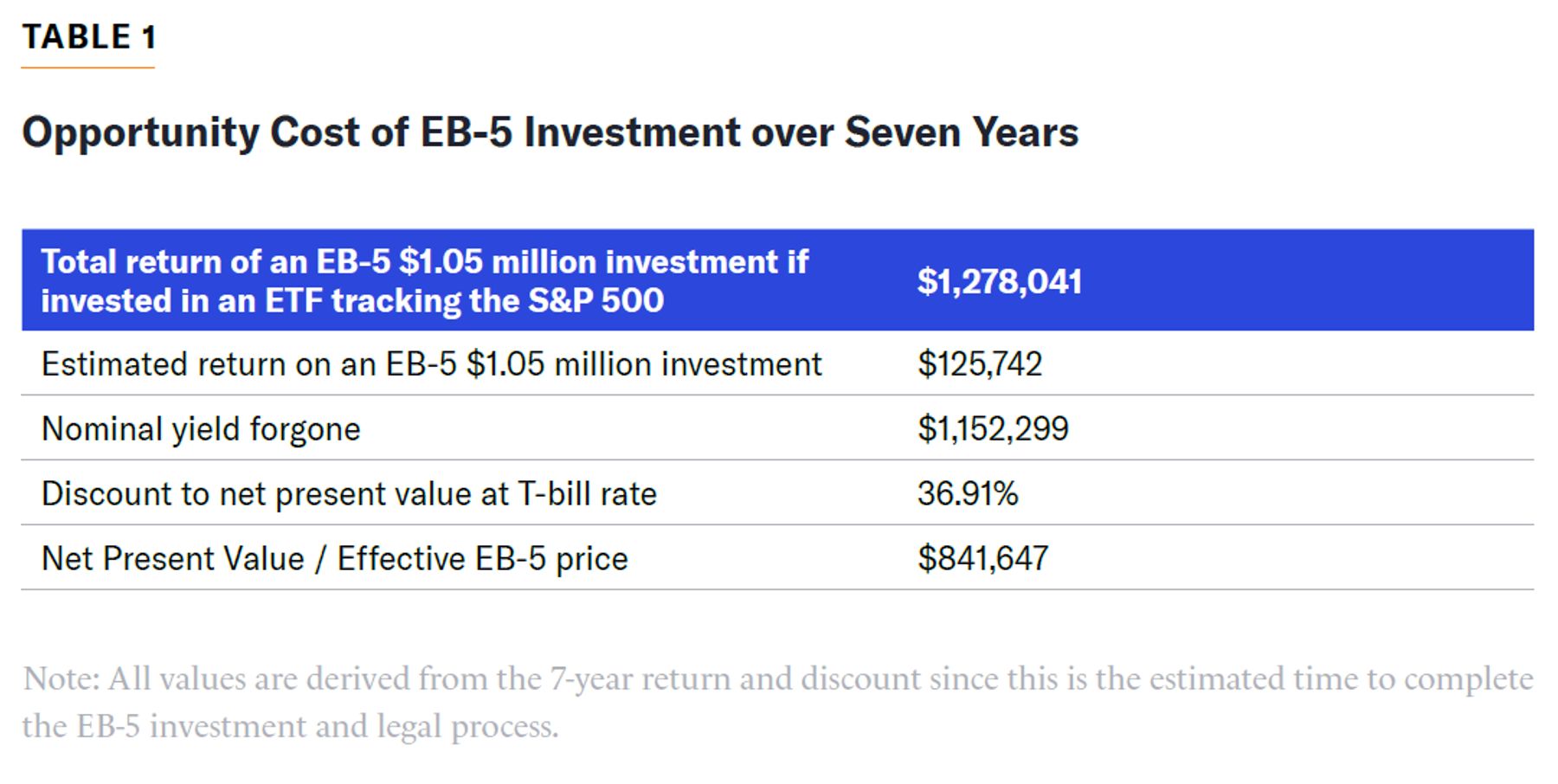
- Opportunity cost on capital. EB-5 investments yield only 0%–2% annually,[23] far lower than typical market returns, meaning that investors are effectively paying a price for a green card through missed returns. By contrast, the S&P 500 index with dividends reinvested yielded an average return of 11.7% per year over the last half-century. Furthermore, an EB-5 standalone or regional-center investment is riskier than investing in the market; thus, the required return on capital must be higher than that of the diversified large-cap stock market. Assuming an average annual discount rate equal to the seven-year Treasury bill of 4.59%,[24] we can estimate the effective price of the opportunity cost of an EB-5 investment under various scenarios of forgone yield (Table 1).
- Direct fees. Regional-center management fees ($50,000–$80,000), USCIS fees (~$10,000), legal fees ($30,000–$60,000), and ongoing administrative charges add roughly $90,000–$150,000 per investor.
- Potential principal loss. Assuming that about 10% of EB-5 capital is ultimately lost (project failures, fraud, or other considerations), this adds another $105,000 in probability-weighted cost.
- Time and uncertainty cost. Two-plus years of processing time before conditional residency, plus another two years to remove conditions, plus per-country backlog risk; for a Chinese or an Indian applicant, the queue is several years.
Totaling these components, the all-in economic cost of an EB-5 visa to a non-backlogged investor today is over $1 million in present-value terms ($1.04–$1.15 million) for non-backlogged applicants. In other words, EB-5 investors have already revealed that they are willing to pay about $1 million to the U.S. government to receive green cards for themselves and their family; but currently, most of that value is dissipated to intermediaries and project losses instead of being captured by the Treasury.
The Demand Curve and Likely Clearing Price
While EB-5 investors are willing to pay over $1 million to receive a green card, two important considerations modify the final clearing price of a gold card. First, the EB-5 investment covers the entire household, not just the investor. Second, the gold card would be more valuable by simplifying the process and reducing uncertainty.
Only 36% of EB-5 green cards went to investors in fiscal year 2024, the last year with data available, while the other 64% went to spouses and minor children.[25] Even at a roughly $1.1 million EB-5 real cost, that means the actual willingness to pay for each person to receive a green card is approximately $400,000. However, gold cards will be more desirable than traditional EB-5 green cards for three reasons:
- Reduced processing time: Processing times for the gold card would be shorter than those for the EB-5, which typically takes about a year.[26] Assuming a 4.06%[27] discount rate over the original per-person willingness to pay the estimate, that adds $16,000 to the value of the gold card.
- Reduced denial rates: There is a risk, albeit small, that an EB-5 investment will not be approved for a green card or that a regional center will be decertified, which would not be true for the gold card. In fiscal year 2025, 6.9% of I-526 and I-526E petitions were denied,[28] adding over $28,000 to the probability-weighted per-person equilibrium price, since 6.9% of the opportunity cost ($400,000) equals $27,600.
- No conditionality: Currently, investors apply to remove conditions on their green card two years after they receive their conditional green card through their investment. This filing fee was already accounted for, but these applications are also denied in 7% of all cases. This raises the combined denial rate for full permanent residency from 6.9% to 13.4%,[29] thus raising the cost of denial from $27,600 to $53,600.[30]
In other words, the full willingness to pay for a gold card can be approximated at $483,000 under the model described here. A price floor below this amount could be established to ensure a minimum threshold to receive a gold card, which would then be adjusted for inflation each following year.
The $470,000 willingness-to-pay amount might also be an underestimate, since the current EB-5 category is “oversubscribed,” meaning that more applicants and their families qualify for the visa than the 9,940 visas available.
Estimated Federal Revenue
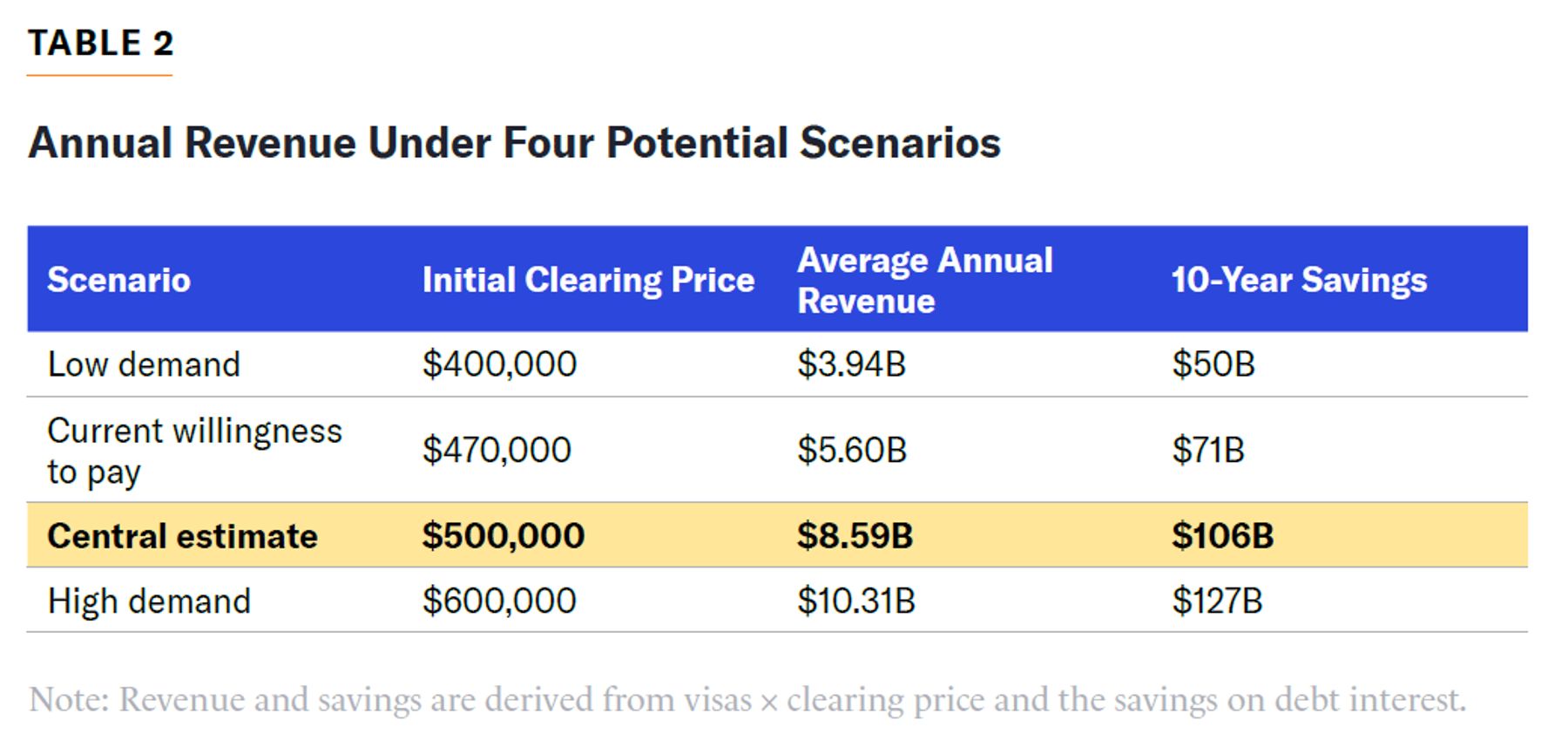
The low demand scenario (Table 2) assumes a binding price floor of $400,000 and that only 9,000 visas are issued, rather than the current 9,940. It also assumes that price grows with inflation at 2% annually. Under this pessimistic scenario, the federal government would raise some $50 billion over a decade through both revenue and savings in interest on the debt.[31]
The current-willingness-to-pay scenario assumes that the full 9,940-visa allocation clears in each fiscal year and that the auction price estimated in this issue brief ($470,000) holds. But the 10-year totals assume modest real growth in willingness to pay as global wealth expands at a rate equal to nominal GDP—about 4%. Under this scenario, the government saves $71 billion over a decade.
The central-estimate scenario assumes a slightly higher clearing price of $500,000, to account for simplicity of filing and potential “queue jumping” between visa categories by Indian nationals from the EB-2 category. It also assumes that the clearing price for the gold card rises with the stock market, by over 11% annually. Under the central scenario, the proposed gold-card auction reduces the federal deficit by over $100 billion over a decade.
The high-demand scenario assumes more demand for gold cards, due to Indian nationals trying to protect their children from aging out of the current green-card backlog. Many of these immigrants may opt to purchase gold cards for their entire families or just for their children, since an approved petition would allow for unlimited H-1B visa extensions for those on the green-card backlog and provides employment freedom. Under this scenario, I assume a $600,000 clearing price, 20% higher than the central estimate, and a full usage of visas, as in the previous two scenarios. In this high-demand scenario, the proposed gold-card auction would reduce the deficit by $127 billion over a decade.
Addressing Objections to the Gold Card
“This Is Selling Citizenship”
The gold card sells permanent residency, not citizenship, although it does allow the buyer to apply for citizenship after five years. In any case, this is exactly what the EB-5 program already does, but the visa auction benefits Americans far more than the status quo. Citizenship still requires five years of residence, and standards for citizenship can and should be raised. The auction makes the existing residency-for-investment transaction transparent and routes the proceeds to the public rather than to intermediaries.
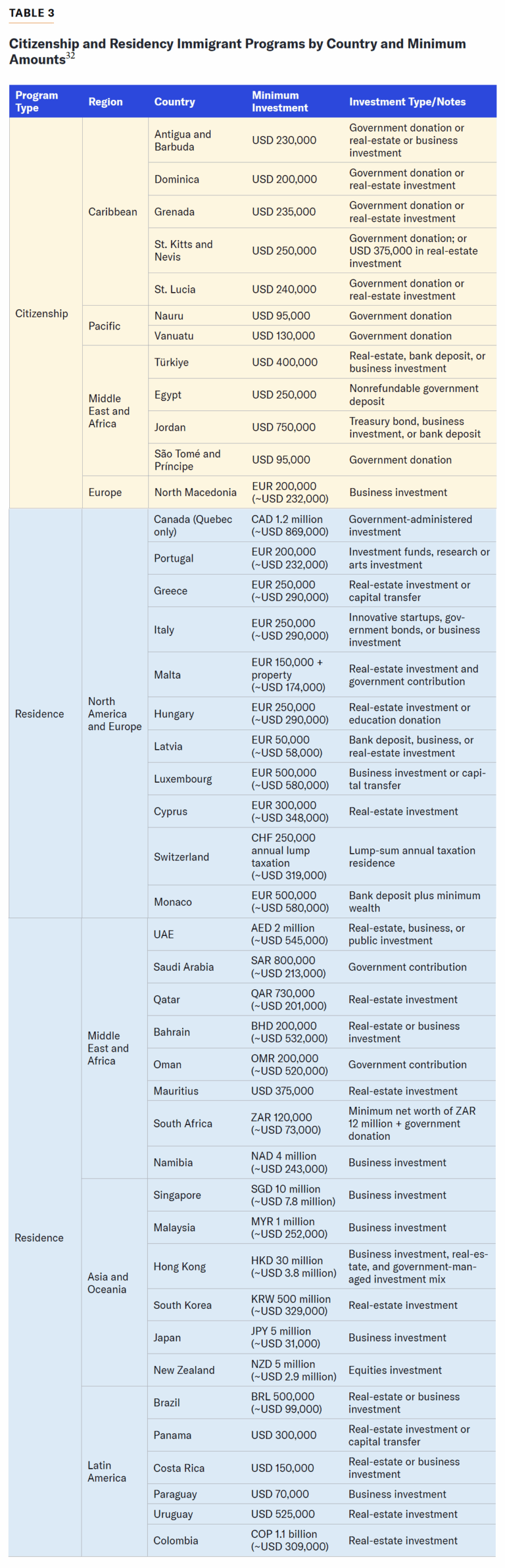
Furthermore, dozens of countries, especially small island nations, already run programs that effectively sell the right to live and work to high-net-worth foreigners as a form of raising revenue. Two non-island nations sell citizenship directly: Egypt and Jordan, for $250,000 and $750,000, respectively. More than two dozen countries, including Italy, have investor visas that effectively sell the right to live there (Table 3).
“It Favors the Already-Wealthy”
That the gold card favors the already-wealthy is true, but it is also true for every investor visa worldwide—the U.S. EB-5 specifically—and the entire immigration system, which imposes a great financial cost on all applicants. The relevant comparison is between auction and the EB-5. The auction is simpler and fairer, and it more efficiently advances American interests. The auction only replaces a category that is already targeted toward millionaires. The change is not who can participate but who captures the value: the U.S. Treasury rather than intermediaries.
“It Will Reduce Job Creation”
Empirical evidence and standard macroeconomic theory suggest that the jobs created by the EB-5 program are largely accounting fictions, at least at the macroeconomic level. The only causal study on this matter examined European investor visa programs and found negligible job creation, with investments overwhelmingly focused on real estate.[33] More important, the intermediary industry extracts billions in benefits from this program, which represents a deadweight loss to the economy. Their resources will have to be reallocated to more productive ends and jobs rather than immigration surplus extraction. Under the gold card, more jobs will be created because additional government revenue from the auction will reduce the deficit, which will lower borrowing costs for the private sector and thus expand productive economic activity everywhere. Investor immigrants will also have a clearer path to permanent residency and thus create even more jobs.
“What About National Security?”
Gold-card purchasers would be vetted after bidding and would not be allowed to immigrate if found inadmissible under U.S. immigration law for any reason. This vetting, however, would occur before payment, such that in case of denial, the funds are not lost, which reduces uncertainty and increases willingness to pay. This is different from the current EB-5 program, where investments must be made before eligibility for a green card is established. Source-of-funds review for the bid amount replaces the more complex traceability requirement for “investment capital flow” through regional-center vehicles, which have historically been the principal channel for money-laundering concerns in the program.[34]
“What About Secondary Markets and Resale?”
Visas issued to natural persons are nontransferable. The auction allocates the right to apply for a visa, not a tradable instrument. This distinguishes the gold card from employer-side visa-auction proposals that involve transferable employer permits.[35] That model can be valuable for work-visa programs but also has problems, which I have explained in earlier work.[36] Applicant-side auctions are simpler and avoid the worker-portability concerns that have complicated employer-side proposals, which expands the pool of potential applicants.
Expanding E-2 Treaty Investor Eligibility
The gold-card auction targets the top of the investor immigration market: HNWIs seeking permanent residency. But the U.S. also benefits from early entrepreneurs and investors who do not necessarily seek permanent immigration but temporary presence in the country to set up a company or start a new business that may succeed or may fail. The existing E-2 Treaty Investor visa serves precisely this purpose, but its eligibility is based on country of origin and currently excludes many potential investors, even from friendly countries.
What Is the E-2 Visa?
The E-2 Treaty Investor visa is available to nationals of approximately 80 countries[37] that maintain a qualifying treaty of commerce and navigation with the U.S. or have been added by specific legislation.[38] The law requires a substantial investment in a U.S. business but does not have a specific threshold. In practice, consular officers and USCIS officers require an investment of $100,000–$200,000,[39] in which the foreign investor is a majority-owner, operating or managing the business actively, and is risking his/her own capital. The visa is renewable every two years for an indefinite number of times, but it is tied to the status of that investment. If the business fails, the visa is not renewed. Typically, the investment must also be profitable enough to pay for all the living expenses of the investor and his/her family.
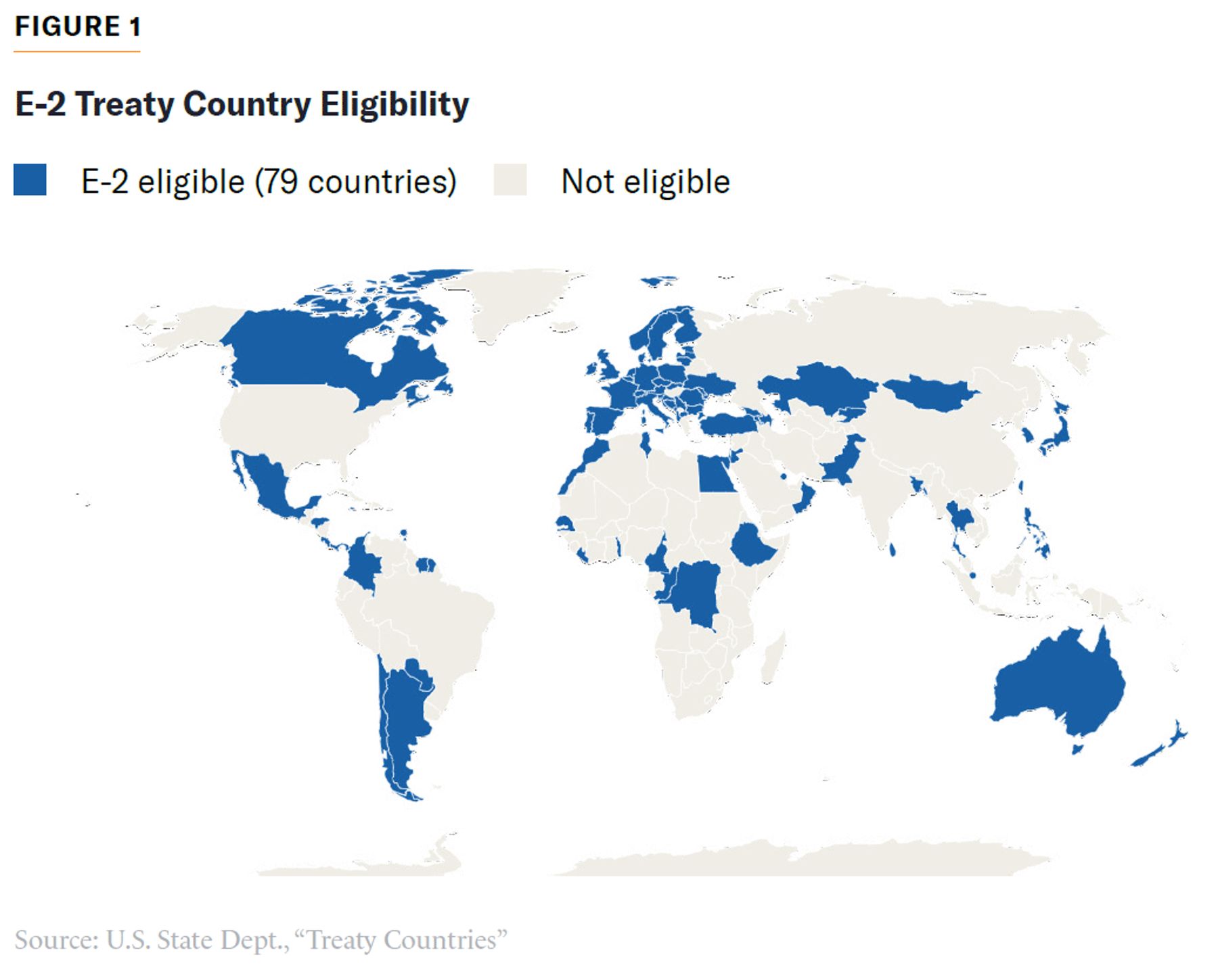
Unlike EB-5, the E-2 visa is a nonimmigrant visa, i.e., it does not lead to permanent residency. And while the visa can be renewed indefinitely, it forbids “immigrant intent,” meaning that investors must have the intention to depart the U.S. and not apply to become permanent residents. E-2 holders can bring their spouses (who are eligible for unrestricted work authorization) and unmarried children under 21. The flexibility, lower investment threshold, and faster processing make the E-2 visa the most accessible entrepreneur pathway that the U.S. offers, but it is only for citizens of treaty countries who do not have an intent to remain. Figure 1 shows the current geographic coverage of E-2 eligibility.
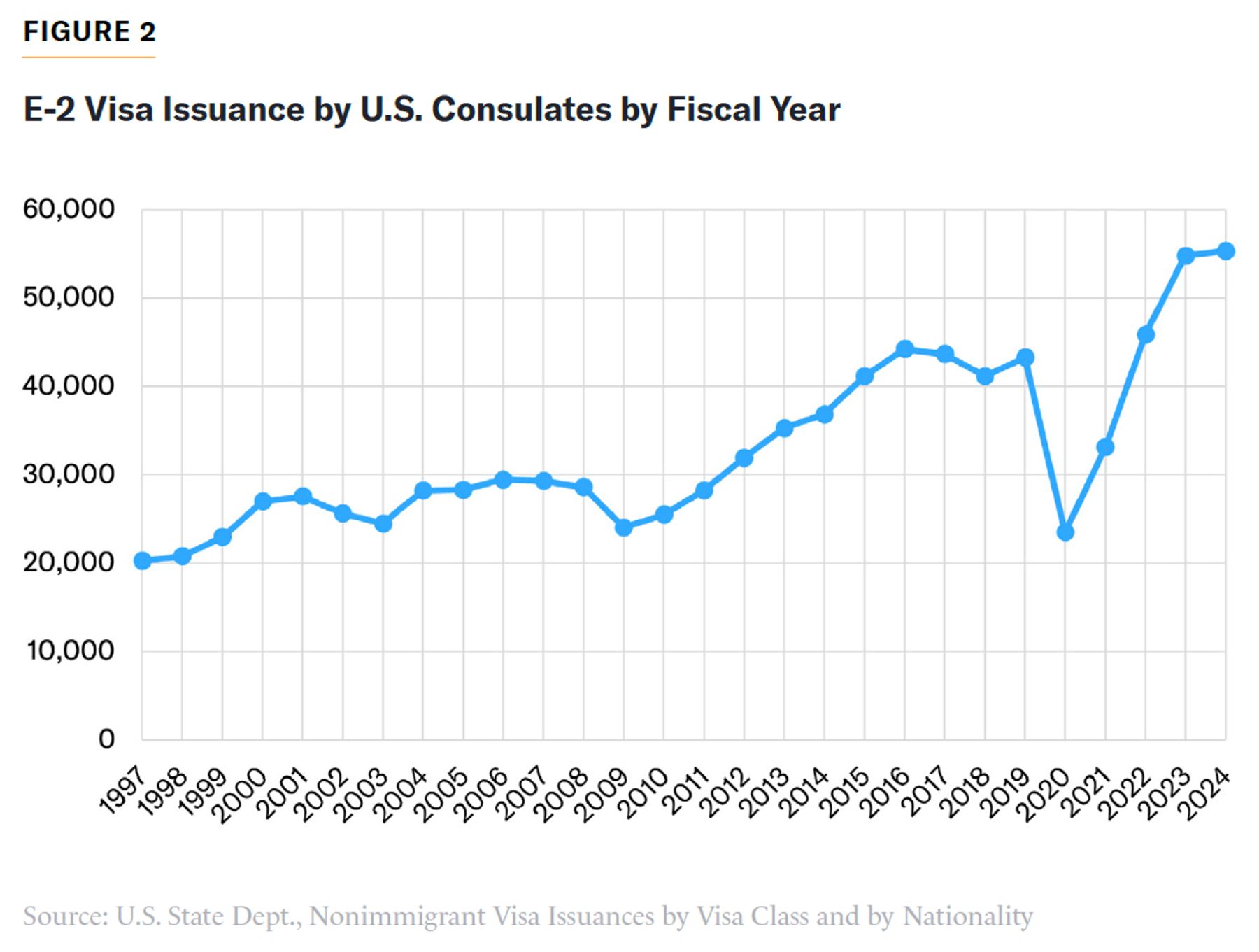
As shown in Figure 2, E-2 visa issuance has been rising; 50,000–60,000 E-2 visas were issued by U.S. consulates in fiscal years 2023 and 2024,[40] the highest number ever. In part, this represents a recovery from the pandemic-era drop in visa issuances, but it also is part of a continuing upward trend driven by the expansion in eligible countries over time and extension of visas by previous visa holders.
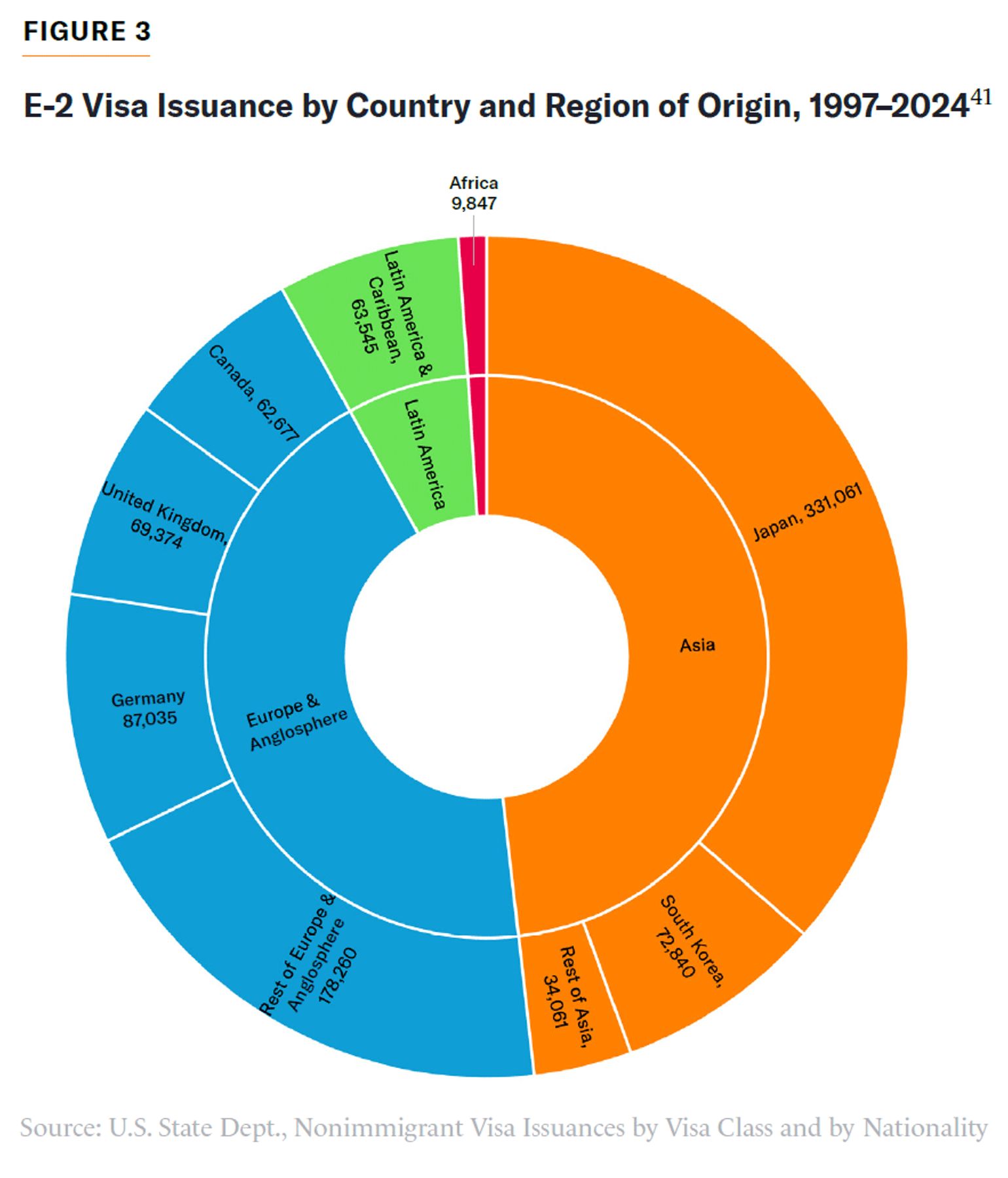
Over 90% of E-2 visas go to Asians, Europeans, and Canadians. Japanese citizens alone account for over 33% of all E-2 visas. And while many Latin American and African countries are eligible for E-2 investor visa classification, few of their citizens have the wealth required to apply for the visa (Figure 3).
Limitations of the E-2 Visa
The biggest limitation of the E-2 visa program is that investors from most countries are ineligible to apply for it.
In many cases, eligibility restrictions based on country of citizenship are justified by concerns over origin of funds and corruption, but those concerns cannot justify excluding nations such as Iceland or Uruguay.
Indeed, citizens of some of the most corrupt countries in the world, such as the Democratic Republic of the Congo (DRC),[42] are eligible for the E-2 visa. But few visas are issued to DRC citizens because it is a poor nation and origin-of-funds vetting is more stringent for these applicants. As a result, only 31 visas have been issued since 1997 for citizens of the DRC, including extensions. In other words, country-eligibility requirements are not necessary to address concerns about corruption and origin of funds.
Other limitations on E-2 visa investment:[43]
- Investor immigrants are required to put their own capital at risk.
- Immigrant investor must be a majority owner of the enterprise.
- While investors do not need to maintain a residence abroad, they must have the intent to depart the U.S. rather than to stay permanently.
How E-2 Visa Reform Complements the Gold Card
The gold-card auction serves the wealthiest tier of investor immigrants seeking permanent residency. E-2 expansion serves active entrepreneurs and small investors making real operating investments without requiring permanent immigration, while also allowing them to build up to a gold card after their investment is profitable enough. Together, these reforms create a coherent two-tier investor immigration, in which the gold card represents an auction-priced permanent residency and pathway to citizenship for high-net-worth immigrants, while the E-2 visa is the testing mechanism for foreign investors, accessible to bright entrepreneurs.
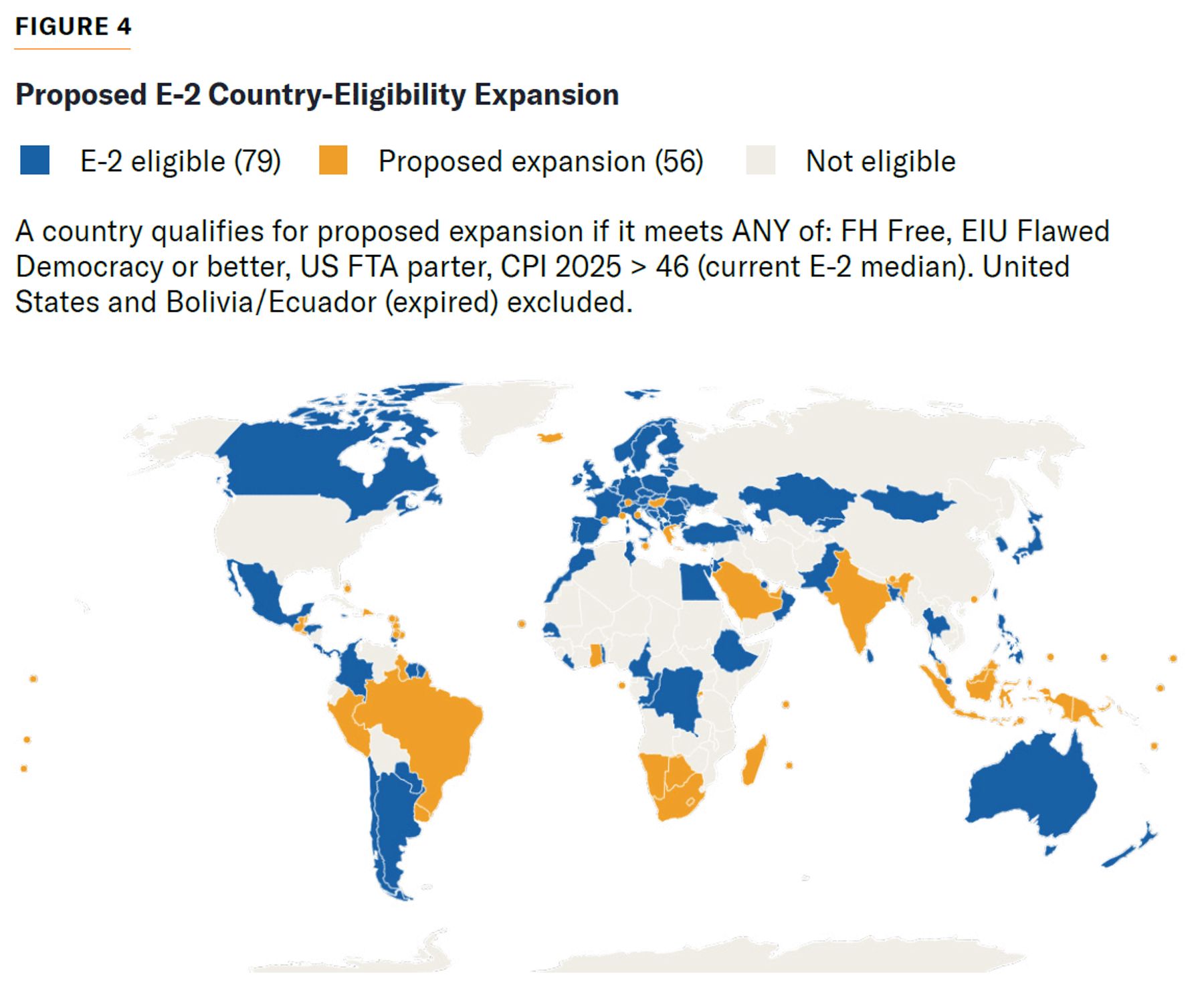
The first step to reform the E-2 visa is to expand country eligibility. Specifically, E-2 visa eligibility should be extended to:
- The remaining democratic European countries ineligible for the visa: Cyprus, Greece, Hungary, Iceland, and Malta
- Citizens from all countries with which the U.S. has a current free-trade agreement[44]
- All democratic nations, specifically those that score as “flawed democracies” or better in the Economist Intelligence Unit’s ranking or as “free” nations under the Freedom House Index[45]
- Those partially or fully authoritarian countries where corruption is low, specifically where the median corruption perception index score is below the current median score of E-2-eligible countries of 46.
If implemented, either by executive order or legislation, this expansion would add 56 countries to the E-2 visa-eligibility list. This expansion would notably include three of the top countries by number of millionaires: India, Brazil, and Saudi Arabia. It would also include countries with free-trade agreements with the U.S., such as Peru, the Dominican Republic, Guatemala, and El Salvador (Figure 4).
FIGURE 4 Proposed E-2 Country-Eligibility Expansion
Furthermore, to expand eligibility for E-2 visas to more investors within eligible countries, Congress should make the following reforms:
- Reduce the ownership requirement below 50% to a lower threshold or give consular officers flexibility on a case-by-case basis.
- Allow investors to qualify without putting their own capital at risk, as long as an American investor—individually or through a venture capital fund—is putting up a substantial amount of capital (over $100,000) and the investor retains operational control and is actively managing the business.
- Explicitly make the E-2 visa a dual-intent visa, so that investors are allowed to seek permanent residence.
These reforms would effectively turn the E-2 visa into a startup visa and increase the number of talented investors who start innovative companies in the United States. In the long run, combined with the auctioned gold card, E-2 visa expansion would increase the number of bidders for gold cards and thus raise their price and government revenue.
Estimating the Economic Impact of E-2 Visa Expansion
The most important country that is not currently eligible for E-2 visas but would become eligible under this proposal is India. India currently supplies more legal employment-based immigration than any other country and is the world’s most populous country and democracy, home to more than 900,000 individuals with a net worth above $1 million. Indian noncitizens in the U.S. earn high incomes and have among the highest levels of educational attainment. Yet Indian citizens seeking to start businesses in the U.S. have no E-2 pathway to invest and start their own businesses.
To estimate how many more investors could obtain E-2 visas under the proposed expansion, I list the number of millionaires in USD among the top countries and the number of E-2 visas issued to that country, based on the most recent available data for both metrics. Then I calculate the rate of E-2 visas per millionaires by country, as shown in Table 4.
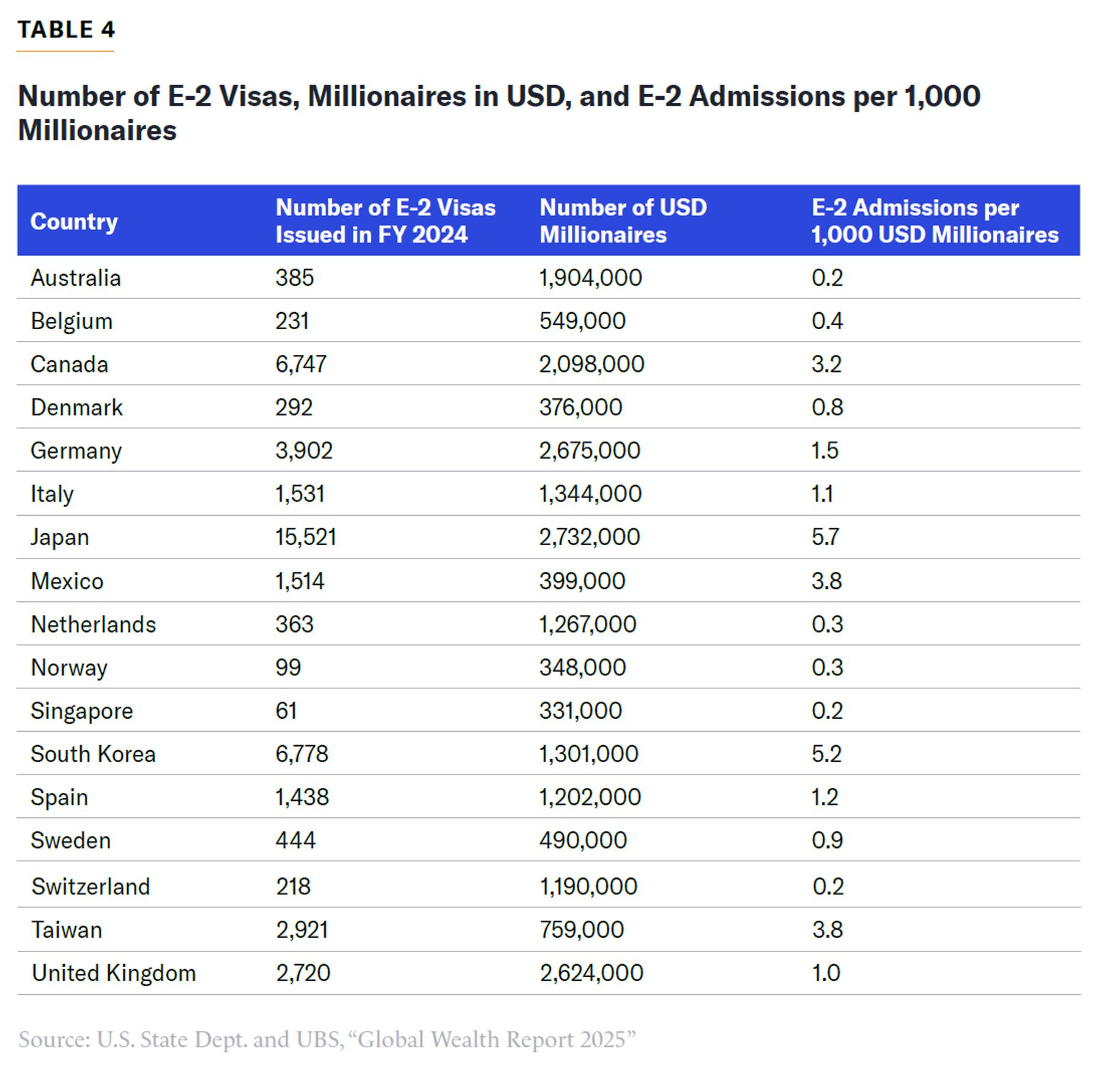
To estimate how many more investors from top HNWI nations like India, Brazil, and Saudi Arabia could be admitted annually if made eligible for E-2 visas, I use the current E-2 visa issuance per number of USD millionaires. The central estimate is based on the median rate of E-2 admissions per 1,000 USD millionaires of current top countries (1.04 per 1,000 USD millionaires), with a range between the 25th percentile rate on the low end (0.29 per 1,000 USD millionaires) and 75th percentile on the high end (3.22 per 1,000 USD millionaires) (Table 5).
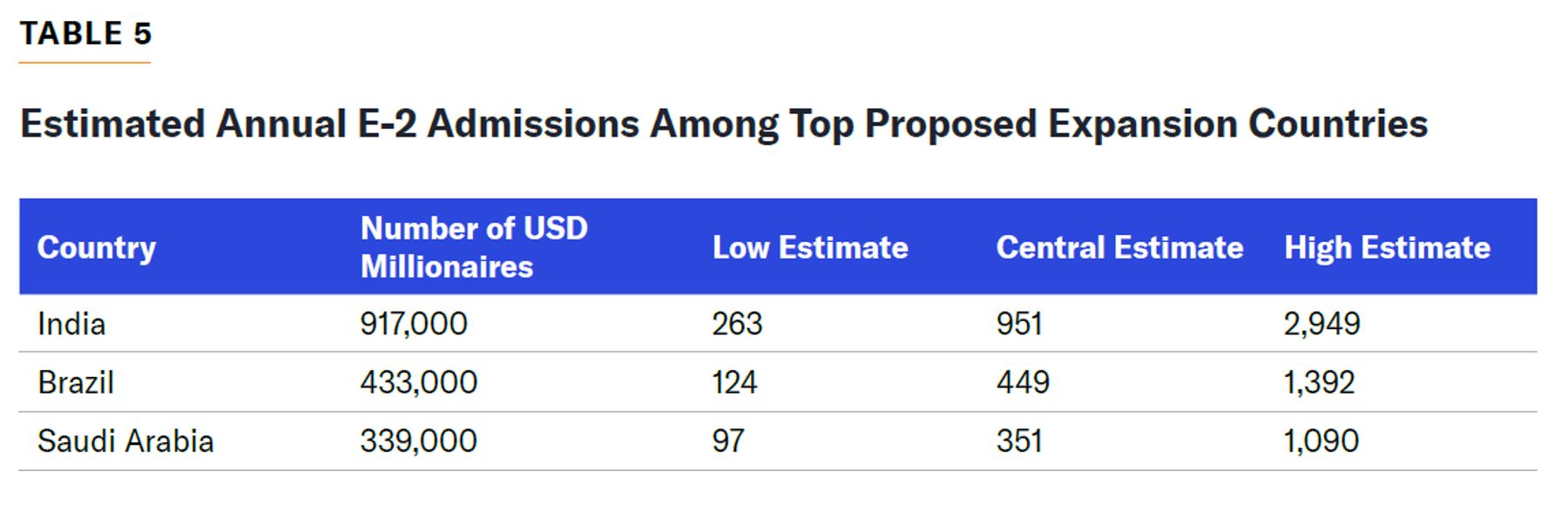
The number of potential E-2 admissions is not large, thus assuaging the concern that E-2 visa expansion would lead to a rapid increase in immigration. On the high end, fewer than 3,000 Indian investors would come to the U.S. annually; but on the low end, that number could be under 300. Among Brazilians and Saudi citizens, the estimated number of new E-2 immigrants would be fewer than 500 each annually. While these numbers may seem small, all of them would be among the top income earners of their countries, and, once in the U.S., they would generate substantial entrepreneurial activity, given that they must start a business that fully pays for their own living.
The one factor that may increase E-2 visa issuance, but not overall immigration, is Indian immigrants on H-1B visas choosing to switch to E-2 status to start a business. This is likely to happen only among Indians because they face decades-long wait times for employer-based green cards and thus have to wait for longer on less flexible H-1B visas than for E-2. Some Indian immigrants may prefer the E-2 because of the self-employment option and the reduced likelihood of facing a layoff that imperils their immigration status. However, switching to E-2 status may imperil their underlying approved green-card petition through an employer because, after switching, there will be no employer who has a petition for them. However, they can retain their priority date and then file for a gold card or EB-1 or EB-2 NIW self-petition.[46] Spouses of H-1B visa holders on the green-card backlog may also choose to use the E-2 visa for flexibility.
Furthermore, reformed E-2-eligibility requirements—allow dual intent, the use of venture capital funds, and a ownership threshold—may result in a doubling of the number of E-2 visas. That would mean an additional 55,000 E-2 admissions annually—and a few thousand more E-2 visas from newly eligible countries.
To estimate the potential tax revenue from these additional E-2 visa admissions, I make the conservative assumption that the average income and tax liability of E-2 visa investors is equal to that of noncitizens with a college degree from their own countries.
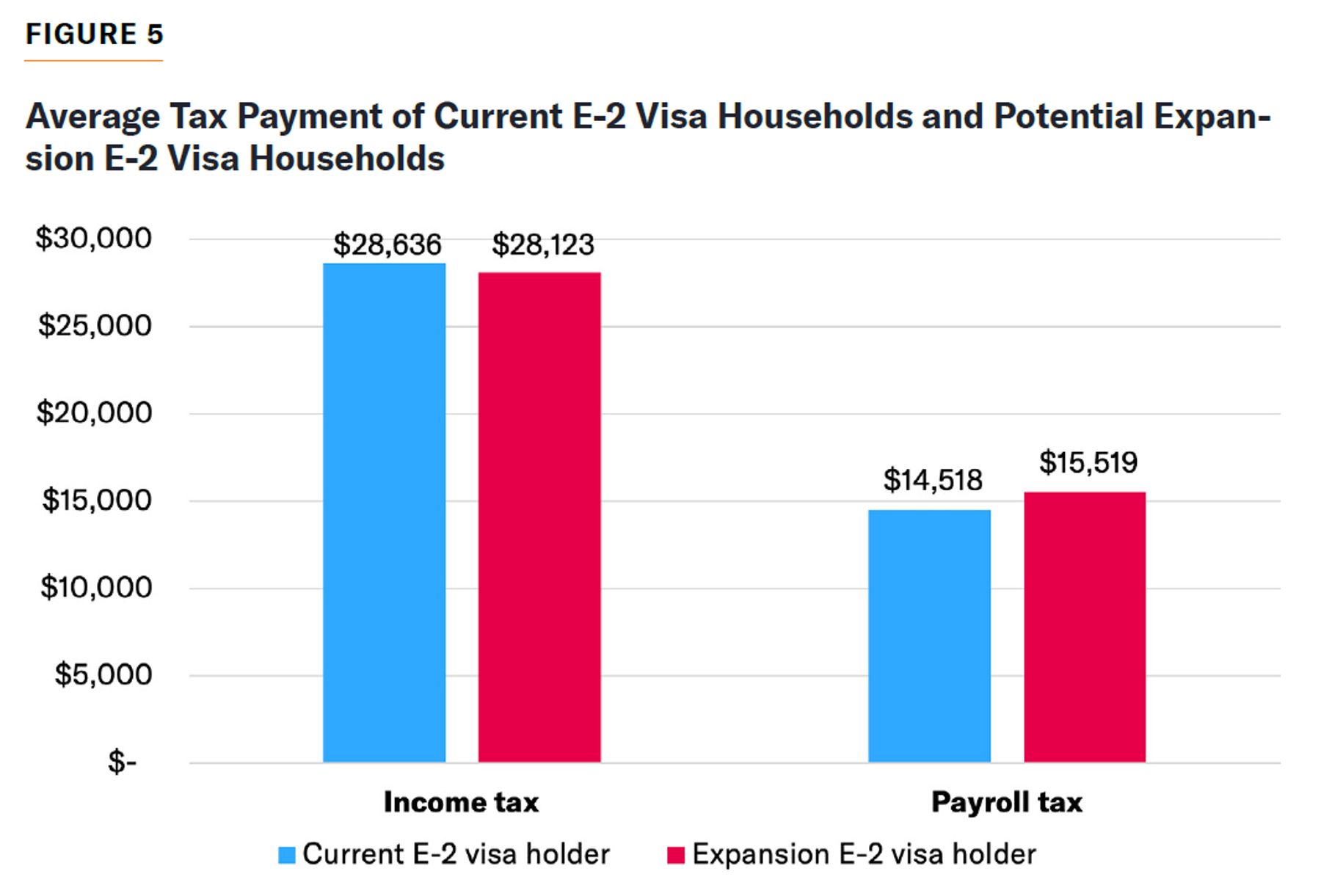
I find that current E-2 visa households likely pay approximately $28,600 in federal income tax after credits every year and $14,500 in payroll taxes, for a total of over $43,000 in annual payments. While we do not have data on the household size of E-2 visa holders, even if every visa holder brought a spouse with them, and most had a child similar to the average U.S. household size of 2.53 persons, then the average total tax payment for every E-2 visa is over $17,000.
To estimate the tax payments of the potential E-2 visa households from expansion countries, I use the characteristics of the college-educated immigrant population from expansion countries who already live in the United States. This population is mostly from India (72%). Although country-of-origin composition differs between current and expansion E-2 visa holders, both pay a similar amount in taxes, with expansion visa households paying $500 less in income tax and $1,000 more in payroll taxes annually (Figure 5). This difference likely reflects lower rates of self-employment among the expansion population, since the estimates are based on current immigrants with college degrees from those countries, which are not eligible for E-2 visas. The estimates are thus illustrative, suggesting that the economic characteristics of immigrants in the U.S. with a college degree from both source-country populations are similar.
With these data, I estimate the potential 10-year tax-revenue impact of E-2 visa reform assuming a doubling in issuance of E-2 visas for currently eligible countries and 10,000 additional annual E-2 visas as a result of country-eligibility expansion. These visas are valid for two years, and thus the equilibrium E-2 visa-holder population increases from 110,000 to 240,000. To be even more conservative, I assume tax-revenue growth equal to inflation and thus constant in real terms.
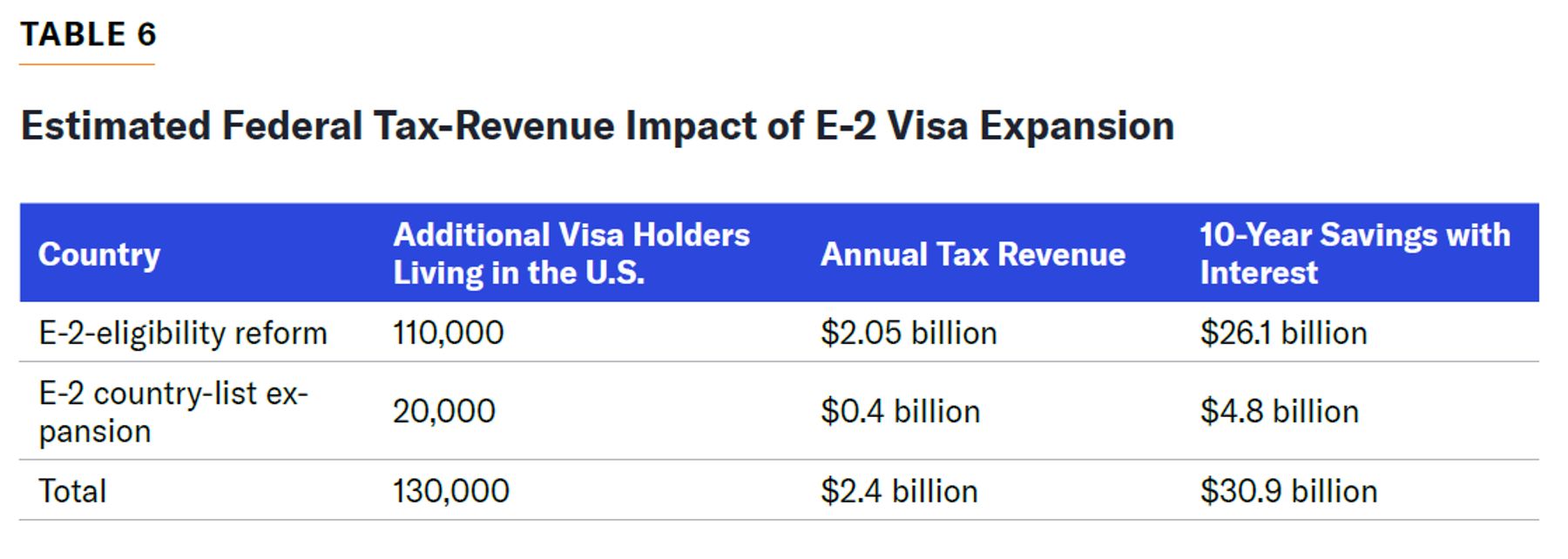
Under a conservative-assumptions scenario, expanding E-2 visa eligibility would increase U.S. tax revenue by $2.4 billion annually over the next decade, resulting in a nearly $31 billion smaller federal debt, merely as a result of increasing the U.S. population by a total of 130,000 people over that period (Table 6).
Furthermore, the additional immigrants would increase the size of the U.S. economy. To estimate exactly how much, I use the same methodology as with tax revenue—but this time, with the wage and business income of likely E-2 visa holders and potential E-2 visa holders from proposed expansion countries.
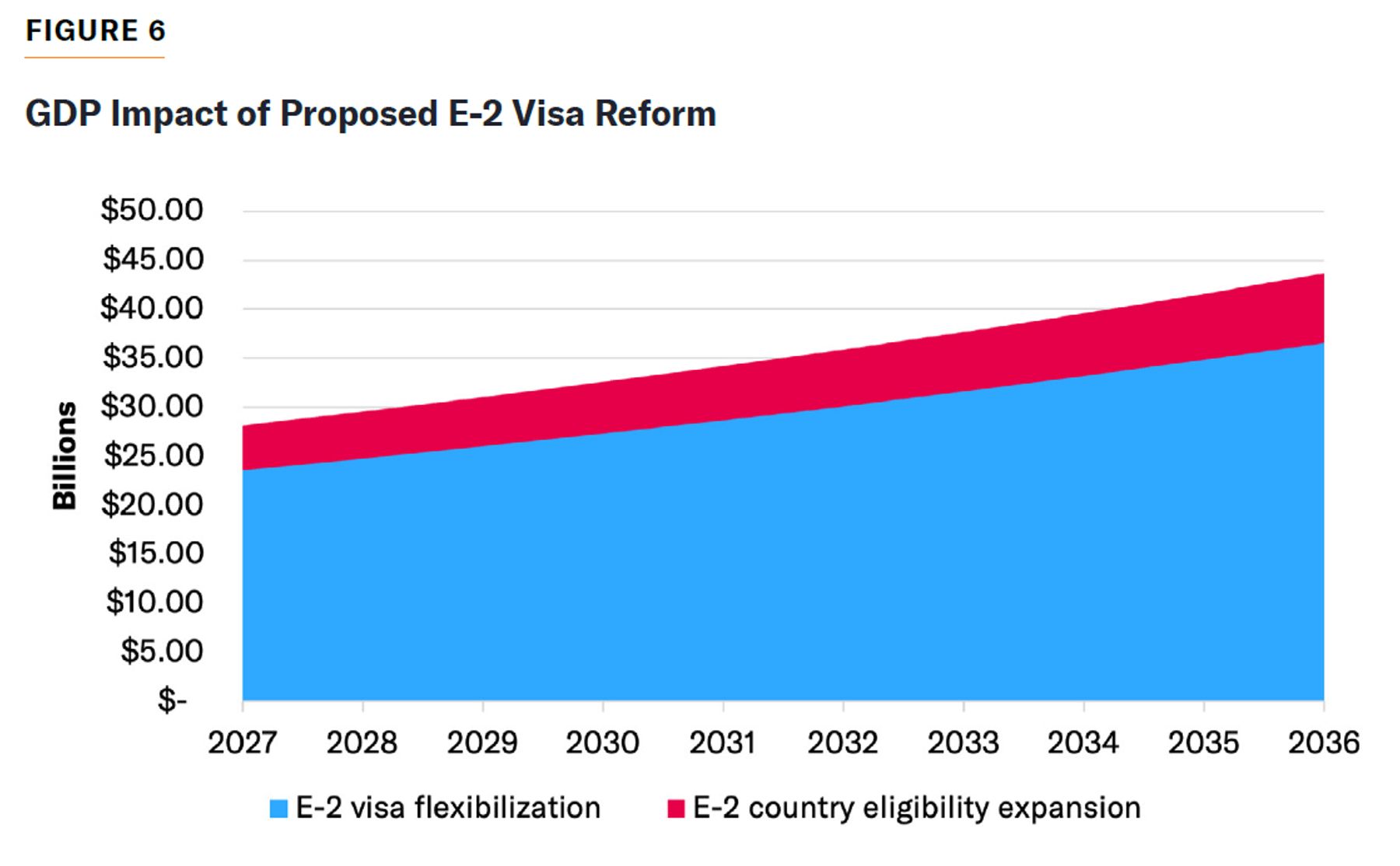
The proposed expansion population earns slightly higher incomes, as predicted by their higher tax payments. While the average likely E-2 visa holder earns $111,300 annually, the average proposed expansion country citizen earns $118,200 annually. To calculate their GDP impact, I divide these amounts by the labor compensation share of GDP, which was 51.9% according to the Bureau of Economic Analysis. In other words, each adult E-2 visa holder likely expands the economy by over $210,000 annually. This might be a slight overestimate, since economists have found that many business owners have reclassified labor income as capital income, with the goal of reducing tax liability.[47] Figure 6 shows the impact on U.S. GDP of both E-2 country-eligibility expansion and E-2 eligibility flexibility, assuming 5% nominal GDP growth and a constant labor share of GDP over a decade.
Conclusion
The EB-5 program has always been a green-card sale dressed up as economic development policy. But the EB-5 visa program is inefficient and requires byzantine processes and long wait times, making it a suboptimal way to allocate immigration rights. Trump’s gold-card plan, especially if implemented through a visa auction, can help solve these problems. Similarly, the E-2 temporary investor visa program is functioning far below its true potential, and a successful investment immigration strategy would expand this visa path so that it works in conjunction with a fixed EB-5 program.
The 2027 sunset of the EB-5 regional-center program is an opportunity for Congress to replace this archaic system with a market mechanism that can raise billions for the federal government. Combined with E-2 visa reform, an auctioned gold card would:
- Generate over $10 billion in new federal revenue per year and reduce the national debt by $81–$158 billion over a 10-year budget window.
- Expand the economy by $28 billion per year in the first year, rising to nearly $45 billion by the end of the decade, without accounting for better selection of immigrants through the EB-5 auction.
- Eliminate a substantial USCIS adjudication burden, freeing capacity for other tasks.
- Strengthen alliances with India, Brazil, the Gulf states, and Vietnam through reciprocal investor mobility that expands U.S. investment and trade abroad.
- Reduce fraud by removing the regional-center intermediary structure entirely.
Endnotes
Are you interested in supporting the Manhattan Institute’s public-interest research and journalism? As a 501(c)(3) nonprofit, donations in support of MI and its scholars’ work are fully tax-deductible as provided by law (EIN #13-2912529).