Good morning:
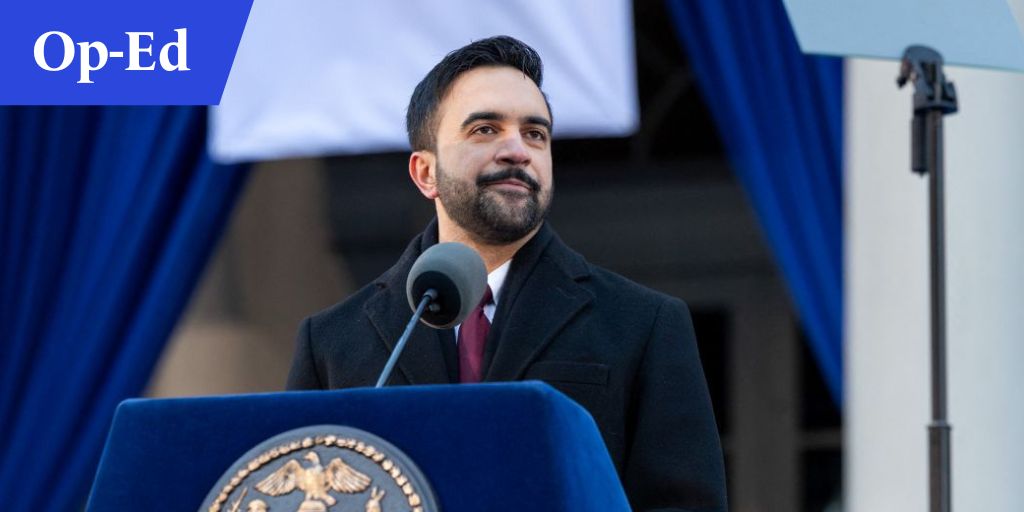
On New Year’s Day, the newly sworn-in Mayor Zohran Mamdani delivered an inaugural speech that reiterated he “was elected as a democratic socialist and I will govern as a democratic socialist.” Mamdani pledged to “make it possible for every New Yorker to afford a life they love once again.”
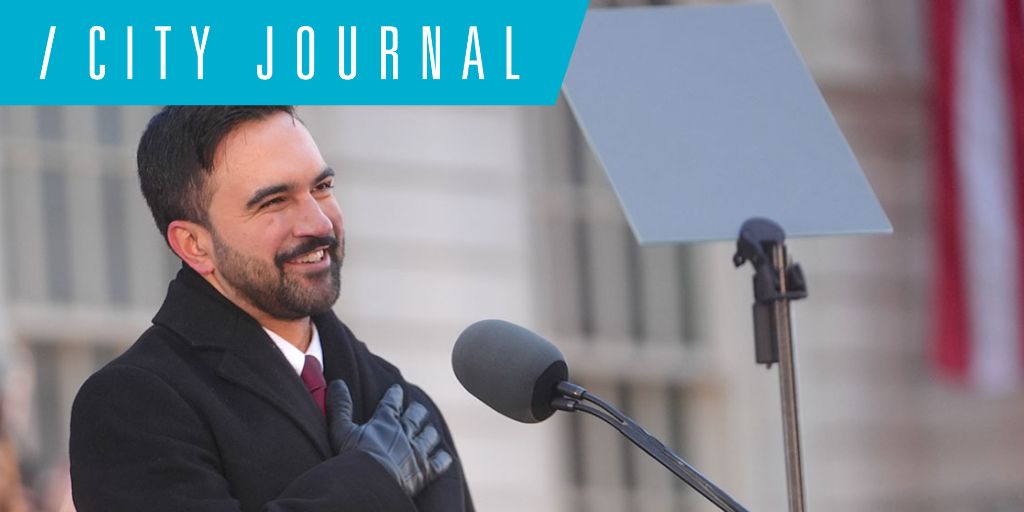
Mamdani’s charm makes socialism look easy, writes senior fellow Nicole Gelinas in City Journal, but his painless new order completely ignores the laws of supply and demand. Make buses free, and demand will soar. Freeze the rents, and the supply will collapse. A mayor can make city government more efficient and effective, which would bring down the cost of government, but even Mamdani will not be able to ignore market forces for long.
And New Yorkers will be unable to ignore the willed disorder that “is set to worsen markedly in Zohran Mamdani’s New York,” fellow Heather Mac Donald writes in City Journal. Law enforcement should be allowed to lock up serial offenders as soon as possible, but putting the interests of regular citizens first has become an alien concept to most Western elites.
Across the country, progressive policymakers are attempting to reshape the market for gig workers, writes legal policy fellow Jarrett Dieterle in the Washington Post. In New York and California, lawmakers are imposing one-size-fits-all rules that tie the hands of business leaders and limit what gig workers most highly prize: flexibility and autonomy.
Just days after Mayor Mamdani took the helm of New York City, the Trump administration conducted a secret operation in Caracas, Venezuela, and captured self-declared president Nicolas Maduro. He now sits in Brooklyn’s Metropolitan Detention Center and faces charges of narco-terrorism conspiracy, cocaine-importation conspiracy, and weapons charges, according to the unsealed federal indictment.
For years, MI’s own Daniel Di Martino, a Venezuelan expatriate, has written about how Maduro’s failed socialist policies, government rationing, food shortages, electricity blackouts, and hyperinflation destroyed his home country. In the New York Post, Di Martino captured his elation—“Venezuela now has a chance to be free again”—and warned that policies advanced by American democratic socialists like Mamdani resemble the ones he and other Venezuelans in the United States fled.
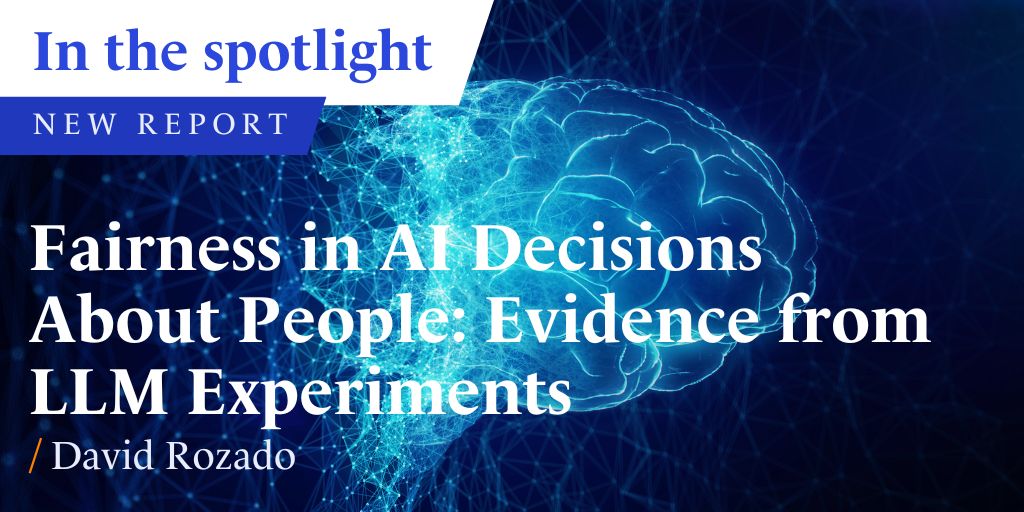
Finally, in a new report, researcher and academic David Rozado used thousands of controlled comparisons to study whether large language models show gender or ethnic bias in making high-stakes decisions that directly affect people, in contexts like loan approvals, promotion or firing decisions, and medical assessments. The study raises important ethical questions about how AI should balance fairness for individuals and among groups.
Continue reading for all these insights and more. Kelsey Bloom Editorial Director |
|
|
Fairness in AI Decisions About People: Evidence from LLM Experiments By David Rozado | Manhattan Institute
In a new Manhattan Institute report, David Rozado examines whether large language models (LLMs) exhibit gender or ethnic bias when making high-stakes decisions about people, such as in hiring, promotions, admissions, or layoffs.
Using thousands of controlled, pairwise comparisons with evenly matched candidates, Rozado finds that most leading LLMs slightly favor female candidates in decisions about favorable outcomes, like job promotions or university admissions. Removing explicit gender information reduces but does not eliminate the disparity, suggesting that candidates’ names can still serve as implicit gender cues. In decisions with unfavorable outcomes—such as layoffs or evictions—models generally behave in a gender-neutral manner. Experiments on ethnicity show even smaller effects, most of which disappear once explicit ethnicity cues are removed.
Rozado also identifies a non-demographic source of bias: models often favor whichever candidate appears first in the prompt, highlighting their sensitivity to arbitrary design choices. He concludes that masking demographic cues, auditing outcomes, mitigating order effects, and establishing oversight are essential safeguards before deploying AI in high-stakes decision-making. |
|
|
Regulatory Attacks on Gig Work Hurt Both Companies and Workers
By Jarrett Dieterle | The Washington Post
“For close to a decade now, policymakers have been locked in a battle over how to regulate workers in the gig economy. ... (But) the debate is evolving. Rather than simply pursuing the forcible reclassification of gig workers into full-time employees, the political left is seeking to accomplish the same end by different means. ...
“Establishing a minimum wage, eliminating at-will employment and permitting unionization and sectoral bargaining are all policies that commonly attach to full-scale employer-employee relationships—which is indeed the point. If reclassification is not possible, the effort to functionally convert gig workers to full-time employees can simply be pursued through other means.
“These various rules do not just hurt large companies. They ultimately hurt gig workers, too. According to surveys, gig workers prioritize flexibility and autonomy. Imposing one-size-fits-all rules will result in outcomes such as arranged scheduling for car-share drivers.” | | |
Mamdani Does Not Stand with Venezuelans — It Was Maduro and ‘Collectivism’ That Destroyed My Country
By Daniel Di Martino | New York Post
“For years, Venezuela has been a grim testament to what happens when socialism takes over: broken hospitals, rampant crime, mass emigration, and the unpunished proliferation of drug trafficking through a regime that weaponizes misery against its own people and the world to profit and remain in power.
“I know this because I lived it. I escaped a country hollowed out by socialist dictator Nicolás Maduro and his predecessor, Hugo Chávez. ... This is why statements such as those of New York City Mayor Zohran Mamdani condemning Trump’s move on behalf of Venezuelans in New York City is so shameful.
“Venezuela’s economy was destroyed by what Mamdani called ‘warm collectivism,’ not the American rugged individualism he decried. It was nationalizations and endless government ‘free stuff,’ public housing projects and eviction prohibitions, price controls and onerous regulations. These are very same policies supported by the mayor. They all failed spectacularly.”
Related: |
|
|
The West Can Protect Itself from Terrorism and Urban Violence
By Heather Mac Donald | City Journal
“The ‘good’ news about the Islamic terrorism and domestic urban violence that have rocked Western nations in recent months is that the attacks were foreseeable—and thus preventable. The bad news is that the fear of being called ‘racist’ will stymie many governments’ ability to act on that foresight. ...
“The same wearying predictability applies to the grotesque street crimes in American cities committed weekly by mentally ill vagrants. ... We are not surprised to learn of the perpetrators’ long criminal records and their avoidance of significant confinement, either in a prison or a mental institution. The exact time and location of the next atrocity may be unknown, but that more such attacks by the same class of perpetrators are coming is certain. ... “This predictability should be a boon to any official who puts public safety ahead of more recent priorities such as promoting diversity and tolerance. Only Donald Trump, however, among Western leaders, possesses the indifference to elite opinion to enact the obvious prophylactic measures.” |
Socialism Made Easy
By Nicole Gelinas | City Journal
“In attempting to Make New York Affordable Again, ... Mamdani is up against an immense force, bigger than charisma or cunning: the marketplace. New York is unaffordable, or at least expensive relative to many other American cities, for many reasons, including its and the state’s environmental and labor regulations and mandates, which push up costs. But it’s also expensive, at some base level, because of intense market demand that cuts across income and education levels. “Rich people want to live here. Poor people want to live here. Young people want to live here. When they get older and have kids, more of them want to stay. New college graduates want to come here. Migrants, lawful and unlawful, come, too. ...
“Mamdani may prefer to ignore the market, but the market won’t ignore him. ... The one force that would make New York City radically cheaper, and thus competitive with most other American cities and suburbs, is lower demand.” |
The Manhattan Institute is proud to serve as the Principal Institutional Partner for the Sun Valley Policy Forum’s 2026 Winter Summit in the iconic resort town of Sun Valley, Idaho on February 11, 2026.
We are thrilled to join Joe Lonsdale and MI senior fellow Christopher F. Rufo for an evening on principled leadership and the future of American institutions in an AI-driven era.
Please click here to learn more about the Sun Valley Policy Forum and our partnership and to purchase tickets at a discounted rate for friends of the Manhattan Institute. |
|
|
Who We Are: Crime and Public Safety (with Heather Mac Donald)
By Manhattan Institute
In the first episode of our new Who We Are series, Heather Mac Donald and Rafael Mangual discuss the work of the Manhattan Institute and City Journal on crime and public safety over the years.
They cover “broken windows” policing, disparate impact, the reality of interracial crime, why public order matters, and what Mayor Zohran Mamdani’s policies will mean for daily life in New York City. |
|
|
For more information and media requests, please contact
communications@manhattan.institute.
Are you interested in supporting the Manhattan Institute’s public-interest research and journalism? As a 501(c)(3) nonprofit, donations in support of MI and its scholars’ work are fully tax-deductible as provided by law. |
|
|
Photo Credits: adamkaz/E+/Getty Images; Noah Berger/AP Photo; Anadolu/Getty Images; Wong Yu Liang/Getty Images; Catherine McQueen/Getty Images; Probal Rashid/LightRocket/Getty Images |
|
|
The Manhattan Institute works to keep America and its great cities prosperous, safe, and free. Manhattan Institute 52 Vanderbilt Ave. 3 floor New York, New York 10017
Want to change how you receive these emails?
Unsubscribe | Subscription Preferences
Copyright © 2025 Manhattan Institute, All rights reserved. |
|
|
|