Good morning:
This week, the Manhattan Institute’s director of higher education policy, John D. Sailer, published a column at the Wall Street Journal highlighting how the biggest funder of the humanities in the United States is subsidizing university programs and faculty specializing in “Ecowomanism,” “Black Trans Studies,” and similarly radical academic specialties. The column draws on Sailer’s original research and public-records requests to show how the Mellon Foundation, an organization which once avoided controversy and supported or created useful research projects like JSTOR, took on a new ideological mission that portends trouble ahead for the academy.
Medical schools face a similar challenge, adjunct fellow Wai Wah Chin writes in the New York Post. Courses in “Microaggressions in Clinical EM Simulation” and “Allegories on Racism” in medical, dental, and similar schools across the country do not lead to better medical professionals. DEI in medical schools is degrading education, which degrades medical care and research, creating dangerous consequences for all of us.
The MI Research team published a report today that introduces a new framework to measure school performance and effectiveness. William Henson applies his “Educational Return on Investment” measure to New York City schools and finds staggeringly expensive results. Henson finds that there are more economically efficient and pedagogically effective schooling alternatives than the public school system as it exists today.
Elsewhere in this newsletter, Cities policy analyst Santiago Vidal Calvo analyzes President Trump’s proposal to cap credit card interest rates, for City Journal. And senior fellow Nicole Gelinas examiners Mayor Zohran Mamdani’s handling of NYC’s recent snowstorm.
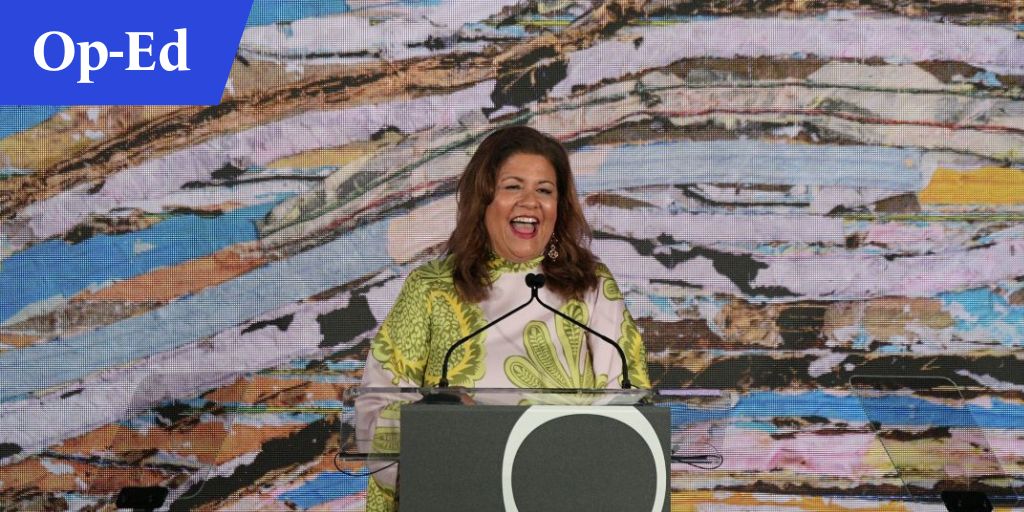
Finally, City Journal is pleased to publish Ben Shapiro’s recent remarks upon receiving the 2026 City Journal Award. Shapiro diagnoses the nihilistic and power-hungry tendencies seen too often in contemporary American politics and, with truthful optimism, leads the charge to rekindle the spirit of the American founders and forefathers. Shapiro’s reminder of the American Dream is an essential lesson this year particularly, the 250th anniversary of the American Founding.
Continue reading for all these insights and more. Kelsey Bloom
Editorial Director |
|
|
If You Can't Measure It, Can You Improve It?
By William Henson | Manhattan Institute
In a new Manhattan Institute report, William Henson offers a novel framework to measure school performance—Educational Return on Investment (EROI)—that integrates spending with concrete outcomes such as test scores, high-school and college graduation rates, and college completion. Rather than examining costs or results in isolation, EROI asks a simple question: How much does it actually cost to produce a high-school or college graduate? Given the scale of investment in education—nearly $1 trillion annually, more than on any program aside from major entitlements—it is important that policymakers are able to clearly determine whether that spending yields strong returns.
Applied to New York City and State public schools, EROI yields sobering results. In NYC, cumulative K–12 spending was roughly $240,000 per student in the years analyzed, but the cost per college graduate approached $1 million. For low-income students, it was significantly higher. Statewide figures were similar.
Henson also shows how the EROI framework can help guide reform by identifying effective school systems. For example, an alternative K–12 model—the Catholic elementary school system paired with Cristo Rey Brooklyn High School—produces college graduates at a fraction of the cost, despite serving primarily low-income students. |
|
|
The Mellon Foundation’s Idea of ‘Social Justice’
By John D. Sailer | Wall Street Journal “For much of its existence, the Mellon Foundation narrowly supported the arts and humanities. One signature project was the creation of JSTOR, the widely used online database of academic research. The foundation avoided controversy. That changed with the dawn of the social-justice era. ... “Mellon has bankrolled many professors notorious for their activism. At the Socialism 2025 conference, Assistant Prof. Eman Abdelhadi referred to her employer, the University of Chicago, as ‘evil’ and a ‘colonial landlord,’ but conceded that working there was useful for political organizing. ...
“Mellon’s funding has amplified a bleak trajectory for the academy. Today, a young person drawn to traditional fields like military history or classics should think twice before entering academia. A young scholar who ‘advances an anti-capitalist, prison abolitionist agenda,’ as one Ohio State professor puts it, can find abundant support, especially from the Mellon Foundation. Higher education reform will only succeed when this unfortunate trend is reversed.” Related: |
|
|
The Death of DEI: Med Schools’ Racial Preferences Degrade All Doctors
By Wai Wah Chin | New York Post
“Have you been to a doctor recently? Or seen a nurse? Lucky you if your doctor or nurse graduated long ago! Americans’ trust in the medical profession has tanked — from 73% confidence in medical leaders in 1966 to a feeble one-third in 2022, with only one in five people feeling confident about the health-care system. ...
“Two recent stories show why Americans increasingly distrust the profession. The smaller repugnant story: A Virginia nurse (now fired) urged medical providers to sicken ICE agents with laxatives, paralytics or poison ivy. ... Must patients worry about health-care providers considering themselves activists first, dehumanizing people to identity labels? The larger, far more consequential story also involves identity and activism. ... For example, “when patients head to the emergency room, they’ll be happy to know that Georgetown University Emergency Medicine Residency Program students took courses like ‘Microaggressions in Clinical EM Simulation’.” |
|
|
Stop Listening to the Pessimistic Chaos Agents. America Kicks Ass.
By Ben Shapiro | City Journal
“Both the Left and significant segments of the Right—call them the horseshoe Right—are no longer interested in solving concrete problems. Instead, both are fascinated with the idea of a simple, magical pill that will wipe away all problems at once. That’s because both the Left and this swath of the Right have decided that our problems are unsolvable. ...
“The solution, according to both Left and horseshoe Right: power. Not the sort of power sufficient to solve problems, which is to say the sorts of power the Founders envisioned, divided between branches and levels of polity. But a sort of unbridled and unchecked power sufficient to overthrow everything. ...
“The American dream isn’t a dream of a Marxist commune or a feudal estate. It’s not the dream of a tutelary power presiding over a vast redistributive scheme. ... It is the dream of a free and ethical people, crossing oceans and mountains to build better lives for themselves, carving communities from wilderness, trading with and giving to one another."
Related: |
Why Trump’s Credit Card Rate Cap Is a Bad Idea
By Santiago Vidal Calvo | City Journal “Perhaps feeling the heat of ‘affordability’ concerns, President Donald Trump recently revived one of those bad ideas that never seem to die: a cap on credit card interest rates. His current proposal would limit rates to 10 percent, reportedly for one year.
“On its face, the pitch sounds appealing. As of November 2025, the median bank credit-card annual percentage rate (across all accounts) was roughly 25.3 percent. Americans are now carrying record credit-card debt. Washington already regulates how credit cards disclose costs, and it even restricts certain fees. Why not cap the interest rate, too? ... “But the question becomes: What replaced high-rate borrowing? Consumers’ credit needs don’t just vanish—they re-route into other products, fees, or informal alternatives.” |
|
|
By Manhattan Institute
“The mayor has focused on public outreach videos and TikTok style public service announcements to get people to call 311 or 911. People are responding to this and they are calling, but it's simply taking too long to get the ambulances to these people, and that's not something that the mayor has dealt with adequately.”
Related: |
|
|
For more information and media requests, please contact
communications@manhattan.institute.
Are you interested in supporting the Manhattan Institute’s public-interest research and journalism? As a 501(c)(3) nonprofit, donations in support of MI and its scholars’ work are fully tax-deductible as provided by law. |
|
|
Photo Credits: adamkaz/E+/Getty Images; Noah Berger/AP Photo; Anadolu/Getty Images; Wong Yu Liang/Getty Images; Catherine McQueen/Getty Images; Probal Rashid/LightRocket/Getty Images |
|
|
The Manhattan Institute works to keep America and its great cities prosperous, safe, and free. Manhattan Institute 52 Vanderbilt Ave. 3 floor New York, New York 10017
Want to change how you receive these emails?
Unsubscribe | Subscription Preferences
Copyright © 2025 Manhattan Institute, All rights reserved. |
|
|
|