Do Democrats Want to Be “Normal”? Survey Analysis of Today’s Democratic Coalition

Photo: UniqueMotionGraphics / iStock / Getty Images Plus
A new national survey conducted by the Manhattan Institute examines today’s Democratic coalition and the tensions shaping the party ahead of the 2026 midterm and 2028 presidential election cycles. The poll reached 2,593 respondents who are either registered Democrats and/or voted for Kamala Harris in 2024. The survey also includes oversamples of Hispanic and black voters who meet that criteria.
This study helps clarify a central question confronting the modern Democratic Party: is the median Democratic voter actually moving left—or is the party being pulled left by a smaller activist faction that dominates elite discourse and low-turnout politics? The findings point to a coalition that is often more moderate, more internally divided, and more pragmatic than what is found across left-leaning social media, cable news, and donor-funded groups. More voters favor moving the party toward the ideological center than further left.
The Democratic coalition is best understood as three blocs. The largest bloc—Moderates—hold middle-of-the-road views across many of the most contentious issues in national politics, including immigration, crime, transgender policy, and DEI. A second bloc—Progressive Liberals—leans left but remains closer to the party’s institutional mainstream. A significantly smaller but distinct third bloc—the Woke Fringe—takes consistently maximalist positions on issues and is disproportionately young and conspiratorial.
Across issue areas, the coalition’s preferences tend to reflect this structure. On immigration, only one-in-ten take a true “open borders” position, less than one-in-four want to see more legal migrants come into the country, and majorities support shifting to prioritize skills-based immigration and deporting criminals. On public safety, the coalition is divided over the criminal justice system in general, but it strongly supports aggressive prosecution of gun crimes, views the police as essential, and rejects political violence. On transgender issues, most voters support parental notification requirements, preventing biological boys from participating in girls’ sports, and age limits on medical transitions. On economics, the coalition favors redistribution and consumer protections, but it shows limited appetite for “burn it down” politics, real concerns about welfare fraud, and a new interest in free trade as well as certain other supply-side policies. On Israel, most voters affirm the Jewish state’s right to exist, though younger voters are markedly less supportive and more open to antisemitic tolerance. And on national identity more broadly, two in three Democrats see America as historically a force for good in the world.
The political implication is straightforward: activist politics often speaks for the most ideologically intense voters, but on many issues, the majority view within the coalition is that of the Moderates—often alongside black and Hispanic voters—rather than the party’s most activist faction. The Woke Fringe, however, may still exert outsized influence in low-turnout primaries and online discourse. Because this group is younger, it represents a plausible source of future ideological change inside the party, even if it is not the median position today.
For the purposes of this report, the Democratic coalition—or today’s Democrats—refers to (1) all 2024 Harris voters, regardless of party registration, and (2) all registered Democrats, including those who did not vote for Harris. To understand the coalition more precisely, we divide it into three analytically distinct blocs based on self-identified ideology:
- Moderates (47% of the Democratic coalition)—voters who describe themselves as a “Moderate Democrat,” “Independent,” or “Anti-Trump Republican.”
- Moderates form the largest segment of the coalition. With an average age of 53, they are somewhat more likely to be non-college graduates and are demographically diverse: 62% white, 17% black, 13% Hispanic, and 5% Asian. More than half live in suburban communities, and they are the most electorally flexible faction in the coalition—only 45% say they have never voted for a non-Democratic presidential candidate.
- Progressive Liberals (37% of the Democratic coalition)—voters who describe themselves as a “Liberal Democrat” or “Progressive Democrat.”
- Progressive Liberals are similar in age, averaging 52 years old. They are the whitest (65%, with 11% Hispanic, 17% black, 5% Asian) of the three groups and are evenly split between those with a college degree and those without. A large majority describe themselves as ideologically left leaning. This group is also disproportionately concentrated on the West Coast and in suburban areas.
- The Woke Fringe (11% of the Democratic coalition)—voters who describe themselves as a “Democratic Socialist” or “Communist.”
- The Woke Fringe stands apart demographically and attitudinally. It is the youngest faction, with an average age of 43 and seven in ten members under the age of 50. It is the group with the fewest Hispanics (6%) but the largest proportion of black (22%) and Asian voters (7%); 60% are white. This group is more likely to live in urban areas, particularly in the Northeast. Ideologically, it is the most consistently left-leaning faction, with a majority identifying as “very left-leaning.” Members of this group are also significantly more likely than other Democrats to report poor mental health (25%), compared to the other groups (14% for Moderates, 16% Progressive Liberals.)
Full Results Available: Toplines, Crosstabs
Methodology
Between February 6 and 15, 2026, the Manhattan Institute surveyed three separate national audiences: 1,782 registered Democrats and/or 2024 Harris voters, 828 black Democrats and/or 2024 Harris voters, and 388 Hispanic Democratic and/or 2024 Harris voters. The sample was reached via online panels (1,968 interviews) and SMS-to-web (625 interviews).
While also reported separately, the black, Hispanic, and general Democrat voters were merged into one national Democrat sample and weighted to reflect Democrats nationwide on gender, education, age, ethnicity, density (i.e., suburban, urban, rural), and region. When referred to specifically, black and Hispanic voters are treated as separate, unweighted samples.
For 2028 presidential primary questions, answers were filtered to a sample of 1,494 likely voters based on whether they said they were “extremely” or “very” likely to vote in the 2028 Democratic presidential primaries.
The margin of error is ±2.3% for the general Democrat sample, ±3.4% for the black sample, and ±5.0% for the Hispanic sample. The margin of error for 2028 presidential primary questions is ±2.5%.
Party Direction
Figure 1
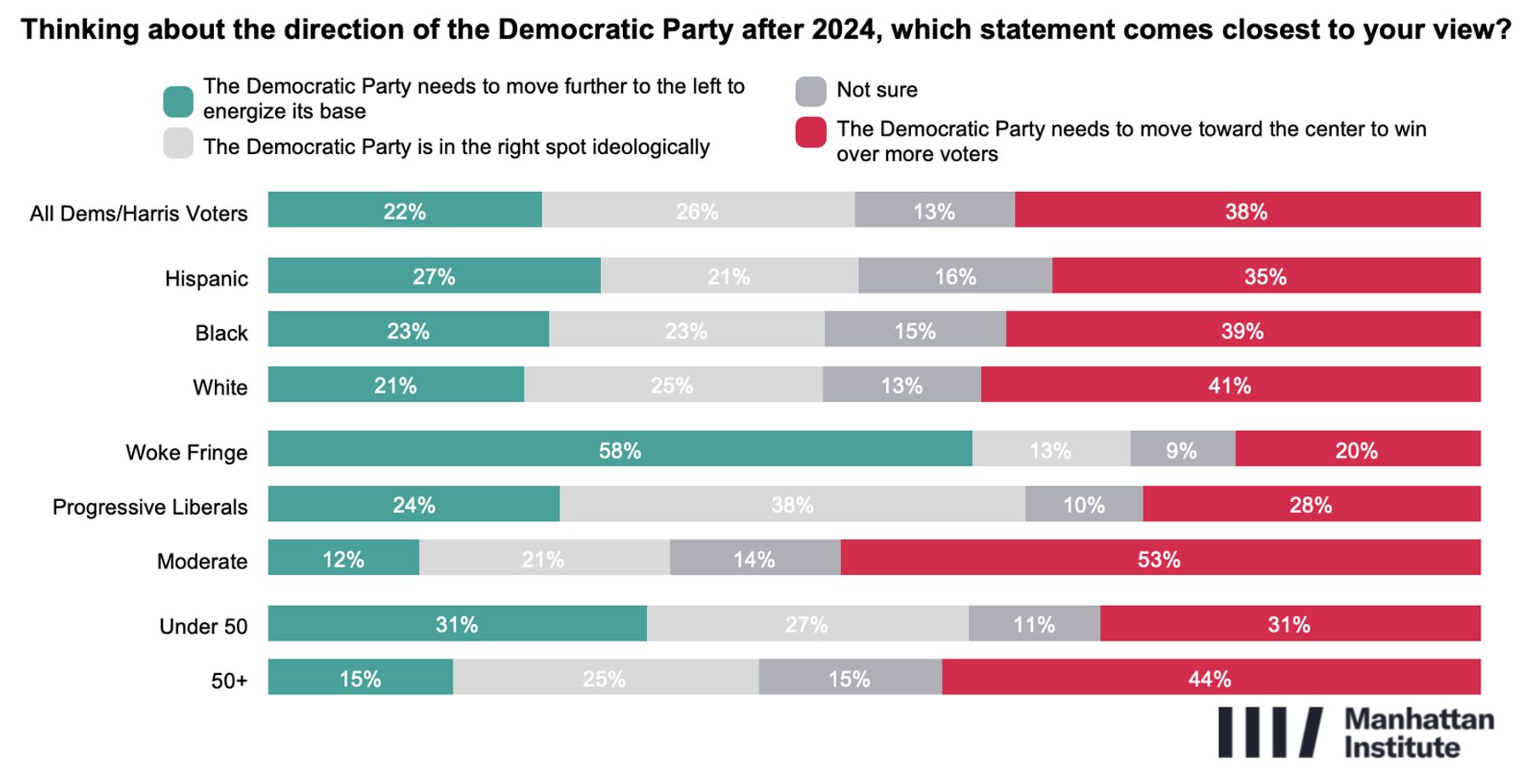
Despite the prominence of the hard left within Democratic politics and corners of social media, today’s Democratic coalition shows a clear preference for moderation. A plurality (38%) say the party should move toward the ideological center, compared with 26% who believe it is in the right place and 22% who want it to move further left.
There is broad support across the coalition for a shift toward the center. Pluralities of black voters (39%), Hispanic voters (35%), and white voters (41%) favor moving toward the center, as do both women (37%) and men (40%), as well as college graduates (39%) and non-graduates (38%). Moderates are the most supportive of a shift (53%), but even among Progressive Liberals, two-thirds either say the party is in the right place (38%) or favor moving toward the center (28%). Only the Woke Fringe registers majority support (58%) for moving further left.
This preference for moderation is mirrored in voters’ expectations for Democratic leadership. By more than two to one, respondents say that future presidential candidates should prioritize effective governing over fighting Donald Trump and Republicans (63% to 27%). This view holds across all segments of the coalition, including the Woke Fringe.
2028 Presidential Primary
Among likely Democratic primary voters, the early 2028 field remains fluid. Kamala Harris holds a narrow plurality at 23%, followed closely by Gavin Newsom at 20%. Pete Buttigieg trails in third with 8%, followed by Alexandria Ocasio-Cortez (AOC) at 7%, Josh Shapiro at 5%, and Mark Kelly at 4%. No other potential candidate exceeds 2%.
Figure 2
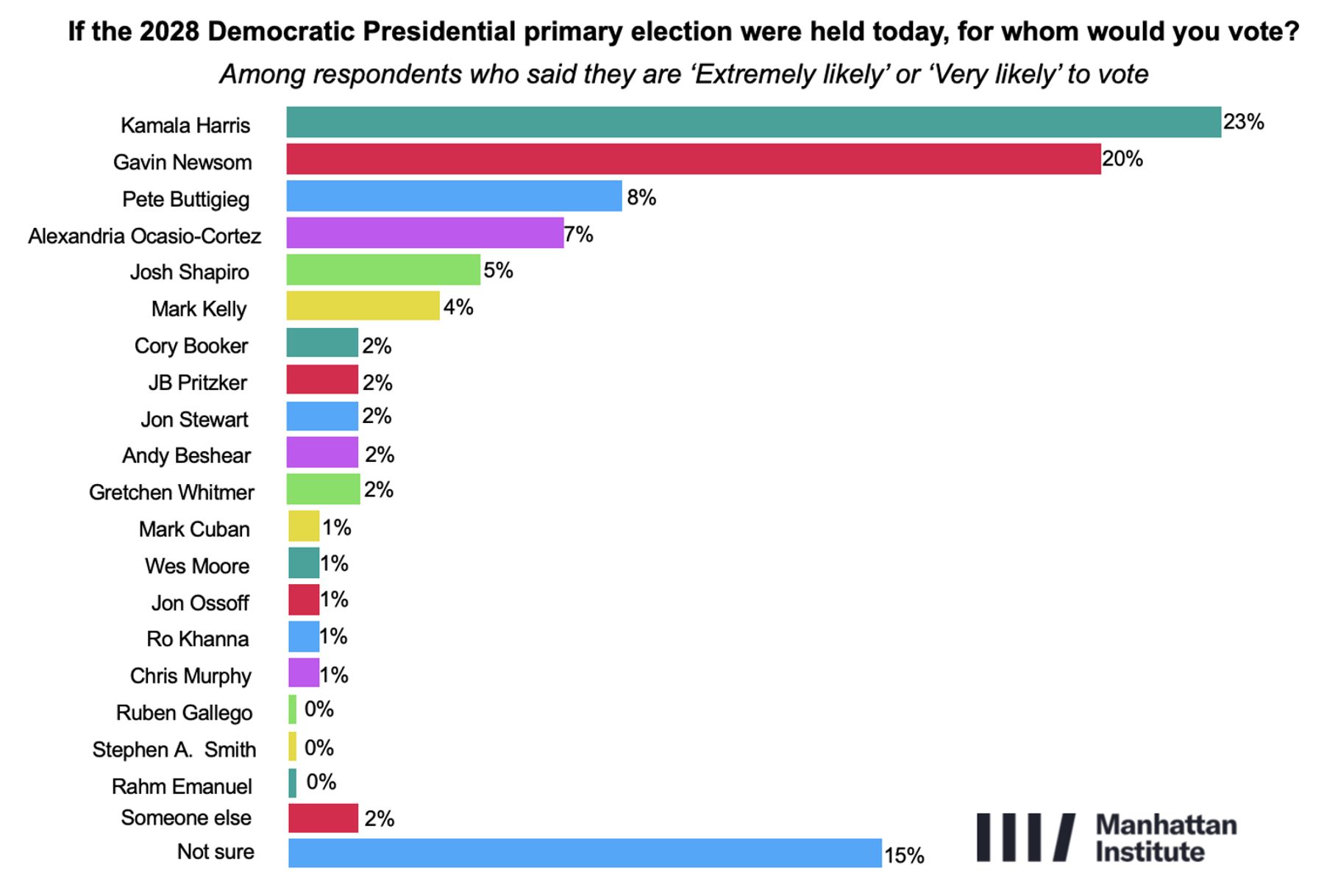
Harris’s advantage is driven largely by her strength among black voters, where she leads Newsom by 34% to 14%, followed by Cory Booker at 6%. Among white and Hispanic primary voters, however, Newsom holds a modest edge, leading Harris 19% to 17% with each group.
Ideological divisions further shape the contest. Moderates narrowly favor Harris over Newsom (24% to 21%), while Progressive Liberals are evenly split between the two (23% each), with Buttigieg registering 10%. Among Woke Fringe voters, AOC leads (26%), followed by Harris (20%) and Newsom (10%). Among 18–29-year-olds, Harris leads with 31% and AOC is second with 24%.
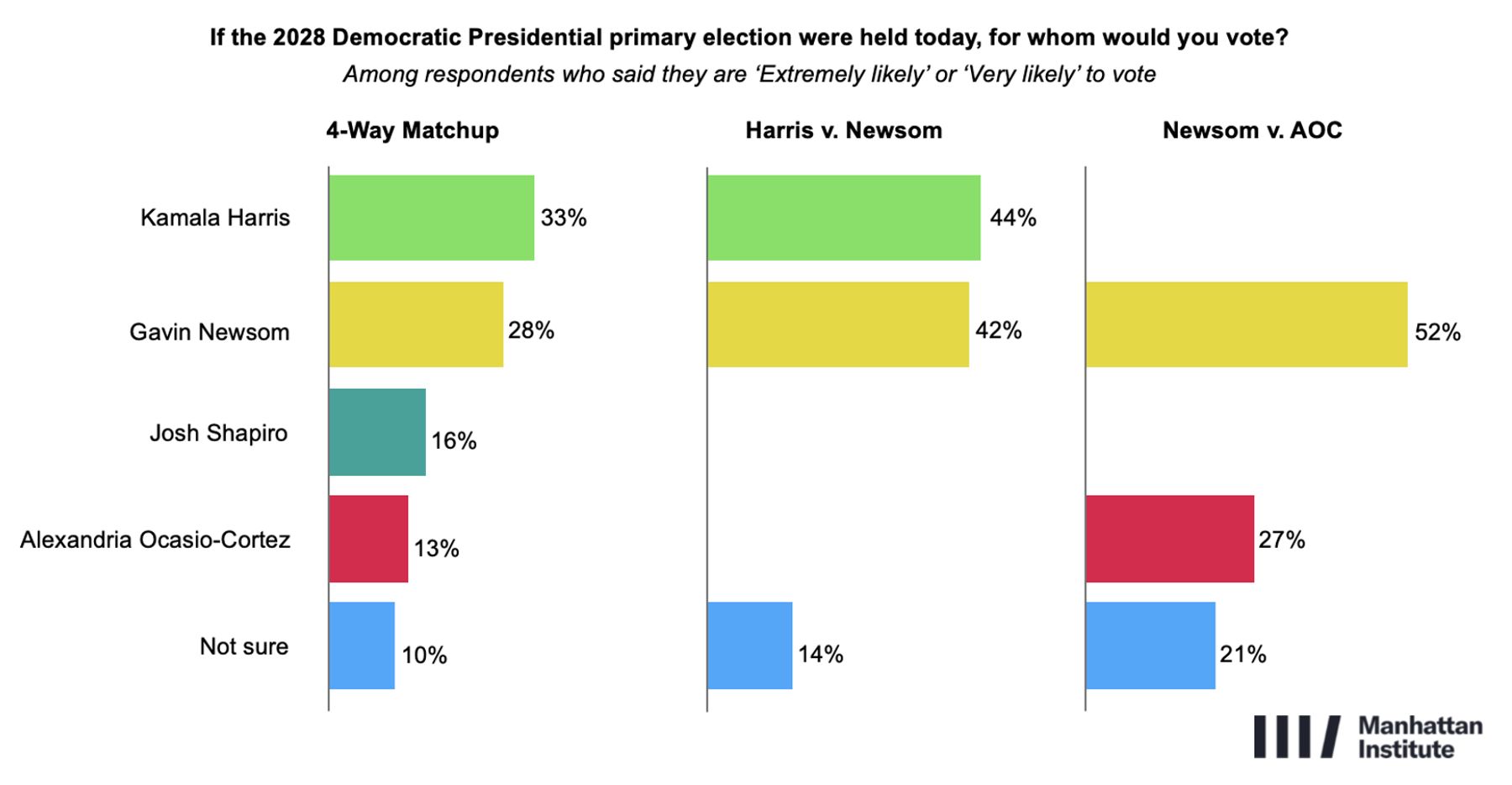
When testing a narrower field, Harris remains the top-performer—albeit by a relatively slim margin. In a four-way matchup with Newsom, AOC, and Shapiro, Harris leads (33%), followed by Newsom (28%), Shapiro (16%), and AOC (13%). A two-way Harris–Newsom contest is essentially tied (44% to 42%), but in a Newsom–AOC matchup, Newsom prevails decisively, defeating AOC by 25 points.
Figure 3
There may also be interest in an outsider. More than half (55%) of Democrats support a notable figure outside of politics running for the Democratic presidential nomination in 2028, with only one in five (18%) opposed. That view is somewhat more prevalent among Moderate Democrats and Progressive Liberals than the Woke Fringe, suggesting that such a figure could represent the center.
Favorability and Electability
Figure 4
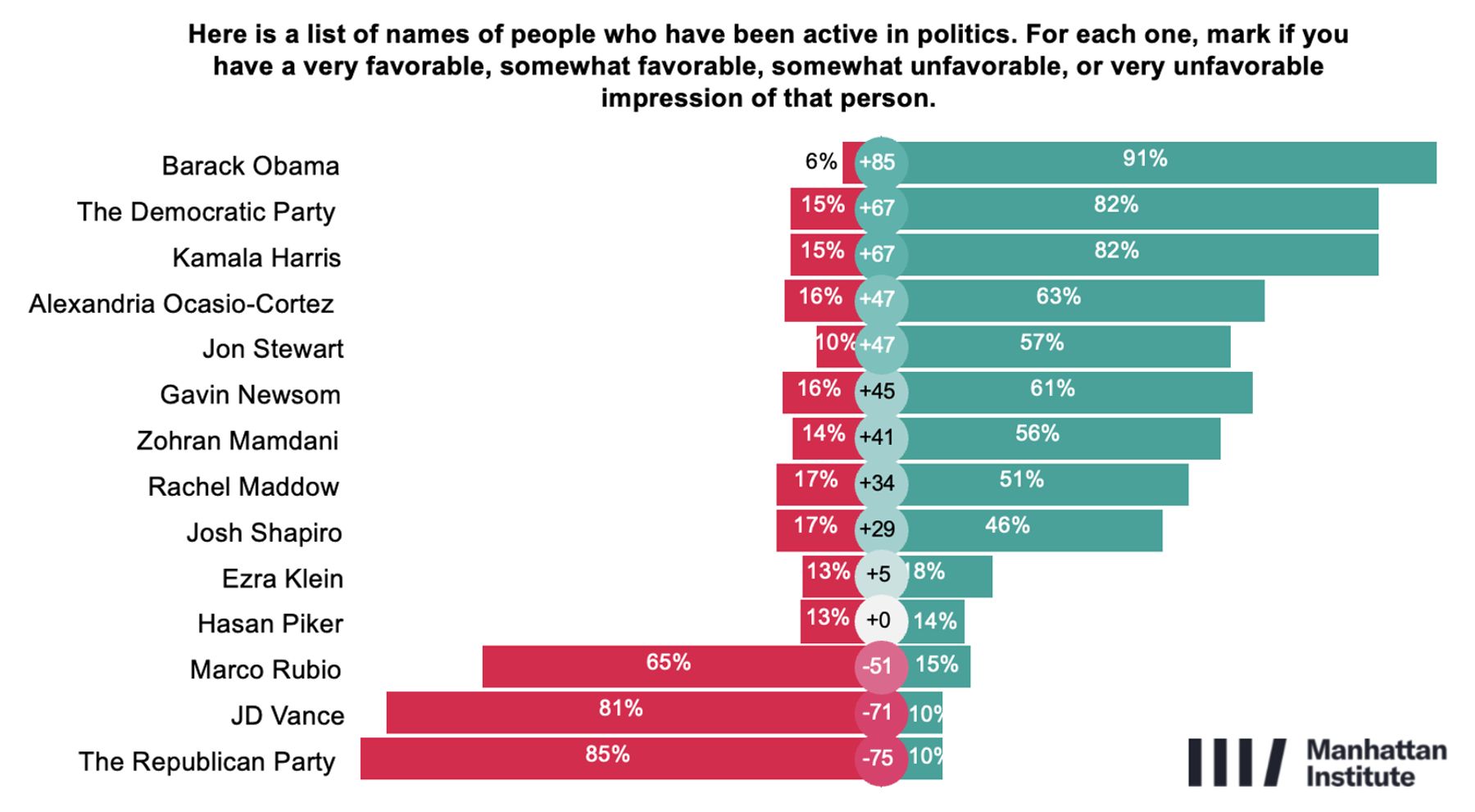
Barack Obama remains, by far, the most popular figure within the Democratic coalition. Seven in ten voters (70%) report a very favorable view of the former president—more than double that of other figures tested, including Gavin Newsom (30%), Zohran Mamdani (30%), Alexandria Ocasio-Cortez (33%), and Josh Shapiro (23%).
One exception is Kamala Harris, who stands out for the depth of her support. Nearly half of today’s Democrats (46%) view her very favorably, the highest figure among the leading primary candidates, while only 5% report a very unfavorable view—lower than Newsom, AOC, or Shapiro. Harris’s standing is broadly similar across black and white respondents, but subgroup differences are evident. She is weakest with men, especially college-educated men, among whom unfavorable views reach 25%. Younger voters also show softer attitudes: 24% of those aged 18–29 view Harris unfavorably.
Gavin Newsom’s favorability varies across age groups. Among voters over 65, three-quarters (76%) view him favorably, compared with only 9% unfavorable. Younger voters are less enthusiastic: among those aged 18–29, favorability falls to 43%, with 23% unfavorable. Ideologically, Newsom performs best with Progressive Liberals (71% favorable), but his appeal is more modest among the Woke Fringe (54%) and Moderates (57%).
Across the field, favorability does not translate cleanly into primary vote share. Harris, Newsom, and AOC all post strong overall favorability ratings among likely Democratic primary voters, yet no candidate exceeds 23% on the ballot. AOC illustrates this gap most clearly: despite a favorability over 60% among today’s Democrats, she receives only 7% in the primary ballot and loses decisively to Newsom in a head-to-head matchup.
One possible explanation is a concern over electability. Many Democrats express skepticism about their party’s viability in a general election under certain conditions. Two-thirds (66%) agree that a Democratic woman—or a black Democratic woman—would “have a very hard time winning the U.S. Presidency in 2028,” while a majority (56%) say the same about a Democratic Socialist. These concerns appear to weigh more heavily on demographic identity than on ideological positioning.
This dynamic helps explain AOC’s uneven coalition profile. While she enjoys strong favorability among the Woke Fringe (80%) and Progressive Liberals (70%), her support falls to 55% among Moderates and is similarly limited among blacks (55%), possibly constraining her broader primary viability.
Immigration
Figure 5
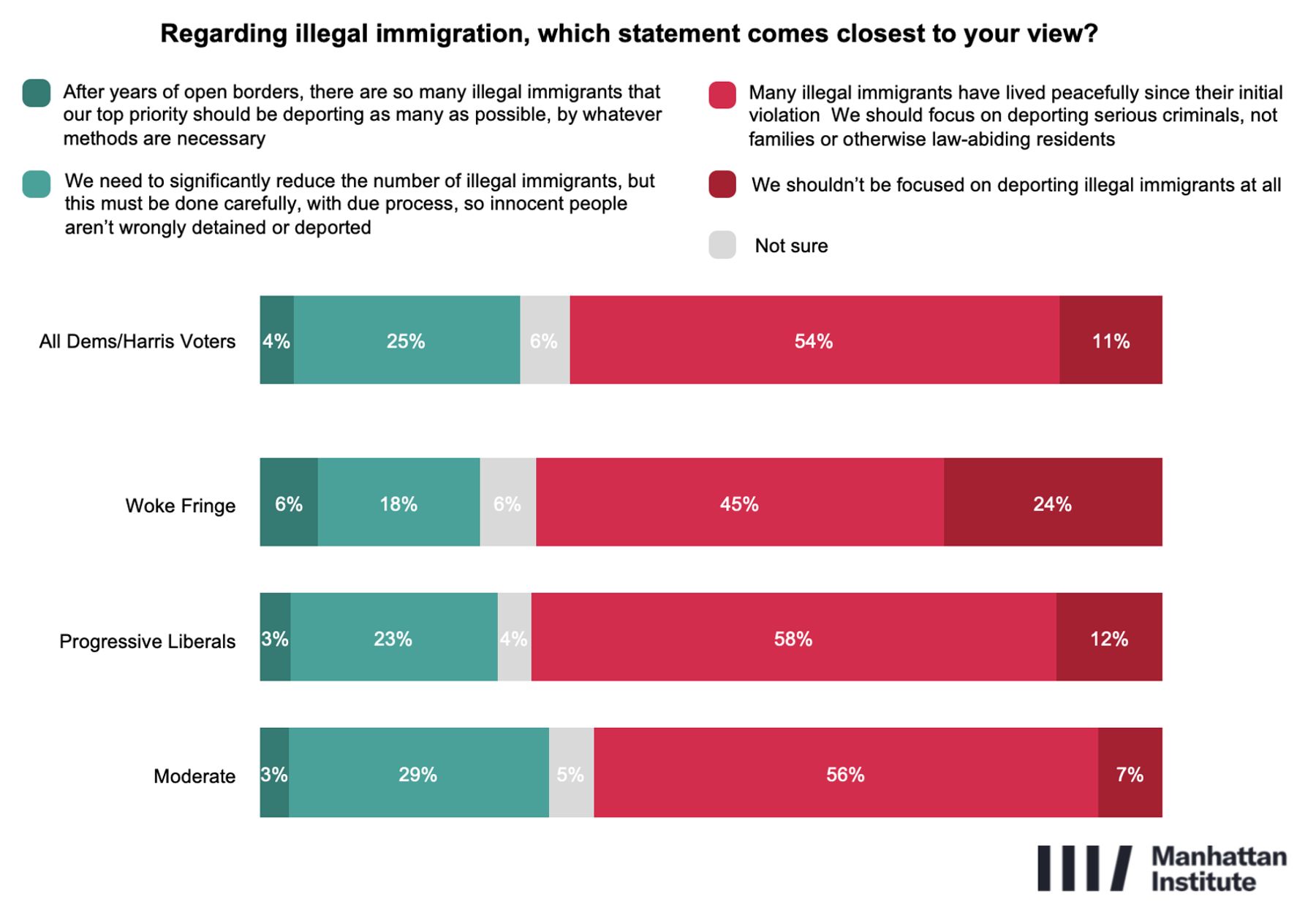
Democratic voters prefer a more pragmatic approach to immigration enforcement than what is often presented by “Open Borders” advocates. Only 11% say there should be no focus on deporting illegal immigrants whatsoever. A majority (54%) favor focusing on the deportation of criminal illegal immigrants rather than families and otherwise law-abiding residents, and an additional 25% support reducing the number of illegal migrants carefully through due process. Just 4% endorse deportation by any means necessary. Even within the Woke Fringe, only one in four favors taking no enforcement action.
Views on Immigration and Customs Enforcement (ICE) are more divided. Roughly half of the Democratic coalition (49%) support abolishing ICE, while 42% prefer keeping the agency but reducing its role and authority. Only 4% say ICE should remain unchanged.
Figure 6
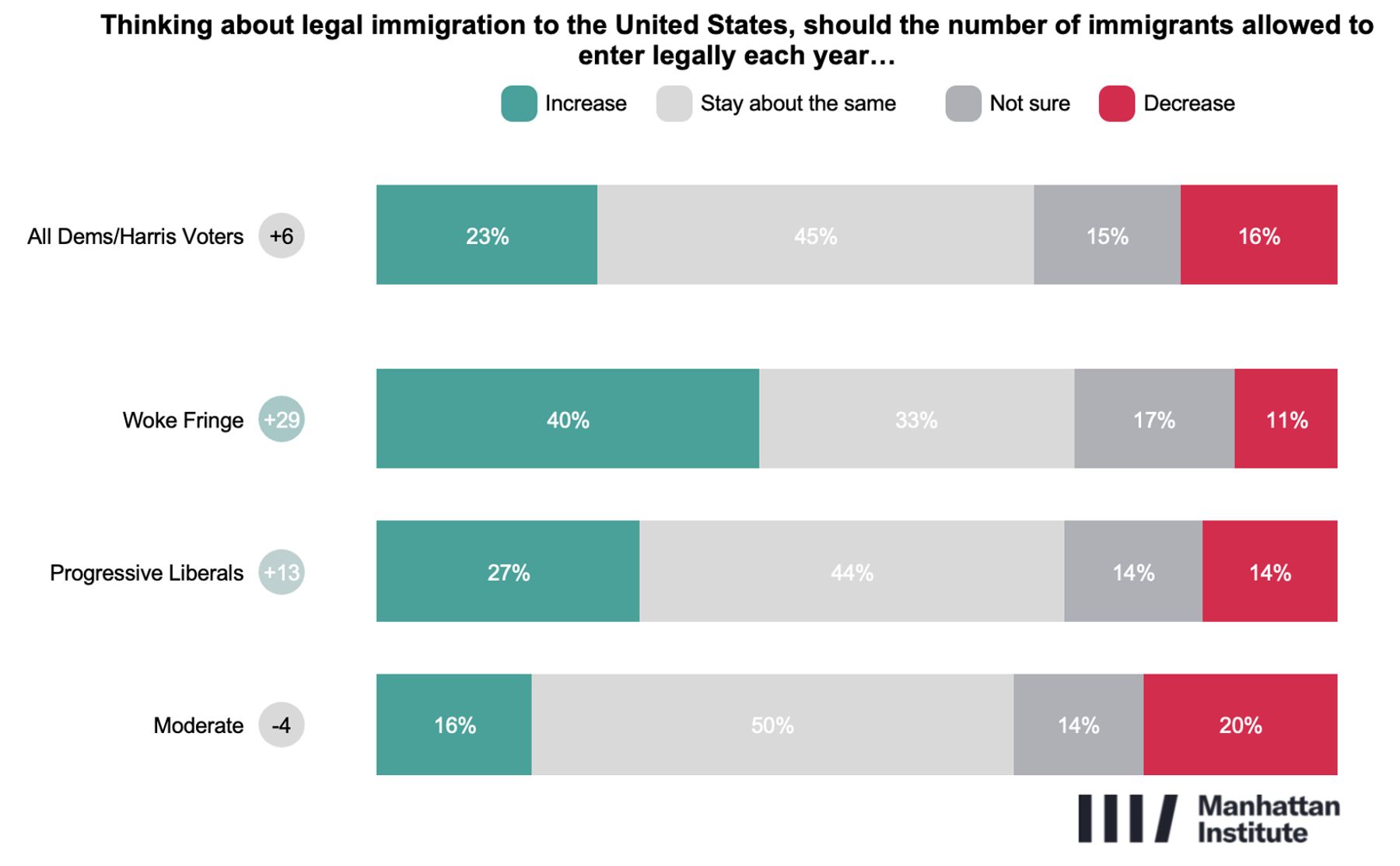
On legal immigration, the Democratic coalition broadly favors a merit-based approach. Nearly two-thirds (65%) say the legal immigration system should put more priority on skills, education, and work experience. A plurality also supports leaving current immigration levels unchanged (45%), while 23% favor increasing admissions and 16% support decreasing them. The Woke Fringe stands apart, with 40% favoring an increase—notably higher than among Progressive Liberals (27%) and Moderates (16%).
Attitudes toward assimilation are mixed. When asked if public schools in areas with large immigrant populations should teach some classes in the immigrants' native languages—like Spanish, Somalian, Arabic, and others—45% of today’s Democratic coalition, including 48% of black voters and 55% of Hispanic voters, agree that schools should offer instruction in native languages. But 38% are opposed, arguing schools should focus on English immersion, suggesting a split within the coalition.
Transgenderism
Figure 7
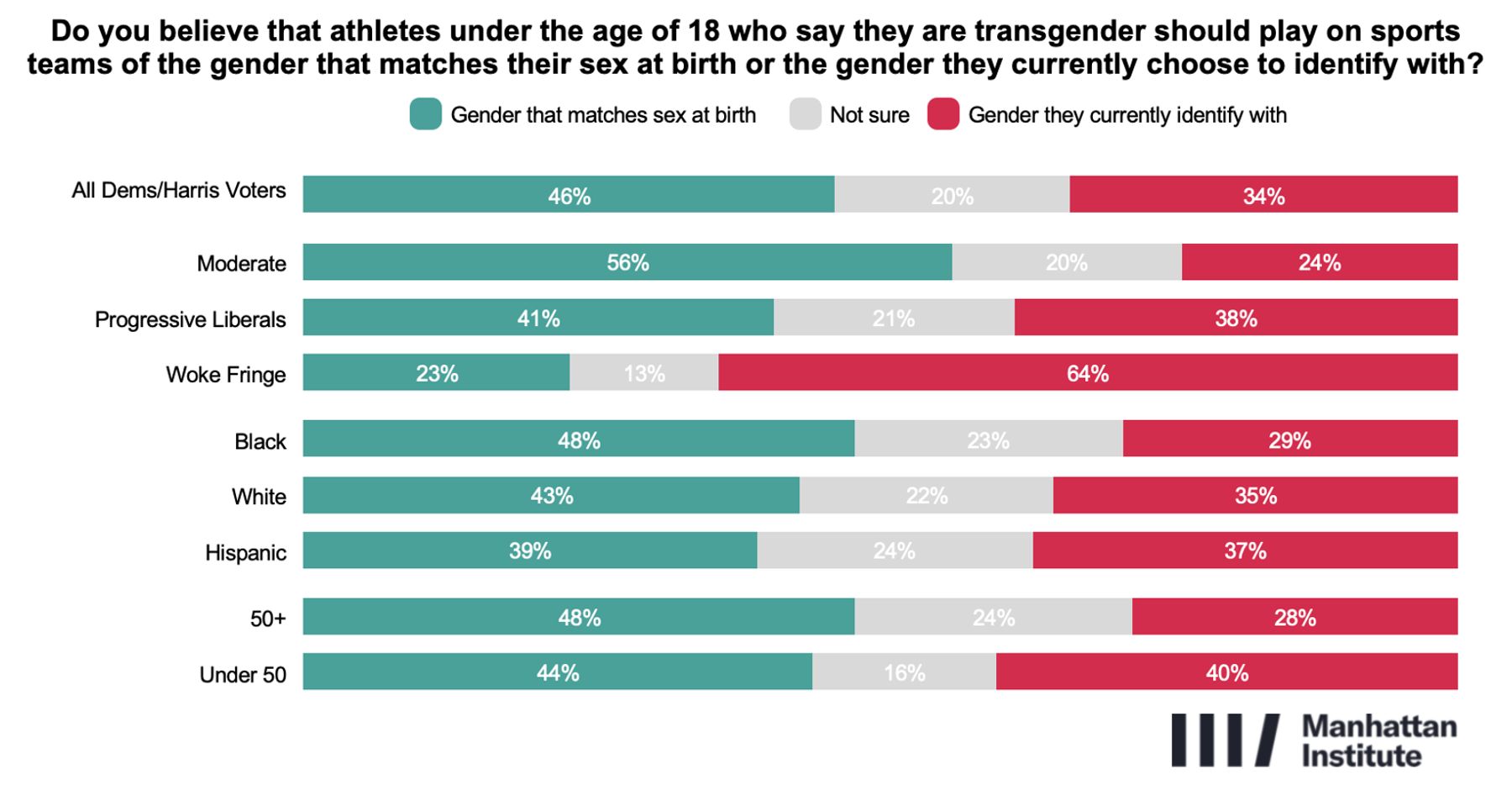
On transgender issues, voters within today’s Democratic coalition often take more cautious positions than is commonly assumed. Regarding youth sports, 46% believe that athletes under 18 should compete on teams corresponding to their sex at birth, compared with 34% who say athletes should compete based on current chosen gender identity; one in five express no preference.
Parental notification requirements also command broad support. Nearly six in ten voters (59%) say schools should be required to notify parents if a child requests to identify as transgender or change pronouns at school, while 26% oppose such a requirement.
Figure 8
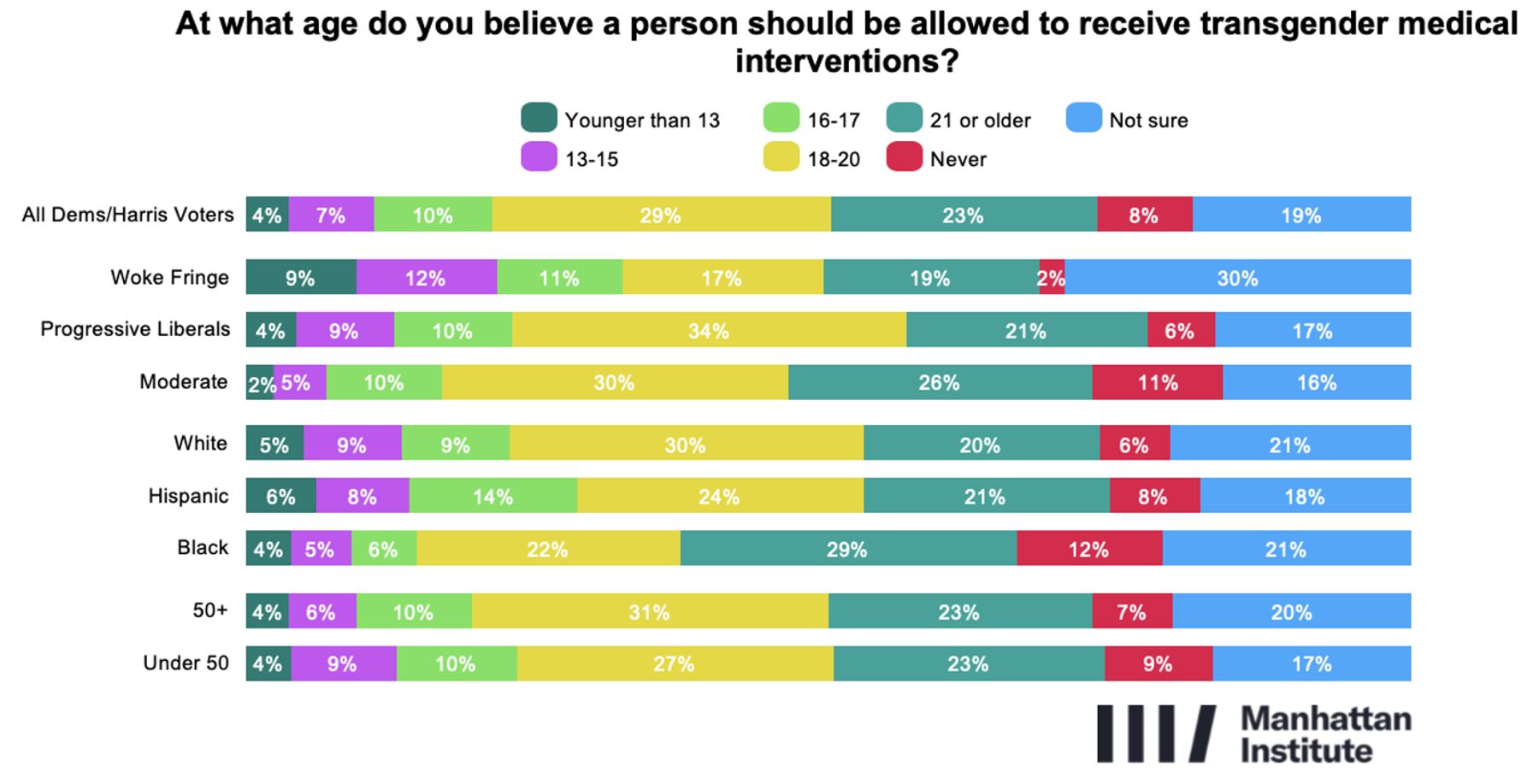
Attitudes toward transgender medical interventions are similarly restrictive. A majority (52%) believe individuals should be at least 18 to receive gender-related medical interventions, and 23% favor a minimum age of 21. Only 4% say children under 13 should be eligible for medical transition, rising to 11% for those under 16. Nearly one-in-ten (8%) voters in today’s Democratic coalition believe that transgender medical interventions should never be allowed—even for adults.
On this issue, the Woke Fringe consistently holds more permissive views than the broader coalition. Nearly two-thirds (64%) say young athletes should compete based on current chosen gender identity, 32% support allowing minors under 18 to medically transition, and 44% oppose mandatory parental notification for transitions in schools.
Despite this disconnect, relatively few voters in the Democratic coalition are willing to concede that “the Democratic Party has gotten too radical on transgender issues.” Just one-third (35%) agree with that characterization, while 46% disagree and 19% are unsure.
DEI
Figure 9
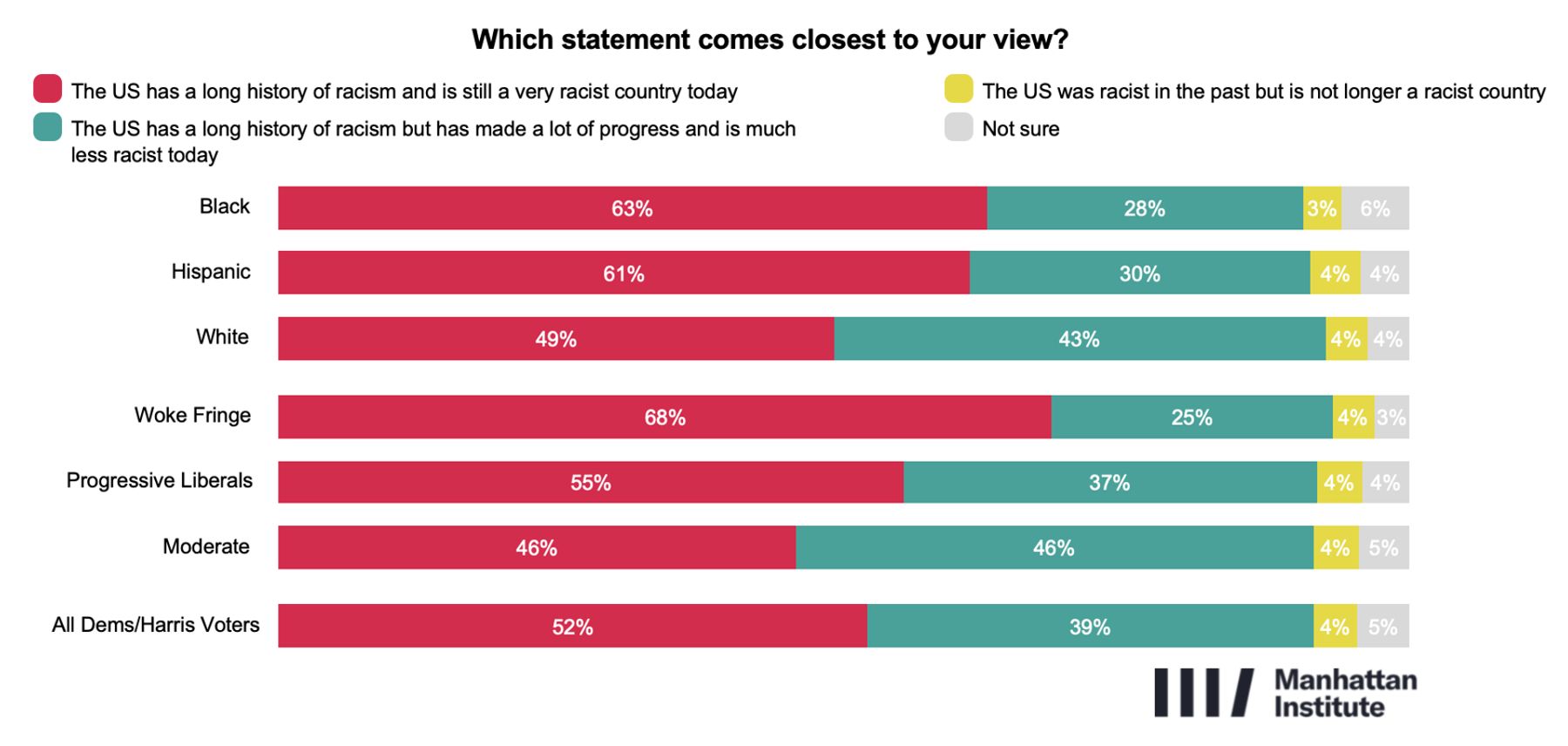
On questions of race, voters within today’s Democratic coalition express broadly pessimistic views about the country’s trajectory. A majority (52%) say the U.S. has a long history of racism and remains a very racist country today, while 39% believe the country has made substantial progress and is much less racist. Only 4% say the U.S. is no longer a racist country.
These attitudes are relatively consistent across demographic groups, though intensity varies by faction. Nearly half of Moderates (46%) say the country remains very racist, compared with 55% of Progressive Liberals and 68% of the Woke Fringe. Racial differences are also evident: 49% of white voters say the country remains very racist, compared with 61% of Hispanic and 63% of black voters.
At the same time, views on identity politics are more divided. Voters in the Democratic coalition are slightly more likely to say that the Democratic Party is right to prioritize the needs of marginalized groups and racial minorities in its policy focus and messaging (47%) than they are to say that the party focuses too much on identity politics and should focus more on issues that affect all Americans (40%), indicating a narrow but meaningful balance. Gender differences are notable: men are evenly split (46% prioritize marginalized groups vs. 45% too much focus on identity politics), while women tend toward the former view (47% to 37%).
Attitudes toward Diversity, Equity, and Inclusion (DEI) in workplaces, schools, and government are mixed. Only 19% say institutional DEI efforts have gone too far, while a plurality (39%) believe that the current balance is appropriate, and 30% say such efforts have not gone far enough.
Figure 10
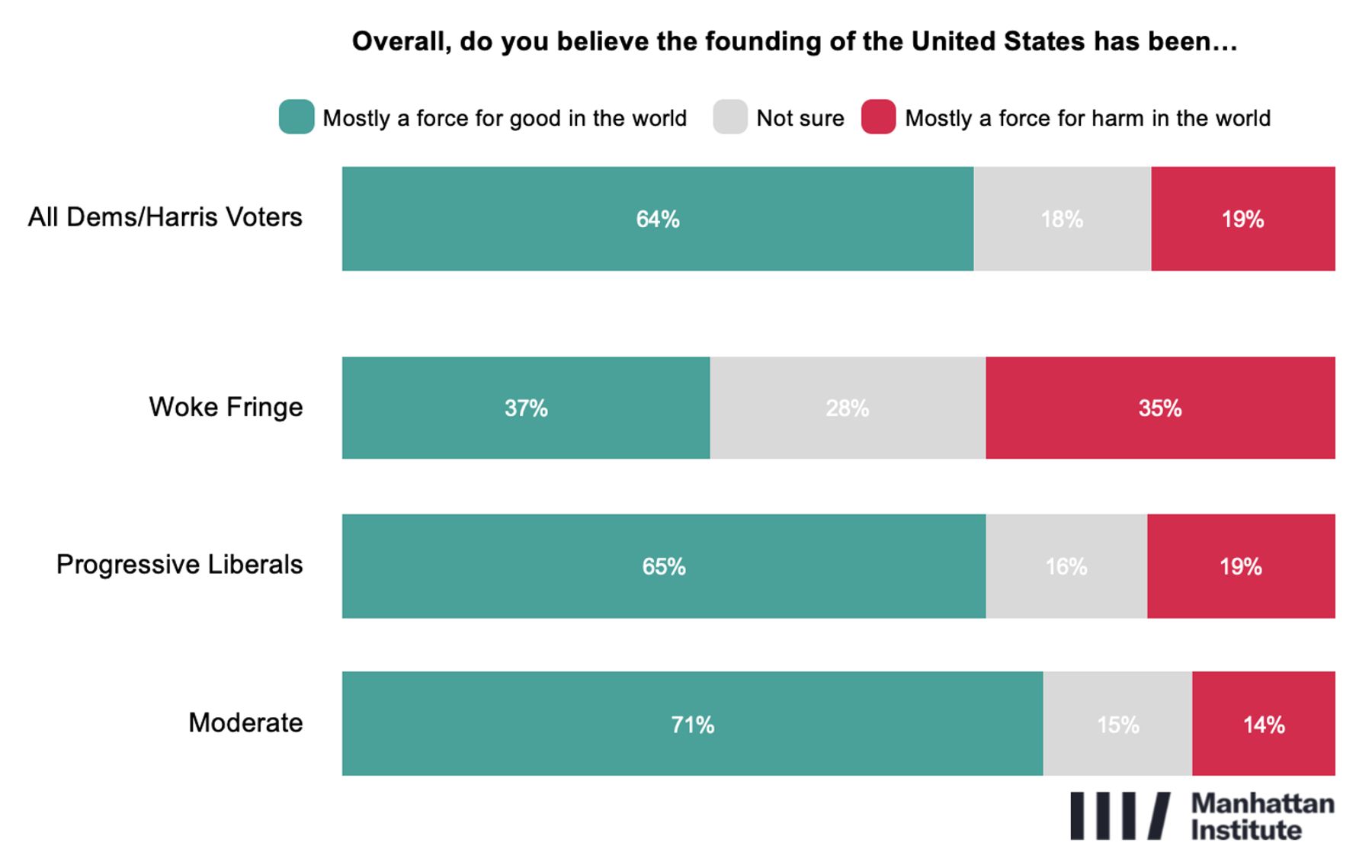
Despite pessimism about racial progress, the Democratic coalition retains broadly positive views of the country’s historical legacy. Nearly two-thirds (64%) say the founding of the U.S. has been mostly a force for good in the world, compared with 19% who view it as mostly harmful. This view is strongest among Moderates (71%) and Progressive Liberals (65%). The Woke Fringe again stands apart, with just 37% saying the founding was mostly a force for good and 35% saying it was mostly a force for harm.
Figure 11
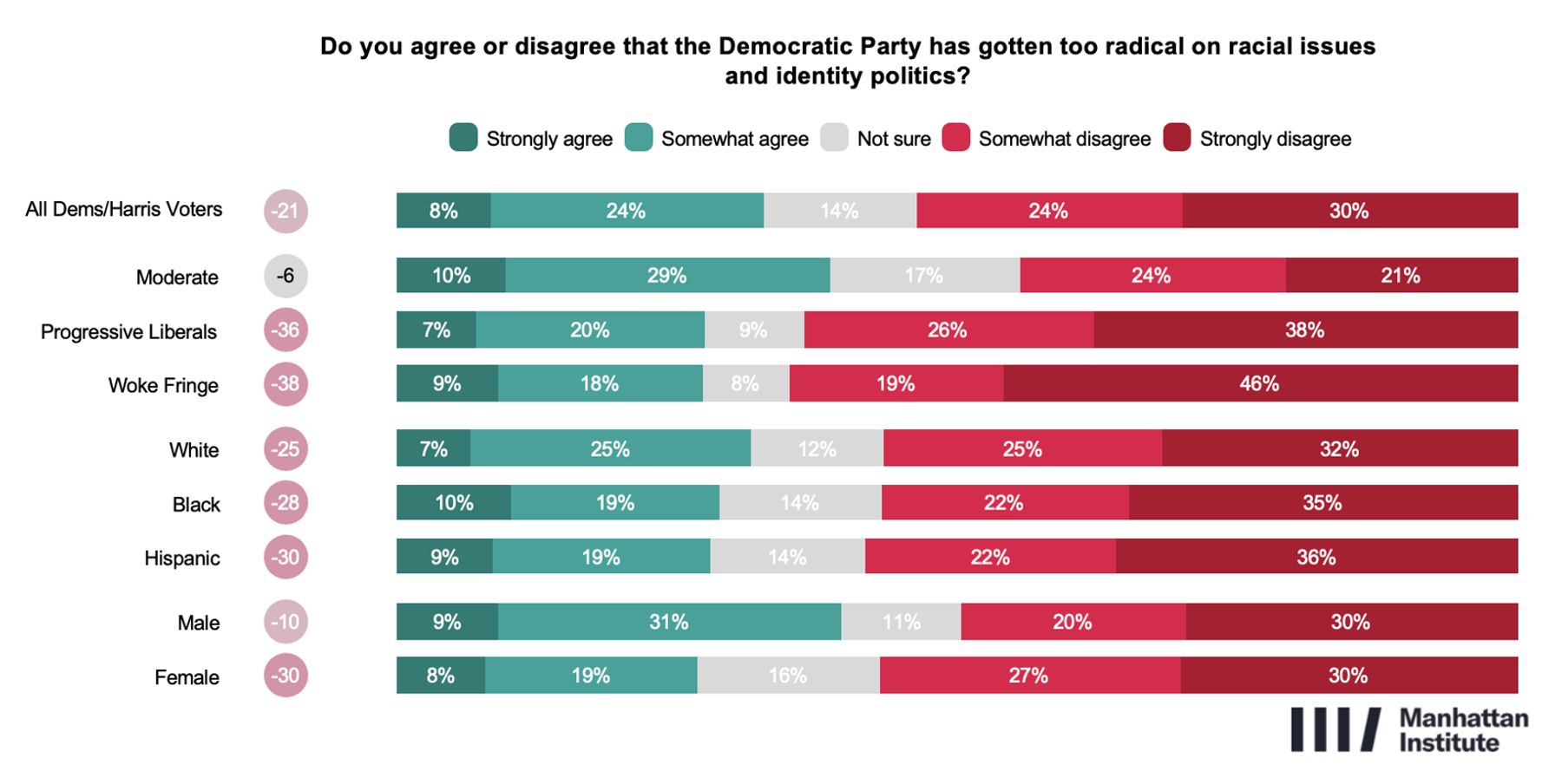
When asked directly whether the Democratic Party has become too radical on racial issues and identity politics, a majority of the Democratic coalition disagrees (54%), while roughly one-third (33%) agrees. Concern is most pronounced among Moderates, nearly four in ten of whom say the party has gone too far, whereas Progressive Liberals and the Woke Fringe are less likely to share that view.
Crime and Public Safety
Figure 12
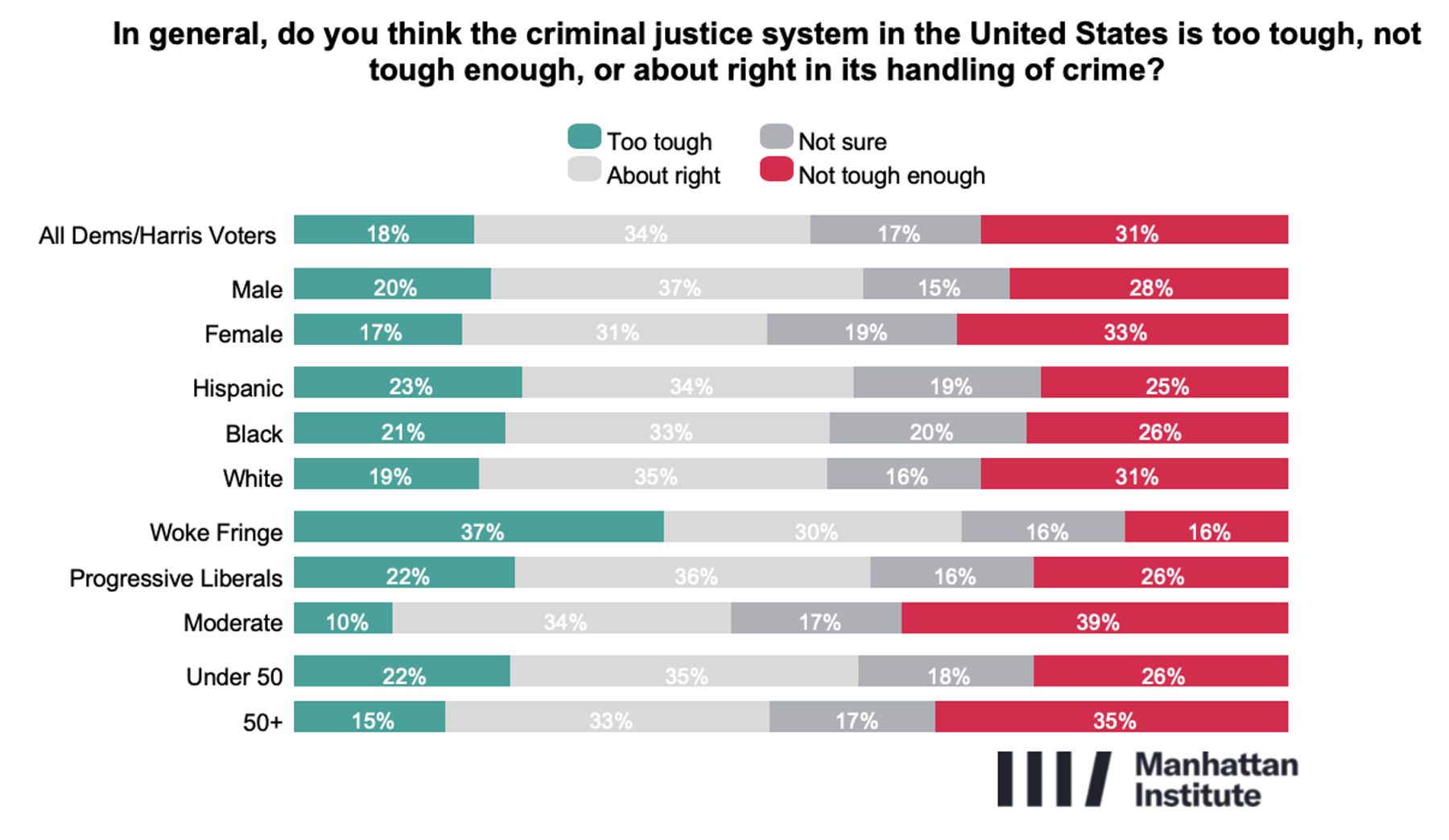
Today’s Democratic coalition is divided along ideological lines on crime and public safety. When asked generally about the U.S. criminal justice system, 18% say the system is too tough, 34% say it is about right, and 31% believe it is not tough enough.
Factional differences are pronounced. Moderates are the most enforcement-oriented, with a 39% plurality saying the system is not tough enough. Progressive Liberals cluster around the middle, with a 36% plurality describing the system as about right. The Woke Fringe stands apart, with a 37% plurality saying the criminal justice system is too tough.
Despite these internal divisions, there is broad agreement on accountability for serious firearm crimes. By a margin of 71% to 18%, voters in the Democratic coalition support more aggressive prosecution tactics in dealing with perpetrators of gun crimes. The coalition also overwhelmingly rejects political violence: 74% disagree with the statement that “in American politics, the use of political violence is sometimes justified.”
Figure 13
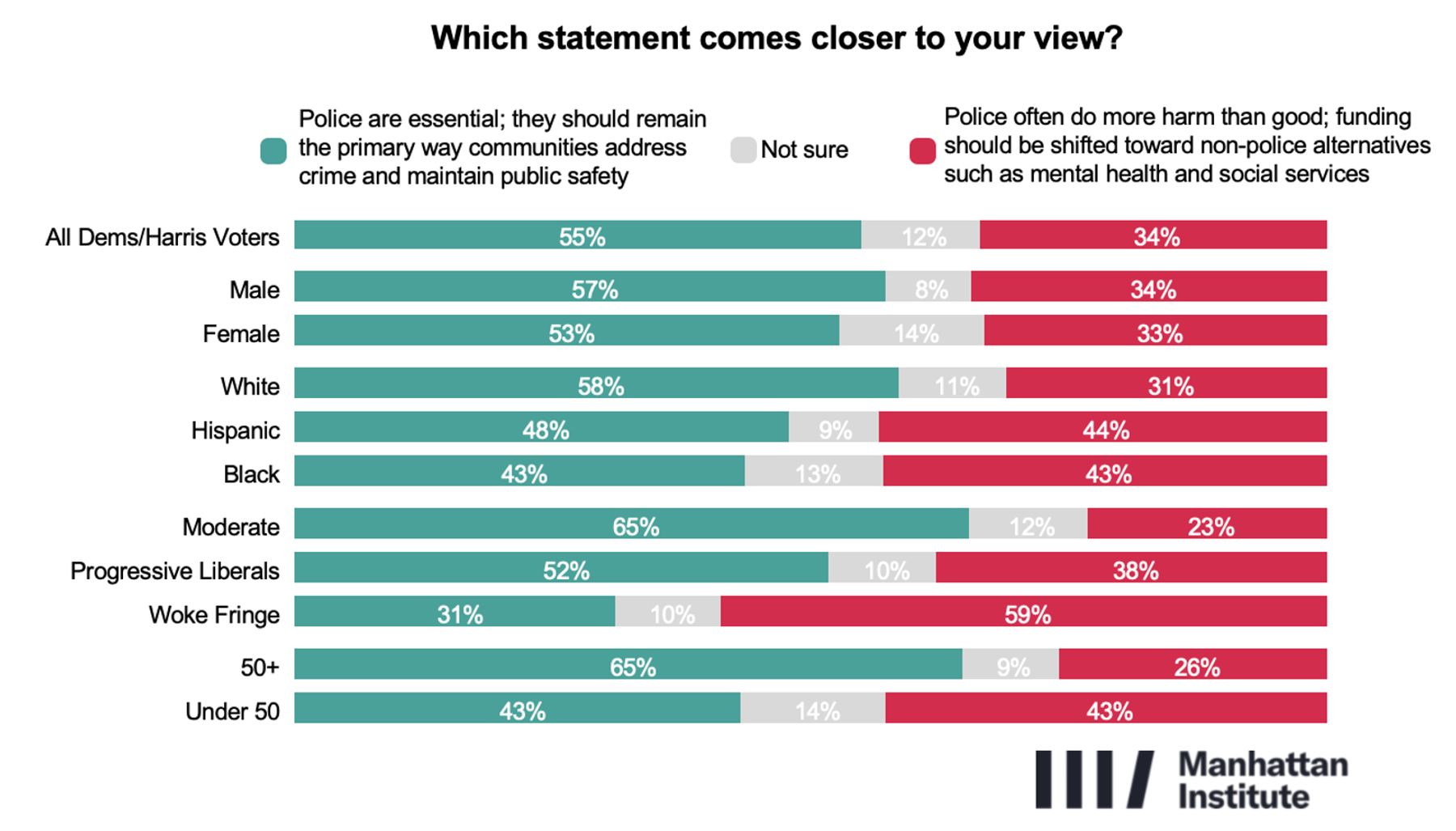
Views of policing reflect a similar pattern. Most of the coalition (55%) say that police are essential and should remain the primary way communities address crime and maintain public safety, while 34% say that police often do more harm than good and that funding should be shifted toward non-police alternatives, such as mental health and social services. Majorities of Moderates (65%) and Progressive Liberals (52%) view cops as essential; the Woke Fringe is the only faction in which a majority (59%) favor shifting resources away from police.
The Woke Fringe is also twice as likely to support political violence—with 34% saying it is sometimes justified, compared with 16% of Moderates and 17% of Progressive Liberals. Support for political violence is heavily concentrated among those who identify as “Democratic Socialist” (29% agree) and “Communist” (68% agree).
Demographic differences add nuance to these ideological splits. Younger voters are more skeptical of the criminal justice system and policing: those aged 18–29 are far more likely to view the system as too tough and substantially less likely to say that police are essential (36% vs. 71% among those 65+). Older voters are also more likely to reject political violence, with 79% of those 65+ strongly disagreeing that it can be justified compared with 33% of younger Democrats. Hispanic and black voters are more evenly divided on whether police are essential: 48% of Hispanic voters say essential and 44% say cops do more harm than good, while black voters split 43% to 43%).
Gender and educational divides are more modest but directionally consistent. Women are somewhat more likely than men to say the criminal justice system is not tough enough, yet slightly less likely to view police as essential. Non-college voters are less open to political violence and somewhat more inclined to favor a tougher criminal justice posture than their college-educated counterparts.
Antisemitism, Israel, and Palestine
Figure 14
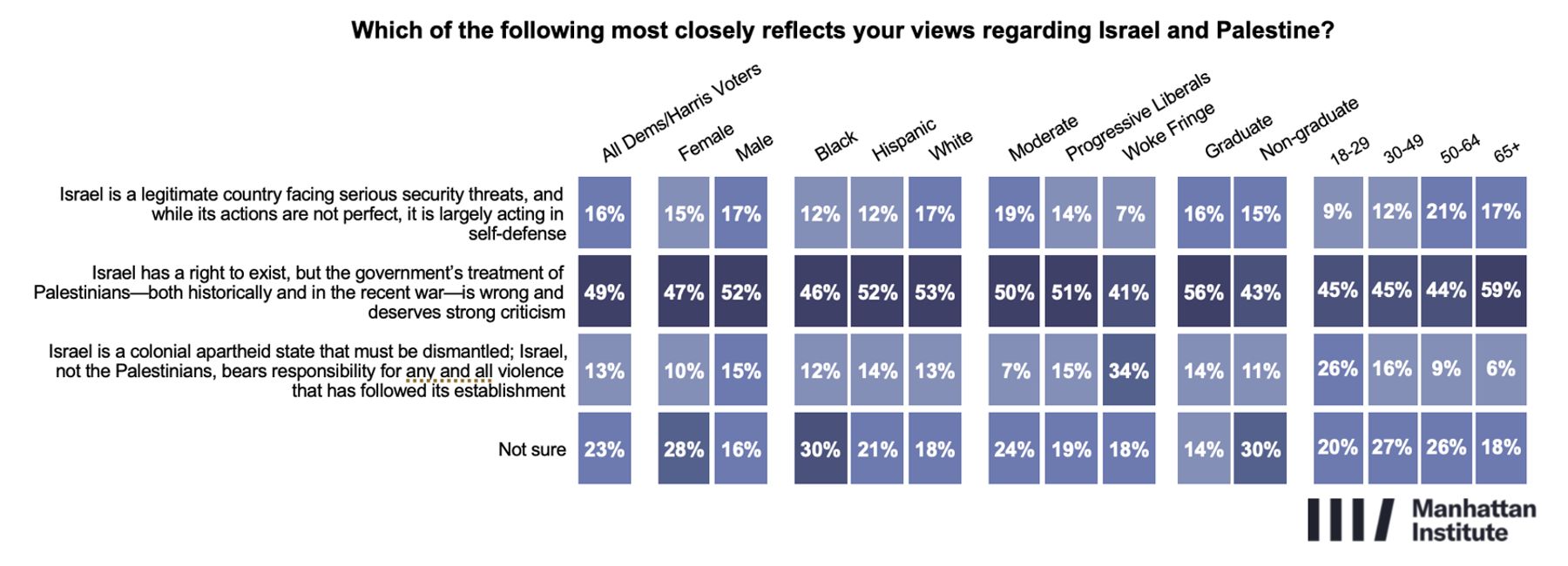
Views on Israel and Palestine within today’s Democratic coalition are more nuanced than often assumed. Only 13% believe that Israel is a colonial apartheid state that must be dismantled and that Israel, not the Palestinians, bears responsibility for any and all violence that has followed its establishment. At the other end, only 16% are willing to say that Israel is a legitimate country facing serious security threats, and that while its actions are not perfect, it is largely acting in self-defense.
Roughly half (49%) instead opt for a middle position: “Israel has a right to exist, but the government’s treatment of Palestinians—both historically and in the recent war—is wrong and deserves strong criticism.” Another 23% say they are unsure.
But 18–29 year-old Democrats are considerably less supportive of Israel. One in four (26%) of these younger Democrats believe that Israel is a colonial apartheid state that must be dismantled and that Israel bears responsibility for any and all violence since its founding. That is four times more than the share of over-65 Democrats who say the same, and three times more than 50–64 year olds. Fewer than one in ten 18–29 year olds (only 9%) believe that Israel is a legitimate country facing serious security threats.
Attitudes toward antisemitism within the Democratic coalition reveal a gap between personal identification and social tolerance. Only 4% of respondents describe themselves as openly antisemitic, though 18–29 year old voters (8%) are much more likely to do so than over-65 voters (1%). Views on how the party should treat those who do express antisemitic beliefs, however, are more mixed. Less than half (44%) say that such individuals are unwelcome and do not represent their views. At the same time, 15% say they’ve had enough of purity tests, and antisemitism should not be counted against people—and an additional 15% say it is acceptable to seek the votes of antisemites, but they should not be in positions of power and leadership. 22% were unsure. Taken together, the results suggest that although overt identification with antisemitism is rare, boundaries around its political acceptability are not uniformly defined within the coalition.
Economy
Figure 15
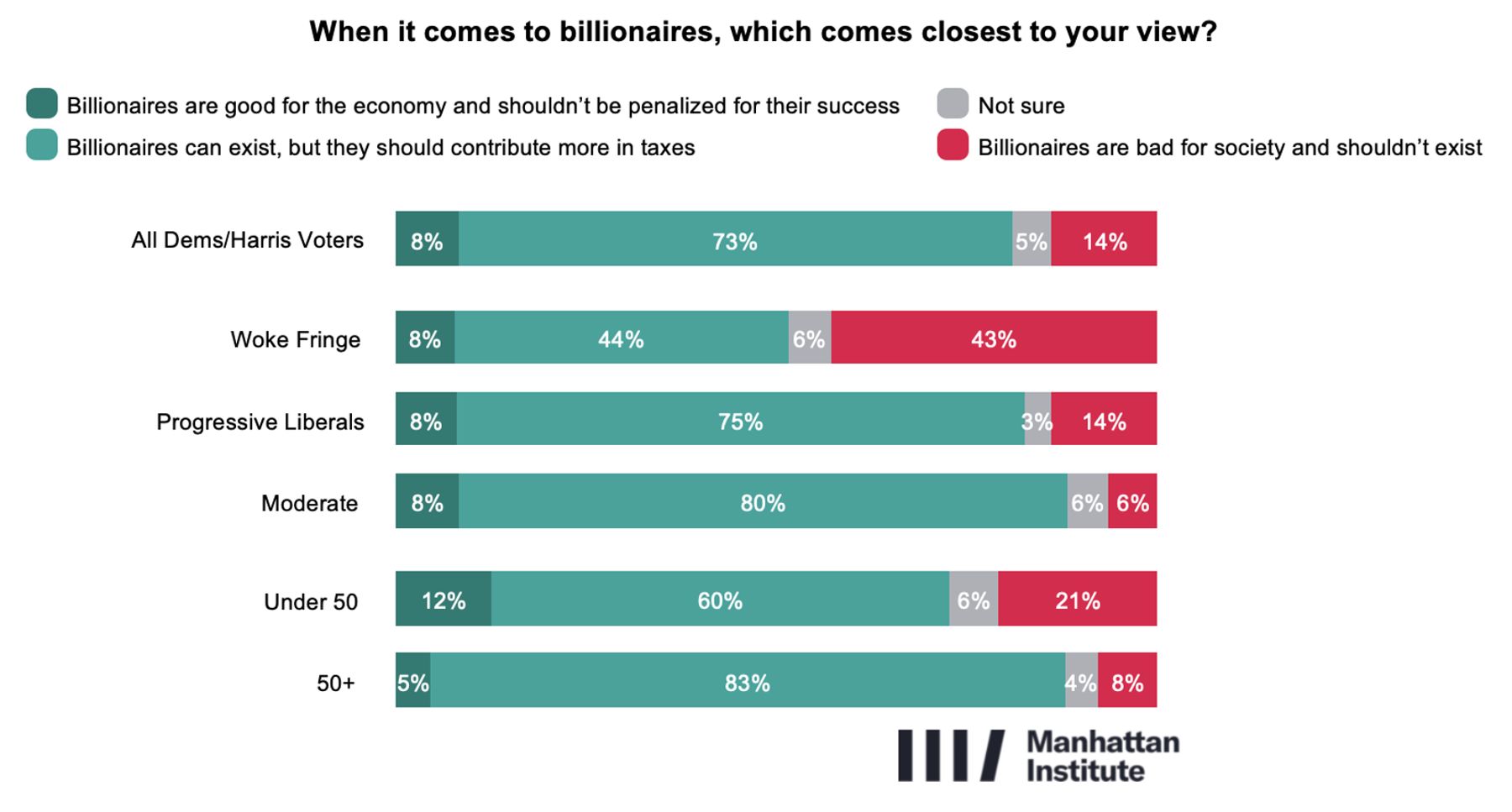
Few in the Democratic coalition embrace the leftist mantra that “every billionaire is a policy failure.” Only 14% say that billionaires are bad for society and should not exist—and only 15% believe that America’s economic and social system is so rigged it ought to be burnt down, without concern for the powerful losing their money or jobs. By contrast, 78% say that the system should either be preserved (“America's system works well overall, so when we change things, we should do so carefully and gradually”) or reformed (“America’s system isn't perfect, but we should fix what’s broken and protect what works”). Anti-system sentiment is more pronounced among younger voters and the Woke Fringe—28% of those aged 18–29 and 43% of the Woke Fringe say billionaires should not exist—but these views remain minority positions across the coalition.
Figure 16
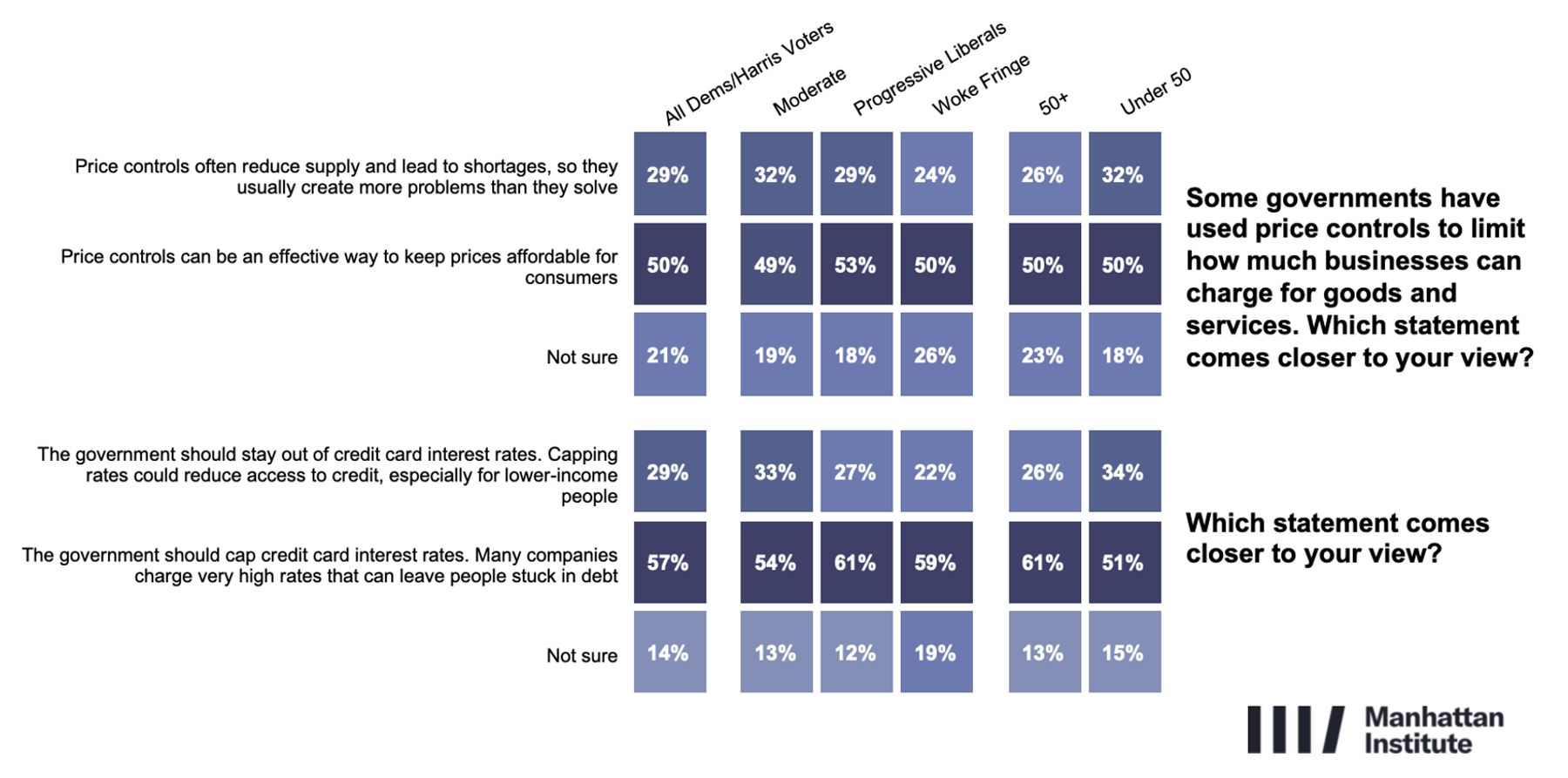
At the same time, today’s Democrats express strong support for targeted economic reforms. Nearly three-quarters (73%) say that billionaires can exist but should pay more in taxes, and majorities back consumer-protection measures such as caps on credit card interest rates (57%) and price controls to address affordability concerns (50%). These positions extend beyond the progressive base, with Moderates also expressing support for interest rate caps (54%) and price controls (49%).
Figure 17
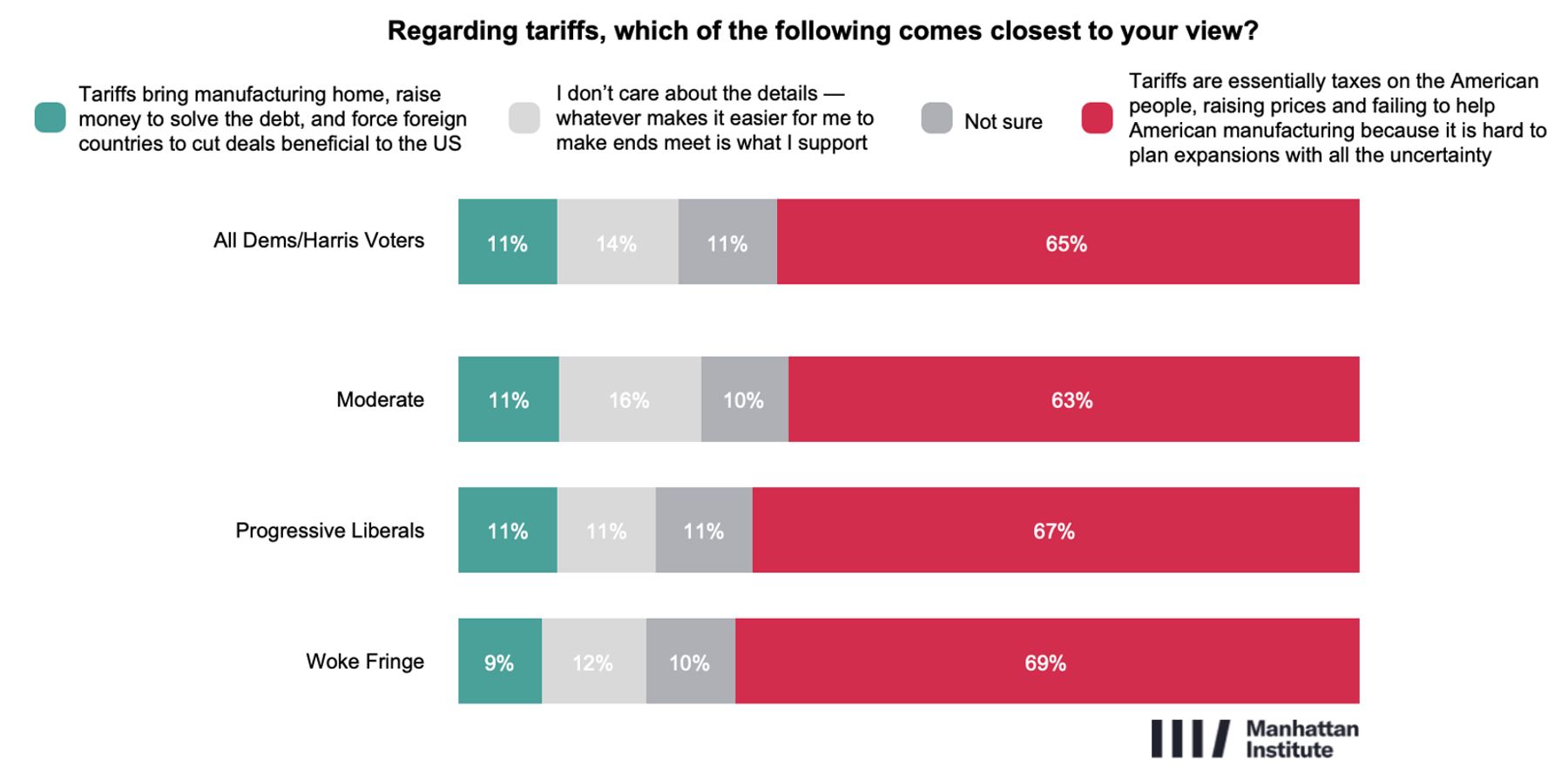
President Trump’s economic agenda has prompted modest viewpoint shifts within the Democratic coalition in two areas. First, Trump’s tariffs have revived a Clinton-era defense of free trade, with two in three respondents (65%) agreeing that tariffs function as a tax on American consumers and only one in ten (11%) defending their use. Second, views on broader government intervention remain divided: 43% say that the government is either doing too much or the right amount in the economy, while a nearly identical share (41%) believe it should be doing more.
Figure 18
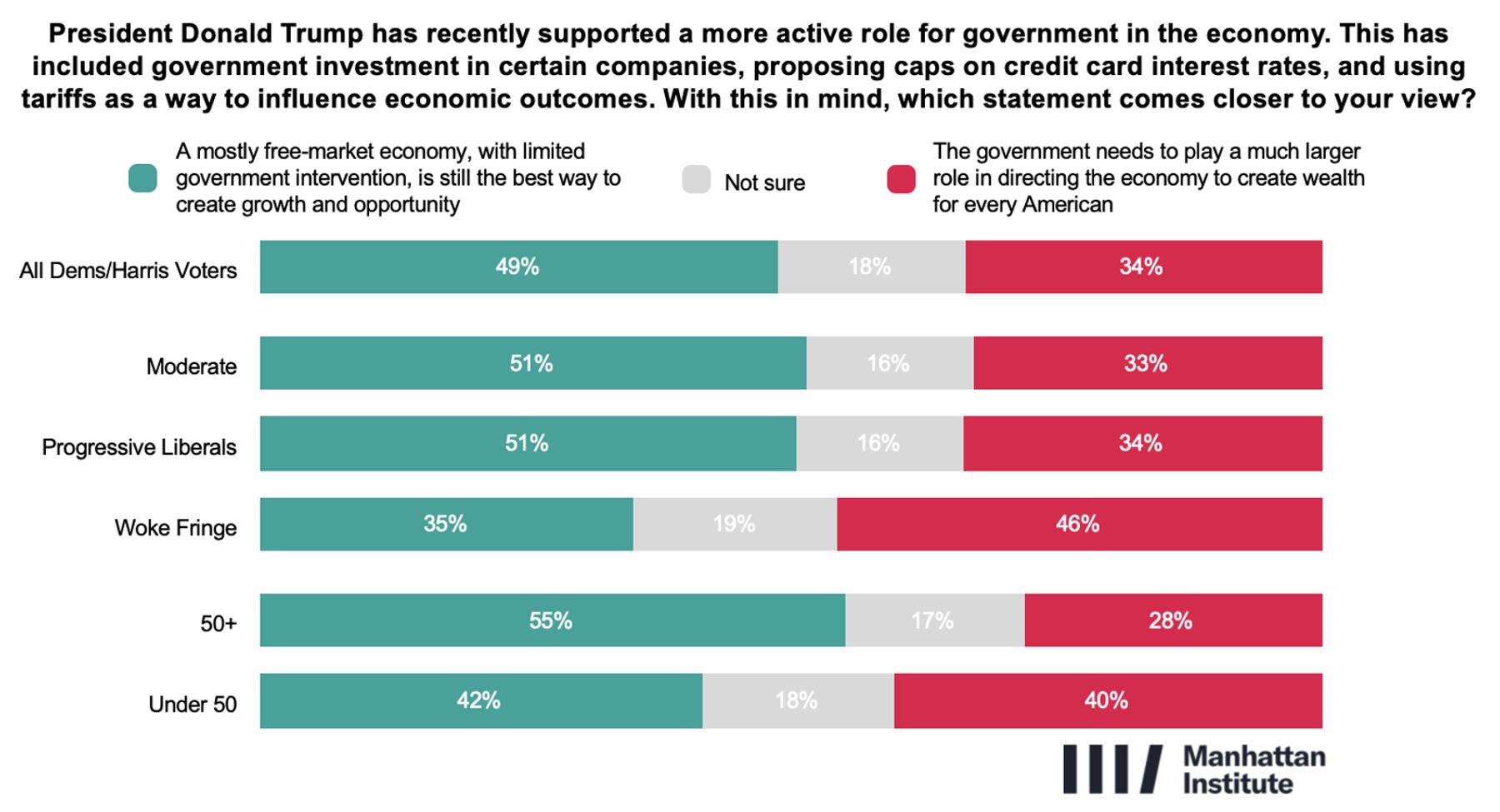
When President Trump’s economic approach is explicitly referenced, attitudes within the Democratic coalition shift modestly toward market-friendly language. Presented with a choice between a mostly free-market economy and a larger government role in directing economic activity, a plurality (49%) select the free-market option, compared with 34% who favor greater intervention, while 18% remain unsure. Given broader support seen in this survey for targeted government actions, such as price controls and interest rate caps, this likely reflects anti-Trump sentiment and context-dependent views rather than a clear ideological shift toward laissez-faire economics.
Concern about the integrity of welfare programs is also widespread. Nearly two-thirds of the Democratic coalition (63%) say they are concerned about welfare fraud, and three-quarters (75%) support measures to limit abuse. This concern spans ideological lines, with majorities of Moderates (81%), Progressive Liberals (74%), and even the Woke Fringe (60%) expressing support for safeguards.
Figure 19
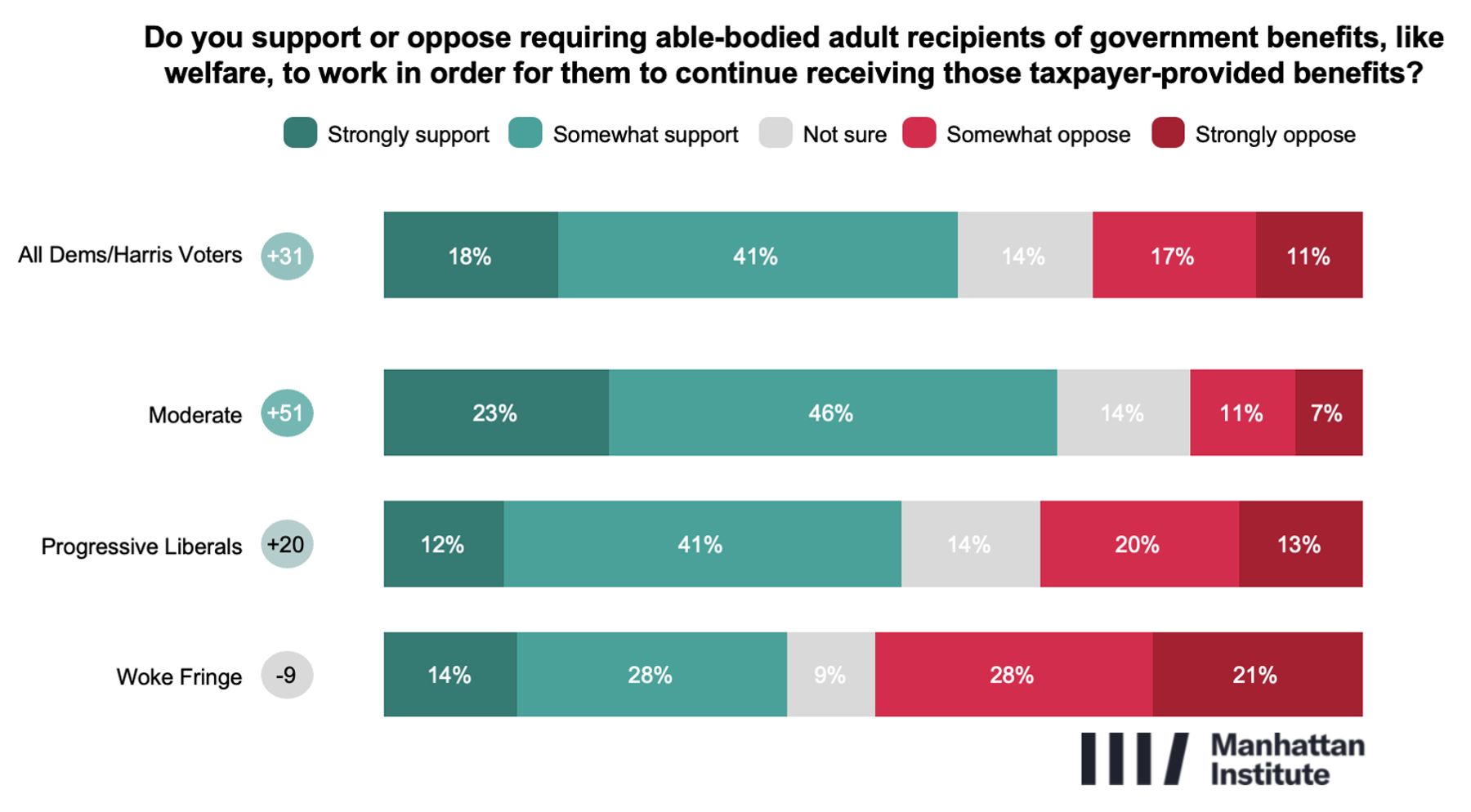
Requiring work in exchange for government benefits like welfare is also widely popular, earning 58% support among today’s Democrats. Moderates and Progressive Liberals are overwhelmingly supportive, while nearly half (50%) of the Woke Fringe oppose such requirements. Hispanic (59%) and black voters (58%) are also supportive of work requirements.
Housing, Energy, and Infrastructure
Attitudes within today’s Democratic coalition toward housing, energy, and infrastructure reflect a familiar tension between support for increased production and caution about reforming the processes that govern it.
On housing, voters are closely divided. A plurality (44%) say that existing zoning and environmental rules should be preserved even if they limit new housing construction, while 42% prefer making it easier to build more housing by relaxing some regulations. This split suggests that while the coalition recognizes housing supply challenges, there is no clear consensus around deregulation as the solution.
On energy, views are more straightforward. Large majorities support expanding domestic energy production across sources. Seven in ten voters (71%) favor building more energy capacity—including nuclear, natural gas, solar, and wind—to reduce costs, with only 15% opposed. Support for an “all-of-the-above” approach is therefore broad across the coalition.
Figure 20
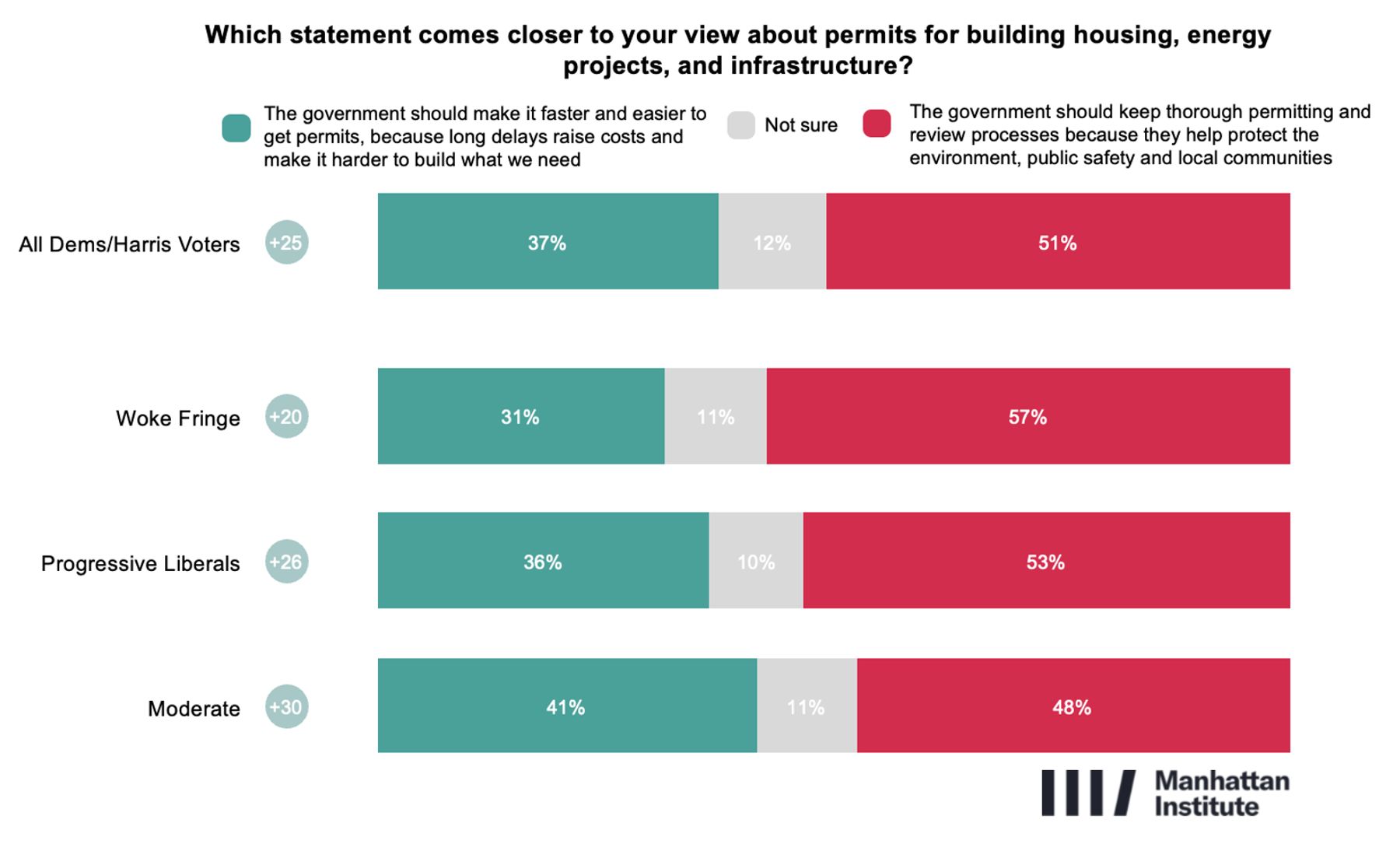
However, when voters are asked specifically about permitting for housing, energy, and infrastructure projects, caution again prevails. A majority (51%) say that the government should maintain thorough permitting and review processes to protect environmental quality, safety, and local communities, while 37% favor faster and simpler permitting to reduce delays and costs. Majorities of Progressive Liberals (53%) and the Woke Fringe (57%) strongly support tight permitting requirements, as do a plurality of Moderates (48%).
Taken together, these findings point to a consistent pattern: in principle, voters in today’s Democratic coalition generally support increased production—or the goals associated with an Abundance agenda—but they remain hesitant to weaken regulatory and procedural safeguards that can slow development.
Conspiracism
Figure 21
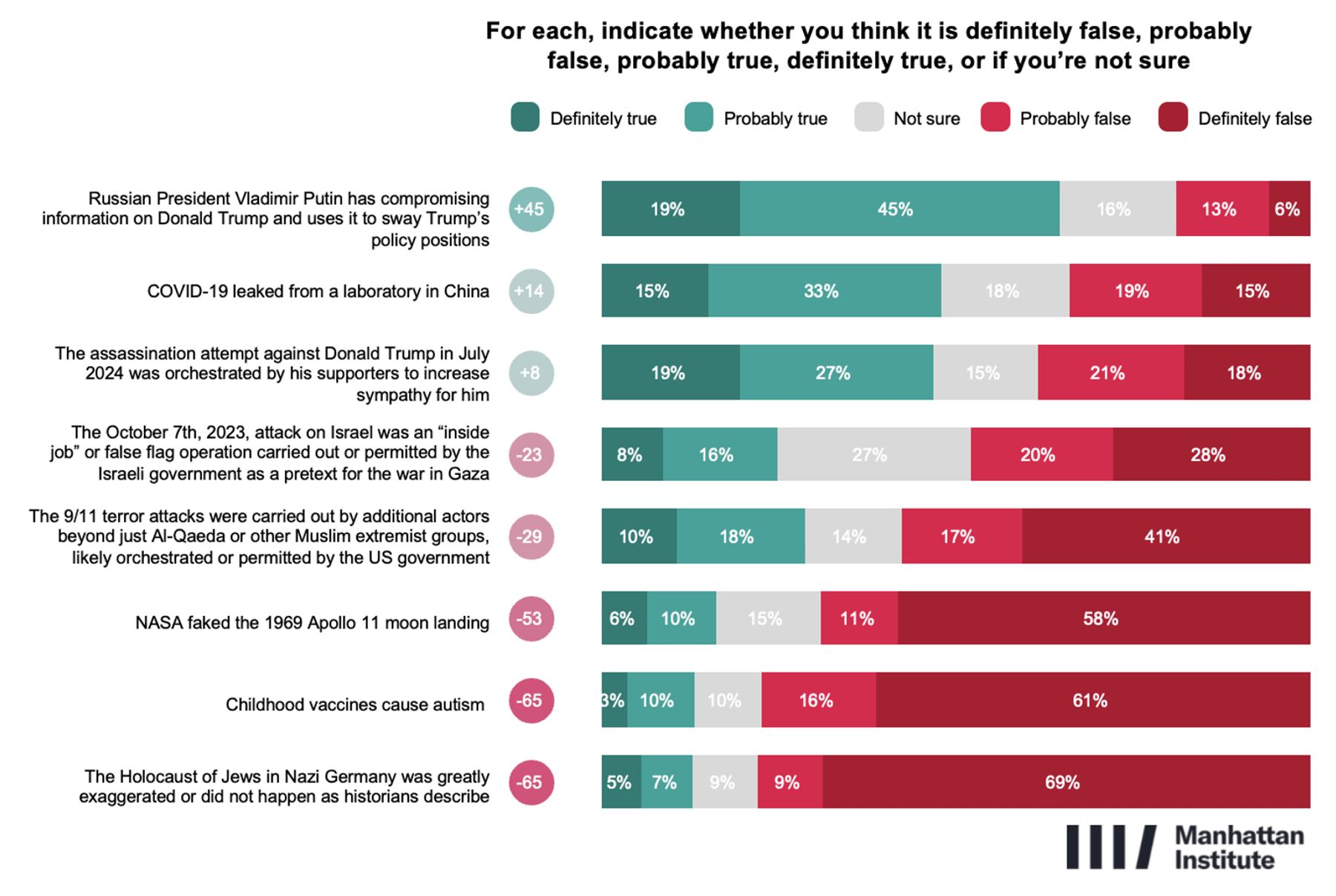
Neither major American political party is immune from voters who embrace conspiratorial thinking, though the specific beliefs that gain traction differ across coalitions. Within the Democratic coalition, there is limited support for claims commonly associated with right-leaning conspiracy culture, such as vaccines causing autism (13%) or Holocaust denial/minimization (13%). But the coalition is very open to other conspiratorial claims. Nearly two-thirds of today’s Democrats (64%) believe that Vladimir Putin holds compromising information on Donald Trump that the Russian leader uses to sway Trump’s policy positions, and a 47% plurality believe that the July 2024 assassination attempt on Trump was orchestrated by his supporters to increase sympathy for him.
While not garnering a majority, other conspiracy beliefs still register meaningful minority support. 28% say that the September 11th terror attacks were carried out by additional actors other than Al-Qaeda or other Muslim extremist groups, likely orchestrated or permitted by the U.S. government. Roughly one in four (25%) believe that the October 7th attack on Israel was an “inside job” or false flag operation carried out or permitted by the Israeli government as a pretext for the war in Gaza. As seen in a recent Manhattan Institute survey analysis of the GOP coalition, acceptance of conspiratorial claims is higher among black and Hispanic voters than among whites.
Age, however, is the clearest dividing line. Younger voters are consistently more open to conspiracy theories that older Democrats are vastly more skeptical of. Among those aged 18–29, 24% say that the Holocaust of Jews in Nazi Germany was greatly exaggerated or did not happen as historians describe (compared with 3% of those 65+), 28% believe that NASA faked the 1969 Apollo 11 moon landing (compared with 3% of those 65+), 37% are 9/11 “truthers” (compared with 11% of those 65+), and 38% view October 7th as an inside job (compared with 11% of those 65+).
These generational differences align with broader attitudinal patterns observed elsewhere in the survey. Younger members of the coalition express lower institutional trust and greater openness to revisionist interpretations of political events and historical narratives than older Democrats. Taken together, the findings point less to a unified conspiratorial worldview than to a widening generational gap in epistemic confidence and institutional credibility within the Democratic coalition.
Acknowledgement
The author would like to thank Sam Kay for his contributions to the analysis.
Photo: UniqueMotionGraphics / iStock / Getty Images Plus
Are you interested in supporting the Manhattan Institute’s public-interest research and journalism? As a 501(c)(3) nonprofit, donations in support of MI and its scholars’ work are fully tax-deductible as provided by law (EIN #13-2912529).