Bringing Regulatory Dark Matter to Light: A Case Study of Reform at the Administration for Children and Families (ACF)

Photo: seb_ra/iStock/Getty Images Plus via Getty Images
Debates about the administrative state often focus on formal rulemaking: the scope of agency discretion, the role of cost-benefit analysis, and the intensity of judicial review. These debates are important, but they do not fully reflect how federal policy is experienced on the ground. For state agencies, local governments, nonprofit providers, and other grant recipients, operationally significant instructions often appear not in regulations but in less formal guidance documents.
These documents—action transmittals, information memoranda, Dear Colleague Letters, program instructions, and similar materials—typically include disclaimers stating that they are nonbinding. In practice, however, they can shape audits, condition funding decisions, inform compliance expectations, and guide day-to-day grant program administration. Grant recipients routinely treat these documents as mandatory, regardless of formal legal status, because ignoring guidance carries programmatic and financial risk.
Despite their influence, guidance documents rarely receive sustained public scrutiny. They are often not published in the Federal Register but are instead scattered across agency websites, embedded in internal manuals, or preserved only because no one has taken responsibility for removing them. The most comprehensive cross-agency analysis to date identified more than 100,000 such documents across the federal government.[1] This vast accumulation of material is difficult to identify, harder to interpret, and nearly impossible to reconcile comprehensively.
Policy analysts have called this accumulation of guidance “regulatory dark matter.”[2] The term captures both its invisibility and its gravitational pull. Though officially nonbinding, guidance exerts force on regulated entities and administrators alike. Over time, guidance can rival or exceed the practical influence of formal regulation.
This brief draws on direct experience in reforms targeting regulatory dark matter at one of the federal government’s largest grantmaking agencies: the Administration for Children and Families (ACF). ACF administers more than 60 programs and approximately $70 billion annually, primarily through grants to states, tribes, localities, and nonprofit organizations. Prior to our reform, ACF had the second-largest volume of regulatory dark matter within the Department of Health and Human Services (HHS) and a total corpus that exceeded that of several cabinet-level agencies.[3]
This brief contributes to the literature by answering empirical questions that have proved difficult to resolve: How much regulatory dark matter exists within a federal agency? How has the sub-regulatory labyrinth grown over time? How does its volume compare with formal regulation? More importantly, it offers a practical, replicable three-step approach for agencies seeking not merely to document regulatory dark matter, but to reduce and manage it.
Step 1: Inventory to Make the Invisible Visible
Reform began with a deceptively simple administrative task: counting. Prior to this effort, ACF lacked a comprehensive inventory of its own guidance documents. Materials were dispersed across program offices, posted on multiple websites, or preserved without clear ownership.
ACF’s Office of Legislative Affairs and Budget was tasked with leading a comprehensive inventory of all guidance documents, in collaboration with program offices. Staff were given three weeks to complete the inventory, alongside their regular responsibilities. Program offices were instructed to identify any document that they considered active guidance, regardless of format, age, or perceived relevance.
Baseline Volume
ACF regulatory dark matter fell into several recurring categories, summarized in Table 1.
TABLE 1
Baseline Review of ACF Regulatory Dark Matter (October 2025)
| Guidance Type | Description | Number of Documents at Baseline | Percent of Total Documents | Number of Pages at Baseline | Percent of Total Pages |
| Action Transmittals (AT) | Time‑sensitive directives, often tied to funding or reporting | 537 | 13% | 9,267 | 17% |
| Dear Colleague Letters (DCL) | Communications highlighting priorities or reminders | 993 | 24% | 7,110 | 13% |
| Field Guidance (FG) | Operational instructions issued to regional or field offices to guide day‑to‑day implementation, oversight, or compliance | 128 | 3% | 5,476 | 10% |
| Information Memoranda (IM) | Contextual explanations of policy or statute | 805 | 20% | 8,927 | 16% |
| Policy Interpretation Question (PIQ) | Formal response to policy inquiries | 70 | 2% | 240 | 0% |
| Policy Guide (PG) | Consolidated policy statements covering a specific program | 16 | 0% | 1,406 | 3% |
| Policy Letter (PL) | Communication highlighting a policy | 333 | 8% | 1,050 | 2% |
| Program Instructions (PI) | Detailed operational directions | 645 | 16% | 15,178 | 27% |
| Technical Bulletins (TB) | Technical or system‑specific clarifications | 361 | 9% | 2,246 | 4% |
| Other | Documents that the program office considered guidance but did not fit into the other categories | 230 | 6% | 4,876 | 9% |
| Total | 4,118 | 100%[4] | 55,776 | 100%[4] |
The inventory identified 4,118 guidance documents, totaling 55,776 pages. Dear Colleague Letters constituted the largest share of documents (24%), while Program Instructions accounted for the largest share of pages (27%). The sheer volume of material was itself revealing. No single program office—or grant recipient—could reasonably be expected to maintain a comprehensive understanding of this corpus.
Growth over Time
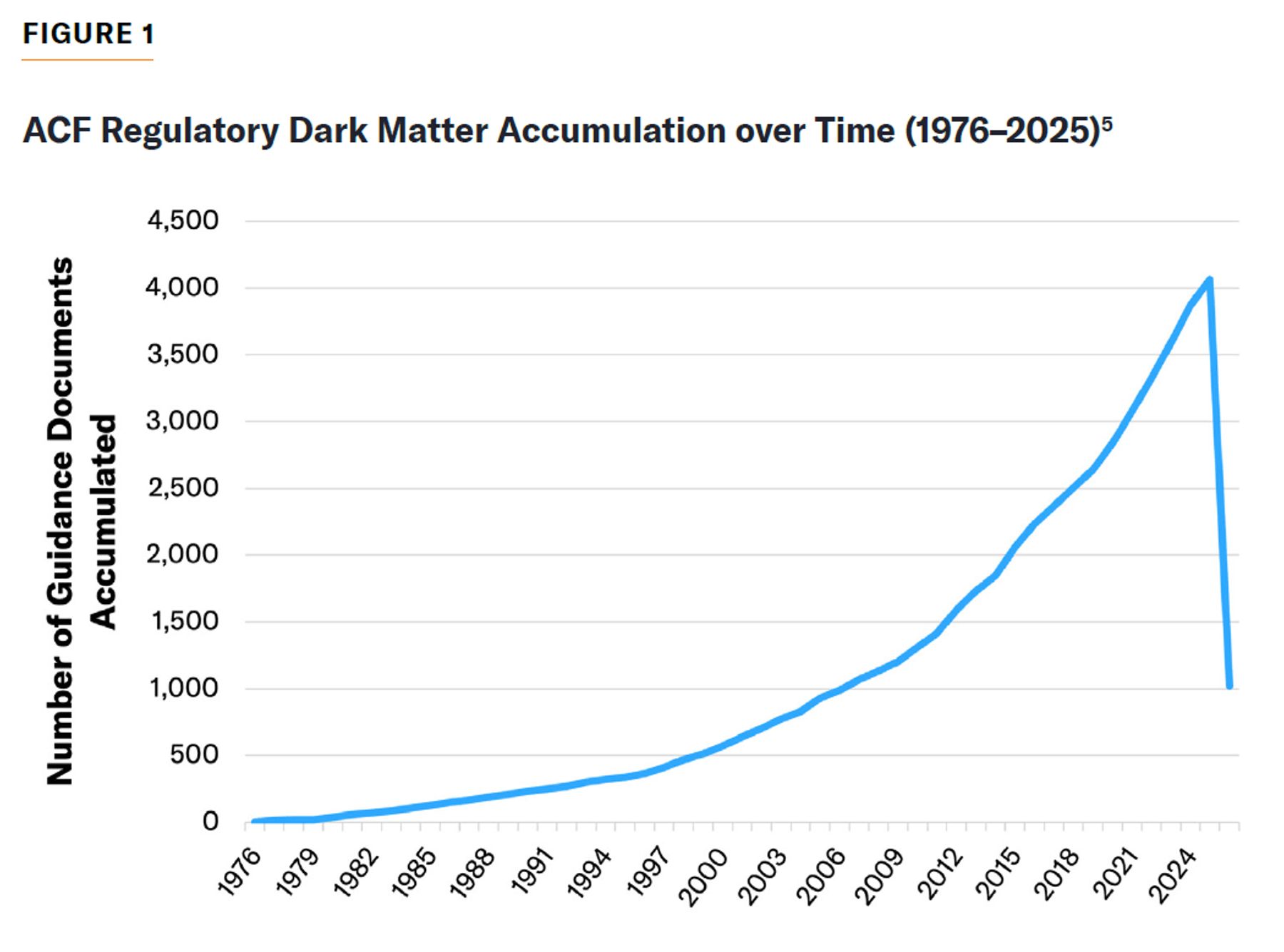
The growth of regulatory dark matter was not a deliberate choice. Instead, it occurred because these documents were easy to issue, and no one was tasked with retiring outdated guidance. Figure 1 illustrates the cumulative growth in the number of active guidance documents over time. The earliest active document dated to 1976. More than half of all guidance documents (54%) were issued after 2015, and growth has accelerated markedly in recent years.
Between 2015 and 2025, ACF issued an average of approximately 200 new guidance documents annually, compared with 113 per year in the preceding decade and 59 per year in the decade before that. This pattern reflects increased reliance on guidance as a policy tool.
Comparison with Formal Regulations
The inventory enabled a direct comparison, using standardized pages, between the volume of regulatory dark matter and that of formal regulation. ACF’s formal regulations comprised only 917 pages. By contrast, ACF maintained nearly 56,000 pages of guidance—more than 61 pages of regulatory dark matter for every page of regulation. From the perspective of grant administrators, informal guidance—not regulation—constituted the dominant operational framework.
Step 2: Review with a Presumption of Obsolescence
Inventory alone does not reduce regulatory dark matter. The second step of the reform therefore focused on review. Program offices were instructed to evaluate each guidance document and designate it as either necessary or obsolete. As with the inventory, offices were given three weeks to complete this review while continuing their regular work.
Importantly, the review focused on the document as a whole, rather than its individual provisions. Program offices were asked to apply a presumption of obsolescence and were guided by a standardized set of questions to guide this determination:
- Do you actively use this guidance document to clarify statutes, regulations, or grant requirements for grant recipients of a current grant?
- Does this guidance refer to a previous funding cycle that has since closed?
- Does this guidance document reflect the policy priorities of the current administration?
- Is this guidance document needlessly duplicative?
- Does this guidance document just copy statute, regulations, or notices of funding opportunities (NOFOs), with no additional clarity?
Program offices were required to provide a brief written rationale for designating a document as either necessary or obsolete. After program offices made an initial determination, appointed staff reviewed and, in some cases, challenged the underlying assumptions of the classification. This often resulted in a second round of review, which led to more documents being classified as obsolete.
The review ultimately resulted in the rescission and removal of 3,045 documents—approximately 74% of ACF’s total guidance corpus—and nearly 36,000 pages, representing 64% of total pages. All program offices eliminated some portion of their guidance, with reductions ranging from 20% to 100%. Table 2 summarizes the results by guidance type.
This illustrates a central truth about regulatory dark matter: it often persists not because it is useful but because it has never been challenged. Once issued, guidance tends to endure indefinitely unless someone is explicitly tasked with reconsidering it.
TABLE 2
ACF Regulatory Dark Matter Eliminated by Guidance Type
| Guidance Type | Number of Documents Eliminated | Percent of Documents Eliminated | Number of Pages Eliminated | Percent of Pages Eliminated |
| Action Transmittals (AT) | 488 | 91% | 8,099 | 87% |
| Dear Colleague Letters (DCL) | 811 | 82% | 5,937 | 84% |
| Field Guidance (FG) | 53 | 41% | 1,024 | 19% |
| Information Memoranda (IM) | 574 | 71% | 5,202 | 58% |
| Policy Interpretation Question (PIQ) | 50 | 71% | 146 | 61% |
| Policy Guide (PG) | 3 | 19% | 36 | 3% |
| Policy Letter (PL) | 237 | 71% | 714 | 68% |
| Program Instructions (PI) | 494 | 77% | 11,358 | 75% |
| Technical Bulletins (TB) | 198 | 55% | 503 | 22% |
| Other | 137 | 60% | 2,762 | 57% |
| Total | 3,045 | 74% | 35,781 | 64% |
Examples of eliminated guidance include:
- Instructions for reallocating prior fiscal-year program funds
- Announcements of tentative allotments for prior-year programs
- Memoranda tied to paper reporting systems long since abandoned
- Covid-era directives rendered moot by the end of the public health emergency
- Letters announcing internal staffing changes from prior administrations
- Non-policy letters, such as those encouraging grantees to recognize World Water Week
- Technical guidance for software platforms that are no longer supported.
Elimination improved clarity. By removing obsolete material, ACF increased the visibility and credibility of the remaining guidance. To ensure transparency, ACF published a list of eliminated documents and archived them on ACF’s website, preserving public access while removing them from active guidance repositories.
Step 3: Maintain Active Efforts to Prevent Re-Accumulation and Reduce Remaining Dark Matter
Elimination alone is insufficient. Without structural change, regulatory dark matter predictably re-accumulates as agencies respond to new issues, audits, litigation, and political priorities. ACF’s third step therefore focused on governance: creating durable systems to discipline future guidance production and prevent unchecked growth.
Transparency as a Default
With a slimmed-down inventory of guidance documents following the removal of those deemed obsolete, ACF was able to more easily highlight what remained. All remaining active guidance documents were published on ACF’s website, as well as on the HHS Guidance Portal.6 This was done to ensure that all interested parties could quickly find the entire inventory of active guidance documents.
Cultural Change
Culture is perhaps the most significant factor in checking the future growth of guidance documents. Staff began to discuss guidance as a scarce resource rather than a default response. Too often, stakeholder groups approach the agency with requests for “clarifications” to create the perception of progress on their special interests. The operative response from the agency shifted from “Can we issue guidance to clarify this?” to “Is guidance necessary, and if it is determined to be necessary, for how long?” This cultural shift is essential to sustaining reform over time.
Ongoing Review
Going forward, guidance documents will be constantly reviewed to ensure that they remain current, relevant, and necessary.
Taken together, this approach reverses the traditional life cycle of guidance. Historically, guidance was treated as permanent unless explicitly rescinded. Review policies invert that presumption, requiring agencies to justify continued reliance. Renewal decisions require program offices to assess ongoing need, duplication, and whether consolidation or formal rulemaking would be more appropriate.
Conclusion
Regulatory dark matter thrives when no one is responsible for managing it. By inventorying guidance, assigning responsibility, applying a presumption of obsolescence, and institutionalizing review, ACF brought discipline to a previously unseen but consequential dimension of governance. This effort was not deregulation for its own sake; it was administrative housekeeping—clearing out accumulated debris so that what remains is useful, current, and trustworthy. The ACF experience demonstrates that it is both feasible and beneficial to reform regulatory dark matter.
Endnotes
Are you interested in supporting the Manhattan Institute’s public-interest research and journalism? As a 501(c)(3) nonprofit, donations in support of MI and its scholars’ work are fully tax-deductible as provided by law (EIN #13-2912529).