Good morning:
On Monday of this week, a random and unprovoked knife attack in New York City left one new mom dead and another passerby injured. NYPD officers fatally shot the mentally ill attacker, a woman who wielded two knives in the heavily trafficked area of Times Square. The new mother, Erin Piacenti, 32, of Chester, NJ, had just celebrated her second wedding anniversary and recently returned to work following the birth of her first child.
In the New York Post, fellow Carolyn Gorman reflects that, sadly, and despite protestations to the contrary, the random and unnecessary attack by a mentally ill woman will likely be forgotten. Despite repeated attacks carried out by troubled people, NYPD’s budget remains stagnant; the executive budget proposes no new funding to address serious mental illness; and NYPD faces a significant staffing crisis.
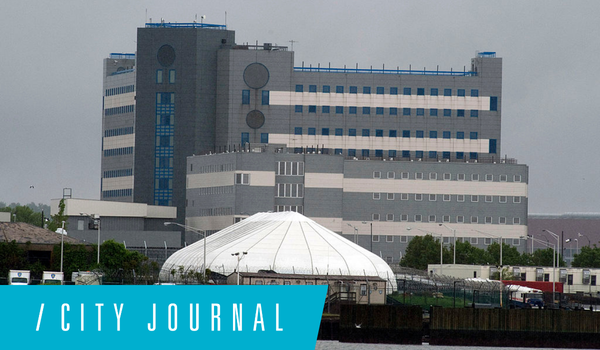
A year from Monday is also the date that NYC is statutorily required to close the Rikers Island jail. But as senior fellow Charles Fain Lehman writes in City Journal, Mayor Zohran Mamdani’s own staff admits they are not on track to meet that deadline or to build the new jails that would be required to house all the Rikers Island inmates. Now is a good time to reconsider the plan, Lehman writes. After all, the call to close Rikers was a fixation of the NYC left, but hasn’t translated into a practical policy. Mamdani shouldn’t waste the opportunity to change directions.
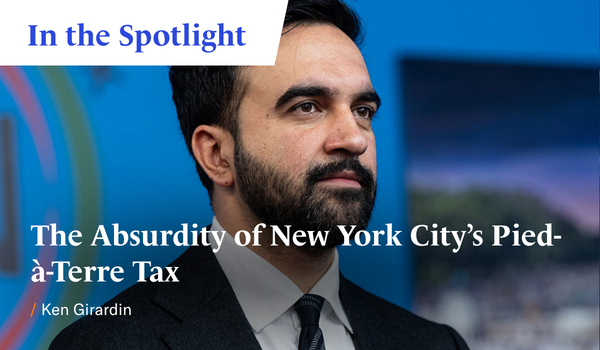
Nor should Mamdani expect his new pied-à-terre tax to solve the city’s long-term financial challenges. As fellow Ken Girardin writes in The Atlantic, the pied-à-terre tax came into being “because the city faced a cash crunch and turned to onetime moves to deal with it.” But this strategy is not sustainable. In this piece, Girardin explains the unique tax status of co-ops and condos and offers a way to deal with the city’s financial burdens without policy gimmicks.
In a new video for the Manhattan Institute, fellow Heather Mac Donald describes the phenomenon of shelter resistance—in which the homeless or people with substance abuse issues refuse shelter and services because they do not want to change their habits of life. In addition to being financially wasteful, housing first policies, says Mac Donald, cannot solve the problems of addiction and mental illness.
Elsewhere in this newsletter, legal policy fellow Tal Fortgang explains how the Trump administration may change IRS rules to ensure convicted terrorists cannot run nonprofits in the United States, in the Wall Street Journal. Senior fellow Shawn Regan warns not to let legitimate political and social concerns over the rise of AI and the proliferation of data centers handicap American access to this new technology, for City Journal.
Continue reading for all these insights and more. Kelsey Bloom Editorial Director |
|
|
|
The Absurdity of New York City’s Pied-à-Terre Tax
By Ken Girardin | The Atlantic | Photo by Lev Radin/Pacific Press/LightRocket via Getty Images
“New York City’s new pied-à-terre tax provokes strong opinions. Supporters argue that the nation’s first tax on luxury second homes will help balance the city’s budget and improve ‘a fundamentally unfair system’ that ‘hurts working New Yorkers,’ as Mayor Zohran Mamdani has put it. Opponents warn that the tax will alienate the rich people who power the city’s economy. Some homeowners fear that the new tax treats them as ‘guilty until proven resident.’
“But Mamdani’s backers and detractors alike are missing the bigger picture. The new tax was created because the city has been spending more than it takes in. That problem has not gone away. Neither has the dysfunctional property-tax system that made the tax so enticing in the first place. New York’s political class would do well to focus on solving these long-term financial challenges before they metastasize into a crisis. By spending political capital on a controversial but largely symbolic policy change, Mamdani has made that task even more difficult.”
|
Don’t Let Terrorists Run Nonprofits
By Tal Fortgang | The Wall Street Journal | Photo by Melina Mara/The Washington Post via Getty Images
“The U.S. Treasury is mulling dramatic changes to our nonprofit system. It announced in April that it plans to revise the Form 990, which nonprofits file annually with the IRS, ‘to improve transparency, strengthen tax administration, and provide clearer reporting on certain activities . . . to detect misconduct and hold wrongdoers accountable.’ …
“One potential measure for increased transparency has raised eyebrows. CBS News has reported that ‘the Trump administration is weighing a proposal to require nonprofits to disclose … whether their top officials have been convicted of certain financial or terrorism-related crimes.’ Though there is nothing inherently illegal about employing ex-convicts, the government wants to know if nonprofits are being run by people who have engaged in ‘material support to terrorists.’ … “This is far from hypothetical. In the largest terror-financing conviction in American history, five members of the nonprofit Holy Land Foundation were convicted for funneling money to Hamas.” |
Mentally Ill Attacks Will Keep Happening Around Our City Without NYPD Funding
By Carolyn D. Gorman | New York Post | Photo by Selcuk Acar/Anadolu via Getty Images “Monday’s unprovoked knife attack in Times Square was ‘a tragedy that will not soon be forgotten,’ says Tom Harris, head of the Times Square Alliance. Sadly, he’s probably mistaken.
“How well do New Yorkers remember April’s machete-slasher episode in Grand Central, or the stabbing of seven individuals in Penn Station in June? This city has a way of moving on from even the most horrific tragedies — and fast. Both of these incidents involved perpetrators with untreated serious mental illness, as did Monday’s. …
“The fiscal year 2027 executive budget was published May 12, just 31 days after April’s incident. … Yet the budget proposed no new funding for serious mental illness — and in Mayor Mamdani’s executive order creating the Office of Community Safety, serious mental illness is not mentioned. In June, within a month of the Penn Station stabbings, the city adopted its budget and kept the NYPD’s funding essentially flat.” |
What the Data-Center Backlash Could Cost Us By Shawn Regan | City Journal | Photo by Brandon Bell/Getty Images
“Halting or slowing down data-center construction would mean deliberately constraining the infrastructure behind one of the most important innovations of the twenty-first century. If the growing panic succeeds in blocking that buildout, it will mean less economy-wide investment, slower scientific and technological progress, more expensive computing power, and fewer productivity gains and breakthroughs—to the detriment of Americans and of humanity more broadly. “AI is rapidly becoming a general-purpose technology in today’s modern economy. Much as electricity transformed the twentieth century, computing capacity is becoming a basic input to innovation in the twenty-first. Data centers are simply the physical infrastructure that supplies it. …
“AI’s biggest promise lies in much broader, more universal applications—cancer treatments, personalized medicine, faster scientific discovery, better manufacturing, and economy-wide productivity gains, to name a few. Chatbots and AI slop are just a distraction.” |
Rikers Must Close in a Year—What’s the Plan? By Charles Fain Lehman | City Journal | Photo by EMMANUEL DUNAND/AFP via Getty Images
“Mayor Zohran Mamdani’s administration has admitted something that’s been obvious for years: there is no chance that New York City can close the Rikers Island jail one year from (August 31), the timeline imposed by the city council in 2019. …
“The city’s comprehensive failure to meet its own schedule offers an opportunity for a reevaluation. Even if it can build the new jails on a revised timeline, New York still will not have enough jail beds to house dangerous offenders and flight risks pretrial. For years, questions about the practicality of shuttering Rikers have been dismissed as racist and retrograde. But now’s a good time to ask: What’s the plan, Mr. Mayor? … “Rikers’s closure was first and foremost a moral crusade aimed at achieving racial and social justice. The practicalities of providing jails that are safe for both their residents and the public were always an inconvenience to be wished away.” |
|
|
For more information and media requests, please contact
communications@manhattan.institute.
Are you interested in supporting the Manhattan Institute’s public-interest research and journalism? As a 501(c)(3) nonprofit, donations in support of MI and its scholars’ work are fully tax-deductible as provided by law. |
|
| |
The Manhattan Institute works to keep America and its great cities
prosperous, safe, and free. Manhattan Institute
52 Vanderbilt Ave. 3 floor New York, New York 10017
Copyright © 2026 Manhattan Institute, All rights reserved. |
|
|
|
|